20 March 2015

American Samoan Delegate to Congress says political status issues should be decided by the people, not by the U.S. courts


Link: Pacific Islands Report
Pacific Islands Development Program, East-West Center
With Support From Center for Pacific Islands Studies, University of Hawai‘i


Am. Congresswoman: Citizenship Issue Should Be Decided By Territory; Federal Courts should not be involved in ‘political status question’


By Fili Sagapolutele
Samoanews


PAGO PAGO, American Samoa (The Samoa News, March 16, 2015) – Congresswoman Aumua Amata says the citizenship lawsuit appeal pending in the federal appeals court in Washington D.C. is a "political status question" for the people of American Samoa to decide on, and not for a federal court thousands of miles away in the nation’s capital.

She also says that she is looking at federal legislation to amend federal law, which would simplify the process for U.S. Nationals seeking to obtain U.S. Citizenship.

Aumua’s comments were made during her first town hall meeting last Thursday with local residents. She was responding to questions raised by military veteran Morgan Suapilimai, who claimed that there are a lot of veterans who are supportive of automatic U.S. citizenship for persons born in American Samoa.

Oral arguments were made last month before a panel of three judges at the federal appeals court, on the citizenship lawsuit filed by eight U.S. nationals led by local resident Leneuoti Tuaua. The plaintiffs also include the Los Angeles-based Samoan Federation of America, a non-profit organization.

In her response to Suapilimai’s question, Amata explained that the citizenship lawsuit is a question on whether U.S. Nationals— who are persons born in American Samoa—have a Constitutional birthright to be automatic U.S. citizens— or is this a Congressional process.

She said that last year, she travelled to 13 different military installations across the county, and the citizenship question came up many times.

"What I feel, is that U.S. Nationals here on island have a different priority than the U.S. Nationals in the States" when it comes to the U.S. citizenship issue, she said, adding that U.S. nationals in the States are involved in the communities where they live and settle, and want to become U.S. citizens.

On the other hand, U.S. nationals in the territory "deal with faasamoa and everything else and they’re a little afraid of the U.S. citizen status, because they feel that it might jeopardize our faaaganu’u [our faasamoa]," she said.

"What I would propose to do— and all of these proposals will have to be cleared by our people and leaders—is amend the [federal] Immigration and Nationality Act, to allow the simplification of the procedure to become a U.S. citizen," she said, adding that only Congress can make this necessary change in the procedure.

She went on to explain that a U.S. national is a non U.S. citizen who owes permanent allegiance to the United States, and a U.S. citizen is also an individual who owes permanent allegiance to the United States.

"To me they are the same, except one has a different label from the other… it was put there in 1900 and it was a way for the United States... to somehow help us hang on to our culture, our language and our customs," she said.

As far as the lawsuit in federal court, Aumua said, "that is a political status question and we must not allow that political status question to be solved in court" thousands of miles away in Washington D.C.

"This is a question for our people to decide," she said, adding that she doesn’t agree to having a federal court decide the citizenship issue.

Pulu Ae Ae Jr., the Congresswoman’s local District Office director, reminded the audience that American Samoa remains an unorganized and unincorporated territory of the U.S. and that he disagrees with automatic citizenship for U.S. nationals.

He also shared his own views on this matter, saying that American Samoa will be faced with many problems if automatic citizenship is granted to persons born in the territory, and among those problems, will be the federal government "taking our land and imposing federal taxes on us just like what’s been done to other states."

Pulu went on to say that he believes that some U.S. nationals want automatic citizenship to avoid having to pay the high cost of obtaining U.S. citizenship.

NEW FILING

Last week, U.S. Assistant Attorney Wynne P. Kelly filed a one-paragraph letter with the clerk of the Court of Appeals to address any misimpression that may have been left after oral arguments on Feb. 9 that the federal government would concede that it could not prevail in a hypothetical case where the American Samoan government supported the plaintiffs’ position.

Kelly said the federal government’s "position, as their brief reflects, has been, and continues to be, that its position is fully consistent with federal law, and thus the American Samoan government’s support of the Federal [government’s]position is not dispositive for the Government to prevail on the issue before the Court."

The federal government’s letter was published by an off-island online group, and some local and off island American Samoans had interpreted the letter as indicating that ASG was changing its stand and heading toward supporting the plaintiffs.

Responding to Samoa News request for comments and reaction on the federal government’s letter, Michael F. Williams— attorney for ASG and for Congresswoman Aumua in the appeal—said the letter is to clarify that the federal government’s position in the case would not change if ASG or the Congresswoman changed their views on the case.

Additionally, the letter was intended to clear up confusion that might have resulted from the United States’ response to a question raised at the oral argument.

"To be sure, the letter is addressing a hypothetical situation because the American Samoa Government and Congresswoman Amata continue to believe that the status of American Samoans is a question for the American Samoan people to decide, not a question for courts in Washington, D.C.," he stressed.

The citizenship lawsuit, with a decision due out later this year, picked up national attention last week on John Oliver’s HBO program "Last Week Tonight", in which the issue of U.S. territories being unable to vote for the U.S. President— and the fact that American Samoans are not U.S. citizens— was discussed on national television.

Oliver said people from Guam still get a better deal than those from American Samoa—the only U.S. territory where citizenship is not inherited at birth.

"The American part of American Samoa is really a title that doesn't mean anything," said Oliver, "like 'People's Choice Award nominee' or 'social media expert.'"



19 March 2015

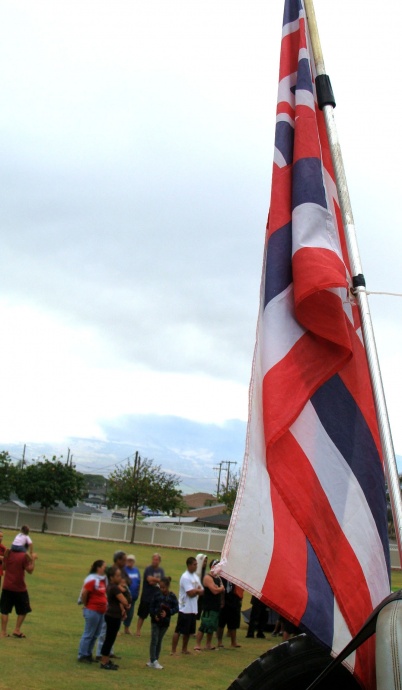
“Hawaiʻi A Voice For Sovereignty” to be Aired in U.S.on March 22

Hawaiian flag. File photo by Wendy Osher.
By Maui Now Staff
A documentary film entitled Hawaiʻi A Voice for Sovereignty will be broadcast nationally on PBS stations affiliated with the First Nations Experience Network.
The film will air in eight states on... March 22, 2015.  The latest broadcast schedule does not include Hawaiʻi.  (A complete listing is available below.)
The award winning documentary focuses on the Native Hawaiian struggle to reconnect to the land and to obtain sovereign rights after the illegal takeover of by US businessmen and military on Jan. 17, 1893.
On November 23, 1993, President William Jefferson Clinton signed United States Public Law 103-150, also known as the “Apology Resolution,” acknowledging the 100th anniversary of the overthrow of the Kingdom of Hawaiʻi and offering an apology to Native Hawaiians on behalf of the United States.
In the film, photojournalist and producer Catherine Bauknight explores the Native Hawaiian culture and the social, economic and ecological issues that have developed since the overthrow.
“I have witnessed firsthand what happens when a small, sustainable society is separated from their land, fresh water and ocean resources and then converted for profit by western powers,” said Bauknight in a press release statement.
“Today, with over 8 million tourists a year crowding their small and ecologically-fragile islands, the Hawaiians are disconnected from their own land and suffer some of the highest rates per capita of poverty, homelessness, health issues related to diet and incarceration in the state. My goal is to continue to share the story to assist the Hawaiian’s ongoing struggle for sovereign rights and their efforts as stewards of the land to protect what’s left from further destruction.”
The documentary was initially released in 2012, and has since been shown internationally at various festivals, screenings, and events.
It was recently honored with the “Best Global Documentary Film Creating Change” during the Pacific Talent Film Festival in Los Angeles, California.  Here in the islands, it earned the Audience Award for Best Hawaiʻi Film at the Maui Film Festival.  Other accolades include the Mana Wairoa Award from the Maori Film Festival, and the Best Global Documentary Film Creating Change from the Pacific Talent Film Festival.
The soundtrack for the film features some of Maui’s talented musical artists including:Richard Hoʻopiʻi, George Kahumoku, Willie K, Keʻeaumoku Kapu, Charles Kaʻupu, Kealiʻi Blaisdell, and Wilmont Kahaialiʻi.
BROADCAST SCHEDULES:
 6:30 p.m. PT, 9:30 p.m. EST on Feb. 22 and March 22, 2015.
  • Alaska: KUAC Channel-9.4
  • California: Greater Los Angeles Area – FNX available on Verizon Fios-KVCR (channel 471); Direct TV KVCR 24-2 (channel 24.2 Over the Air), and locally (channel 24.2) in the greater Los Angeles; KEET TV Channel-13.4 (California Public Television for the Northcoast; Eureka, Hoopa & Fortuna); KJHP-LP Channel-18 (Morongo Valley)
  • Illinois: Chicago WYCC PBS Channel-20.2
  • Indiana: Comcast Channel-373
  • Minnesota: Paul Bunyan Channel-173; Lakeland Public Television (LPTV) in Bemidji Channel-9.2; Lakeland Public Television (LPTV) in Brainerd Lakes Channel-22.2; Mid Continent Communications Channel-595
  • Oklahoma: Cat Channel-47
  • Utah: UEN Channel-9.3
  • Wyoming: K32EL-D Channel-32.1

18 March 2015

Bonaire Activist comments on "illegal" political status on eve of territory's election (Dutch)


Aan: De gezaghebber van het eilandgebied van Bonaire, dhr E Rijna en Minister van Binnenlandse zaken en Koninkrijksrelaties, Dhr. Plasterk Plaza Wilhelmina 1 

Bonaire, 17 maart 2018 

Betreft: verkiezing van de leden van de eilandsraad 18 maart 2015


Uit

James Finies
Postbus 341 
Kralendijk, Bonaire


Geachte Gezaghebber en Minister, 

In verband met de te houden ER-leden verkiezing van 18 maart a.s. breng ik U het volgende onder Uw aandacht:

-in 2004 is er een referendum gehouden die een fraudulente process heeft doorlopen en geen internationaal rechtsbasis bezit om de huidige staatsstructuur te hebben opgelegd op onze volk en niet het legitieme volkenrechterlijk stem geniet.

-op 10 Oktober 2010 is het autonome land Nederlandse Antillen ontbonden zonder de legitieme toestemming van het Antilliaanse volk (non-dissolution-principle) en tegen het stem van het volk van St Eustatius in.

-in december 2010 is er een referendum gehouden die de ilegale status van integratie in Nederlands staatsbestel als “openbaar lichaam” onder artikel 134 had moeten legitimeren. Dit nadat de afgesproken referendum in maart 2010 door de on-democratische vertegenwoordigers van het Nederlands belang gezaghebber Thode en gouverneur Goedgedrag op international-rechterlijke betwistbare redenen, waarbij volkenrechterlijk referenda verzwaardere eisen kan worden opgevoerd om de binding met het gebied te waarborgen hebben vernietigd. De vraag stelling: “ Ik ben er het ermee eens, dat Bonaire een openbaar lichaam is geworden in de zin van van artikel 134 van de Nederlandse grondwet: “Ja” of “Nee”. Dus de legitimatie van deze illegal status dat de bedoeling was van deze referenum is ook tot vandaag nog steeds uitgebleven , door de duidelijke afwijzing en sabotage van het referendum en tot op dit moment nog niet en nooit uitgebrachte rapport van de Verenigde Naties supervision.

-de eilandsraadsverkiezing van 8 maart 2011 had geen rechtsbasis door het niet legitimeren van de illegale OLB status door de referendum van december 2010. En bovendien heeft het volk ook de partij UPB die de status van OLB steunde en trok afgewezen en stemden op de andere partijen , PDB, PHU en MLB die een referendum wilden om het volk zich uit te laten spreken over hun toekomst.

-in september 2011 heeft dmv de gezaghebber Thode en de rijksvertegenwoordiger Stolte beiden a-politiek en on-democratisch vertegenwoordigers van Nederlands belang, door politieke interventie in de lokale politiek, de rechtmatige regerende koalitie gedestabiliseerd met het gevolg met het val van de koalitie en vormen van de huidige koalitie die ondemocratisch(met ca 1000 minderheids-stemmen) tot nu toe heeft geregeerd. 

-in september 2012 heeft het Boneriaans(en BES) bevolking weer uitdrukkelijk deze status, door de opgelegde 2de kamer-verkiezingen die ook een “verkapte legitimatie van deze status zou kunnen worden” afgewezen als hun volks-vertegenwoordigers (ca 80%).

-in mei 2014 heeft het Boneiraans(en BES) bevolking weer uitdrukkelijk deze status en Europese parlament verkiezing afgewezen(ca 80%).

-in december 2014 heeft St Eustatius een referendum georganiseerd waar u op de hoogte ben dat er hevig is gesaboteerd door de verantwoordelijke authoriteiten maar wel weer een duidelijk beeld en signaal gaf van de onvrede en opgelegde status van openbaar lichaam overduidelijk afwees en koos voor hun rechtmatige onschendbaar recht op zelf-bestuur of autonomie. 

Al deze feitelijke officiele legale intenties om subtiel via een verkapte democratie deze illegale status te legaliseren is zoals u ook weet door onze volk afgewezen, en niet eens mee te voegen de talloze protestacties, handtekening-acties, enz, tenzij U blijft doorzetten met het forceren van deze illegale status die het Boneriaans volk totzover heeft verdeeld en ongelukkig houdt. Nu is weer een oproep voor de Boneriaanse bevolking te gaan stemmen voor de eilandsraadsleden op 18 maart 2015. U gaf diverse malen aan dat deze eilandsraadsleden verantwoordelijk zijn voor het referendumwet en organiseren hiervan. En u zal ook weten dat er na 2004 oplopend tot un een bevolkings-imigratie-groei explosie was, 400% stijging waarvan de overgrote meerderheid Europese Nederlanders die naar hun (ei)land Nederland in de cariben, Caribisch Nederland, openbaar lichaam Bonaire zijn geimmigreerd en allemaal direkt stemrecht hebben verworven. Dus dat deze ER verkiezing van 18 maart 2015 nooit en nimmer een eerlijke democratische weergave zal zijn door deze invasieve stemgerechtigden, en u beweerd een verduidelijke beeld en zelfs als legitimatie of legalisatie van de tot nu toe illegale status van integratie(nooit heeft iemand of het volk van Bonaire voor integratie gestemd en op geen enkele stembiljet of referendum) in het Nederlands staatsbestel als Openbaar Lichaam. Verschijdene verzoeken aan U en de Minister om in een a-politieke positie in te grijpen en een a-politieke referéndum te helpen organiseren voor het volk, gebaseerd op het feit er een grove mensen en volkenrechterlijke schending van rechten plaats heeft gevonden en bovendien ons “onschendbare recht op zelf-bestuur” heeft geschonden en onteigend en u telkens weer verwijst en naar deze “ilegale en korupte en met invasief/besmette Europees-Nederlands stemmen democratie” overlaat. Dus al het corruptie en omkooppartijen dat niet meer een publieke geheim is maar een alledaagse aktiviteit(Booi heeft zelf op de Nlse TV bekend dat het normaal is?) omtrent de verkiezingen, dus uw ingevoerde volmacht-stemmen dat afgeschaft was op de Antillen daardoor, en u geen gehoor of geen serieuze intentie doet of neemt voor onderzoek of een of andere commissie in het leven heeft geroepen om de bevolking gerust te stellen dat u ook een oor heeft voor hun zorgen, dus het afkopen van hun enige zeggenschap, dus de verkiezing. Dat u dan laat blijken dat u de andere kant opkijkt, dus niet naar het waarborgen van hun veiligheid en rechtstaat basis, dus een eerlijke democratisch process. En verder het stempas distribuitie was direkt op hetzelfde pad als de gesaboteerde St Eustatius referendum van december 2014, onduidelijkheid en chaotisch, en verder stembiljetten uitgegeven aan mensen die zelfs meer dan 10 jaar niet meer op Bonaire wonen. Vandaar of is wel te begrijpen dat U aangeeft dat u alleen een geldige identificatie van voor 19 maart 2010 ook geldig is, dit zeker voor het uitoefenen van een corrupte-volmacht van een uitlandig wonende stemgerechtigde. 


Ook is te melden dat er de ca 25% funktioneel-analfabeet bevolkings-groep zeker grove problemen zal hebben met uw uitgebreide Nederlandstallige stempas instructies en zeker met uw Europees Nederlands stembiljetten zonder partij-kleuren tenzij u wel toestaat dat de partijen met hun folkloristische kleuren volop kampagne voeren, dus nog meer verwarring en chaos ondersteund en geen eerlijke democratisch process hier gaande is. Een en al en niet te vergeten hoe het mogelijk is of wij als volk moeten kunnen begrijpen dat u in de autonome landen Curacao, Aruba en St Maarten in hun interne politiek en autonomie ingrijpen en in uw eigen politiek-verantwoordelijk gebied en Nederland in de Cariben, Bonaire dat niet doet. Dus politieke leider die corruptiezaak bekent en veroordeeld wordt en door uw eigen ministerie ontslagen wordt toch blijft funktioneren als gedeputeerde, (plaatvervangende)gezaghebber en zonder enig argwaan van uw kant. Dus dan is ook duidelijk voor het volk dat de stapels corruptie zaken die uw openbaar ministerie jarenlang hebben uitgepluist en door uw zgn niet mee willen bemoeien met lokaal-politiek nooit zullen begrijpen en accepteren dat u presteer net voor alle laatste voorgaande verkiezingen onredelijk en wantrouwig te handelen in de zaken van de bekende politicus Booi die de trekker van deze illegale status is en verklaard heeft een referendum “over zijn dead body” dus nooit zal plaatsvinden. Nooit zal u kunnen verklaren dat voor de referendum van desember 2010, op 30 november 2010 de nasporing, onderzoek te stoppen door uw rechter, dan 26 januari 2011 seponeren van de zaken en in maart de verkiezing 2011, en in oktober 2014 een week voor de laatste stap in een unaniem geakoorde besluit tot starten van de referendumprocess, Booi weer vrij, weer in de Eilandsraad als lid toe-treed en direkt het referéndum stopt en nu alweer, echt het record , vrijspraak een paar dagen voor de verkiezingen. U zal wel begrijpen dat ons geloofwaardigheid in uw te noemen onafhankelijk rechtstaat organen en systemen echt geschaad is of niet meer te vertrouwen zijn en u als lokaal politiek instrumenten tegen de mensen en volkenrechterlijke zelfbeschikkingsrecht van het volk wordt beschouwd en wordt gebruikt.

Tenslotte teken ik hiermede oficieel bezwaar tegen deze eilandsraads-leden-verkiezing die geen legitieme rechtsbasis bezit, en geen eerlijke democratisch basis bezit door uw invasieve opgelegde Europese Nederlanders stemgerechtigden en deze illegale status niet legitimeer omdat het alleen te legitimeren of te leagliseren is door een legitieme zelfbeschikkings volksraadpleging en mijn stem (en alle willige petitie tekenaars voor een zelfbeschikkings referendum en anderen) onder protest uit zal brengen.


cc. Kabinet van de Koning Leden van de 2de kamer van de Staten-Generaal Leden van de 1ste kamer der Staten –Generaal Leden van de vaste commissie voor Koninkrijksrelaties Office of the High Commisioner for Human Rights

La 2da Marcha Oscar – Mandela en Puerto Rico / The 2nd Oscar - Mandela March in Puerto Rico


Saludos, 
La presente es para informarle que el domingo 22 de marzo de 2015 habrá una marcha pacífica para la excarcelación de nuestro preso político de 33 años, el patriota Oscar López Rivera y la descolonización de Puerto Rico.  La Segunda Marcha Oscar – Mandela en Puerto Rico será desde las 2 PM hasta las 5 PM.  La marcha será en el Viejo San Juan este año.  Oprima el siguiente enlace para ver un reportaje de nuestra primera marcha el año pasado: http://www.wapa.tv/noticias/locales/-primera-protesta-oscar-mandela-_20131122237557.html


Macharemos desde el Capitolio hasta el Tribunal de Estados Unidos en Puerto Rico. La ruta será por la Avenida Muñoz Rivera para seguir por la Calle San Francisco. Doblaremos a la izquierda por la Calle San José, para volver a doblar a la izquierda por la Calle Fortaleza.  Haremos una derecha por la Calle O’Donnel para continuar por laCalle Recinto Sur.  Nos ubicaremos frente al tribunal.  Los manifestantes pueden exhibir sus carteles y banderas de sus organizaciones. 


Habrán discursos de diferentes oradores y música.  Pepe Sánchez y Luis Enrique Romero serán los maestros de ceremonia.   


Algunos de los participantes, entre otros, serán: José Nogueras, El Topo, Noel Hernández, Luis Oliva, Silverio Pérez, Adean Caban Butter, y Daniel Rivera (hijo).


Los oradores serán: José M. López Sierra, Rafael Cancel Miranda, Dr. Héctor Pesquera, Lic. Alejandro Torres, Rafael Bernabé, Pedro Muñiz, Padre Efraín Rodríguez y Tito Kayac.


El Comité Timón del Pueblo de Compañeros Unidos para la Descolonización de Puerto Rico invita a todo aquel que cree que el colonialismo es un crimen en contra de la humanidad y una amenaza a la paz mundial a marcha con nosotros en el mismo día que conmemoramos la abolición de la esclavitud.  Oscar López Rivera ha cumplido casi 34 años en la cárcel por defender nuestro derecho inalienable a la auto-determinación e independencia. ¡Necesitaremos un tsunami de gente para que el gobierno de Estados Unidos cumpla con las 33 resoluciones de la Organización de Naciones Unidas para descolonizar inmediatamente a Puerto Rico!    


Ayude a sacar del closet a la colonia puertorriqueña.  Nuestras protestas serán permanente hasta que se logre la descolonización de Puerto Rico, y por supuesto, la excarcelación de nuestro patriota Oscar López Rivera.  El tsunami de gente es obviamente indispensable para lograr eso, porque los que practican o aceptan el colonialismo no creen en la justicia para todos.


Un abrazo solidario,

José M López Sierra
Comité Timón del Pueblo (CTP)
Compañeros Unidos para la Descolonización de Puerto Rico (CUPDPR)


Greetings Partners,

This is to inform you that on Sunday, March 22, 2015, a peaceful march will be held for the decolonization of Puerto Rico and the release from prison of our Puerto Rican political prisoner Oscar López Rivera.  The 2nd Oscar – Mandela March in Puerto Rico will be from 2 PM to 5 PM.  This year’s protest will be in Old San Juan.  We will march from the Capital Building to the United States (US) Courthouse in Puerto Rico.  Click on the following link to see a news report of last year’s march:http://www.wapa.tv/noticias/locales/-primera-protesta-oscar-mandela-_20131122237557.html

We will gather at the Capitol Building at 2 PM.  We will march on Avenida Muñoz Rivera and continue on Calle San Francisco.  We will make a left on Calle San José, and make another left on Calle Fortaleza.  We will turn right on Calle O’Donnel, to continue on Calle Recinto Sur.  We will assemble in front of the courthouse.  Marchers are encourage to bring signs and flags from their organizations.

We will have various orators and music.  Pepe Sánchez and Luis Enrique Romero will be our masters of ceremony.   

Some of the participants, among others, will be: José Nogueras, El Topo, Noel Hernández, Luis Oliva, Silverio Pérez, Adean Caban Butter, y Daniel Rivera (Jr.).

The orators will be: José M. López Sierra, Rafael Cancel Miranda, Dr. Héctor Pesquera, Lic. Alejandro Torres, Rafael Bernabé, Pedro Muñiz, Padre Efraín Rodríguez y Tito Kayac.


The People’s Steering Committee of United Partners for the Decolonization Puerto Rico invites everyone who believes that colonialism is a crime against humanity and a threat to world peace to protest on the very same day that we commemorate theAbolition of Slavery.  Oscar has spent almost 34 years in prison for defending Puerto Rico’s right to self-determination and independence.  This is why, Oscar is our Nelson Mandela! 

We will need a tsunami of people to make the US government comply with 33 United Nations resolutions to immediately decolonize Puerto Rico.  Help us get Puerto Rican colonialism out of the closet.  Our protests will be permanent until we achieve Puerto Rico decolonization, and of course, Oscar’s release.   The tsunami of people is indispensable to achieve that, because those who practice or accept colonialism don’t believe in justice for all!

Sincerely, 

José M López Sierra
The People's Steering Committee
United Partners for the Decolonization Puerto Rico

17 March 2015

Guam Congressional Delegate supports self-determination Process

CONGRESSIONAL ADDRESS 2015

Mar 12, 2015

"We cannot begin a conversation on improving the quality of life for our people without discussing the need to exercise our right to political self-determination."

Congresswoman Madeleine Z. Bordallo
Let me begin by asking everyone to rise for a moment of silence to honor the late Speaker Franklin J.A. Quitugua and Speaker Ben Pangelinan both faithful public servants for whom our island owes a debt of gratitude.

Governor; Acting Speaker; Acting Chief Justice; Members of the Diplomatic Corps; Monsignor David; Pastor Bob; Military Officials and other podium guests.

My dear people of Guam,

This evening, I stand before you with humble gratitude for the trust you continue to place in me to represent our island in Congress, and to report on federal issues important to our people. I congratulate Governor Calvo and Lieutenant Governor Tenorio on their reelection as our island’s chief executives.

I congratulate the reelected members of the 33rd Guam Legislature: Speaker Won Pat; Vice Speaker BJ Cruz; Legislative Secretary Tina Muna Barnes; Majority Leader Rory Respicio; Assistant Majority Leader Tom Ada; Minority Leader Tony Ada; Senator Frank Aguon Jr.; Senator Dennis Rodriguez; Senator Mike San Nicolas; Senator Brent McCreadie and Senator Tommy Morrison on their re-election.

I also want to recognize our newly elected Senators: Senator Nerissa Underwood and Senator Mary Camacho Torres.

And finally I want to recognize our two returning Senators, Senator Frank Blas Jr and Senator Jim Espaldon.

I also want to recognize our newly elected Attorney General Elizabeth Barrett-Anderson who has the distinction of being the first women appointed Attorney General. She joins a proud tradition of women firsts on Guam including the first woman in the Guam Assembly Rosa Aguigui Reyes; the first women Senators Cynthia Torres Johnston and Lagrimas Leon Guerrero Untalan; the first woman Public Auditor Doris Flores Brooks; the first woman President of the University of Guam Rosa Roberto Carter; the first woman to earn a PhD Katherine Bordallo Aguon, the first woman Federal judge Frances Tydingco-Gatewood; the first women US Attorney Alicia Limtiaco and the people of Guam have given me the distinction of being the first woman Lieutenant Governor and the first woman Delegate. All of you woman have contributed by being trailblazers in your fields. Nationally, I hope that a woman will break the glass ceiling and we will one day have a woman President of the United States. 

Over the past twelve years that I have been in office, we have made much progress to improve the quality of life here on Guam. I am committed to working with all our elected leaders to ensure that we continue to build a better Guam for our families and our children.

Self Determination

As I have stated on numerous occasions before this body, we cannot begin a conversation on improving the quality of life for our people without discussing the need to exercise our right to political self-determination. Resolving our political status with the United States through a legitimate act of self-determination is the most important step that we can take to address many longstanding legacy issues we have with the federal government, and it would provide us with a stronger foundation to ensure that policies enacted serve the best interests of our people.

I have witnessed every major effort to resolve our political status, and in every instance there have been stumbling blocks that have prevented us from achieving our goals. A few weeks ago, I heard a story that puts this journey in perspective. Hannah Gutierrez was a young girl around 3 or 4 when she accompanied her father, former Governor Carl Gutierrez, to one of the meetings of the Guam Constitutional Convention. She remembered hearing a speaker making the case for statehood. Hannah asked her dad if Guam were to become a state, would that mean that we would get snow like the states?

Today however, Hannah has grown up; she is an attorney and the Clerk of Court for the Supreme Court of Guam. Look at how much time has passed and consider all that has happened since Hannah was 3. Now consider how much we have lost by not moving in a more focused and determined way to resolve our political status.

Of course, hindsight is 20-20, and we cannot dwell on our past. We can however act now, and not wait for more years to pass before we have this conversation again. Over the years we have worked to move this issue forward, but whether it has been a lack of political will or our quest to obtain the perfect process for the political status vote, we have been unable to move off of square one. 

I believe that we must get on with this process, and I am urging the Governor and the Legislature to work with the Commission on Decolonization to begin the process so that we can make the self-determination vote a reality. I would also suggest that we remove the requirement to have a certain percentage of eligible voters registered before the vote can be set. I urge the Legislature to set the vote and let those who are eligible register by a certain deadline. Achieving decolonization will be a multi step process that will take time but we must begin to set the stage for this to completely play out. If we do not get this process going, Hannah may be a grandmother with little grandkids before we ever see our status quest come to fruition.

To promote our efforts to resolve our political status, in 2010 , I authored legislation, H.R. 3940, that authorized the Department of the Interior’s Office of Insular Affairs to use technical assistance grants for political status education. At that time, OIA had assured me that it would follow Congressional intent and make funds available to ensure that our people were knowledgeable of the options that would be presented to them, and understood the ramifications a change in political status would have on their daily lives. 

I continue to believe that the federal government should support our efforts to resolving our political status, and I will work with OIA to ensure that these grants are made available. However, OIA has consistently asked that local leaders submit a single grant proposal to them, as the Department will not selectively decide which programs to fund. The ball is in our court, and I hope that the Governor, the Legislature, and the Commission on Decolonization will provide the leadership needed to move on this issue.

Last week President Obama was in Selma, Alabama to commemorate the 50th anniversary of the ‘Bloody Sunday’ march. For those of us who live in the territories, the Presdient’s call for full voting rights seems a little hollow when you consider that Americans in the territories cannot vote for President and do not have full voting representation on the floor of the House. Following the Selma commemoration, comedian John Oliver, in his syndicated show Last Week Tonight, had a 15 minute segment on the territories and our quest for voting rights and representation. For those of you who have not seen this segment, I urge you to look it up on YouTube because the biting satire of comedy is probably the best way to express our frustration with the status quo. 

I am honored to be a part of a legal effort led by my former staffer, Neil Weare, and joined by many people on Guam including Leevin Camacho who are challenging the status quo through a current case before the DC Court of Appeals and other cases they may file to overturn the Insular Cases. I urge our local leaders and our people to join this grassroots movement and to support the “We the People” project. As President Obama said in Selma, “Because the single most powerful word in our democracy is the word “we.” We the People. We shall overcome. Yes we Can. It is owned by no one. It belongs to everyone. Oh, what a glorious task we are given, to continually try to improve the great nation of ours.”

READ THE FULL ADDRESS HERE .

16 March 2015

Corps électoral: nouveau rebondissement dans le feuilleton des demandes de radiations; Nations Unies implication nécessaire

  • Par Angélique Souche (A.P.)


Face au très faible nombre de radiations prononcées à l’issue des commissions administratives spéciales, l’UC-FLNKS et Nationalistes change de stratégie: pas de recours individuels massifs devant les tribunaux, mais une demande d’annulation totale du travail des commissions.

Le groupe UC-FLNKS et Nationalistes conduit par Rock Wamytan dénonce de nombreux dysfonctionnements qui auraient entaché le travail des commissions. Et cette fois, ce sont les magistrats qui sont pointés du doigt. Face au refus de la CAFAT et des services fiscaux de communiquer des données nominatives, ces derniers ont laissé le bénéfice du doute à l’électeur. Une position que l’UC-FLNKS et Nationalistes estime contraire aux directives préalables de l’Etat, le fameux vadémécum.


Pire, pour l’UC-FLNKS et Nationalistes, le magistrat officiant sur la Côte Est aurait refusé d’office toutes les radiations, sans même tenter la moindre investigation. L’Union Calédonienne et ses alliés crient donc à l’injustice, mais renoncent à porter les 3 500 électeurs devant les tribunaux, persuadés de s’engouffrer dans une nouvelle impasse.

Roch Wamytan during interview on grounds of
United Nations
Headquarters. (File Photo by OTR).


La contre-attaque sera donc plus politique : en demandant au Haut-commissaire – comme le permet le code électoral - de saisir le tribunal administratif pour annuler le résultat de ces commissions, l’UC défie en quelque sorte l’Etat et sa volonté de faire prévaloir le droit sur la lecture politique que réclament les non-indépendantistes.


Vincent Bouvier n’a pas encore dévoilé ses intentions, mais il est probable que l’épisode s’arrêtera là pour cette année… Pour cette année seulement, les leaders du groupe indépendantiste n’ont pas caché leur intention d’utiliser les 12 prochains mois pour récolter les preuves nécessaires à la radiation de ces mêmes 3 500 personnes en 2016.

**********************


New Caledonia Election Controversy Needs UN Involvement: Wamytan


Pro-independence leader skeptical French efforts ‘in line with the law’

WELLINGTON, New Zealand (Radio New Zealand International, March 13, 2015) – A New Caledonian pro-independence leader, Roch Wamytan, says his side is now convinced that without involving the United Nations, the electoral rolls won't be in line with the law.

Last month, France's highest court ruled that those eligible to vote in the territory's provincial elections must have been enrolled since 1998 or submit proof that they lived in the territory since 1988.

The restricted roll is part of the decolonisation process which is expected to lead to an independence referendum by 2018.

Magistrates sent from France have joined special commissions this month to vet the rolls amid claims by the pro-independence side that thousands of people voted last year illegally.

The commissions have thrown out most challenges, prompting Mr Wamytan to call on the French High Commission to seek a court order to annul the commissions' work.

He says the laws are made in Paris but they are not being applied in New Caledonia, in particular not in areas controlled by the anti-independence side.

Mr Wamytan says the magistrates don't exercise their full powers, with organisations withholding relevant information by citing privacy concerns.

The anti-independence camp, however, is incensed at the restrictions confirmed by the court, criticising Paris for failing to show political leadership.

But the French prime minister, Manuel Valls, this week confirmed that the government will strictly adhere to the court ruling, saying it is normal in a country with the rule of law.


14 March 2015

Grappling with the Bomb: Opposition to Pacific nuclear testing in the 1950s - by Nic Maclellan


LABOUR HISTORY MELBOURNE

THE AUSTRALIAN SOCIETY FOR THE STUDY OF LABOUR HISTORY INC.


Nic Maclellan, “Grappling with the Bomb: Opposition to Pacific nuclear testing in the 1950s”, Proceedings of the 14th Biennial Labour History Conference, eds, Phillip Deery and Julie Kimber (Melbourne: Australian Society for the Study of Labour History, 2015), 21-38. ISBN: 978-0-9803883-3-6. Available for download via Grappling with the Bomb LH Proceedings.

In the fifty years from 1946-1996, the United States, France and the United Kingdom conducted over 315 nuclear tests in the Pacific islands. Starting in the 1940s, there was popular opposition to these testing programs across Australia, New Zealand and the Pacific Islands, led by trade unions, churches and indigenous organisations. The author, who was a member of the Nuclear Free and Independent Pacific movement (NFIP) and served in its regional secretariat in Fiji, will discuss the impacts of nuclear testing on the civilian and military personnel who staffed the test sites over fifty years, as well as neighbouring island communities. Using British nuclear testing on Kiritimati (Christmas Island) as a case study, the article will detail ongoing efforts by nuclear survivors to seek recognition and compensation for the health an environmental impacts of testing.

From the beginning of the nuclear age, the United States, Britain and France sought “empty” spaces to conduct their Cold War programs of nuclear testing. For fifty years between 1946 and 1996, the deserts of Australia and the islands of the central and south Pacific were used to conduct over 315 atmospheric and underground tests at ten different sites. From 1946 to 1958, the United States conducted 67 atomic and hydrogen bomb tests at Bikini and Enewetak atolls in the Marshall Islands. In the 1960s, there were 25 further US tests at Christmas (Kiritimati) Island for Operation Dominic and nine more at Johnston (Kalama) Atoll.[1] Britain tested nuclear weapons in Oceania between 1952-58, with 12 tests at the Monte Bello Islands, Maralinga and Emu Field in Australia (1952-57).[2] These were followed by nine hydrogen bomb tests at Christmas (Kiritimati) Island and Malden Island in the central Pacific (1957-58).[3] After conducting 17 nuclear tests in Algeria at Reganne and In Eker between 1960-66, France moved its test sites to the South Pacific. From July 1966 to January 1996, France conducted 193 atmospheric and underground tests at Moruroa and Fangataufa atolls in French Polynesia.[4]

These desert and ocean sites were chosen because they seemed to be vast empty spaces. But the nuclear powers showed little concern for the health and well being of nearby indigenous communities and those civilian and military personnel who staffed the test sites. Many people in the Pacific welcomed the development of nuclear installations across the region, for the economic and employment opportunities created by an influx of military personnel. Political leaders, from Sir Robert Menzies in Australia to Gaston Flosse in French Polynesia, enhanced their political careers through their fawning loyalty to Empire. But significant minorities in countries across the region resisted the nuclear era and continue to campaign for compensation for the health and environmental consequences of more than 300 nuclear tests. Throughout the decades of testing in the Pacific islands, there was widespread popular resistance. Alliances of trade unions, churches, women’s organisations and customary leaders in the islands campaigned for an end to nuclear testing and the abolition of nuclear weapons. Support for nuclear disarmament in Pacific Rim countries like Australia, New Zealand, Japan and the United States is well documented, but there is less recognition of the long-standing resistance by Pacific Island peoples to the nuclear weapons programs.[5]

Following its founding conference in Fiji in 1975, the Nuclear Free and Independent Pacific (NFIP) movement was a driving force in this campaign, linking the issues of environmental damage to indigenous campaigns for self-determination and political independence. The signing of the Rarotonga treaty for a South Pacific Nuclear Free Zone (SPNFZ) on Hiroshima Day 1985 and the end of French nuclear testing in 1996 were important milestones. However, before the revival of Pacific disarmament campaigning in the 1970s and 1980s, there were sporadic protests against nuclear testing in earlier decades across the islands region.

This paper starts with some examples of these islander protests during the 1950s. The paper then details responses to the UK nuclear testing program in the British Gilbert and Ellice Islands Colony, codenamed Grapple, in 1957-8.[6] Most people recognise the names Maralinga, Bikini and Moruroa as nuclear test sites, but Kiritimati and Malden Island are less well known. For this reason, the paper presents the history of the Grapple tests through a patchwork of letters, archival records and oral testimony for four people: pacifist Harold Steele, businessman James Burns, Gilbertese woman Sui Benan Kiritome, and Fijian sailor Paul Ah Poy. These stories reflect the growing number of personal testimonies about nuclear testing in the Pacific. In recent publications, workers, military personnel and indigenous peoples have told their own history in their own words: women from Yankunytjatjara and Pitjantjatjara communities in South Australia; the Gilbertese workers and Fijian soldiers and sailors who witnessed Britain’s H-bomb tests; and the Maohi labourers who staffed the nuclear test sites of French Polynesia for 30 years.[7

READ THE FULL PAPER HERE.


13 March 2015

Life sentence for fighting Africa’s last colonial power


Peter Kenworthy
Africa Contact


A life-sentence in prison, torture and no medical treatment is the price Sidahmed Lemjayed and 22 of his fellow Saharawis have had to pay for fighting for independence and against the exploitation of resources in their homeland, Western Sahara.

“Saharawi political prisoners are daily exposed to systematic torture and ill-treatment, harassment, medical neglect and other abusive treatment”, the Committee for Supporting the UN Settlement Plan and the Protection of Natural Resources in Western Sahara (CSPRON) said in a statement last week.


Western Sahara, Africa’s last colony, has been illegally occupied by Morocco since 1975 despite the International Court of Justice, the international community and over 100 UN resolutions dismissing Moroccan claims to the territory and demanding a referendum on the status of Western Sahara that would almost certainly lead to independence for the indigenous population, the Saharawis.

ASSAULTED BY POLICE

CSPRON’s founder and President, Sidahmed Lemjayed, is suffering from a multitude of ailments due to the torture he has suffered at the hands of the Moroccan authorities. CSPRON reports that he has severe kidney, back, eye and foot pains and that he is not being given proper medication or treatment to ease this pain. Many of the other Saharawi prisoners in Salé prison near Rabat complain of similar disorders.

Sidahmed Lemjayed and 22 other Saharawis are serving prison sentences from 20 years to life imprisonment. Sidahmed was arrested, assaulted and imprisoned in December 2010 and subsequently held in isolation for 70 days and for two years without trial.

He was subsequently charged with membership of a “criminal gang” and “deadly violence” against members of the Moroccan security forces and sentenced by a Moroccan military court. Sidahmed and his fellow prisoners vigorously deny these charges and claim that they are being punished by the Moroccan authorities for having campaigned for the independence of Western Sahara – in effect a punishable offense according to Moroccan law.

TORTURE IS COMMONPLACE

Sidahmed Lemjayed had met with several human rights organizations and politicians to ask them to push for independence for Western Sahara and protect the natural resources of Western Sahara that Morocco is both illegally plundering and dangerously exhausting and over-exploiting prior to his arrest. Amongst others, he met with Human Rights Watch in 2006, a delegation of the European Parliament in 2009 and representatives of the US Embassy, says CSPRON.

For their part, Human rights Watch, Amnesty International, several other human rights organizations and the UN heavily criticized the trial of Sidahmed and the 22 other prisoners. Amnesty International regularly reports of Moroccan torture of Saharawis, and in an international anti-torture campaign last year they deemed Morocco (including Western Sahara) to be one of the five worst torturing nations in the world.

Based on visits to Morocco and Western Sahara, the UN Special Rapporteur on Torture, Juan Mendez, concluded in 2013 that a “systematic pattern of acts of torture and ill-treatment during the detention and arrest process can be detected”, and that “conditions in most prisons are still alarming, due to overcrowding, cases of ill-treatment and abusive disciplinary measures, unsanitary conditions, inadequate food and limited access to medical care”.

* 

12 March 2015

Seeking a course: forum to discuss self-determination for Okinawa


Seeking a course: forum to discuss self-determination for Okinawa
In the afternoon of February 15, at the Okinawa International University in Ginowan City, intellectuals discussed Okinawa’s future at a panel forum "Seeking a course" to confirm Okinawa's right to self-determination.


On February 15 at the Okinawa International University, Ryukyu Shimpo and the Okinawa International University Institute of General Industrial Research held a forum called “Seeking a course-discussions of Okinawa’s right to self-determination.”
Intellectual panelists talked about the vicious cycles of discriminatory and colonial situations following the annexation of the Ryukyu Kingdom, known as the Ryukyu disposal in 1879, and World War Two, in which Okinawa was sacrificed. They claimed that now is the time for Okinawa to claim the right to self-determination and peace. They added that Okinawa could be a hub of conversations and exchanges in Asia.
Kang Sang-jung, president of Seigakuin University, suggested Okinawa declare itself as a demilitarized autonomous zone in Asia. Other intellectuals suggested Okinawa should make use of business opportunities with Asia and develop a cosmopolitan hub of human resources for Okinawa’s economic self-sufficiency.

Kang delivered a keynote speech with the title of “Ryukyu and Asia-debates over sovereignty.” Kang explained that the role of the U.S. military in Okinawa will diminish if Okinawa can build a security framework among Asian countries and regions. He said, “In order to do so, we need to overcome the issue of the divided Korean peninsula which is a symbol of the disjuncture of Asia.” Kang continued, “We need to stop the Cold War in the Korean peninsula, and strengthen the ties of solidarity in Asia.”

The first session was a discussion on the theme of “Lessons from history, and looking to futures.” Professor Hideaki Uemura of Keisen University pointed out the annexation of the Ryukyu Kingdom is internationally illegal based on treaties such as the 1854 Ryukyu-U.S. Treaty of Amity.
Beijing Normal University Associate Professor Kyo Ko claimed, “If East Asia is not at peace, Okinawa is not peace. If Okinawa is not at peace, there will be no peace in East Asia.” He said he hoped to promote exchanges between Okinawa and China.
Referring to the issue of the relocation of Futenma Air Station to Henoko, Professor Tsuneo Namihira of the University of the Ryukyus stated, “Now is the time to claim our self-determination and peace.”
Professor Jun Shimabukuro of the University of the Ryukyus said, “First of all, it is crucial to create the Bill of Rights for Okinawa. For that, it is important for people in Okinawa to be aware that we are subjects who hold the rights to self-determination.”
In the second session “Rights to Self-determination and the Economy of Okinawa,” Professor Moritake Tomikawa of Okinawa International University (OIU) explained that business expansion in Asia has started. Professor Ken Nakachi of OIU suggested promoting medical tourism. Chokei Taira, Kariyushi Group CEO, said, “Okinawa needs to decide on its own tourism infrastructure development and acquire the right to control relaxation of regulations.” Ryo Okada of Naha Business Incubate Office stated, “Transferring the latest information technology to Okinawa is very important.”
About 600 people audited the panel discussions.
(English translation by T&CT and Megumi Chibana)