
Showing posts with label Santa Catalina. Show all posts
Showing posts with label Santa Catalina. Show all posts
27 December 2018


SAN ANDRES PEACEFUL DEMONSTRATION OVER POLITICAL CRISIS MET WITH COLOMBIAN RIOT POLICE
 |
| The peaceful demonstration led by leaders of the indigenous Raizal community of San Andres, Providencia and Santa Catalina in front of the government headquarters in San Andre was held in the wake of the imposition of Colombian military governance of the archipelago. The civic action was met with a large contingent of military police, clad in full riot gear, who sought to remove the demonstrators by force. The Raizal leaders stood their ground. The civic action was taken in the wake of the violation of current law which requires civilian governance by a resident of the territory. |
16 September 2017
San Andrés en el Caribe oeste víctima de cambio climático
El Isleño
San Andrés, región más afectada por el cambio climático

San Andrés sería el departamento más afectado por cuenta del calentamiento global, según lo dio a conocer la Tercera Comunicación Nacional sobre Cambio Climático en Colombia. Vaupés, Amazonas, Guainía y Atlántico, son en su orden, son otros puntos geográficos con potencial amenaza.
Señala también el informe, que los 20 departamentos con mayor riesgo en el país representan el 69 % del PIB nacional y albergan al 57 % de la población. Además, que Colombia estaría en riesgo de perder 23.000 hectáreas de línea costera en el Caribe y 26.000 en el Pacífico.
La Tercera Comunicación, fue construida colectivamente por el Ministerio de Ambiente y Desarrollo Sostenible; el Departamento Nacional de Planeación (DNP) y la Cancillería de Colombia, programa liderado por el Instituto de Hidrología, Meteorología y Estudios Ambientales (Ideam); con el apoyo permanente del Programa de las Naciones Unidas para el Desarrollo (PNUD) y del Fondo para el Medio Ambiente Mundial (FMAM).
Leer el artículo completo en El Isleño.05 August 2017
PROVIDENCIA & SANTA CATALINA, COMMEMORATE EMANCIPATION
The Western Caribbean islands of San Andres, Providencia and Santa Catalina are presently under Colombia jurisdiction


04 January 2017
Asamblea del Pueblo Raizal invita a reunión este 7 de enero

Con un espíritu de unión, hermandad y buena voluntad, que intenta incluir y construir un espacio transparente para todos, la Asamblea del Pueblo Raizal ha adoptado nuevas disposiciones referentes a sus comunicados, con lo que espera mejorar significativamente su relación con todos los estamentos de la comunidad. (información bilingüe)
Esta decisión se toma luego de evidenciar las continuas dificultades que se han tenido para comunicar de forma efectiva las reuniones, decisiones y convocatorias, lo que se ha traducido en una serie de malentendidos que afectaron directamente al poder decisorio y la legitimidad de la Asamblea.
Para una plenaria efectiva es necesaria la presencia de la mayor cantidad de personas pertenecientes a nuestro Pueblo Raizal. Por lo anterior:
1. A partir de la fecha, la Asamblea del Pueblo Raizal se pronunciará de forma única a través de comunicados escritos dirigidos al Pueblo Raizal, comunidad general, medios de comunicación y medios alternativos. Todos estos serán emitidos por la red social Facebook, órgano de comunicación oficial designado por la Asamblea. De igual modo, se realizará una labor de difusión informal que incluirá comunicación puerta a puerta, reuniones en los barrios, volantes, cartas dirigidas a las iglesias y sus miembros, entre otros.
2. Se convoca a todo el Pueblo Raizal a una reunión el próximo sábado 7 de enero, en la Casa de la Cultura Tamarind Tree, a las 2:00 p.m. En esta importante reunión se trataran los siguientes temas:
• Organización del congreso del Pueblo Raizal.
• Discusión de herramientas participativas para el Pueblo Raizal.
• Discusión de problemáticas varias.
• Discusión de herramientas participativas para el Pueblo Raizal.
• Discusión de problemáticas varias.
Recuerda seguirnos por el nuevo canal de comunicación:
Contamos con su participación.
Asamblea del Pueblo Raizal.
Asamblea del Pueblo Raizal.
24 June 2016
Colombia’s San Andres Island, a Jewel in the Caribbean
SAN ANDRES, Colombia – San Andres Island has become a jewel for Colombia’s tourism industry, giving visitors a taste of a vibrant urban lifestyle and the beauty of the sea.
San Andres, located in the Caribbean Sea off the coast of Nicaragua, is a UNESCO biosphere reserve and its waters harbor the third-largest barrier reef in the world, a natural feature that is only smaller than those in Australia and Belize.
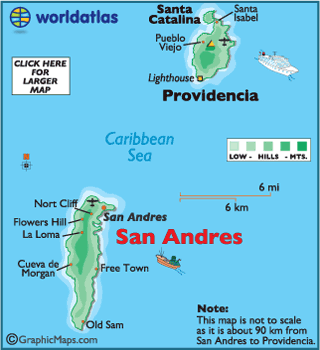
San Andres, just a two-hour flight from Colombia’s capital, Bogota, is the largest island in an archipelago that also includes Providencia and Santa Catalina islands, as well as 18 keys.
San Andres is also the largest island in the group, with an area of 26 sq. kilometers (10 sq. miles) and about 70,000 year-round residents.
The government has banned new construction on the island unless developers undergo a rigorous process, investing a large sum and demonstrating that the project will benefit San Andres and its residents.
Most of the lodging is British-style bed and breakfast offerings, providing visitors with an affordable stay that brings them into contact with locals.
The archipelago’s big draw, however, is nature, with an estimated 10 percent of the world’s marine plants and animals living in its waters.
One surprise for many visitors is the large military presence in the islands, with the Colombian armed forces deployed in the area to fight drug trafficking and provide a show of force in the face of Nicaragua’s claims to the archipelago.
26 April 2016
Anti-Colonialism Day marked on April 24 across the globe

April 24 mark(ed) World Anti-Colonialism Day and teleSUR English takes a look at the current and former anti-colonial struggles in Latin America and the Caribbean.
On April 24, 1955, 29 “non-aligned” nations from Africa, the Middle East and Asia concluded the historically significant Afro-Asia Conference, or what was more popularly known as the “Bandung Conference,” a landmark event on anti-imperialism, anti-racism, anti-colonialism and anti-militarization in the midst of an escalating Cold War.
Held in Bandung, Indonesia the meeting brought together revolutionaries from around the world, who condemned Western imperialism and colonialism.
April 24 also marks the Easter Rebellion by the Irish people against British rule. The uprising represents a refusal of British imperial rule by Irish revolutionaries who denounced the empire's unfair and oppressive occupation.
READ THE FULL REPORT HERE .

10 March 2016
Speech James Finies di NKBB den konseho insular reunion 23 feb 2016 tokante referendum ((Papiamentu)
Special to Overseas Territories Review
 |
| worldatlas.com |
Statement by
James Finies, Nos Ke Boneiru Bek
Bon nochi na : sr Gezaghebber i griffier, miembronan
di konseho, deputadonan, i tur presente i na esnan ku ta sigui e reunion aki
via di radio o televishon
Awe 23 di februari sigur ta un dia importante pasobra
ta bai diskuti riba e topiko resultado di referendum. Pues e derecho esklusivo
di nos pueblo pa por disidi su mes riba su futuro. Esaki ta e derecho di outo determinashon di e
pueblo Boneriano ku ta un derecho humano ku ta pertenese na ami i tur otro
Boneriano.
Den e kaso aki , e topiko di referendum, ta un kaminda
basta largu a kana , hopi kos a okuri, ku e 5 minuut aki nunka lo jega pa
relata tur lokual ku e representashon di e pueblo Boneriano i nan gobiernunan a
presta riba e tereno aki desde 2004 bini ariba ku a kulmina na 10-10-10 den
destrui i desmantela e pais Antias. Den nos kaso kreashon di e struktura
estatal aktual, entegrando nos parsialmente i hinkando nos den konstitushon
Hulandes bao di artikulo 134 komo Entidat Publiko, komo islanan BES. BES ku ta
inklui tambe Saba i Statia, pues e islanan mas chiki i vulnerabel di e pais i
pueblo Antiano, Hulanda a aneksa e islanan aki bao di preshon, i a hinka nos
den e struktura temporal aki pa 5 anja. I esaki kontra voto demokratiko di e
pueblo di Statia i tambe sin aprobashon legal di e pueblo Boneriano, ku nunka
tabata na altura di e konsekuensia di `nan eskoho. Esaki violando i trapando e
base di ley internashonal konserniendo derechonan fundamental di
outodeterminashon.
I ku e struktura aki lo keda vigente te ku 2015 ora evalua,
lokual ku a sosede ku resultado konosi, ku obviamente tabata un frakaso i nos
gobiernu a wordu deskribi den e raport aki komo esun ku prinsipalmente a hanja
mayoria kulpa den esaki. Awor mester bai na disidi i traha riba un struktura
definitivo.
Resumiendo en korto:
-E resultado di referendum di 2004 i akuerdonan
politiko pa e struktura BES despues di 10-10-10
nunka tabatin un fundamento o base legal di akuerdo ku ley
internashonal, e pueblo nunka tabata na altura di konsenkuensia di su eskoho i
nunka a ratifika o legalisa esaki. -E
resultado di
referendum di desember 2010 pueblo demokratikamente a rechasa e inkorporashon
den e konstitushon Hulandes bao di artikulo 134. Raport di mesun Boersma ku awe
sigur ta tema di diskushon a raporta negativo riba esaki i aun mas peor ta ku e
supervishon di Nashonan Uni, Sra Luethy, ku a bisami personalmente den un
kombersashon ofisial, pero a pidimi pa nunka ripiti e kombersashon ey, pasobra
ku e lo bai raporta tambe negativo kontra e referendum ey, te ku awe e raport
aki no a mira lus di dia. Ni Boneiru ni Hulanda ni Nashonan Uni no tin e raport
aki, anto awe ke bai diskuti tokante raport? Esaki no ta aseptabel i tambe nada
otro ku lo bai kontra bos i eskoho demokratiko di e pueblo Boneriano. E 5040
votonan NO mester wordu respeta!
-Ku e resultado di e referendum di 18 desember 2015,
pueblo demokratikamente a rekonfirma su posishon ku e no ta di akuerdo ku e
kontenido ku a wordu duna na su eskoho sin kontenido di referendum di 2004.
Esaki ta e uniko konklushon di e resultado, no purba na inteprete di ningun
otro forma, pasobra si e pueblo a vota Si, awe henter e proseso i struktura ku
nos ta den awe Si lo a bira legal. Pesey e eskoho No, 66% a rechasa esaki i awe
e struktura aki no tin base legal definitivamente i ta ilegal, pasobra e no tin
aprobashon di e pueblo. Esaki ta komprendibel?
O kon tin ku hasie komprendibel pa esnan ku no kier
komprende esaki, espesialmente oposishon ku a kampanja pa Si, ku parse ta aki
awe ku e intenshon pa kuestiona i ke kambia e desishon di pueblo?
-E mesun situashon igual ku na St Eustatius a
inkorpore tambe den struktura BES i konstitushon Hulandes tambe kontra deseo i
eskoho demokratiko di e pueblo Statiano. -Ku na St Eustatius, desember
2014 a tene un referendum di struktura estatal kaminda dos tersera parti a vota pa outonomia den Reino Hulandes
pero ku indikashon di praktikanan di boicot di referendum meskos ku esun di
Boneiru di 2010 i 2015.
- Meskos a purba tur sorto di manera pa boycot esun di Boneiru di18 desember tambe. I e pueblo ku 5
anjana largu a sufri, i boso tur uniko kos ku boso por a bisanan, 5 anja largu,
no ta nos, ta Hulanda, nos no por hasi nada, awor boso a hanja kurashi , a uni,
i duna e pueblo oportunidat pa usa su poder. I e pueblo a bisa ta basta. I awor
kier kambia o hunga politika ku e resultado? Ta problema ta buskando?
-Ku e gobiernu nobo di St Eustatius a ratifika e resultado di nan referendum
ku a wordu boicota i lo mester kumpli ku bos i deseo di e pueblo.
-Ku e dos pueblonan di Boneiru i St Eustatius a demonstra
konbensientemente i demokratikamente ku nan no ta felis ku e situashon ku a
hinka nan den despues di 10-10-10 i a vota kontra e status aktual ku Hulanda
den nan referendumnan.
Awor e pregunta na boso, apesar ku boso a eksperensia,
pues biba e disgustu i rabia bao di e pueblo Boneriano, ku a protesta,
manifesta, hasi tur sorto di kos pa demonstra esaki pa e ultimo anjanan, ku
boso no ta rekonose ku henter e situashon ku nos ta den aki ta uno illegal? Ku
e no tin ningun fundeshi legal pa sigui persisti ku ne? Ku boso tambe siguiendo
ku e rumbo aki ta violando leynan i trapando derechonan fundamental di e pueblo
Boneriano?
Hasi politika ku referendum pa partido i puesto i poder, ta hungando
ku e derechonan i futuro i destino di e pueblo aki.
Mi kier pa rekorda boso ku boso a wordu eskohe pa e
pueblo pa represente i defende su derechonan i no pa entega o kita esakinan for
di dje, loke a okuri desde 10-10-10. Kaminda a entrega e pueblo su derechonan i
su poder demokratiko i asta boso poder pa representa boso pueblo den man bek di
e mesun ku a kolonisa nos. I nos tur a re-biba nos historia kolonial di nobo,
na un forma moderno, pues kiko ta nifika pa wordu domina i oprimi, di nobo, nos
a eksperiensa e desesperashon i inkapasidat di gran parti di nos pueblo kaminda
mayoria di nan a entrega. Asta boso mes no tabata mira salida for di e trampa
ku nos ta den aki, e jamada pa un referendum a dune e pueblo un speransa bek,
nos lucha i sakrfisio sobre-humano pa por juda konvense boso pa duna e pueblo e
oportunidat, su derecho pa papia.
I awor pueblo su bos a resona i a duna boso
bek e mandato legal demokratiko pa tuma nos poder bek i asina boso por ta esnan
responsabel pa juda e pueblo rekobra su prosperidat i felisidat bek. Ta esaki
ta bai diskuti ku e referendum ku esaki tin balides?
Nos lo no asepta esaki di ningun forma. I pa rekorda o
refreska memoria o pa esnan ku no sa, ku referendum ta un mekanismo demokratiko
ku a wordu implementa, despues di segunda guera mundial, pa evita guera i promove
pas, i ta na lugar di guera pa un pueblo por defende su mes na un manera
siviko. I nos tur ta bon na altura ku bida di hende mester wordu respeta i esun
ku kita esaki for di e otro ta un kriminal ku lo wordu persigui i kondena.
Pero ku den guerra esaki si ta posibel pa kita bida di
e otro legalmente, pues esey nifika un referendum. Evita ku nos mester jega dje
lew ey ku nos tin defende nos libertat ku nos bida, pasobra esaki tambe ta nos
derecho i ta legal pa por defende nos derecho i libertat ku tur medio posibel.
Apesar di dokumentonan, raportnan, analisnan di
ekspertonan legal, ets, pero parse ku politika, puesto i poder, ta mas
importante ku ley i derecho, ta pesey nos ta bai na e nivel aki awe, pa
rekorda, ku si nos sakrifisio no tabata basta i sufisiente pa bira konsiente
kiko ta posibel ora hende ta kapas pa hasi, ora sin interes o agenda den nada,
solamente pa protega su derecho i libertat i pa por pasa esakinan pa su
siguiente generashonan, i ku ta boso ta responsabel, pasobra referendum ta uniko
responsabilidat ku por juda e pueblo Boneriano ku boso a keda ku ne despues di
10-10-10, i ta boso ta responsabel si mester bai na sakrifika mas pa nos
derechonan i nos libertat wordu respeta i rekobra i restora.
Pueblo a papia, 5040 voto NO, no por tin ningun duda
riba esaki hamas , niun otro impretashon, ni tampoko purba kamoufla i o bini ku
ningun maniobra pa tene e pueblo den e mes un estado aki kaminda e ta wordu
domina i oprimi i ta infelis. Pues nos ta roga boso, pa komprende ku e asuntu
aki ta hopi serio i ta para riba ego personal o politika partidista i ta pa e
pueblo Boneriano den su totalidat.
Sperando ku boso lo refleha i boso konsenshi guia boso
direkshon kaminda hustisia i derecho di e pueblo Boneriano lo prevalese den
boso desishonan awe i padilanti ku lo ta determinante pa nos futuro i nos
destino.
Danki i bon
nochi.
See Also:
Self-determination referendum for Bonaire being sabotaged
Bonaire group petitions for self-determination referendum
Bonaire Government requests U.N. listing as non self-governing territory
14 August 2015
Raizal people of San Andres commemorate emancipation
 | ||||||||||
Sergio Estrada J.D. (r) presents paper on "Contesting the International Court of Justice Ruling" during Emancipation Conference. On left is Professor Fady Ortiz. (OTR Photo)
|


 |
| Officials at the head of the Emancipation Parade. (OTR Photo) |
 |
| Conference attendee sports Emancipation Tee Shirt - Since 1834! (OTR Photo) |
 |
| Traditional Dancers go through their steps during intermission in Emancipation Conference. (OTR Photo) |
 |
| Cultural Dancers perform. (OTR Photo) |
 |
| More Dancing. (OTR Photo) |
 |
| Marchers carry Raizal flag during Emancipation Commemoration. (OTR Photo) |
 |
| Marchers in traditional dress during the Emancipation Parade. (OTR Photo) |
 |
| Young musicians wow the crowd with their music. (OTR Photo) |
 |
| Young Musicians marching. (OTR Photo) |
 |
| More marching musicians. (OTR Photo) |
 |
| And more marching musicians. (OTR Photo) |
 |
| People of San Andress gather in park for the Emancipation concert. (OTR Photo) |
 |
| Conference Coordinator Corrine Duffis (center) is flanked by Dr. Corbin (l) and Attorney Estrada (r) during break in the conference proceedings. |
03 April 2015
“Voices of Decolonization: A University of Guam Political Status Debate”
Announcement
Ep. 218 “Voices of Decolonization: A UOG Political Status Debate” (hosted by Dr. Michael Lujan Bevacqua with producer Alan Grossman) was recorded 1/16/15 at the University of Guam and airs 4/3/15.
| ns.gov.gu |
Guam is one of 17 non-self-governing territories recognized by the United Nations as needing decolonization. Chamorros have been pushing for this for several decades but momentum on the issue has built and waned over time. There has been a resurgence of interest since the start of 2015 as both Governor Eddie Baza Calvo and Congresswoman Madeleine Bordallo highlighted the importance of political status change in their state of the island addresses.
For the first time in several years the Commission on Decolonization, the government body tasked with helping guide the island towards decolonization has received a modest budget for public education on the issue.
This episode features a debate over political status courtesy of a Guam History class at the University of Guam, taught by Dr. Michael Lujan Bevacqua. As part of this course, a debate on decolonization is conducted whereby the students are divided into three groups, each representing a different possible political future for Guam (statehood, free association or independence).
The students research each status, conduct interviews and develop their arguments as to why their particular status would be the best choice. Although the process of formally voting on this political issue is limited to only those who are considered “native inhabitants” of Guam, this exercise shows the importance of non-Chamorros to participate in the discussion as well.
Vivian Loyola Dames, Ph.D.
Anchor Host & Coordinator
Beyond the Fence
KPRG -89.3FM
303 University Drive
UOG Station
Mangilao, GU 96913
20 April 2014
Petition to Free the Raizal People from Columbian Colonization
 |
| csmonitor.com |
 "We are tired of being a Colony of Colombia and of her bad treatment, we are taking back our Land and our Freedom".
The ancestors of the Raizal People voluntarily adhered to Colombia in 1822 ("according to Colombian historians"), thinking it would be a safe relationship; but today, the Raizal People are on their way to extinction under the ethnocidal and genocidal Colombian regime by:
(1) Losing more than 50% of their ancestral land titles. (2) The capital island being intentionallyoverpopulated, today with a density of more than 3.000 inhabitants per km2 causing multiple problems, making it unsustainable environmental, social, economically, giving deaf ears to the pleas by Raizals (3) Being outnumbered by immigrants and becoming a minority on their ancestral Territory. (4) Being discriminated in their own land. (5) Having their Territory ceded to other countries through unconsulted treaties. (6) Having their traditional peace and welfare affected by Colombia's tolerating and encouraging drug trafficking, money laundering and violence through its corrupted forces and its corrupted political system.
03 September 2013
Western Caribbean islands subject of continued territorial dispute
A Territorial Dispute Prompts Colombia and Nicaragua to Beef Up their Navies

Univision

In the past eight months, tensions have flared between Colombia and Nicaragua over a maritime territorial dispute that has led to a local arms race.
Both countries’ armies have announced new weapons purchases as part of an effort to modernize their military, and war is already viewed as an actual possibility by members of both armies.
“We’re not facing an imminent confrontation with this Central American country,” a high-ranking Colombian officer told El Espectador. “But it has become a priority in what we call the ‘sand boxes’ [war training exercises based on possible conflict scenarios], which are nothing more than our troops’ preparation for the worst while hoping for the best.”
The causes of the conflict are fairly recent.
In 2001, Nicaragua sued Colombia at the International Court of Justice (ICJ) over a significant portion of Colombian maritime territory. For 11 years, Nicaraguan lawyers argued that nearly 50,000 square kilometers of Colombian sea in truth belonged to the Central American nation. The area in question included the archipelago of San Andrés, Providencia, and Santa Catalina, a group of tropical islands surrounded by coral reefs, which are located 482 miles from the Colombian coast and just 140 miles from Nicaragua, but have been settled by Colombians since the 19th century.
In November 2012, the ICJ ruled that the archipelago and most of the contended territory belonged to Colombia. The court also said, however, that an area containing two islets, potential gas and oil reserves, and a major industrial fishing spot that benefitted San Andrés’ residents, was indeed part of Nicaragua.
As a result of the decision, the relationship between both countries has been steadily strained and the tone has become increasingly hostile, raising concerns about a possible confrontation.
“There is a real necessity to acquire war material to guard these new and vindicated seas,” said Julio César Avilés, head of the Nicaraguan military. “We need new naval resources to insure Nicaragua’s sovereignty over these waters.”
In Colombia, the ICJ’s ruling spurred accusations of international diplomatic foul play, an internal political crisis, and problems between Colombia’s national government and the San Andres community. President Juan Manuel Santos, who rejected the ICJ’s ruling immediately after it was announced, has since called for a commission of experts to review Colombia’s judicial and diplomatic options.
Nicaragua, meanwhile, welcomed the ruling. The Central American country ramped up its activities in the disputed territory, dispatching commercial ships and approving exploratory oil drillings. Nicaragua is also reportedly seeking to buy four Russian warships and several long-range cannons to patrol the area.
For Colombia, a country that is even considering an utter dismissal of the ICJ decision to reclaim the area, Nicaragua’s activities in the contended territory are seen as an affront further increasing the growing tension between the two nations.
“If Nicaragua starts threatening us with these Russian ships, then Colombia must call on other countries to increase its maritime force with other ships,” Colombian Senator Alexandra Moreno Piraquive recently said.
Colombian Defense Minister Juan Carlos Pinzón, speaking shortly after Nicaragua revealed its purported purchases, also warned that the country wouldn’t respond lightly to any provocations.
“Colombia is very respectful of other countries’ sovereignty to acquire new offensive equipment, but let it be clear: no one should dare to enter Colombian territory, no one should dare to violate Colombia’s sovereignty,” Pinzón said.
The chances of a full out war are incredibly slim, though. War is a last resort that both countries would try to avoid at all costs.
Colombia is in the midst of a civil conflict and the government would be unlikely to welcome the opening of a new front in the Caribbean Sea.
Nicaragua, on the other hand, faces a military disadvantage when compared with the South American nation, so it is highly unlikely that it would choose to initiate a confrontation.
Furthermore, Nicaraguan authorities have made an effort to lower the tone of their statements in the past few days.
“We don’t want a war,” Nicaraguan general Julio César Avilés said after being asked about his nation’s weapon purchases. “They are ships with a greater autonomy to navigate those vast spaces. Colombia shouldn’t worry about those acquisitions.
Subscribe to:
Posts (Atom)