Showing posts with label Columbia. Show all posts

20 December 2018

LIDERES DE SAN ANDRES ARCHIPELAGO DEMANDA LA RETIRADA DEL GOBERNADOR MILITAR "ILEGAL" COLUMBIANO


sanandres-colombia.com
_________________________________________________________________


COMMITE PERMANENTE por la DEFENSA DE LOS  DERECHOS HUMANOS
 
Hacemos la Paz defendiendo los Derechos Humanos 


Ante la situación que se presenta desde este miércoles en la madrugada, donde un grupo de ciudadanos Raizales se encuentran protestando de forma pacífica, encadenados a las afueras de la Gobernación de San Andrés, el Comité Permanente por la Defensa de los Derechos Humanos (DDHH), emitió una ‘alerta temprana’ ante las posibles “afectaciones a la integridad de cualquier manifestante” o “cualquier procedimiento que atente contra los derechos humanos del pueblo raizal”.


ALERTA TEMPRANA 

Desde las 4 a.m. del día de hoy, 19 de diciembre, un grupo de raizales dio inicio a una toma pacífica de la Gobernación de San Andrés, debido a que el Gobernador elegido en 2015, Ronald Housni Jaller fue destituido por presuntos actos de corrupción y en su lugar fue nombrado el Contralmirante Juan Francisco Herrera Leal, ante el incumplimiento de la condición legal establecida respecto a la calidad de residente de la Isla, se pide la remoción inmediata del Gobernador encargado, Contralmirante Herrera. Entre otras exigencias se encuentra la devolución de unos lotes que le pertenecen al pueblo raizal y que en este momento han sido ocupados por la Policía del departamento. 

Transcurridos pocos minutos de la toma, sobre las 04:30 a.m. hace presencia Fuerza Disponible y ESMAD a cargo de un uniformado que los pobladores logran identificar como el Mayor Sánchez, sacando de forma violenta a dos personas que se encontraban encadenadas dentro de la Gobernación como acto simbólico y político de la toma pacífica. Además de esto empezaron a intimidar y agredir con sus implementos y los caninos de apoyo a los manifestantes que se encuentran en este momento exigiendo sus derechos frente a la entidad gubernamental . Se quitaron agresivamente los carteles y desmontaron las carpas que se tenían para proteger de la lluvia al pueblo raizal. 

Rechazamos los actos de intimidación, agresión y amedrentamiento por parte de la Fuerza Pública, igualmente rechazamos la forma en que se violenta la ley y la Constitución por parte del Gobierno Nacional al designar al Contralmirante Juan Francisco Herrera Leal. 

Exigimos garantías para el ejercicio de la protesta pacífica, de acuerdo con el artículo 37 de la Constitución Política, los tratados en materia de DDHH y DIH que Colombia ha ratificado y los protocolos para el manejo correcto de manifestaciones y multitudes. 

Hacemos el llamado a la comunidad nacional e internacional, a los movimientos sociales y populares para respaldar, difundir y apoyar las diferentes exigencias del pueblo raizal en la Isla de San Andrés. 

Por último, hacemos responsables al presidente de la Republica Iván Duque, al Ministro de Defensa Guillermo Botero y al Comandante de la Policía en el departamento de San Andres Jorge Antonio Urquijo Sandoval, por las violaciones de Derechos Humanos que puedan ocurrir y las afectaciones a la integridad de cualquier manifestante , de igual forma cualquier procedimiento que atente contra los Derechos Humanos del pueblo raizal.

12 January 2017

African Heritage Remembered at Colombia’s Black and White Carnival


PASTO, Colombia – Typical rhythms from Colombia’s Pacific region can be heard on Thursday in the streets of the southwestern city of Pasto to celebrate the Day of the Blacks, a tribute to the portion of the population descended from African slaves during the traditional Carnival celebration in this zone bordering on Ecuador.

“This day is celebrated (to commemorate) the free day our ancestors who arrived from Africa as slaves received to hold their festivals and rituals and at the same time to calm the anxieties the blacks felt at being bound and imprisoned,” the director of the Los Alegres de Telembi folkloric group, Liloy Ortiz, told EFE.

At the Black and White Carnival “what we want is to show people the cultural legacy our ancestors left us that we still experience in African music, dance, poetry and theater,” said Ortiz, who has been part of the musical group for the past 10 years.

To the rhythms of the marimba, an instrument with African origins, residents and tourists in Pasto, the capital of Nariño province, smudge their bodies black to begin a game of exchanging identities where mixed-race people take on the appearance of blacks.

“This event is the chance to leave to the side those racial differences and social prejudices that exist in the country among the black and white races, and to see that we’re all humans and brothers,” Ortiz said.

Ortiz added that the music at the Carnival is also designed to denounce the problems that currently exist in the Pacific region.

“The Pacific (region) is a zone with great biodiversity. However, we’re ignored by the state and there’s very generalized corruption that results in the region not prospering economically, and so it’s one of the poorest in Colombia,” the musician added.

Meanwhile, Lisenia Gallo, the executive director of the Cueros y Chonta Musical Foundation, a musical group participating in the Carnival, said that “through rhythms such as the ‘currulao,’ the ‘bunde’ and the ‘juga,’ among others” the performers sing about corruption “but also about peace, love and life.”

The Black and White Carnival, in 2010 designated as part of the World Heritage by Unesco, will conclude on Jan. 6, the Day of the Whites, with a parade of floats the main aim of which is to present the myths and legends of the region through the talent of Nariño’s artisans.

04 January 2017

Asamblea del Pueblo Raizal invita a reunión este 7 de enero


No hay texto alternativo automático disponible.
Con un espíritu de unión, hermandad y buena voluntad, que intenta incluir y construir un espacio transparente para todos, la Asamblea del Pueblo Raizal ha adoptado nuevas disposiciones referentes a sus comunicados, con lo que espera mejorar significativamente su relación con todos los estamentos de la comunidad. (información bilingüe) 
Esta decisión se toma luego de evidenciar las continuas dificultades que se han tenido para comunicar de forma efectiva las reuniones, decisiones y convocatorias, lo que se ha traducido en una serie de malentendidos que afectaron directamente al poder decisorio y la legitimidad de la Asamblea.
Para una plenaria efectiva es necesaria la presencia de la mayor cantidad de personas pertenecientes a nuestro Pueblo Raizal. Por lo anterior:
1. A partir de la fecha, la Asamblea del Pueblo Raizal se pronunciará de forma única a través de comunicados escritos dirigidos al Pueblo Raizal, comunidad general, medios de comunicación y medios alternativos. Todos estos serán emitidos por la red social Facebook, órgano de comunicación oficial designado por la Asamblea. De igual modo, se realizará una labor de difusión informal que incluirá comunicación puerta a puerta, reuniones en los barrios, volantes, cartas dirigidas a las iglesias y sus miembros, entre otros.
2. Se convoca a todo el Pueblo Raizal a una reunión el próximo sábado 7 de enero, en la Casa de la Cultura Tamarind Tree, a las 2:00 p.m. En esta importante reunión se trataran los siguientes temas:
• Organización del congreso del Pueblo Raizal.
• Discusión de herramientas participativas para el Pueblo Raizal.
• Discusión de problemáticas varias.
Recuerda seguirnos por el nuevo canal de comunicación:
Contamos con su participación.
Asamblea del Pueblo Raizal.

24 December 2016

2016 STATE OF THE BLACK WORLD CONFERENCE CALLS FOR GLOBAL COLLABORATION ON STRUGGLE FOR REPARATIONS

State of the Black World Conference IV

DECLARATION OF INTENT AND CALL TO ACTION

Intensifying the U.S. and Global Reparations Movement


Work to intensify the U.S. and global struggle for reparations within the context of the Durban Declaration and Program of Action and the U.N. Decade for People of African Descent.  To that end, IBW will:
  • Strive to strengthen the National African American Reparations Commission (NAARC) as a co-partner with the CARICOM Reparations Commission in expanding the global Reparations Movement.
  • With the consent of Congressional John Conyers, finalize the revision of HR-40 from a “Study Bill” to a “Remedy Bill” to be introduced in the next Congress of the United States as a tool for mass public education, mobilizing/organizing and action to advance the struggle for reparations.
  • Encourage the creation of Reparations Studies Curricula at Historically Black Colleges and Universities in collaboration with the University of West Indies Mona Campus in Jamaica.
  • Support the convening of Reparations Summits in Africa and Columbia in 2017.
.....

Addressing Key Issues in Africa, the Caribbean, Central and South America

Based on the deliberations and documents developed by the Pan African Unity Dialogue convened by IBW in New York, work to mobilize mass based, popular support for:
  • African-centered Principles of Democratic Governance in Africa and the Caribbean.
  • Guidelines for Addressing and Resolving Crises in Africa and the Caribbean.
  • Principles and Guidelines for Foreign Investment in Africa to counter the “new scramble for Africa.”
In addition, continue efforts to strengthen the capacity of the Diaspora to impact U.S. policy toward Africa, the Caribbean, Central and South America; strengthen bonds of solidarity and action with Afro-Descendant communities in Central and South America; and intensify efforts to develop mutually beneficial business and commercial relations between Africa, the Caribbean, Central and South America and the Diaspora in the U.S.


14 December 2016

Elegirán a representantes raizales para mesa de concertación


Este viernes 9 de diciembre se dieron cita en el auditorio de la Gobernación, el viceministro del Interior Luis Ernesto Gómez; el gobernador Ronald Housni Jaller; miembros del grupo ‘Raizal Union’ que adelantaron la manifestación del 19/11 que propició este encuentro, y otros miembros de la población raizal.
Tras una prolongada deliberación con abundantes intervenciones de los diversos líderes allí presentes, se acordó elegir en asamblea el próximo sábado 17 de diciembre a los representantes para la mesa de concertación con este Ministerio.  
La anunciada reunión se programó luego de que el grupo de manifestantes del 19/11 levantara el bloqueo que mantuvo cerrado un céntrico sector de San Andrés durante cuatro días y donde exigían presencia del alto gobierno para ello; esto con el fin de poner en conocimiento de la Presidencia de la República un pliego de peticiones, entre las que se cuentan, la declaratoria del Estatuto Raizal y la solución a la problemática de la sobrepoblación.
El fin de la reunión era el de fijar una mesa de concertación entre miembros de esta población y el Gobierno Nacional para tratar las problemáticas planteadas, sin embargo varios de los presentes manifestaron dudas sobre quiénes serían los representantes raizales en estos encuentros con el alto gobierno.
Luego de varios planteamientos y posturas, se acordó que éstos se definirían en una asamblea autónoma que se realizará el próximo sábado 17 de diciembre a las 2:00 pm en centro cultural Tamarind Tree en La Loma, a donde se cita a los líderes de esta población que contará con el respaldo organizacional de la Defensoría del Pueblo y el apoyo de la Procuraduría Departamental como garante.
Por otra parte, a pesar de no concretarse la mesa de concertación con el Gobierno Nacional, el viceministro Gómez manifestó abiertamente su intención y apoyo para que se lleve a cabo y propuso que la misma se instale en la última semana de enero de 2017, una vez definidos los representantes de la población raizal que harán parte de dicha Mesa.
Así mismo, el funcionario especificó que según la competencia de su Ministerio, los temas a tratarse en dicha mesa girarán en torno a lo relacionado con derechos, constitución y representación política raizal.

24 June 2016

Colombia’s San Andres Island, a Jewel in the Caribbean


SAN ANDRES, Colombia – San Andres Island has become a jewel for Colombia’s tourism industry, giving visitors a taste of a vibrant urban lifestyle and the beauty of the sea.

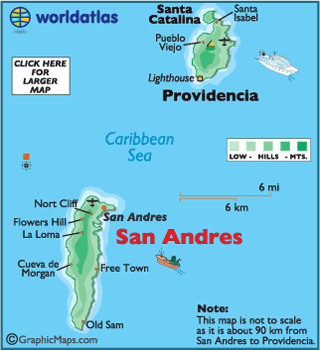
San Andres, located in the Caribbean Sea off the coast of Nicaragua, is a UNESCO biosphere reserve and its waters harbor the third-largest barrier reef in the world, a natural feature that is only smaller than those in Australia and Belize.

San Andres, just a two-hour flight from Colombia’s capital, Bogota, is the largest island in an archipelago that also includes Providencia and Santa Catalina islands, as well as 18 keys.

San Andres is also the largest island in the group, with an area of 26 sq. kilometers (10 sq. miles) and about 70,000 year-round residents.

The government has banned new construction on the island unless developers undergo a rigorous process, investing a large sum and demonstrating that the project will benefit San Andres and its residents.

Most of the lodging is British-style bed and breakfast offerings, providing visitors with an affordable stay that brings them into contact with locals.

The archipelago’s big draw, however, is nature, with an estimated 10 percent of the world’s marine plants and animals living in its waters.

One surprise for many visitors is the large military presence in the islands, with the Colombian armed forces deployed in the area to fight drug trafficking and provide a show of force in the face of Nicaragua’s claims to the archipelago.

29 November 2015

Afrodescendientes succeed in regaining their ancestral lands


BOGOTA – The Afro-Colombian community of Rio Naya has been granted title to approximately 188,000 hectares (725 sq. miles) of land that they historically occupied, the Colombian Rural Development Institute, known as Incoder, said Tuesday.

The awarding of the land, which straddles the boundary between the southwestern provinces of Cauca and Valle del Cauca, finally wraps up a lawsuit filed in 1999 when the more than 16,000 Rio Naya inhabitants presented Incoder with a demand for collective ownership.

The process of awarding title to the territory was achieved thanks to a December 2014 ruling of the Council of State ordering the University of Cauca to turn over the land to Incoder.

“This is the greatest possible move toward recognizing the ethnic, cultural, territorial, social, economic and political rights of the Afro-Colombian population and for strengthening its right to own and occupy the land of its ancestors,” Incoder said.

The Rio Naya community council is made up of 4,551 families distributed among the municipalities of Buenaventura, Valle del Cauca, and Lopez de Micay, Cauca, and currently has 64 villages.

The chief economic activities of this community are mining, hunting and fishing.

The collective land ownership of the black community in the Naya region is “a true act of reconciliation of the country with a forgotten community that has suffered all the hardships of war,” Incoder said.

19 September 2015

Raizal people of Colombian Caribbean archipelago defend cultural traditions


By Carlos Meneses Sanchez

The Raizals, a Creole-speaking, Afro-Caribbean people who inhabit the Colombian archipelago of San Andres, Providencia and Santa Catalina, are fighting to achieve greater respect for their centuries-old culture and achieve a place for their language in all local institutions.
This Protestant ethnic group makes up more than half of the population of San Andres, the largest island in the archipelago, which is located 220 kilometers (135 miles) off the coast of Nicaragua and 700 kilometers (435 miles) from mainland Colombia.
San Andres-Providencia Creole has its origins in different African dialects spoken by slaves brought to these islands by the English, guide Rodrigo Sarmiento, a native of San Andres and member of the Raizal community, told EFE, adding that slaves mixed English with words from their native tongues so their owners would not understand them.
He gave one example of a phrase in the local language, noting that the question "How are you?" sounds like "Jo yo de."
San Andres-Providencia Creole is the language most commonly heard in the primarily Raizal neighborhoods of San Luis and La Loma, two of the three sectors into which San Andres is divided.
Meeting the demand from that community is a small local television station, TeleIslas, that offers programming in Creole with Spanish subtitles.
"We're fighting so that Creole is in all the institutions. Previously it was considered a dialect because it didn't have a written form or grammatical rules, but now it can be both written and spoken. There are even books," said Mario Bailey, a young Raizal who sings in the local Baptist church's youth choir.
Constructed entirely with wood brought from the U.S. state of Alabama, the church, the first of that denomination to be built on San Andres, was founded on the island's highest point by Rev. Phillip Beckman in the mid-19th century, shortly after Britain's Parliament abolished slavery throughout the British Empire.
The Raizal's Baptist tradition, also adopted from British slave owners and settlers on the archipelago, makes their belief system distinct from the majority Catholic population of Colombia, since they believe in the Holy Trinity but not in the intercession of "saints or virgins."
They do, however, have respect "for the Virgin Mary as Jesus' mother," Bailey said.
The Raizals' architecture also hearkens back to the past with its cone-shaped roofs and wooden stilt houses to prevent flooding in the rainy season.
Another cultural novelty is the existence of some private cemeteries hidden away between houses, even though they are prohibited because of their potential for contaminating groundwater.
But because of the Raizal population's cultural differences with the rest of the country, locals say Colombian governments for a time completely neglected the island.
There was a period in which the national government paid no attention to the Raizal population concentrated in the neighborhoods of San Luis and La Loma, the guide Sarmiento said, adding that things improved somewhat when a military dictator, Gen. Gustavo Rojas Pinilla, became the first Colombian president to visit San Andres and declared it a free port in 1953.
In Rojas Pinilla's remembrance, the island's small airport bears his name.
Despite the government's neglect, the Raizals have managed to implement an educational system in their schools that ensures a place for their culture in Colombian history books.
"In my high school, they're very strict with our traditions. We had to learn what slavery was like, the history of the church, everything ... They also teach us all the dances, and we have to be able to dance them to graduate," Bailey said.
In terms of local permits, if a private company wants to carry out a construction project it must first obtain the approval of the Raizal population and then only hire native workers.
This ethnic group also has its own cuisine that includes empanadas (a stuffed bread or pastry) and crab soup as well as rondon, a fish and seafood stew simmered in coconut milk and accompanied with rice, breadfruit, cassava or fried banana.
Inside the Baptist church, which is sober in appearance but features a drum set on the side of the altar to liven up the services, several people are fixing part of the roof and putting up the portraits of some of the seven pastors who have spiritually guided the community over the past 171 years.

Up high in the scaffolding, one young Raizal woman says something to one of her work companions in Creole. She is wearing a T-shirt that reads: "Dis dah fiwi: teritory, stuory, langwij ahn koltyo!" which means "This is Ours: Land, History, Language and Culture!" 

14 August 2015

Raizal people of San Andres commemorate emancipation


Sergio Estrada J.D. (r) presents paper on "Contesting the International Court of Justice Ruling"  during Emancipation Conference. On left is Professor Fady Ortiz. (OTR Photo)


Professor Fady Ortiz presents paper on "Land and Territory" at Emancipation Conference. (OTR Photo) 


Dr. Carlyle Corbin presents paper on "Self-Determination, Referendum and Decolonization"


Panelists listen intently to questions from the audience following presentation of papers. (Left to right) Mari Margi, Sergio Estrada J.D., Dr. Carlyle Corbin.  


Panelists respond to questions during interactive dialogue


Conference Coordinator Corrine Duffis (center) and other conference participants review the panel presentations. (OTR Photo)

Officials at the head of the Emancipation Parade. (OTR Photo) 

Conference attendee sports Emancipation Tee Shirt - Since 1834! (OTR Photo)

Traditional Dancers go through their steps during intermission in Emancipation Conference. (OTR Photo)

Cultural Dancers perform. (OTR Photo)

More Dancing. (OTR Photo)


Marchers carry Raizal flag during Emancipation Commemoration. (OTR Photo)

Marchers in traditional dress during the Emancipation Parade. (OTR Photo)

Young musicians wow the crowd with their music. (OTR Photo)

Young Musicians marching. (OTR Photo)

More marching musicians. (OTR Photo)

And more marching musicians. (OTR Photo)

People of San Andress gather in park for the Emancipation concert. (OTR Photo)


Conference Coordinator Corrine Duffis (center) is flanked by Dr. Corbin (l) and Attorney Estrada (r) during break in the conference proceedings.


11 August 2014

Cooperation Agreement between Curacao and Republic of Colombia


Asjes in Colombia
WILLEMSTAD – During his stay in Bogota, the Prime Minister of Curaçao, Ivar Asjes had a meeting with the Colombian Minister of Foreign Affairs, Mrs. Maria Angela Holguin Cuellar. According to the Prime Minister, this meeting was very positive for both countries. At the end of the meeting the Prime Minister and the Colombian Minister of Foreign Affairs signed a memorandum of understanding (MoU) to open the doors to continue promoting, strengthening and intensifying the bilateral ties and cooperation between Curaçao and Colombia. The areas of cooperation indicated in the MoU are: agricultural products and services, fishery, customs, culture and education, tourism, infrastructure, transport and urbanization, health and energy.
Premier Asjes is very satisfied that the Curaçao government was able to sign this important agreement after both Curaçao and Colombia has been working on it for some time now. “As it is known, Curaçao and Colombia have historical ties, solidarity and friendship. Seeing that Colombia went through an economic boom these last years, this MoU represent a concrete opportunity to realize more cooperation between Curaçao and Colombia,” the Prime Minister said.
Asjes in Colombia
To achieve more cooperation on the areas discussed in the MoU, the governments of Curaçao and Colombia will install working groups, which will jointly prepare a plan and indicate action steps to execute these plans. Prime Minister Asjes is convinced that this cooperation agreement will benefit both the people of Curaçao and from Colombia.

23 April 2014

Pueblo indígena Raizal de San Andrés busca estrechar lazos con pueblos caribeños nicaragüenses

El 19 Digital

Raúl Lenin Rivas

(see original article here) 

Pueblo indígena Raizal de San Andrés busca estrechar lazos con pueblos caribeños nicaragüenses


Establecer relaciones culturales, comerciales y tener un acercamiento con los pueblos originarios de la Costa Caribe nicaragüense es el propósito de la visita de una delegación de la Autoridad Nacional del pueblo Raizal del Archipiélago de San Andrés, Providencia y Santa Catalina que arribó a suelo nicaragüense la noche de este lunes 10 de marzo.

Dicha delegación, integrada por el Vicepresidente de la organización, su Coordinador, el Secretario General y la Vocera, fue recibida en el Aeropuerto Internacional Augusto C. Sandino por el Vicecanciller de Cooperación Externa Valdrack Jaentschke y a partir de este martes realizará una gira de trabajo por territorio de la Región Autónoma del Atlántico Sur de Nicaragua, donde sostendrá encuentros con las autoridades locales y regionales de los pueblos indígenas de Bluefields, Corn Island y Laguna de Perlas en búsqueda de lograr un intercambio y relaciones comerciales, culturales y deportivas para unir a los hermanos caribeños sin importar fronteras o límites territoriales.

“Nosotros tenemos una relación desde hace muchos años que se ha roto y nosotros estamos buscando volver a lo que es nuestra herencia ancestral, tenemos hermanos aquí en este país y queremos volver a encontrarnos y mantener esa unión que nunca debió habernos separado”, manifestó Corine Beberly Duffis Steele, Vocera de la Autoridad.

Jairo Rodríguez Davis, Coordinador de la Autoridad Nacional Raizal detalló que con su visita pretenden reconstruir esa relación ancestral de forma armoniosa entre los pueblos indígenas aprovechando las afinidades y vínculos muy fuertes con las poblaciones de Corn Island y Bluefields, relación que se debe mantener independientemente de los países que tengan dominio sobre los territorios marítimos.

“Nosotros tenemos claras las relaciones ancestrales que siempre ha habido entre el pueblo raizal y los pueblos indígenas y tribales de la Costa Caribeña de Nicaragua. Ha sido un vínculo familiar, cultura, de lengua y de vecinos. Supimos convivir armoniosamente por mucho tiempo y desafortunadamente esas relaciones se fueron deteriorando ante una disputa territorial ante ese mar y lo que buscamos como pueblos es reconstruir las relaciones, las buenas relaciones con esos hermanos nuestros, el pueblo creole en Bluefields, en las Regiones Autónomas Atlántico Norte, Atlántico Sur y pueblos indígenas también como el miskito”, expresó Rodríguez.

Solo Nicaragua reconoce autonomía de pueblos originarios

El Coordinador de la Autoridad Nacional Raizal valoró de muy importante la Ley de Autonomía que el Gobierno del Frente Sandinista ha promovido sobre los territorios y pueblos originarios de la Costa Caribe, algo que no ha vivido el pueblo Raizal en San Andrés producto de las políticas de Estado que ejecuta el gobierno colombiano.

“Se ha sido muy maduro acá en concederle una autonomía muy merecida que tienen los pueblos indígenas en la Costa Atlántica nicaragüense. Esas dos regiones autónomas bien merecido lo tienen. Allá en San Andrés y Providencia el pueblo raizal todavía no disfruta de tales beneficios de una autonomía, no tenemos, es una lucha con Colombia […] estamos en esa lucha de tener derecho a la autodeterminación”, dijo Rodríguez Davis.

El Vicecanciller aseveró que el régimen de autonomía y los derechos reconocidos a los pueblos originarios por parte del Gobierno de Nicaragua, es un buen ejemplo para construir con los hermanos del Caribe las relaciones que históricamente se han venido desarrollando y se vieron interrumpida por diferentes factores.

Colombia agrede a pueblo Raizal

Enrique Pusey Bent, Vice-Presidente de la Autoridad, señaló que el pueblo Raizal sufre agresiones producto de las políticas y leyes aprobadas por el Gobierno de Colombia, que ha permitido la inmigración de continentales a las islas del archipiélago ocasionándoles la pérdida del 53% de su espacio vital sin una ley que los proteja como pueblos originarios, incluso excluyéndoles de los negocios de turismo que se han establecido en las islas.

“Hoy en día San Andrés se está convirtiendo, por la superpoblación, en un gran desierto, sacan el agua del subsuelo, bombean el agua para el sector continental y se olvidan de los raizales. Solamente una vez al mes llega el agua a San Luis y las Lomas por unas horas, mientras en los sectores donde viven los continentales el agua va diario, pero algo paradójico, las reservas de agua están debajo de nuestras casas y nuestras finquitas”, comentó

Según Pusey otra de las agresiones que sufren constantemente de parte del gobierno colombiano es el irrespeto a su cultura y a su lengua dado que los avisos públicos, la educación, los medios de comunicación escritos y documentos oficiales se emiten únicamente en español y son obligados por los agentes policiales, soldados y la fiscalía a hablar español.

“Hay discriminación en todos los niveles y el gobierno Colombiano no nos está tratando bien, no hay respeto para nosotros y lo único que piensan es en la soberanía y la nacionalidad, mientras mi pueblo Raizal está siendo extinguido, o sea aquí configura genocidio conforme al convenio internacional para prevenir y sancionar el delito de genocidio”, declaró Pusey.

Pusey sostuvo que mediante la Ley 52 de 1912 en su Artículo 14 y la Ley 127 de 1959 en el Artículo 13, el gobierno de Colombia promueve masivamente la inmigración de continentales de Suramérica y Colombia hacia las islas de San Andrés, Providencia y Santa Catalina, lo que les ha ocasionado la pérdida del 53% de su suelo vital al pueblo los Raizales, donde realizar sus cultivos y construir, “porque ya hemos perdido el 100% de las playas, de los cayos, de las lagunas y de los manglares, porque ya la defensa colombiana se han apoderado de estas zonas y nosotros apenas tenemos menos del 5 por ciento de permisos para pescar en nuestras propias aguas”.

Gobierno de Nicaragua reconoce derecho ancestral sobre Mar Caribe

Rodríguez Davis calificó como un acto de respeto y de reconocimiento del derecho ancestral del pueblo Raizal sobre las aguas del Mar Caribe, al permitir el Gobierno del Comandante Daniel Ortega que sus miembros realicen labores de pesca en el territorio que le fue devuelto a Nicaragua tras el fallo del 19 de noviembre del 2012 por la Corte Internacional de Justicia.

Destacó las facilidades que existen en Nicaragua para que las poblaciones de los Raizales visiten territorio nicaragüense, lo que debería ser reciproco y brindar el gobierno de Colombia también facilidades para que los pueblos originarios nicaragüenses mantengan contacto los que son sus hermanos en San Andrés y Providencia.

“Creo que efectivamente tanto la posición del Comandante Daniel (Ortega), presidente de la República, alrededor de los derechos de los pueblos raizales ha sido clara, ellos reconocieron y creo que hay que ver con una diáfana claridad, una claridad como los compañeros raizales se refieren a la necesidad de fortalecer las relaciones y de seguir comunicándonos como en el pasado”, agregó Jaentschke.

20 April 2014

Petition to Free the Raizal People from Columbian Colonization


csmonitor.com

"We are tired of being a Colony of Colombia and of her bad treatment, we are taking back our Land and our Freedom".

The ancestors of the Raizal People voluntarily adhered to Colombia in 1822 ("according to Colombian historians"), thinking it would be a safe relationship; but tod
ay, the Raizal People are on their way to extinction under the ethnocidal and genocidal Colombian regime by:
(1) Losing more than 50% of their ancestral land titles. (2) 
The capital island being intentionallyoverpopulated, today with a density of more than 3.000 inhabitants per km2 causing multiple problems, making it unsustainable environmental, social, economically, giving deaf ears to the pleas by Raizals   (3) Being outnumbered by immigrants and becoming a minority on their ancestral Territory.  (4) Being discriminated in their own land.  (5) Having their Territory ceded to other countries through unconsulted treaties.  (6) Having their traditional peace and welfare affected by Colombia's tolerating and encouraging drug trafficking, money laundering and violence through its corrupted forces and its corrupted political system.

02 October 2013

San Andres subject of new challenge in International Court


Nicaragua files new claim against Colombia 
over San Andres


BBC News 
Latin America and the Caribbean

Daniel Ortega says his demands do not affect 
the interests of other countries in the region

Nicaragua has launched legal action against Colombia in the International Court of Justice, claiming potentially oil-rich areas in the Caribbean.


Last year the court in The Hague ruled that a group of small islands belonged to Colombia, but expanded disputed maritime limits in favour of Nicaragua.

In the new case, Nicaragua asked the court to rule on the exact boundary.

Colombia rejected the earlier ruling, and denounced the "unfounded pretensions of Nicaragua".

Colombian President Juan Manuel Santos says the ruling "cannot be implemented" as new international borders can only be fixed by bilateral accords.

'Drilling for oil'

In an statement issued on Monday, Nicaraguan President Daniel Ortega says the possibility of bilateral talks on the dispute were "put off by Colombia's reaction" to the ICJ ruling.

In the new case, Nicaragua requests an expansion on the borders fixed last year by the court, and "beyond its 200 nautical miles".

The ICJ ruled last November that the San Andres archipelago, which includes three islands and several uninhabited islets, would remain with Colombia.

Colombia's Juan Manuel Santos has decided to pull out of the ICJ 
over last year's ruling

But most of the sea around it would become Nicaragua's economic zone. The decision was celebrated in Nicaragua at the time.


"The court has given to Nicaragua what belonged to us: thousands of kilometres of natural resources," said Mr Ortega.

Last month, Nicaragua announced it would begin drilling for oil and gas in the area.

The Central American nation calculates its territorial waters have been expanded by some 90,000 sq km (35,000 sq miles), while Colombia says what it would have lost amounts to 75,000 sq km (29,000 sq miles).

Other countries in the region are taking sides in the dispute.

Panamanian President Ricardo Martinelli accused Nicaragua of encroaching on his country's territorial sea.


Mr Martinelli said he would sign a letter with Colombia, Costa Rica and Jamaica denouncing Nicaragua's attitude to UN Secretary General Ban Ki-moon.


The long-running case has been before the ICJ since December 2001, when Nicaragua first filed its claim.

But the dispute goes back much further. The competing claims date from the early 19th Century, when the nations of Latin America were gaining their independence from Spain.

Nicaragua and Colombia signed a treaty in 1928 to settle the border and sovereignty of islands in the Caribbean.

But in 1980, Nicaragua's Sandinista government unilaterally annulled the agreement, arguing that it had been signed under US pressure.

In 2007, the ICJ ruled that the treaty was valid and that the sovereignty of three islands, San Andres, Providencia and Santa Catalina, remained with Colombia.

The archipelago lies some 775km (480 miles) from the Colombian coast and 230km from Nicaragua.

See also: 


A Territorial Dispute Prompts Colombia and Nicaragua to Beef Up their Navies