Showing posts with label French overseas territories. Show all posts

08 July 2019

FRANCE HAS VIOLATED THE U.N. CHARTER FOR SIX YEARS SINCE THE RE-INSCRIPTION OF POLYNESIA ON THE U.N. COLONIES LIST


Statement to Special Committee on Decolonization (C-24)

Mr. Richard Ariihau TUHEIAVA
Elected Member of the Assembly of French Polynesia
United Nations, New York, N.Y.
27th June 2019


Madam Chair,

Distinguished Members of the Special Committee,

I have the honour to address you in my capacity as an elected member of the House of Assembly of Ma’ohi-Nui/French Polynesia from the Tavini Huiraatira party.

Since the adoption of Resolution 67/265 of 17 March 2013, the General Assembly has adopted seven resolutions on Ma’ohi-Nui/French Polynesia calling for specific actions to be undertaken in furtherance of our decolonization process. These resolutions have recognized the inalienable right of our people to self-determination and independence, and have reaffirmed that Ma’ohi-Nui/French Polynesia remains a non self-governing territory within the meaning of the United Nations Charter.

The General Assembly also adopts its annual resolution on the implementation of this Decolonization Declaration which is applicable to all territories, including Ma’ohi-Nui/French Polynesia, which have not achieved a full measure of self-government. The Assembly adopted these resolutions on the self-determination and independence of our territory on the basis of careful review and assessment of the actual dependency relationship which existed in 2012, and which informed its consensus adoption of its resolution 67/265 of 17 March 2013. 

The political status of Ma’ohi-Nui/French Polynesia has not changed since 2013 despite cosmetic adjustments to the so-called Autonomy Statute made unilaterally by France in 2019 as an attempt to avoid a true self-determination process.

Madam Chair,

Accordingly, the General Assembly is consistently clear that Ma’ohi-Nui/French Polynesia “remains a non self-governing territory within the meaning of the (U.N.) Charter” and this should remain our point of departure. What must follow now are the ways and means to implement this General Assembly decolonization mandate through the actions adopted in its resolutions.

Continued violation by the administering Power of Article 73 of the U.N. Charter in withholding its cooperation with the U.N. on our territory can no longer be used as an excuse or rationalization for not implementing this mandate. On this point, this Committee may wish to consider strengthening its repeated language in resolutions which only politely expresses "regret that the administering Power has not responded to the request to submit information on French Polynesia under Article 73(e) of the U.N. Charter."

In fact, it is not a mere request. It is an international legal obligation that is being violated. The resolution on the question of Ma’ohi Nui/French Polynesia should reflect this noncompliance for what it is - a violation of the Charter which should be condemned, as in the
same language of General Resolution 1699(XVI) of 19 December 1961 on similar violations.

Since the re-inscription in 2013, a work programme for Ma’ohi-Nui/French Polynesia has been requested repeatedly, and included in the resolution on such territory. I wish to state again that this is the recognized approach to initiate the self-determination process. The outline of a work programme for Ma’ohi-Nui/French Polynesia has been drafted to update the procedure adopted by the General Assembly in its Resolution 57/91 of 6 December 1999, and
can be provided at the appropriate time.

This updated outline is divided into five phases beginning with
1) an in-depth examination of the intricacies of the dependency relationship between the territory and the administering Power, proceeding with 2) an extensive public education programme in the
territory with 3) a subsequent C-24 visiting mission, followed by 4) an act of self-determination to select a choice from the legitimate political status options. The 5th step phase concludes with the
transition to the full measure of self-government. 

The entire process would involve the participation of the relevant U.N. institutions.

Madam Chair,

This committee in its 2018 resolution on Ma’ohi-Nui/French Polynesia inexplicably recommended to the Fourth Committee the deletion of the entire operative paragraph that would have requested the Secretary-General to “provide continuous updates to his report on the environmental, ecological, health and other impacts of the 30-year period of nuclear testing in French Polynesia”. Our pleas to the C-24 and Fourth Committee that the language be restored could not be honored in 2018, but promises were made that the issue would be addressed this year.

We are very pleased that these promises were honoured and the language has been restored in this year’s draft resolution. We strongly request that the Committee ensures that the “continuous updates” requested of the Secretary-General in the resolution are far more extensive than the two previous reports. 

In this connection, I would humbly urge the researchers for the Secretary-General’s report to avail themselves of a broader range of information available in the public domain to include such documents as the 2014 Independent Report on “The French Nuclear Testing in French Polynesia” prepared by renowned scientists, or the compliant of the Tavini Huiraatira Party that was submitted to the Office of the Prosecutor of the International Criminal Court (ICC) last 2 October 2018. 

Thank You, Madam Chair.

27 November 2018

FRENCH POLYNESIA PRESIDENT ADMITS TO LYING TO THE PEOPLE ABOUT THE DANGER OF 30 YEARS OF NUCLEAR TESTS

The admission of guilt by the President - an accomplished defender of French colonialism in his country -  comes weeks after a complaint was filed against the French state before the International Court of Justice on the consequences of 30 years of nuclear testing conducted in the atmosphere and waters of French Polynesia.

See also: 

CONSEQUENCES OF FRENCH NUCLEAR TESTING EXPOSED AT U.N.


Licorne test, 1971, French Polynesia. Photo: The Official CTBTO Photostream


Northwest Arkansas Democrat Gazette


The Associated Press | 

PARIS — French Polynesian President Edouard Fritch has said the leaders of the French collectivity of islands in the South Pacific lied to the population for three decades over the dangers of nuclear testing.

From 1960 to 1996, France carried out 193 nuclear tests in French Polynesia. The images, such as a mushroom cloud over the Mururoa atoll, provoked international protests.

“I’m not surprised that I’ve been called a liar for 30 years. We lied to this population that the tests were clean. We lied,” Fritch told officials in the local assembly Thursday in footage broadcast by Tahiti Nui Television.

France’s overseas ministry declined to comment Friday.

Bowing to decades of pressure, in 2010 the French government offered millions of euros in compensation for the government’s 201 nuclear tests in the South Pacific and Algeria. But the process is painstaking and many have still not received compensation.

Bruno Barrillot, a whistleblower investigating the impact of the Polynesian nuclear testing who died last year, raised awareness on the disproportionate rates of thyroid cancer and leukemia to hit Polynesia’s 280,000 residents.

In 2016, then-President Francois Hollande acknowledged during a visit that nuclear weapons tests carried out in French territories in the South Pacific did have consequences for the environment and residents’ health.

But Hollande spoke also about the testing in positive terms as he praised the region’s contribution to France’s position as one of the world’s nine nuclear powers.

03 November 2018

ANGUILLA, SINT MAARTEN/ ST. MARTIN IN POST-BREXIT TRAP


A tale of 2 islands: Brexit blues hit Caribbean cousins

Amandine Ascensio,
Agence France-Presse


THE VALLEY, United Kingdom -- The tiny Caribbean island of Anguilla lives in harmony with neighboring Saint Martin but the borders could soon be going up in this sun-soaked paradise due to Brexit.

Five miles (eight kilometers) of turquoise sea separate the British overseas territory of Anguilla from Saint Martin, a larger island split between two European Union states: France in the northern half and the Dutch-run south.

Chief Minister Victor Banks said Anguillians consider Saint Martin as "downtown Anguilla".

"People go there to go to shopping, to make business, or get, for example, medical services," he told AFP.

Britain is more than 4,000 miles (6,500 kilometers) away from the pristine white beaches fringing Anguilla, an island 16 miles (26 km) long by 3 miles (5 km) wide, with a 15,000-strong population.

After a 25-minute ferry ride, visitors from Saint Martin stroll straight through the entry checks at what is left of the port at Blowing Point. Anguilla and its neighbor were ravaged by Hurricane Irma in September last year.

"People here in this part of the world have very, very, very close family ties," said Tim Foy, the British civil servant who is the head of state Queen Elizabeth II's representative in the territory.

The 2017 records were partially lost in Hurricane Irma but he said there were around 300,000 movements of people between Anguilla and Saint Martin in 2016.

Free movement of goods and people between the 3 administrations is a historical mainstay, said Sherman Williams, finance manager of the Anguilla Air and Sea Ports Authority, which runs Anguilla's three harbours and its small airstrip.

The traditional arrangement was legally reinforced by EU rules but is now in question due to Britain's decision to leave the bloc. Internally self-governing Anguilla did not take part in the 2016 vote.

Anguilla's capital and largest town, The Valley, is strung out around 3 main roads, punctuated with occasional administrative buildings, small grocery stores and some under-occupied modern buildings with herds of goats occasionally roaming by.

'SEPARATION OF FAMILIES'

There are few immediate concerns about the island's economic health.

EU development aid accounts for only 1 to 2 percent of Anguilla's budget at $6-7 million and the island's government is planning on negotiating post-Brexit replacement money with London.

Around 80 percent of Anguilla's economy is based on services, notably offshore finance and tourism, which rely on smooth cross-border flows.

Most longer-haul tourists come via the bigger airport on Saint Martin, famous for its runway right by the beach.

"We don't know exactly what Brexit means for Anguilla," said Shellya Rogers, the Anguilla Tourist Board's corporate affairs manager.

While 80 percent of the island's tourists come from the United States, European visitors "may have a few more restrictions on travelling", including possibly visas, she said.

There are also concerns in Britain's other Caribbean overseas territories: the British Virgin Islands, the Cayman Islands, Montserrat and the Turks and Caicos Islands.

Banks said they were working together but none faced the same challenges as Anguilla, relying so closely as it does on its neighbor split between EU states.

Daniel Gibbs, the president of the territorial council of French Saint-Martin, is Banks's cousin and shares his point of view.

He hopes Brexit will not impose dramatic changes on the 2 islands.

"We are determined to put in place a memorandum of understanding to facilitate the exchanges that have always characterised our relationship," said Gibbs.

Williams summed up how citizens in the 3 jurisdictions see themselves as one and the same.

"Brexit may be justified in Europe; however, in the Caribbean it almost amounts to the separation of families," he said.

"Families, friends, culture, ethnicity, heritage -- all are the same," said the financial manager of the air and port authority.

"Brexit's impact goes beyond a mere trade of goods and services and enters into the kinship of a Caribbean people."

The question hangs in the air in cafes between games of dominoes: can Caribbean people continue to live their lives under decisions taken in mother countries in Europe?

14 October 2018

FRANCE FACES GLOBAL SCRUTINY OVER POLYNESIA NUCLEAR TESTS


France detonated 200 nuclear bombs in colonies but never answered for it

Licorne test, 1971, French Polynesia. Photo: The Official CTBTO Photostream

TRT WORLD

What will it take for France to take responsibility for its extensive nuclear testing across its colonies and what are the effects of the radioactive legacy they left behind?

French Polynesia has filed a case at the International Criminal Court against France for crimes against humanity, regarding over 193 nuclear tests conducted there over three decades, according to a French Polynesian opposition leader on Tuesday, October 2.
READ THE FULL REPORT HERE.

01 August 2018

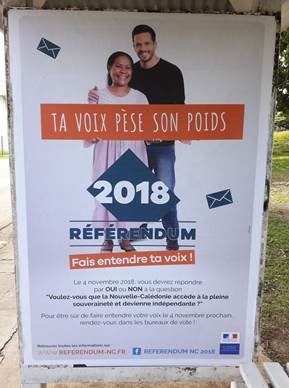
Independence vote rolls released in New Caledonia


Town halls across New Caledonia have published the provisional rolls for the November referendum on independence from France.
New Caledonia referendum poster
Photo: RNZ/ Adrienne Baron

Until 9 August, it is still possible to ask to be registered or to demand that names be struck off.
The rolls are restricted to long-term residents and include more than 173,000 names compared to the general roll which lists more than 210,000 voters.
The final rolls for the plebiscite will be released on the last day of August.
The rolls have been vetted by commissions appointed by the French state after a prolonged period of concern over their make-up.
The pro-independence movement had accused the authorities of allowing thousands of people to be enrolled despite them failing to meet the residency requirements.

07 July 2018

FRENCH UNILATERAL ELECTORAL CHANGES IN POLYNESIA AN INDICATION OF LACK OF ACTUAL "AUTONOMY" OF THE COLONY


The French overseas minister Annick Girardin has defended planned institutional reforms which are being challenged by French Polynesian politicians.

One change would allow a French Polynesian president to serve more than two consecutive terms, which a French Polynesian member of the French National Assembly Moetai Brotherson says is a paradoxical move.

It also follows a French Polynesian assembly vote, unanimously rejecting such a plan.

Ms Girardin said the reform package was aimed at making government more efficient.

She said the reforms concern all Frenchmen people, and also apply to French Polynesia.

Earlier she rebuffed a French Polynesian member of the French Senate Lana Tetuanui who complained about planned cuts to the number of parliamentarians overseas territories can send to Paris.
Ms Girardin said the specifics of the territories are respected but there are issues where the national interest won't allow for that.


26 June 2018

FRANCE TO REDUCE REPRESENTATION OF COLONIES IN PARIS


French Polynesia's political parties have spoken out against French reform plans which would cut the number of parliamentary representatives.

The plans by the French government for a more efficient administration also call for limits to the number of terms mayors can serve.

A French Polynesian member of the French Senate representing the ruling Tapura Huiraatira party Lana Tetuanui says the plan amounts to a muzzling of democracy.

She said however she was pleased that the territory's representatives were unanimous in their opposition.

A pro-independence opposition politician Antony Geros said France should not interfere in local politics, referring to the repeated reelection of Oscar Temaru as the mayor of Faaa.

As such a reform would supersede French Polynesian rules for the top job, Edouard Fritch could become eligible to run for the presidency again in 2023.

He had earlier said the current term was his last one.

22 December 2017

KANAKY REFERENDUM PREPARATIONS INTENSIFY IN NEW CALEDONIA


ISLANDS BUSINESS/PACNEWS

Independence movement prepares for referendum

By Nic Maclellan


 Remembrance Day, November 11. French soldiers, sailors and police stand in ranks near Noumea’s war memorial at Bir Hakiem, to remember the fallen.
Across town, at Ko We Kara, members of the Union Calédonienne Party recall those who have fallen in the struggle for independence, as they gather at the 48th UC congress. Founded in 1953, the oldest political party in New Caledonia took up the call for independence in 1977.
These competing ceremonies open a crucial year for New Caledonia, just one year away from a referendum on self-determination.
Under the Noumea Accord, New Caledonia must hold the referendum before the end of 2018, with the vote likely next November. With newly elected French President Emmanuel Macron scheduled to make his first visit to the French Pacific dependency next May, the coming year will see increased political mobilisation and debate.
But more than 19 years after the Noumea Accord was signed, the French State has failed to resolve disputes over who is eligible to vote in this crucial decision on the country’s political status.
In early November, political leaders travelled to Paris, to try to forge a compromise on this longstanding dispute. French Prime Minister Edouard Philippe hosted the Committee of Signatories, an annual meeting of the original signatories to the 1998 Noumea Accord, together with New Caledonia’s elected representatives to the French parliament and leaders of the major political parties represented in New Caledonia’s Congress.
The Paris meeting made crucial decisions about the electoral roll for the referendum, but there’s still a long way to go. With Prime Minister Philippe due to visit Noumea in early December for further discussions, the independence movement is starting to mobilise its forces.
Last month, the four political parties that make up the Front de Libération Nationale Kanak et Socialiste (FLNKS) each held their own congresses. Leaders reported back on the outcomes of the Committee of Signatories, and began to mobilise their members for the year ahead.
The Party of Kanak Liberation (Palika), led by Paul Neaoutyine, gathered at Arama in the north of the main island, while Victor Tutugoro’s  Union Progressiste Mélanesienne (UPM) met on Ouvea in the outlying Loyalty Islands. The Rassemblement Démocratique Océanienne (RDO) – which links Wallisian and Tahitian supporters of independence – gathered in Dumbea. The largest congress was for Union Calédonienne (UC), the “older brother” of the independence movement, which met on the outskirts of Noumea from 11-13 November.
Despite improved inter-community relations under the Noumea Accord, the FLNKS still draws most of its support from the indigenous Kanak community. The independence movement has not made a strategic breakthrough to rally mass support from the European community or the large Wallisian and Tahitian population in Noumea and surrounding towns.
Relations between different pro-independence parties have been stretched in recent years, as they debate the best pathway to independence and the type of economy and society to be forged in a sovereign nation. As well as the four-member FLNKS, the smaller Rassemblement des indépendantistes et nationalistes (RIN) includes more radical parties such as Dynamique Unitaire Sud (DUS) and the union-backed Parti Travailliste (PT).
Within the FLNKS, long-standing debates between UC and Palika have led to sharp contests during electoral campaigns and differing tactics within government. In New Caledonia’s national Congress, pro-independence representatives sit in two separate parliamentary groups. The “Union Nationale pour l’Independance” (UNI) links Palika, UPM and RDO, while the “UC FLNKS and Nationalists” group incorporates elected members from UC, PT, and DUS.
Despite these differences, the looming referendum on self-determination is driving these groups together. In a symbol of unity that has not been seen for some time, the closing session of the UC Congress was attended by delegations from all these political parties, as well as representatives from the Melanesian Spearhead Group (MSG), the USTKE trade union confederation and the Eglise Protestante de Kanaky-Nouvelle-Caledonie (EPKNC), the largest Protestant church in the country.
Re-elected as president of Union Calédonienne, Daniel Goa welcomed the diverse leaders from “the independence family” to the UC congress. Speaking to Islands Business, Goa said: “All the parties represented at the congress are on the same path. The timeline is very short and there’s a lot of work to be done.”

Committee of Signatories

The Committee of Signatories was another welcome sign of convergence. French Prime Minister Edouard Philippe won praise from most participants for his steady handling and attempts to find compromises between competing interests.
A central political agreement was to register thousands of people on New Caledonia’s general electoral roll – a legal prerequisite to participation in the 2018 referendum on self-determination. FLNKS activists have long complained that up to 25,000 Kanaks are not registered on the general roll, seen as a failure of the French State, given the responsibility of the administering power to ensure that the colonised people should vote in a decolonisation referendum.
In an interview, French High Commissioner to New Caledonia Thierry Lataste acknowledged: “We’ve been talking about the electoral roll for thirty years, but differences and disputes have continued to the present day. For two years, it’s been clear that there are many people – both Kanak and also other people with common civil status – that are not registered to vote on the general electoral roll, and therefore on the list for the consultation in 2018.
“The challenge has been to find these people, identify them, find their address and write to encourage them to register. The High Commission, which is neutral in this matter, must write to say you should register.”
Last year, the French High Commission wrote to nearly 9,000 people encouraging them to register, with a 25 per cent success rate in response. However members of RIN have argued that Kanaks of voting age should be registered automatically, without preconditions, as the “concerned population” under international principles of decolonisation.
The Committee of Signatories agreed on a process to register at least 7,000 Kanaks holding customary civil status under French law, together with another 3,900 people with common civil status (these are people with “material and moral interests” in the country who can also prove three years of residence based on evidence from the CAFAT social security fund). This latter group could include both Kanaks and non-indigenous voters, but French laws on privacy and data collection mean the French State has refused to reveal who is on this list.
Sylvain Pabouty of the DUS party said: “Every time the French State addresses this issue, they find more Kanaks who are not properly registered. The Committee of Signatories agreed that there are another 7,000. But there are 19,646 people with customary civil status in New Caledonia, so what about the other 12,000? It’s important to note that the figure of 7,000 Kanaks is just provisional, and needs further investigation – yet all registration must be completed by the end of the year.”
This call for automatic registration of all Kanaks of voting age has been opposed by anti-independence leaders, who question the numbers on unregistered voters and argue that non-indigenous New Caledonians should also be given automatic registration.
High Commissioner Lataste notes: “People in the non-independence camp argue that it’s not fair that for some this process is automatic, while for others it involves compiling a dossier of documents, searching for information from their parents etc.”
Lataste told Islands Business that despite agreement at the Committee of Signatories, the registration process needs further work. The political compromise must be legalised by changes to the 1999 French legislation that codified the Noumea Accord into law.
“Union Calédonienne believes this can all be resolved without modifying the organic law – the text which frames the elections,” Lataste said. “In contrast, the view of the French government and the other political parties is that we can’t introduce a change which is unknown in France without modifying the organic law.”
Beyond the issue of the electoral roll, the Committee of Signatories debated a number of outstanding issues, still unresolved in the final year of the 20-year transition established by the Noumea Accord in 1998. There will be further discussions in the New Year on the transfer of the remaining “Article 27” powers from Paris to Noumea (granting authority over higher education, TV and radio, and local municipal councils). Leaders also established a working group for the final transfer of ADRAF, the organisation responsible for land reform.

Mobilising voters

Once people are registered, political parties face the challenge of mobilising their supporters. The Kanak population is a minority in its own country, and current polling suggests a majority of registered electors will not vote for independence in November 2018.  
Beyond this, voting is not compulsory in New Caledonia for elections or the looming referendum. The country has a high abstention rate, and across the political spectrum, there are many who express a general disinterest in politics. For the FLNKS, a key challenge would be to mobilise support amongst younger voters who were not born during the troubled decade in the 1980s, and were not part of the renaissance of Kanak nationalism and widespread political and cultural mobilisation.
Over the last five months, an FLNKS team has been touring the country to present a draft framework for “a sovereign Kanaky-New Caledonia.” More than twenty community consultations have been held to outline proposed changes of government, society and economy after the 2018 referendum.
At some community meetings, there have been sharp questions about the lack of detail in the draft, which will be finalised this month. Some people fear the loss of French subsidies for pensions, health or welfare benefits. In response, FLNKS members have started to put out details of the economic options to replace French funding, but there’s a lot of work needed to mobilise wavering independence supporters in the Kanak community.
UC’s Daniel Goa noted: “Currently, about 40 per cent of Kanaks – or at least 30 per cent – don’t vote. So we must work at the level of the family, to provide information so these people can be found. We will find a way to reach out to each tribe, to each extended family, to contact people who are not registered to vote or who abstain. Our objective for 2018 is to mobilise the majority of electors who might participate.”  

Finding a way forward

Members of the UC-FLNKS and Nationalists group in the Congress are calling for full and sovereign independence.  The re-election of Daniel Goa as president of the largest independence party has re-affirmed the path that saw a UC boycott of the French legislative elections last June.
Palika spokesperson Charles Washetine also reaffirmed that “the Noumea Accord is a decolonisation process which must lead to the emergence of a new country called Kanaky-Nouvelle-Calédonie.”
However, Palika has called for dialogue in coming months over the concept of “pleine souveraineté avec partenariat” (full sovereignty in partnership with France). This would see Kanaky-New Caledonia as a member of the United Nations, with its own passport and sovereign status, but with ongoing relations with France. Palika leaders present this concept as a bridge between the independence movement and those settlers fearful of the model of “free association” promoted by the French State in the 1980s.
The Committee of Signatories established a working group to finalise the wording of the referendum question. Daniel Goa stressed that UC supports the three core elements outlined in the Noumea Accord: transfer to New Caledonia of the remaining sovereign powers (such as defence, foreign affairs, currency and justice), achieving a status of full international responsibility and the transition from citizenship to nationality.
“We’re satisfied with the question set out in the Noumea Accord,” said Goa. “We won’t budge from that. Every time we’ve revisited deals that have been struck, every time we’ve had to make concessions.”

Disunity on the Right

Even as the FLNKS works to unify its forces, there is chaos in the other camp. Anti-independence parties maintain a dominant position in New Caledonia’s political institutions, but are deeply divided as the country moves towards the decision on its political status.
Four anti-independence parties make up the so-called “Platform of Loyalists”: Calédonie Ensemble (CE), Rassemblement Les Républicains (LR), Mouvement pour la Calédonie (MPC) and Tous calédoniens (TC). But unity with other anti-independence forces is broken. A new extreme-right grouping, Les Républicains calédoniens (LRC), brings together leaders such as Sonia Backes, Philippe Blaise and Isabelle Lafleur.
The LRC leaders are angry at the CE and LR, which have tried to promote dialogue with the independence movement. They’re even angrier over the result of the bitter battle for New Caledonia’s seats in the French parliament, which saw CE’s Philippe Gomes and Philippe Dunoyer win both seats in the National Assembly last June and LR’s Pierre Frogier returned to the Senate in October.  
LRC leader Sonia Backes says: “We want to renew the political class, in contrast to the Platform, which today reunites all the old guard. We certainly have support from some veterans like Simon Loueckhote, Harold Martin or Didier Leroux, but they all want to push forward a new generation and won’t be standing for seats in the future.”
This rift amongst anti-independence politicians has – once again – paralysed the Government of New Caledonia. Dunoyer’s victory in the June National Assembly elections forced a spill of all government positions, and 11 new members were chosen by Congress on 31 August. But the members of the government have again been unable to choose a President from their ranks, even though anti-independence forces have a 6/5 majority in the government. The sole representative of the LRC in the government has refused to join the five members of the Platform of Loyalists to re-elect President Philippe Germain. With independence members abstaining, Germain cannot gain an absolute majority.
Germain has continued as caretaker President, attending the Forum leaders meeting in Apia and the Committee of Signatories in Paris, but without the authority to sign new commitments. With the government in caretaker mode, the 2018 national budget is yet to pass through Congress, stalling crucial initiatives in a politically sensitive period.  
High Commissioner Lataste has tried three times to break the deadlock, but as IB goes to press, LRC is holding firm. The five pro-independence members have said that it’s up to the parties of the Right to decide on their own candidate, leaving the Vice Presidency to the independence forces. Daniel Goa notes wryly: “Every time it’s the same – they fall out, then they want us to sort out their foolishness.”

 International monitoring

A delegation from the Melanesian Spearhead Group (MSG) secretariat travelled to Noumea last month to meet with FLNKS leaders and discuss the path towards the referendum. MSG’s Ilan Kiloe told the UC Congress: “Our presence here today demonstrates our commitment to assist you, the Union Calédonienne party as well as the FLNKS, as a member of the MSG.”
Daniel Goa noted that the FLNKS is still looking for international support.
“The work that we’ve begun to clarify the voting list is not yet finished,” he said. “So between now and the end of 2018, we’ll be asking international institutions to call on the French State to meet its commitments. We’re looking internationally for this support, to the United Nations, to the Melanesian Spearhead Group and to the countries of the Pacific region.”
High Commissioner Lataste confirmed that France was open to international scrutiny of the self-determination vote in 2018.
“The French State is open to international monitoring of the process, to describe, to monitor, to freely give their opinion on the manner which the referendum will be organised,” he said. “On the part of the State, it’s not complicated. This is not necessarily the case for the local political parties, especially on the Right, who have long resisted international overview and for whom the words ‘United Nations’ raise a certain fear. However the Committee of Signatories agreed that a UN mission would continue to monitor the electoral registration process next year, as they have done in 2016 and 2017.”
The UN Special Committee on Decolonisation has asked to send a mission to New Caledonia. In Paris last month, political leaders agreed a UN mission could visit in early 2018. All political leaders also agreed there could also be UN observers for the vote itself.   
High Commissioner Lataste was less certain about the involvement of the Pacific Islands Forum, which didn’t mention the looming referendum in its 2017 communique: “Curiously, I though the issue would be raised by the Forum in September when they met in Apia, but Philippe Germain told me that this wasn’t raised at all at the highest political level in the leaders retreat. The only person raising Forum involvement is the Secretary General Meg Taylor, but does she have the authority herself to involve the Forum without the agreement of the heads of state and governments themselves? This poses a question.”.


30 October 2017

CARIBBEAN PEACE CONFERENCE WANTS END TO COLONIALISM

Conference participants cite French, U.S. colonialism in Caribbean. Dutch and British colonialism also deeply intrenched in region.

Resisting Nuclear and Environmental Disaster:
Building Peace in the Caribbean
A Declaration from the 1st Caribbean Peace Conference
Bridgetown, Barbados, Oct. 6-7th, 2017
Introduction
The Peace organisations existing in the Caribbean — the Caribbean Movement for Peace and Integration (CMPI), the Cuban Movement for Peace and People´s Sovereignty (MovPaz), the Jamaica Peace Council (JPC), the Guyana Peace Council (GPC) , and the Caribbean Chapter of the International Network In Defense of Humanity (NIDOH-C) , as well as several national delegates of other progressive organizations (all together representing eight sister nations of the Caribbean– Barbados, Cuba,, Guyana, Jamaica, Martinique, Saint Lucia, Trinidad and Tobago, Venezuela) and the USA Peace Council   met in Barbados  over the period of 6th and 7th October 2017 to discuss critical matters relating to world peace and to adopt the Declaration inscribed hereunder.
Background
At a meeting of the World Peace Council held in São Luis ,Brazil from November 18-19 2016 and hosted by the Brazilian Center for Solidarity of the Peoples and Struggle for Peace (CEBRAPAZ), and meeting under the theme “Strengthen the peoples’ solidarity in the struggle for peace, against imperialism” it was determined that “strengthening the World Peace Council is a key task in this solidarity”, and to this end the peace councils of the Caribbean were requested to stage a pan-Caribbean conference in the year 2017.
Given the call from the World Peace Conference in Sao Luis, the Caribbean Peace Movement moved to organize its first Caribbean Peace conference in the island of Barbados between October 6th and 7th, 2017.
The delegates of the First Caribbean Peace Conference view with concern, the neo-liberal counter-offensive of imperialism, which is impacting Caribbean societies largely through the installation of retrograde capitalist forces, which have opened the countries to private sector dominance and the reversal of the social gains in health, education, public housing and transportation, adversely impacting the quality of life of the Caribbean working people.
The First Caribbean Peace Conference also recognizes that climate change poses a major threat to the countries of the Caribbean region, as it impacts negatively on our ecological and economic systems and increases the risk of natural disasters that can wipe out Caribbean economies by wreaking havoc on infrastructure and by causing significant loss of life. 
The Conference notes with alarm the extra-ordinarily intense and violent current hurricane season which has resulted in billions of dollars in infrastructural damage, destroyed entire islands, crippling their economies and has resulted in scores of deaths.  It has not escaped notice that these natural events that have been exacerbated by the effects of human activity, have occurred following denials by the leadership of the USA — the world’s most eco-unfriendly nation — of the need for any global agreements to combat global warming.  From that perspective, the failure to build global consensus around climate change and the necessary responses represents a tremendous threat to Peace in the Caribbean region and militates against the stability and the proper functioning of Caribbean institutions and societies in general.
We also recognize the presence of foreign military bases in the Caribbean as contributing significantly to further environmental degradation and as an erosion of the security and stability of the region.  We therefore denounce the military maneuvers and exercises which destroy the environment and undermine the health of the populations residing in proximity to those military bases.
BUT IN addition to their environmental costs, the First Caribbean Peace Conference also views the presence of the large number of foreign military bases and facilities in the Caribbean region as a serious threat to the peace and stability of all the nations given their warlike and interventionist purposes.  We consider it to be both urgent and necessary to resolutely join in the actions of the international campaign against foreign military bases and for a world of peace without nuclear, chemical and bacteriological weapons.
The First Caribbean Peace Conference acknowledges the 1967 Tlatelolco Treaty which established our region of Latin America and the Caribbean as a nuclear free zone, and to this end, we demand the immediate cessation of the transshipment of nuclear waste through the Caribbean Sea.
We also recognize the significance of the fact that 122 United Nations member states have adopted the Treaty prohibiting nuclear weapons, the first and only international legal instrument that declares illegal all nuclear weapons. However, we forcefully condemn the fact that the superpowers possessing such weapons that can wipe out humanity have deliberately and arrogantly avoided signing this essential treaty.
We also  note with alarm that a specific threat to Caribbean peace resides in the proliferation of firearms in the Caribbean , in an environment of economic and social collapse occasioned by neo-liberal capitalism and the corrupt activities of drug trafficking, money laundering, and human trafficking.  When coupled with the intense foreign media penetration that the Caribbean has been subjected to, the phenomenon of imported values eclipsing our local values of respect and human decency, and with movies and films perpetuating greed, violence, opulence and selfishness, then the rise in senseless killings and gang warfare, presents itself as a direct threat to our Caribbean civilisation. 
AGAINST THIS BACKGROUND, the 1st Caribbean Peace Conference hereby:
  1. Dedicates the work, results and outcomes of the conference to the memory and honour of the eternal Commanders Ernesto Che Guevara and Fidel Castro Ruz, and in recognition of both the 50thanniversary of the fall-in-combat of Commander Ernesto Che Guevara and the 1st anniversary of the passing of Dr. Fidel Castro on November 25th 2016. We pay homage to these two world visionary leaders, who made extra-ordinary contributions to peace and to the liberation struggle of African, Latin-American and Caribbean countries.
  2. Demands the end of the foreign military presence that MINUSTAH represents in Haiti and its replacement by a civilian and humanitarian support mechanism. In addition, the Conference rejects the notion of a “failed state”, which is a concept that is used by the forces of imperialism as a justification for interference in the internal affairs of sovereign nations and as a motive for military intervention for regime change.
  3. Affirms our determination to safeguard peace in Latin America and the Caribbean in keeping with the Havana Declaration approved by the Heads of State and Government of the Community of Latin American and Caribbean States (CELAC) at the second CELAC Summit held in Havana, Cuba in the year 2014– a Declaration which establishes our region as a Zone of Peace.
  4. Re-Affirms our commitment to the principle of Latin America and the Caribbean as a Zone of Peace, and our profound respect for the principles and norms of international law, the inalienable right of every State to freely choose their political, economic, social and cultural system without interference of any kind, and the sovereign equality of states.
  5. Recognizes the role played by women in advancing the peaceful and sustainable future of the planet, and acknowledges that the achievement of peace and an end to violence are dependent on respecting cultural, racial, religious, and sexual diversity.
  6. Commits to fight against imperialism, neoliberal policies, and foreign military actions which seek to undermine and defeat the progressive and democratic governments and movements of the region.
  7. Rejects the prevailing hegemonic concept of the “ideal western state”– a concept which encourages racism, white supremacy, and discrimination. Instead, we recognize and accept a broader and more inclusive concept of human development, participation and democracy.
  8. Rejects the interventionist actions, the threat of military intervention, the media campaigns, the psychological threats, the economic war, and the financial blockade orchestrated and directed by the government of the United States of America (USA) and by sections of the national and international conservative oligarchy, which undermine the peace and stability of the Bolivarian Republic of Venezuela, as they attempt to destroy the Bolivarian revolution and its positive influence on Latin America and the Caribbean.
  9. Recognizes the sovereign right of the Venezuelan people to undertake reform of their nation’s Constitution, and accepts the National Constituent Assembly elected by over eight million people as a legitimate expression of the Will and sovereignty of the Venezuelan people: and we also remind the world that the National Constituent Assembly is provided for within the Venezuelan Constitution.
  10. Supports the efforts made by the revolutionary government of Venezuela to establish dialogue with the Venezuelan opposition — with the aim of achieving a lasting peace — within the framework of the discussions that are being held in the Dominican Republic with the support of the International Community.
  11. Expresses the broadest solidarity with countries and peoples under colonial rule in the Caribbean and South America who have been denied the right to self-determination and sovereignty, and in particular we demand the end of French colonialism in Martinique, Guadeloupe, and French Guiana and commits to giving active solidarity to the people of those countries in their struggle for independence, sovereignty and self-determination.
  12. Demands an end to foreign military presences in Latin America and the Caribbean in general, and in Puerto Rico, the Malvinas, Georgia and South Sandwich Islands in particular. We also reaffirm that the Malvinas, Georgia and Sandwich Islands are part of the territory of Argentina and must return to the sovereignty of the Argentine nation.
  13. Condemns the refusal of certain Caribbean countries to recognize the legitimate right of the people of Palestine to sovereign statehood.
  14. Condemns the government of the Dominican Republic for its mass deportation of persons described as “Haitians” and carried out from the year 2015 to the present. The Conference demands the cessation of such deportations, and calls for an internationally supervised determination of the nationality and legal status of the remaining dark-skinned residents of the Dominican Republic in order to remove the anxieties of this group. The Conference also calls for the establishment of an international committee to determine compensation for persons illegally displaced by the mass deportation carried out directly or encouraged by the government of the Dominican Republic.
  15. Demands the return to Cuban national sovereignty of the territory illegally occupied by the US Naval base in Guantanamo; and further demands that the US government accept the formal proposal made by the Cuban government to include this issue in the bilateral agenda as being a key factor in the process towards the normalization of the relationship between the two countries, as well as a key issue in the quest for regional peace and safety.
  16. Supports the struggle of Cuba in all fora for the unconditional removal of the illegal economic, financial and trade blockade, which is the longest one in known history, and which not only qualifies as an act of genocide in International Law but is also a fundamental violation of the Sovereignty of third nations in that it is based upon the extra-territorial application of national or domestic USA legislation.
  17. Rejects the nasty, unfounded and unjustified decision taken by the Donald Trump administration against Cuban diplomats in the USA, and evidently aimed at erasing all the constructive steps recently achieved towards the normalization of the bilateral USA / Cuba relationship, and which is– by extension– a new obstacle to the development of normal relations with the rest of the Caribbean.
  18. Condemns all acts of terrorism as the anti-thesis of peace, and in particular we recall and condemn the terrorist act committed on October 6th 1976 when a bomb was planted on a Cuban commercial aircraft which resulted in the deaths of 73 persons within the territorial space of the island of Barbados. And to this end we demand that the Government of the USA extradite Luis Posada Carriles, the mastermind of the terrorist act, to Venezuela in order that he may stand trial, and we also reiterate our support for the campaign of the Caribbean Chapter of the International Network in Defense of Humanity to have the United Nations declare October 6th as “International Day Against Terrorism”.
  19. Supports the people from several Caribbean islands in their struggle to overcome the aftermath of the repeated natural disasters which have destroyed much of the country’s infrastructure and to achieve the necessary political and social stability that will enable them to overcome the current situation.
  20. Expresses solidarity and encourages concrete actions to alleviate the suffering of the victims of recent natural phenomena, which have led to devastation, destruction and loss of life in the Caribbean, and in this regard the Conference demands the creation of global institutional responses that are morally, economically and politically commensurate with the crises which have befallen these countries.
  21. Insists that global climate change discussions be re-engaged in order to reduce the possibilities of such disasters that have befallen the Caribbean in the 2017 hurricane season.
  22. Condemns the policies that produce the indiscriminate deportation of Caribbean prisoners from North American prisons, human trafficking and arms trafficking in the Caribbean, and that help to generate high crime rates that threaten the stability of several Caribbean nations.
  23. Rejects the Media Penetration and the Media Propaganda which dull the senses of Caribbean populations to violence, crimes against the person, the assassination of leaders, invasion and war, and we encourage our governments to create the conditions for local media practitioners and cultural activists to advance our own aesthetics, feelings and concerns.
  24. Supports the right of the nations and people of the Caribbean to pursue and demand reparations from the colonial powers for the centuries of vassalage and exploitation founded on the genocide of the indigenous people, African enslavement and colonialism.
  25. Identifies the United States, NATO and the great powers of the European Union and their allies, in their ambition for world domination, as the main threats to peace and the happiness of the peoples of the entire planet and we demand an end to all wars of imperialist aggression.
  26. Demands the elimination of nuclear weapons and an end to the threat of their use, and further demands that our respective governments and the nuclear-weapon possessing states promptly sign and ratify the treaty on the prohibition of nuclear weapons.
  27. Celebrates the renewed commitment to the founding or reactivating of the Caribbean movements and associations of Peace and their linkage to the World Peace Council, and recognizes that it is vital to articulate and engage upon such collective work in favor of Peace in the region and in support of the sustainability and validity of the proclamation of Latin America and the Caribbean as a Zone of Peace.
  28. Expresses gratitude to the hosts, supporting institutions and personalities, and to the Barbadian people as a whole for the warm welcome given to the participants in the meeting, and for supporting all the logistical arrangements of the 1st Caribbean Peace Conference in Barbados.
  29. Supports and undertakes to — individually or in a collective manner — pursue the actions and initiatives contained in the Plan of Action approved by the Conference.
  30. Reminds the Caribbean people of our unique history of race and class based oppression, and of our historic struggles to resist, overcome and transcend such oppression and denial of human dignity, and re-affirm that our history has bequeathed to us a sacred mission to advocate and defend the principles of freedom and human dignity, and to stand with and give active solidarity and support to all peoples who are legitimately fighting against oppressive forces, and for freedom, dignity, respect, sovereignty, self-determination and peace.
 List of signatories to the Bridgetown Declaration:
1. Silvio Platero. Cuban Movement for Peace and People’s Sovereignty.
2. Trevor Prescod M P. Caribbean Movement for Peace and Integration.
3. David Comissiong. International Network In Defense of Humanity.
4. Hope Mc Nish. Jamaica Peace Council.
5. Omesh Satyanand. Guyana Peace Council.
6. Henry Lowendorth. United States Peace Council.
7. Garcin Malsa. International Movement for Reparations (Martinique)
8. Khafra Kambon. Caribbean Pan-African Network.
9. David Abdulah. Movement for Social Justice.
10. Gerald Perreira. Organization for the Victory of the People.
11. His Excellency Francisco Fernandez. Ambassador of the Repubic of  Cuba
12. His Excellency Francisco Perez. Charge-de-Affairs of the Bolivarian Republic of Venezuela
13. Bobby Clarke. Clement Payne Movement.
14. David Denny. Caribbean Movement for Peace and Integration.
15. Dr. Tennyson Joseph. International Network In Defense of Humanity.
16. John Howell. Pan-African Coalition of Organizations.
17. Thelma Gill-Barnett. International Network In Defense of Humanity.
18. Margaret Harris. International Network in Defense of Humanity.
19. Lalu Hanuman. International Network In Defense of Humanity.
20 Edson Crawford. Clement Payne Movement.
21. Buddy Larrier. Non-State Actors Reparations Movement.
22. Ivana Cardinale. Caribflame .
23. Akanni Mc Dowall. National Union of Public Workers.
24. Myrna Belgrave. Pan-African Coalition of Organizations.