Showing posts with label African Union. Show all posts

11 March 2017

Western Sahara: An albatross on the AU’s conscience

PAMBAZUKA


Spsrasd.info


Morocco is back in the African Union unconditionally while illegally occupying Western Sahara, the continent’s last colony. This raises troubling questions about the Union’s commitment to its own principles. Morocco has no intention of giving up its occupation. Its return to the Union is intended to eventually push Western Sahara out of the AU in connivance with friendly member states and foreign powers, thus silencing the voices of the Sahrawi people.

At the 28th Summit meeting of the African Union (AU) held in Addis Ababa on 30 January 2017, Morocco’s readmission to the continental body generated heated discussion. At the end of the day the Kingdom of Morocco managed to win over sufficient member states on its side and it was allowed to re-join the fold unconditionally. 

Morocco left the Organisation of African Unity (OAU), precursor to the AU, in 1984 after the OAU recognised the right to self-determination and independence for the people of the Western Sahara and admitted the Sahrawi Arab Democratic Republic (SADR) that was proclaimed in 1976 by the Sahrawi people’s Polisario Front. Western Sahara is a founding member of the OAU.

It was in keeping with the OAU principle not to recognise the occupation of any part of the continent that it admitted the SADR to its membership. While SADR claimed sovereignty over the Western Sahara territory, Morocco saw it as an integral part of its own territory. Thus, rather than accept SADR’s independence, Morocco left the OAU.

Since then Morocco refused to join the AU unless the organisation withdrew the membership of SADR.

The area of Western Sahara has been occupied by Morocco since 1976 when Spain pulled out and relinquished its claim as a colonial power over the territory. This former Spanish colony was then annexed by Morocco. Saharawi people, who fought Spanish colonial oppression, were now forced to fight Moroccan occupation. They conducted a resistance struggle under the leadership of Polisario Front until 1991 when the United Nations (UN) brokered a truce.

A UN-supervised referendum on independence of Western Sahara was promised in 1992 but it was aborted by Morocco. A UN peacekeeping mission that was to organise the referendum has remained in the territory ever since, while Morocco built a 2,700km-long sand wall, with landmines.


READ THE FULL REPORT IN PAMBAZUKA


31 January 2017

African Union criticises US for ‘taking many of our people as slaves’ and not taking refugees


Trump has suspended all US refugee programmes and banned immigration from seven Muslim-majority countries, three of which are AU members


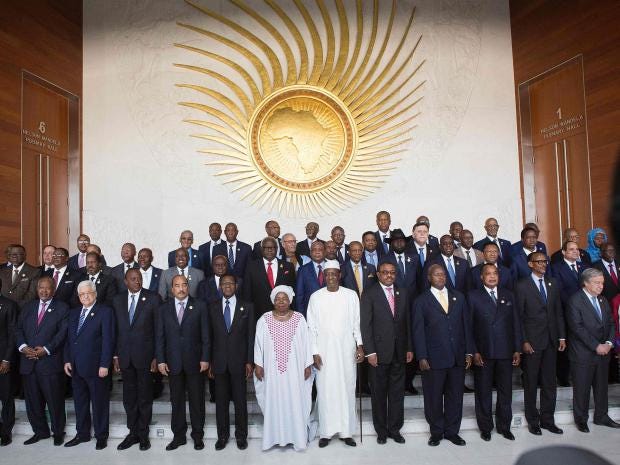
African Heads of State pose for a group photo ahead of the start of the 28th African Union summit in Addis Ababa on 30 January, 2017 AFP


The head of the African Union has criticised Donald Trump’s ban on immigration from some Muslim-majority countries, saying it presents “one of the greatest challenges” for the continent.

As representatives of the AU’s 53 member states met in Addis Ababa for a two-day summit, the chief of its commission said the bloc was entering “very turbulent times” after the US President’s election.

“The very country to which many of our people were taken as slaves during the transatlantic slave trade has now decided to ban refugees from some of our countries,” said Nkosazana Dlamini-Zuma.

_______________________________


ADDIS ABABA – A top African Union official denounced on Monday the United States’ recent travel ban affecting seven Muslim-majority countries, saying that the same country that once took African slaves by the million was now denying entry to refugees from the continent.

Chairperson of the AU Commission Nkosazana Dlamini-Zuma said that the ban decreed by US President Donald Trump was one of the greatest challenges to Africa’s unity and solidarity.

“The very country to which many of our people were taken as slaves during the transatlantic slave trade has now decided to ban refugees from some of our countries,” said Dlamini-Zuma at the AU’s annual summit held in the Ethiopian capital, Addis Ababa.

“What do we do about this?” she added.

The travel ban, which was issued on Friday, affects three African countries (Libya, Somalia and Sudan) as well as four nations in the Middle East (Syria, Iraq, Yemen and Iran).

Dlamini-Zuma declared that Trump’s executive order heralded “very turbulent times” for the continent.

United Nations Secretary-General Antonio Guterres, who was also present at the summit, said that African countries host the largest refugee populations in the world.

“African borders remain open for those in need of protection when so many borders are being closed, even in the most developed countries in the world,” said Guterres, to the applause of the plenary assembly.

The executive order, titled “Protecting the nation from foreign terrorist entry into the United States,” has caused domestic waves of outrage manifested in multitudinous protests across dozens of US airports.

It also drew sharp rebukes from various members of the international community, including several key US allies such as Canada and Germany.

12 January 2012

United Nations General Assembly endorses erection of permanent memorial to transatlantic slave trade


General Assembly
GA/11193

Department of Public Information • News and Media Division • New York
Sixty-sixth General Assembly
Plenary
83rd Meeting (AM)

GENERAL ASSEMBLY ENDORSES INITIATIVE OF MEMBER STATES TO ERECT, AT HEADQUARTERS,


PERMANENT MEMORIAL ACKNOWLEDGING VICTIMS OF SLAVERY, TRANSATLANTIC SLAVE TRADE 

**** 
 The General Assembly today, recommitting itself to honouring the victims of what several delegates called “the most tragic chapter in human history”, adopted a resolution endorsing the construction at United Nations Headquarters of a permanent memorial to those who had suffered under the yoke of slavery and the transatlantic slave trade system.

By the terms of that consensus text, the Assembly stressed the importance of educating and informing current and future generations about the causes, consequences and lessons of slavery, and requested the Secretary-General to continue organizing activities related to the commemoration of the International Day of Remembrance of the Victims of Slavery and the Transatlantic Slave Trade, which is held annually on 25 March.

Speaking earlier during the Assembly’s corresponding debate, several delegates added that adopting the resolution, and in turn completing the permanent memorial, were the “least the United Nations could do” to honour those who forcibly became part of the global African Diaspora.

Moreover, said the representative of Guyana, who introduced the resolution on behalf of the Caribbean Community (CARICOM), the memorial would offer current and future generations the opportunity to contemplate and reflect on the horrors and indignity of the ignoble system of slavery. It would also serve as a source of inspiration, a symbol of the indomitable spirit of human beings and their capacity to triumph over the worst forms of oppression and bigotry.

The permanent memorial, first called for in General Assembly resolution 62/122, was slated to be completed by the end of 2012, and would be erected in a place of prominence at United Nations Headquarters in New York. An international competition to select its design was launched in September, and a Trust Fund was established to support its construction. Numerous delegations today stressed the importance of contributing to that Fund, which to date had raised over $1 million of the estimated $4.5 million needed to complete the project.

“We are magnanimous enough to forgive, but human enough not to forget,” said the representative of the United Republic of Tanzania, speaking on behalf of the African Group of States. The transatlantic slave trade had torn millions of Africans from their homes, “dragged them in chains to the Americas and sold them as slaves”. Its most salient outcome, he stressed, was the dehumanization of people of African descent, which led to a disturbing legacy of racism and racial discrimination in many countries.

Referring to the annual International Day to commemorate victims of the slave trade, he said that event recognized the dearth of inquiry into the experience of enslaved Africans, as well as a continuing gap in literature regarding their individual and collective experiences. More efforts were needed to promote research, education and outreach programmes to fill that gap, he emphasized, adding that it was “unacceptable” to continue to sweep the identities and contributions of enslaved Africans under the carpet.

The representative of Jamaica, which chairs the Permanent Memorial Committee, said that while some of the gravest historical wrongs against humankind had been addressed, others had not. Slavery and the transatlantic slave trade had not yet met the threshold of acknowledgement and redemption, which served as rationale for continued action at the United Nations. As the theme for the permanent memorial stated, he said, we are “acknowledging the tragedy, considering the legacy, lest we forget”.

The representative of Israel agreed that the memorial was of vital importance, and stressed that today’s resolution recalled the legacy of 30 million human stories - the vast majority of them untold. The need for that memorial was clear, she said: It would complement the work of the Organization’s existing outreach programme and provide a reminder to all delegates and visitors of the slave trade’s history and lessons. Only through education, remembrance and constant vigilance could the tragedies of the past serve as clear lessons for the future, and the United Nations had a duty to take up that cause.

Meanwhile, some speakers pointed out that the unjust legacy of slavery was still alive and well in the social life of many countries. The representative of Cuba, stressing that the people of his country were proud of their heritage - which included both Spanish and African blood – said that Africans would remain exploited as long as the “unsustainable and unjust” consumption patterns continued to exclude the majority of people around the world. Former colonial metropolises must “honour their debt” to slaves; it was impossible for them to “wash their hands of the past” and of their responsibilities in that regard.

Moreover, he said, if the current system was not checked, Africa would continue to finance the “extravagance” of wealthy developed countries, while commitments to development on the African continent were not honoured. Others added that, though slavery had long since been abolished in Latin America and the Caribbean, people of African descent living in that region continued to disproportionately face extreme poverty, unemployment and other challenges.

Background

For its consideration of the first item, the Assembly had before it a report of the Secretary-General (document A/66/162) entitled, “Permanent memorial to and remembrance of the victims of slavery and the transatlantic slave trade: status of the United Nations Trust Fund for Partnerships – Permanent Memorial”. The report states that, as at 30 June 2011, the Fund had recorded a total of $990,700 in income, comprising voluntary contributions from Member States amounting to $944,700, private donations totalling $28,000 and accrued interest in the amount of $18,000.

Also for its consideration of the agenda item relating to the slave trade commemoration follow-up, the Assembly had before it a second report of the Secretary-General (document A/66/382) entitled, “Programme of educational outreach on the transatlantic slave trade and slavery”. Submitted pursuant to General Assembly resolution 65/239 (2010), the report outlined the related activities of the Department of Public Information. In close collaboration with States members of the Caribbean Community (CARICOM) and the African Group, the department had organized the fourth annual observance on 25 March 2011 of the International Day of Remembrance of the Victims of Slavery and the Transatlantic Slave Trade.

The commemoration’s 2011 theme, “The Living Legacy of 30 Million Untold Stories”, recalled the estimated 30 million Africans who were uprooted by the system of slavery and whose many stories under that system have not been told fully. The theme emphasized the importance of a more constructive portrayal in history and literature of the diverse skills which enslaved Africans brought to the homelands they were forced to adopt, and which were indispensable contributions to the economic foundation of the countries in the Americas and of the world economy of the eighteenth century.

The outreach and awareness strategy of the Department of Public Information utilized its network of information centres to disseminate the message of the observance internationally, and promoted partnership activities with civil society organizations committed to building awareness of the dangers of racism and racial discrimination, as well as the continuing legacy of slavery and the slave trade.

The Assembly was also slated to consider a draft resolution (document A/66/L.25) on the permanent memorial to and remembrance of the victims of slavery and the transatlantic slave trade. By that resolution, the Assembly, endorsing the initiative to erect a permanent memorial at a place of prominence at United Nations Headquarters, would request the Secretary-General to organize a series of annual activities related to the commemoration of the International Day of Remembrance of the Victims of Slavery and the Transatlantic Slave Trade. That would include a commemorative meeting of the General Assembly. It would further request the Department of Public Information to continue to take appropriate steps to enhance world public awareness on that issue, and would request both the Secretary-General and the United Nations Office for Partnerships to report on that programme of educational outreach – including on actions taken by Member States – at its sixty-seventh session.

Anniversary of Abolition of Transatlantic Slave Trade

Introducing the draft resolution on the permanent memorial to and remembrance of slavery and the transatlantic slave trade (document A/66/L.25), GEORGE TALBOT (Guyana), speaking on behalf of the Caribbean Community (CARICOM), said that the initiative of the Caribbean delegation, along with the African Group, to erect a memorial at Headquarters had responded to the need to honour, at a global level, “the victims of this most tragic chapter in human history.” Once completed, the memorial would offer current and future generations the opportunity to contemplate and reflect on the horrors and indignity of the ignoble system of slavery. It would also serve as a source of inspiration, a symbol of the indomitable spirit of human beings and their capacity to triumph over the worst forms of oppression and bigotry.

“With that in mind, we reaffirm our commitment to the erection of a permanent memorial in a place of prominence at United Nations Headquarters, that is accessible to delegates, United Nations staff and visitors,” he said. It was well established that the inhuman system which had led to the forced removal of millions of people over centuries from Africa to the Caribbean, the Americas and Europe, indeed the largest forced displacement of human beings in history, had contributed today to continued economic underdevelopment, social inequalities, racial discrimination and prejudice. The current resolution before delegations would have the Assembly endorse the initiative to erect the memorial and to take into account new developments, such as the conclusion of the tripartite Memorandum of Understanding, and welcome the recent launch of the international design competition.

OMBENI SEFUE (United Republic of Tanzania), speaking on behalf of the African Group, called for the outstanding physical and spiritual resilience of people of African descent, who for centuries endured and survived all manner of adversity, injustice, oppression, exploitation, discrimination and suffering, to be celebrated. “We are magnanimous enough to forgive, but human enough not to forget,” he said of the transatlantic slave trade, which tore millions of Africans from their homes, dragged them in chains to the Americas and sold them as slaves. Its most salient outcome, he stressed, was the dehumanization of people of African descent, which led to a disturbing legacy of racism and racial discrimination in many countries.

Recalling that the United Nations observed the annual International Day to commemorate victims of the slave trade earlier this year, he said that event recognized the dearth of inquiry into the experience of enslaved Africans and recognized a continuing gap in the literature regarding their individual and collective experiences. While it was bad enough to enslave Africans, it was unacceptable to sweep their identities and contributions under the carpet. More efforts were needed to promote research, education and outreach programmes to fill that gap. He praised the work of the Office of the United Nations Security Coordinator (UNSECOORD) and the Department of Public Information in that regard, while also noting the erection of a permanent memorial and remembrance of the victims of slavery and the slave trade were an important component of raising awareness. He further recognized the importance and necessity of sustained voluntary contributions towards the permanent memorial.

RAYMOND O. WOLFE (Jamaica), aligning with CARICOM and the African Group, said the question continued to be asked – why did the States involved continue to feel the need to remind the world about this tragic past when there was a need to look to the future and contemporary forms of slavery. Yet, in the words of Jamaican singer Bob Marley, “in this great future, we can’t forget the past”. While some of the gravest historical wrongs against humankind had been addressed, others had not. Slavery and the transatlantic slave trade had not yet met the threshold of acknowledgement and redemption. That was the rationale for continued action at the United Nations, including to ensure that a lasting tribute be erected on its grounds. As the theme for the permanent memorial stated, we are “acknowledging the tragedy, considering the legacy, lest we forget…”

He expressed appreciation for the programme of education and outreach on the transatlantic slave trade and slavery for 2011, organized by the Department of Public Information (DPI). He encouraged that Department to ensure that the annual commemorative activities were a fitting and solemn tribute to slavery’s victims. Noting that Belgium, Oman, Finland, Guyana, Costa Rica, Slovenia, United Arab Emirates, Pakistan, Azerbaijan, Israel and Trinidad and Tobago had contributed to the Permanent Memorial Trust Fund, he said the total amount given to date was $1.02 million.

As Chair of the Permanent Memorial Committee, he noted the launch this year of a dedicated website for that initiative: www.unslaverymemorial.org. A Facebook presence had also been set up and R&B singer Melba Moore had been appointed as a Goodwill Ambassador. Consultation had led to the signing of a tripartite Memorandum of Understanding allowing UNESCO to undertake phase one of the international design competition that was launched on 30 September. Other efforts focused on its fundraising drive, he added.

OSCAR LEÓN GONZÁLEZ ( Cuba) said that Cubans were proud of their heritage, which included both Spanish and Africans. “The slave trade left a very clear trail,” he said, referring to the Caribbean community. Indeed, that region’s cultural wealth and singularity were the result of the wisdom, languages, culture, music and verbal spirit of the slaves that were brought there, and its spirit was imbued with the courage and valour of those who had struggled against their oppression.

Today, he continued, Africans would remain exploited as long as the “unsustainable and unjust” consumption patterns continued to exclude the majority of people around the world. Former colonial metropolises must “honour their debt” to slaves; it was impossible for them to “wash their hands of the past” and of their responsibilities in that regard. Moreover, if the current system continued, Africa would continue to finance the “extravagance” of wealthy developed countries, while commitments to development on the African continent were not honoured. For its part, Cuba had established the first museum dedicated to the Slave Route in the Americas, he said. It recognized the importance of organizing annual activities under the umbrella of the United Nations and of the construction of the permanent memorial. That was “the least the United Nations could do” to honour the past and those who had suffered, he said.

GARY QUINLAN ( Australia) said the transatlantic slave trade had forcibly removed tens of millions of Africans from their communities and separated them from their families. Millions died while being transported and uncounted others while resisting the slavers. What in Swahili was known as the “Maafa – the great disaster” – was for more than 400 years the institutionalized face of the very worst kind of racism and an almost unimaginable contempt for human life. “We need to recognize the dark side of our own history and bring it into the light,” he said, stressing that the permanent memorial would be a lasting tribute to all those who had died and suffered through the slave trade.

“It will also be a physical symbol of our common obligation to remember; and acknowledge that the fight against such savagery is really never won,” he said, noting that racism always threatened and, through human trafficking, perhaps some 26 million more people were enslaved today. Educating current and future generations about the transatlantic slave trade and its lasting consequences was essential. The resolution stressed that, and Australia, he continued, had placed emphasis on the consequences of racism and prejudice in its school curriculums. Indeed, his country had seen the mistreatment of the first Australians for too long. The historic 2008 Apology to Australia’s Indigenous people had been a dramatic acknowledgement “of the many wrongs our own community has suffered”. Finally, he announced that Australia was providing a further contribution, of some $150,000, to support the permanent memorial.

MARIA LUIZA RIBEIRO VIOTTI ( Brazil) said that, as an early supporter of the permanent memorial initiative and as a repeated co-sponsor of the annual draft before the Assembly, Brazil hoped that the General Assembly would, through those actions, demonstrate its commitment to adequately honour the victims of slavery and the slave trade. As the Brazilian demographic census of 2010 had indicated, more than half of the Brazilian population had identified itself as African descended. Brazil took great pride in that legacy, which marked its society and culture in many different ways. “It is an essential part of our historic formation and of our national identity,” she stressed. That recognition had translated into a number of concrete actions. Since 2003, the Government had opened 19 new embassies in Africa and several more in CARICOM States. Commercial activity with both regions had increased, and Africa was now Brazil’s fourth largest trade partner. Among other activities, the country had also held a Brazil-CARICOM Summit in 2010, and was deeply engaged in the stabilization and development of Haiti, where it led the United Nations Stabilization Mission in Haiti (MINUSTAH).

Although Brazil had formally abolished slavery 123 years ago, its enduring impact could still be felt in many aspects of its social life. People of African descent continued to disproportionately face extreme poverty, unemployment and other challenges. In that context, Brazil, alongside the Ibero-American General Secretariat, had organized a conference in Salvador, Bahia; the resulting “Declaration of Salvador” had decided to establish a Statistical Data Observatory for People of African Descent, to create a Fund for People of African Descent, and to establish a “Decade for People of African Descent in Latin America and the Caribbean”. “Only by building cultures together and creating a true atmosphere of tolerance and mutual understanding will it be possible for the international community to fight the persistent scourge of racism and racial discrimination,” she concluded.

KENDRICK MEEK ( United States) described a wide number of programmes through which his Government had commemorated the two-hundredth anniversary of the abolition of the transatlantic slave trade. The United States also remained committed to promoting outreach and education to raise awareness about the slave trade and its consequences, as part of its effort to reduce prejudice and inequalities wherever they existed. He said that his Government was also pressing ahead with initiatives to tackle modern forms of racism and slavery. The United States was also honouring the historic and modern-day contributions of African Americans and persons of African descent, those who had fought for freedom during the Civil War, those who had contributed to the enrichment of the country throughout history, and those who were enhancing ordinary life in the United States today. The United States looked forward to expanding its partnerships to tackle all aspects of slavery, including its modern forms, in the spirit of the Universal Declaration of Human Rights.

HAIM WAXMAN ( Israel) recalled Nobel Laureate Elie Wiesel’s statement that, “If anything can, it is memory that will save humanity… hope without memory is like memory without hope.” Reaffirming memory’s vital importance, he said today’s resolution recalled the legacy of 30 million stories, the vast majority of them untold. It was among the stories of those who suffered unimaginable cruelty and persecution that the world found hope. The Jewish people knew well the joys of freedom and the pain of persecution. This was why Israel today joined hands with the nations of the world in laying the foundation for a permanent memorial at the United Nations to honour the victims of the transatlantic slave trade. It had recently contributed $20,000 to support the memorial’s construction. Indeed, the need for that memorial was clear: It would complement the work of the Organization’s existing outreach programme and provide a reminder to all delegates and visitors of the slave trade’s history and lessons. Only through education, remembrance and constant vigilance could the tragedies of the past serve as clear lessons for the future, and the United Nations had a duty to take up that cause, he emphasized.

OLIVIER MAES ( Luxembourg) paid tribute to all Member States of CARICOM and the African Group for their key role in promoting the permanent memorial. The transatlantic slave trade was undoubtedly one of history’s darkest chapters and it should not be ignored. From a political and moral point of view, that human tragedy, which lasted several centuries, must be duly commemorated. It must also permeate the world’s collective conscience, so the current and future generations could draw the right lesson and ensure it never happened again. For that reason, Luxembourg was cosponsoring the draft resolution and welcomed the consensus the text enjoyed. It had regularly contributed for years to the Trust Fund and encouraged all Member States to demonstrate tangible support to the permanent memorial. His delegation also welcomed the launch of the international design competition. Because it was also imperative that that period of history continued to be studied in depth, adequate resources must be made available to researchers.

HARDEEP SINGH PURI ( India) said the slave trade was one of the most abhorrent chapters in the history of mankind and the work of the United Nations could never be completed until the Organization condemned the transatlantic slave trade “emphatically and without reservation”. It was also necessary that the international community took upon itself to never let such crimes ever take place again. “Education has a critical role in creating awareness amongst present and future generations about the history, causes and impact of slavery and the transatlantic slave trade,” he continued, adding that India supported the various activities and programmes being carried out by the Department of Public Information to commemorate the International Day of Remembrance, annually on 25 March.

While he announced that India, with a contribution of some $260,000, was now the lead contributor to the Trust Fund for the permanent memorial, he said that it had collected just over $1 million of the estimated $4.5 million that was needed and “the international community must come forward and contribute”. “The international community cannot let the idea of this memorial just remain on the drawing board,” he said, underscoring his delegation’s firm belief that there must be a genuine acceptance of the fact that the horrible crimes associated with slavery occurred, along with the sincere repentance for their commission. India, therefore, strongly urged all countries, and especially those that had benefited from the slave trade, to come forward and contribute to the memorial project.

The Assembly then adopted without vote the resolution on the permanent memorial to and remembrance of the victims of slavery and the transatlantic slave trade (document A/66/L.25).


07 September 2011

White House Attorney Denies Pardon for Marcus Garvey

*****


By Karl Walker 
Jamaica Observer Online 
News editor


THE Barack Obama administration has flatly rejected a request for a presidential pardon for Jamaica's first national hero, the Right Honourable Marcus Mosiah Garvey.

Garvey was imprisoned for mail fraud totalling US$25 in June 1923, and after spending two years and nine months in an Atlanta Federal Penitentiary, was deported from New Orleans, Louisiana to Jamaica on a ship.

Florida-based Jamaican-born attorney Donovan Parker has been writing to president Obama every week since January requesting a posthumous pardon for Garvey, who many believe was set up by the J Edgar Hoover-led Federal Bureau of Investigations (FBI), fearful of his widening popularity among downtrodden US blacks.

The Sunday Observer has acquired a copy of one letter sent by Parker to the US President, and the first ever reply from the White House on the matter .

"Marcus Mosiah Garvey is also a National Hero of Jamaica, West Indies and a leading forebear of the African American civil rights experience," wrote Parker."It is full time that this extraordinary human being of humble beginnings and strong moral character be pardoned by the pen of an American president. It would be fitting if both you, Mr President, and the first lady visit Jamaica for the purposes of signing the executive order pardoning Marcus Mosiah Garvey."

In a tersely worded reply to Parker's request, White House Pardon Attorney, Ronald Rodgers said such a move would be a waste of time and resources since Garvey had been dead for ages.

"It is the general policy of the Department of Justice that requests for posthumous pardons for federal offences not be processed for adjudication. The policy is grounded in the belief that the time of the officials involved in the clemency process is better spent on pardon and commutation requests of living persons.

"Many posthumous pardon requests would likely be based on a claim of manifest injustice, and given that decades have passed since the event and the historical record would have to be scoured to objectively and comprehensively investigate such applications, it is the Department's position that the limited resources which are available to process requests for Presidential clemency -- now being submitted in record numbers -- are best dedicated to requests submitted by persons who can truly benefit from a grant of the request," Rodgers replied on behalf of Obama, who is the first black president in the history of the United States.

Parker expressed his utter disappointment at the latest development and called on US ambassador to Jamaica Pamela Bridgewater, to add her voice to the call for Garvey to be officially pardoned.

"She should advise Secretary of State Hillary Clinton to strongly recommend an posthumous presidential pardon for the Right Honourable Marcus Mosiah Garvey in the name of human decency and justice. There is no reason why the US government shouldn't do this and Obama shouldn't sign it," Parker said.

The Jamaican-born attorney also pointed out that the original transcripts of Garvey's trial cannot be found. "They don't have it. Somebody took it. I was told this by the Jamaican Consul General in Miami, Sandra Grant-Griffiths, who informed me via a letter," he said.

He doubted whether President Obama had actually seen the request. "I believe there has been no co-ordinated effort to get this issue in front of the president. I think if President Obama reads it, he will sign it," Parker said.

Six years after being deported to his homeland, Garvey was also imprisoned in Jamaica for contempt of court and Culture Minister Olivia 'Babsy' Grange had, earlier this year, signalled her intention to do all within her powers to clear Garvey's name at home and abroad. Grange is reportedly assembling a team of Garveyites and legal minds to deal with this task.

Efforts to contact Grange yesterday were unsuccessful, but director of communications in the ministry of youth, culture and sports, Oliver Watt, said the news of the presidential rejection was a hard pill to swallow.

"We will be pursuing all the other options available to us. We definitely think his name should be cleared at home and overseas," Watt said.Head of the Marcus Garvey-founded People's Political Party, Miguel Lorne, was also livid as well as disappointed by the rejection of Parker's request.

"The language used in the reply is most disdainful. It makes you wonder if Obama actually read the request. Obama must know about Garvey, who is the forerunner of the civil rights movement. It is most disappointing," Lorne told the Sunday Observer.

Former Prime Minister Edward Seaga asked the US President, the late Ronald Reagan to grant a full pardon to Marcus Garvey on the 1923 charge of mail fraud. A resolution was brought to the US House Subcommittee on Criminal Justice from as far back as 1987, but the issue seemed to have been pushed on the back burner.

Marcus Garvey died in London on June 10, 1940, reportedly after succumbing to the effect of two strokes attributed to his reading a false obituary of himself in a Chicago newspaper which stated, in part, that he died broke, alone and unpopular. His remains were interred at the Kensal Green Cemetery in London.

In 1964, his remains were exhumed and re-interred at the National Heroes Park in Kingston and he was named Jamaica's first national hero.


Read more: http://www.jamaicaobserver.com/news/No-pardon-for-Garvey_9489036#ixzz1WgLZaHsG


08 August 2011

Mau Mau torture claim Kenyans win right to sue British government

*****
Four Kenyans allegedly tortured at hands of colonial officials during 1950s insurgency can pursue compensation, judge rules


Owen Bowcott
Legal Affairs Correspondent
guardian.co.uk


Four elderly Kenyans who claim they were tortured by colonial officials and soldiers during the Mau Mau insurgency in the 1950s have won the right to sue the British government for compensation. Without deciding whether there had been systematic torture of detainees, the judge, Mr. Justice McCombe, ruled they have "arguable cases in law".

The decision is a setback for the Foreign Office, which has argued that the UK government should not be answerable for any abuses committed by the former British colony and that liability had devolved to the present Kenyan government.

Of the five original claimants, one has already died. The remaining four – Wambugu Wa Nyingi, Paulo Muoka Nzili, Ndiku Mutwiwa Mutua and Jane Muthoni Mara – are mostly in their 80s. They allege brutal treatment in detention camps, including castration and sexual assaults at the hands of British colonial officials and soldiers. Other detainees interned during the Mau Mau uprising, it is alleged, were murdered, forced into labour, starved and subjected to violence from guards. Among those allegedly abused was Barack Obama's grandfather.

Previously unseen evidence of atrocities emerged during the case when colonial-era files withheld from the National Archives were discovered by historians working with the claimants' lawyers.

In dismissing a Foreign Office application to strike out the legal action, McCombe said: "I have decided that these five claimants have arguable cases in law and on the facts as presently known, that there was such systematic torture and the UK government is so liable."

He described the UK authorities' attempts to avoid responsibility as "dishonourable" but accepted that before a full trial, the issue of whether the injuries were sustained too long ago – beyond any legal time limit – would have to be argued at a separate hearing.

"It may well be thought strange, or perhaps even 'dishonourable', that a legal system which will not in any circumstances admit evidence obtained by torture should yet refuse to entertain a claim against the government ... for that government's allegedly negligent failure to prevent torture which it had the means to prevent, on the basis of a supposed absence of a duty of care."

Elsewhere in the judgment he said: "There is ample evidence in the few papers that I have seen suggesting that there may have been systematic torture of detainees during the [Mau Mau] emergency.

"The [documents] evidencing the continuing abuses in the detention camps … are substantial, as is the evidence of the knowledge of both governments that they were happening and of the failure to take effective action to stop them."

The case has been supported by a large number of human rights groups and prominent international figures. Archbishop Desmond Tutu, who has urged the British government to deal with the Kenyan victims honourably, said: "Responding with generosity to the plea of the Kenyan victims is not a matter of legal niceties. No, it is about morality, about magnanimity and humaneness, about compassion."

Welcoming the judgment, Martyn Day of the solicitors Leigh Day and Co, which represented the Kenyan survivors, said: "It is an outrage that the British government is dealing with victims of torture so callously. We call on the British government to deal with these victims of torture with the dignity and respect they deserve, and to meet with them and their representatives in order to resolve the case amicably."

Day said that even if the next hearing ruled too much time had passed for a full trial, "a lot of the evidence about what happened will be put into the public domain and people will be able to judge for themselves".

The Foreign Office minister for Africa, Henry Bellingham, said: "We understand the pain and grievance felt by those on all sides who were involved in the divisive and bloody events of the emergency period in Kenya.

"The government will continue to defend fully these proceedings given the length of time elapsed and the complex legal and constitutional questions the case raises. Our relationship with Kenya and its people has moved on since the emergency period."


Mau Mau uprising


The Mau Mau uprising was a revolt mainly by the Kikuyu people in Kenya against British colonial rule. It was suppressed with brutal security measures, including the execution of more than 1,000 convicted rebels.
In response to the uprising, a formal state of emergency was declared that lasted from 1952 until 1960. British regiments were drafted in to support the local King's African Rifles.

In an attempt to control areas outside Nairobi, a policy of forced "villagisation" was introduced. By 1955, more than a million Kikuyu people had been removed from their homes and relocated inside barbed wire compounds that were patrolled by armed guards.

The officially accepted death toll for the period is around 11,000, but many historians suspect the true figures were far higher. The overwhelming majority of victims were native Kenyans rather than white settlers.

David Anderson, professor of African politics at Oxford University, has estimated the death toll to have been as high as 25,000; Caroline Elkins, of Harvard University, suggests it could have been up to 300,000.

The extent of the atrocities has begun to be acknowledged as colonial-era files, discovered in a government storage depot at Hanslope Park, in Buckinghamshire, have emerged. They are now in the process of being transferred to the National Archives.

Two of the techniques regularly used by security forces were "screening", or interrogation; and "dilution", the use of force to extract co-operation from suspects. In one camp, Hola, the beatings are believed to have left 11 detainees dead.


Ijahnya Of Anguilla to Lecture On Raising Pan-African Consciousness

*****

Raising Pan-African Consciousness is the theme of a public lecture and slide presentation to be held in Anguilla and St. Martin during the month of August 2011.

The presentation will be made by Ms. Ijahnya Christian, who serves on the executive committee the Caribbean Pan-African Network, and who is the Caribbean Rastafari Organisation’s Liaison to the African Union in Addis Ababa.

According to the presenter, ‘Many people may ask what Africa has to do with our situation here in the Caribbean. The answer is that both Anguilla and St. Martin are very much part of the Pan-African world and if we organise ourselves along these lines, our societies could be more empowered economically and socially as well as culturally. It is said that knowledge is power so self-knowledge must mean more power. It is important for all people to be able to feel powerful in positive and creative ways so that negativity and destruction are minimised.

Since the Caribbean islands were identified by Marcus Garvey as having a critical role to play in African Redemption, Anguilla and St. Martin are excellent places to focus on re-educating and re-acculturating the people so that every young person can be empowered to participate meaningfully in the African Renaissance.’

The lecture will focus on a sample of Pan-African intellectuals and activists sharing their methods of organising for self-knowledge and power among people of African descent. These include Bob Marley, Walter Rodney and Marcus Garvey whose organising accomplishments remain a relevant blueprint for the 21st century.

In Anguilla, the presentation will be held at 7.30 p.m. on Friday 12 August at the Teachers’ Resource Centre Auditorium. In St. Martin the lecture/presentation will be coordinated by the Solidarity Rastafari Organisation and held at the We Agree With Culture Farm, in Belle Vue on Saturday 13th August at 7.00 p.m. Both events will begin on time.

Persons attending the lecture presentations are asked to bring along monetary contributions in support of the work of the Athlyi Rogers Diaspora Center which is being established in Ethiopia.

04 August 2011

Gene Emanuel, Virgin Islands scholar, Pan Africanist and culture bearer, joins the ancestors


  • *****

    Office of the Governor
    Government of the U.S. Virgin Islands


    Governor John P. de Jongh Saddened by Loss of Gene Emanuel

    Governor John P. de Jongh, Jr. extended his deepest condolences today to the family and students of University of the Virgin Islands Professor Gene Emanuel, an educator and scholar who challenged his students by asking them to challenge conventional thinking.

    “In the death of Gene Emanuel, the Virgin Islands has lost an outstanding professor and a man who has been credited with representing the cultural consciousness of the University of the Virgin Islands where he served as a faculty member since 1981. He was most recently the Associate Professor of Humanities at UVI.

    Professor Emanuel's research and academic studies greatly illuminated our territory's cultural identity and the proud legacy of Caribbean peoples as a whole. He brought the same energy devoted to his research into the classroom, where his charismatic style and deep reservoir of knowledge lit an intellectual fire in thousands of UVI students over the years, inspiring them to learn through great literature about the experiences of the African peoples in diaspora, de Jongh added.

    “For three decades, Professor Emanuel guided the intellectual development of our territory's finest young scholars, helping them discover their voice, their passion for learning and their awareness of the great issues we face as a people,” de Jongh said, adding, Professor Emanuel's expertise and vast knowledge in his field was recognized when he was selected as a delegate to the African Union's African Diaspora Technical Committee of Experts earlier this year in Pretoria, South Africa.

    “To know Professor Emanuel was to know his untiring passion for Afro-Caribbean history and culture. Not only was he an outstanding and sought-after professor, he was a mentor to many who sought a higher education at the University of the Virgin Islands. For many years, Professor Emanuel attempted to increase the public’s awareness of the role of UVI in the community through his weekly radio program on WSTA Radio. “Up to last Saturday afternoon, Professor Emanuel spoke of the University and its many programs and course offerings on the radio show. His voice was always one of depth and wisdom, he was truly an advocate for UVI and his numerous contributions will be sorely missed,” de Jongh said.

    “My wife, Cecile and I were saddened to learn of Professor Emanuel's passing, but we take solace in knowing that he lives on in generations of Virgin Islanders who were inspired by his teachings and touched by his generosity of spirit,” de Jongh said.

    _________________________________________________________________________________


    Message from David Hall, President of the University of the Virgin Islands
    and
    Karl S. Wright, Provost, University of the Virgin Islands

    on the passing of Professor Gene Emanuel

    The University community is saddened to learn of the sudden passing of Mr. Gene Emanuel, Associate Professor of English. Across both campuses throughout the day today, members of the University community remembered Professor Emanuel, and spoke of the loss to the University community of this native son, who touched the lives of so many, both within and outside the University and the U.S. Virgin Islands.

    An esteemed member of the UVI faculty since 1981, the iconic Prof. Emanuel was an important force not only on the campus, but throughout the community. He hosted a weekly radio show, “On Air University” and directed the VI Folk Life Festival in 1991. Prof. Emanuel was also the inspirational force in the formation of the Debate Society in 2005 and chaired the Young Men United Organization at the University.

    For his stellar contributions, Mr. Emanuel received numerous recognitions and honors, from such organizations as the Phi Beta Lambda Business and Professional Society in 1994; the Virgin Voice publication in 2006; and UVI’s chapter of the Golden Key Honour Society in March, 2011.

    A gifted and caring teacher, Prof. Emanuel was beloved by his students for his knowledge and his passion. To his peers on the faculty, he was a colleague whose intellect and scholarship were widely acknowledged.

    The Administration will advise the University Family in the near future of plans to recognize and celebrate the magnificent contributions Prof. Emanuel made to this historic institution.

    Prof. Emanuel joined the UVI faculty in 1981, when the University was still the College of the Virgin Islands (CVI). Throughout his career, Prof. Emanuel stressed that learning involves more than acquiescing to the status quo – that the consciousness of students must actually be raised. An avid Pan-Africanist, Prof. Emanuel’s passion for Afro-Caribbean history and culture was always evident.

    He was one of almost 100 delegates of the African Union’s (AU) African Diaspora Technical Committee of Experts to gather this past February in Pretoria, South Africa. The delegates set out to create a roadmap for the African Diaspora, which includes defining the Diaspora, organizing it through regular AU Diaspora Conferences and developing a program of action.

    “The University of the Virgin Islands is not the same place today as it was yesterday because Professor Gene Emanuel is no longer with us,” President Hall said. “We are saddened by his sudden death, and mourn with his family and this community, which he loved so much and served so well. He represented the cultural consciousness of the University, and we must now work even harder to carry forth his work and preserve his outstanding legacy.”

    A thought-provoking instructor, it was Prof. Emanuel’s charismatic style that engaged UVI students in courses he taught, including the Freshman Development Seminar, World Literature, American Literature, Black American Literature and English courses “Perspectives on Contemporary Issues” and “Conscious Reader.”

    Social Science Professor Dr. Dion Phillips and Prof. Emanuel had been colleagues since the 1980s.
    “He taught a cluster of courses. Because of his classroom charisma, which emboldened him to students, his classes were always in great demand,” Dr. Phillips said.
     
    Emanuel and retired UVI Humanities Professor Dr. Gilbert Sprauve annually led hikes to the Fortsberg historic site on St. John, where enslaved Africans led a rebellion against a garrison of Danish soldiers in 1733.
     
    A former faculty representative to the UVI Board of Trustees, Emanuel spearheaded the Intercollegiate Debate Society at UVI and helped to create the curriculum for a Caribbean literature course at UVI. He was so beloved by UVI students that year after year he was selected to be the Commencement marshall. “He’s left indelible memories. The challenge for those who are left behind and the next generation is to carry forth that torch,” Dr. Phillips said.
     
    “He was an excellent teacher and great mentor,” said UVI student Shawna Ludvig, whose Summer Session II course with Prof. Emanuel ended on July 29. “He became a friend – someone you can talk to, go to, anytime.” Ludvig, who took three Humanities courses with Prof. Emanuel, said she will remember him as someone who always emphasized the brilliance of Caribbean authors. “He always wanted people to know about Caribbean authors, whether they were on other islands or in the Virgin Islands,” she said. “I cried because I had this great mentor and now he is gone.”
     
    Stanley Jacobs, the bandleader of “Stanley and the 10 Sleepless Nights,” remained Prof. Emanuel’s lifelong friend. The two grew up in the Water Gut area of Christiansted, St. Croix, graduated from Christiansted High School and attended Lincoln University in Pennsylvania together. Jacobs said Emanuel’s interest was clear from the start. “He was always interested in the cultural part of the Virgin Islands.”
     
    “Prof. Emanuel was certainly one of our most beloved professors,” UVI Professor Emerita of History Marilynn Krigger said. “This is a loss for both the University and the Virgin Islands community as a whole.”

    He is survived by his wife Mary and his children.


    18 April 2011

    Occupying the World - The New Colonialism

    *****

    By PAUL CRAIG ROBERTS


    What we are observing in Libya is the rebirth of colonialism. Only this time it is not individual European governments competing for empires and resources. The new colonialism operates under the cover of “the world community,” which means NATO and those countries that cooperate with it. NATO, the North Atlantic Treaty Organization, was once a defense alliance against a possible Soviet invasion of Western Europe. Today NATO provides European troops in behalf of American hegemony.

    Washington pursues world hegemony under the guises of selective “humanitarian intervention” and “bringing freedom and democracy to oppressed peoples.” On an opportunistic basis, Washington targets countries for intervention that are not its “international partners.” Caught off guard, perhaps, by popular revolts in Tunisia and Egypt, there are some indications that Washington responded opportunistically and encouraged the uprising in Libya. Khalifa Hifter, a suspected Libyan CIA asset for the last 20 years, has gone back to Libya to head the rebel army.

    Gaddafi got himself targeted by standing up to Western imperialism. He refused to be part of the US Africa Command. Gaddafi saw Washington’s scheme for what it is, a colonialist’s plan to divide and conquer.

    The US Africa Command (AFRICOM) was created by order of President George W. Bush in 2007. AFRICOM describes its objective:

    “Our approach is based upon supporting U.S. national security interests in Africa as articulated by the President and Secretaries of State and Defense in the National Security Strategy and the National Military Strategy. The United States and African nations have strong mutual interests in promoting security and stability on the continent of Africa, its island states, and maritime zones. Advancing these interests requires a unified approach that integrates efforts with those of other U.S. government departments and agencies, as well as our African and other international partners.”

    Forty-nine countries participate in the US Africa Command, but not Libya, Sudan, Eritrea, Zimbabwe, and Ivory Coast. There is Western military intervention in these non-member countries except for Zimbabwe.

    One traditional means by which the US influences and controls a country is by training its military and government officers. The program is called International Military and Education Training (IMET). AFRICOM reports that “in 2009 approximately 900 military and civilian students from 44 African countries received education and training in the United States or their own countries. Many officers and enlisted IMET graduates go on to fill key positions in their militaries and governments.”

    AFRICOM lists as a key strategic objective the defeat of the “Al-Qaeda network.” The US Trans Sahara Counter Terrorism Partnership (TSCTP) trains and equips “partner nation forces “ to preclude terrorists from establishing sanctuaries and aims to “ultimately defeat violent extremist organizations in the region.”

    Apparently, after ten years of “the war on terror” an omnipotent al-Qaeda now ranges across Algeria, Burkina Faso, Chad, Mali, Mauritania, Morocco, Niger, Nigeria, Senegal and Tunisia in Africa, across the Middle East, Afghanistan, Pakistan, the UK and is such a threat within the United States itself as to require a $56 billion “Homeland Security” annual budget.

    The al-Qaeda threat has become Washington’s best excuse for intervening in the domestic affairs of other countries and for subverting American civil liberties.

    Sixty-six years after the end of World War II and 20 years after the Collapse of the Soviet Union, the US still has an European Command, one of nine military commands and six regional commands.

    No other country feels a need for a world military presence. Why does Washington think that it is a good allocation of scarce resources to devote $1.1 trillion annually to military and security “needs”? Is this a sign of Washington’s paranoia? Is it a sign that only Washington has enemies?

    Or is it an indication that Washington assigns the highest value to empire and squanders taxpayers’ monies and the country’s credit-worthiness on military footprints, while millions of Americans lose their homes and their jobs?

    Washington’s expensive failures in Iraq and Afghanistan have not tempered the imperial ambition. Washington can continue to rely on the print and TV media to cover up its failures and to hide its agendas, but expensive failures will remain expensive failures. Sooner or later Washington will have to acknowledge that the pursuit of empire has bankrupted the country.

    It is paradoxical that Washington and its European “partners” are seeking to extend control over foreign lands abroad while immigration transforms their cultures and ethnic compositions at home. As Hispanics, Asians, Africans, and Muslims of various ethnicities become a larger and larger percentage of the populations of the “First World,” support for the white man’s empire fades away. Peoples desiring education and in need of food, shelter, and medical care will be hostile to maintaining military outposts in the countries of their origins.

    Who exactly is occupying whom?

    Parts of the US are reverting to Mexico. For example, demographer Steve Murdock, a former director of the US Census Bureau, reports that two-thirds of Texas children are Hispanics and concludes: “It’s basically over for Anglos.”

    Ironic, isn’t it, while Washington and its NATO puppets are busy occupying the world, they are being occupied by the world.

    Paul Craig Roberts was an editor of the Wall Street Journal and an Assistant Secretary of the U.S. Treasury. His latest book, HOW THE ECONOMY WAS LOST, has just been published by CounterPunch/AK Press. He can be reached at: PaulCraigRoberts@yahoo.com .