Showing posts with label Mauritius. Show all posts

26 June 2017

Chagos to be subject of International Court Advisory Opinion

GA/11924
22 JUNE 2017
SEVENTY-FIRST SESSION, 88TH MEETING (AM)

General Assembly Adopts Resolution Seeking International Court’s Advisory Opinion on Pre-independence Separation of Chagos Archipelago from Mauritius

Minister Cites Need to Complete Decolonization Process as United Kingdom Says It Will Cede Territory When No Longer Needed for Defence

The General Assembly requested today that the International Court of Justice render an advisory opinion on the legal consequences arising from the separation of the Chagos Archipelago from Mauritius before that Indian Ocean island nation’s independence in the 1960s.
By a recorded vote of 94 in favour to 15 against, with 65 abstentions, the Assembly adopted the text contained in document A/71/L.73, recalling its 1965 resolution in which it asked the United Kingdom not to dismember the territory of Mauritius ahead of its independence in 1968.  It asked the Court whether the decolonization of Mauritius had been carried out in a lawful manner, given the Archipelago’s subsequent separation.
Also by the text, the Assembly asked the Court to advise on the consequences arising from the United Kingdom’s continuing administration of the Chagos Archipelago under international law, including the Declaration on the Granting of Independence to Colonial Countries and Peoples.  It pointed, in particular, to Mauritius’ inability to resettle its nationals, including those of Chagossian origin, on the islands.
Speaking before the action, Anerood Jugnauth, Mauritius’ Minister Mentor and Minister for Defence and Rodrigues – also a former Prime Minister and President – said “a vote for the draft resolution […] is a vote in support of completing the process of decolonization, respect for international law and the rule of law”.  Recalling that that he had been accompanied by Chagossians forcibly evicted from their islands following the separation, he emphasized that his country had never accepted the situation, and had not been in a position to consent before gaining statehood, even if the United Kingdom claimed that compensation had been given for its consent.
Describing the Chagos Archipelago as part of his country since at least the eighteenth century, when France had governed it, he said the entire territory had been ceded to the United Kingdom in 1810, and kept intact until the unlawful excision of the Chagos Archipelago on 8 November 1965.  He added that information had come to light about British efforts to manipulate the international community at the time, and to present the United Nations with a fait accompli regarding the separation.  Those facts alone should warrant a fresh look at the situation, he emphasized.
The United Kingdom’s representative called for withdrawal of the draft resolution in order to keep a more constructive path open.  Emphasizing that his country would not consent to having a bilateral dispute submitted for judicial settlement, he recalled that, in recent talks, the United Kingdom’s offers had clearly signalled acknowledgement of Mauritius’ long-term interest in the Archipelago, offering a framework for joint management of all its islands except Diego Garcia, the site of a military base.
He went on to state that United Kingdom had decided against resettling the Chagossians on the grounds of feasibility, cost, defence and security interests.  However, it was implementing a $50 million support package designed to improve their livelihoods.  The focus of Mauritius throughout recent talks had not been on the Chagossians, but rather on transferring sovereignty, he said.  However, since the territory had been created for defence purposes in a joint agreement with the United States, sovereignty would revert to Mauritius when the territory was no longer required for that purpose.
Other speakers voiced respect for the principles of self-determination of peoples, the sovereignty of States and international law.  Those opposing the resolution underlined the need for a consensual bilateral approach to resolving disputes between States, pointing out that the Court did not have mandatory jurisdiction in such issues.  The representative of the United States said the Assembly’s action represented the circumvention of normal procedure, describing it as a “back-door” way to get the issue on the Court’s docket.
Many of those supporting the text prioritized the need to complete the decolonization process.  India’s representative, while conceding his country’s security concerns relating to the Indian Ocean, said that, on balance, it was a matter of principle for India to uphold the decolonization process, as well as respect for the sovereignty of nations.
El Salvador’s representative called for broadening the Court’s jurisdiction, pointing out that his small country lacked large armies and nuclear weapons.  “It is international law that protects us,” he pointed out.
On the budgetary implications of the resolution, a Secretariat official reported that it was not possible to determine an exact figure, but based on recent precedents, the cost of an advisory opinion concerning the Chagos Archipelago could range from $450,000 to $600,000.
Also speaking today were representatives of Congo, Venezuela (for the Non‑Aligned Movement), Angola (for the Southern African Development Community), Egypt, Kenya, United Republic of Tanzania, Chile, Croatia, France, Trinidad and Tobago, Australia, Uruguay, Germany, China, Mexico, New Zealand, Sweden, Canada, Portugal, Israel, Brazil, Myanmar and Indonesia.
Before the action on the resolution, the Assembly paid tribute to the late President Baldwin Lonsdale of Vanuatu.  Following a minute of silence and a statement by the Assembly President, the following delegates delivered statements:  Congo (on behalf of the Group of African States), Mongolia (on behalf of the Group of Asia-Pacific States), Romania (on behalf of the Group of Eastern European States), Honduras (on behalf of the Group of Latin American and Caribbean States), Australia (on behalf of the Western European and other States), United States (the host country) and Vanuatu.
READ THE FULL REPORT HERE


20 November 2016

G-77 wants obstacles to self-determination removed, points to illegal British occupation of Chagos under international law


"Ministers noted with great concern that, notwithstanding the strong opposition of Mauritius, the United Kingdom purported to establish a “marine protected area” around the Chagos Archipelago, which would contravene international law and further impede the exercise by Mauritius of its sovereign rights over the archipelago and the right of return of Mauritius citizens who had been forcibly removed from the archipelago by the United Kingdom."


ZIANET.COM
________________________

Ministerial Declaration adopted at the fortieth annual meeting of Ministers for Foreign Affairs of the States members of the Group of 77 New York

 23 September 2016

EXCERPTS

Self-Determination


136. The Ministers reaffirmed that the right to self-determination is a primordial right that anchors the United Nations. For developing countries, it has been and continues to be a beacon of hope for all those who struggle under the weight of occupation. In that context, in the implementation, follow-up to and review of the 2030 Agenda, the international community must not forget the severe difficulties faced by peoples living under colonial and foreign occupation and strive to remove the obstacles to their full realization of the right to self-determination, which adversely affect their economic and social development and their ability to achieve and implement the Sustainable Development Goals and to ensure that they will not be left behind.


Chagos Archipelago


149. The Ministers reaffirmed the need to find a peaceful solution to the sovereignty issues facing developing countries, including the dispute over the Chagos Archipelago, including Diego Garcia, that had been unlawfully excised by the United Kingdom from the territory of Mauritius prior to independence, in violation of international law and General Assembly resolutions 1514 (XV) and 2066 (XX). Failure to resolve those decolonization and sovereignty issues would seriously damage and undermine the development and economic capacities and prospects of developing countries. 


Ministers noted with great concern that, notwithstanding the strong opposition of Mauritius, the United Kingdom purported to establish a “marine protected area” around the Chagos Archipelago, which would contravene international law and further impede the exercise by Mauritius of its sovereign rights over the archipelago and the right of return of Mauritius citizens who had been forcibly removed from the archipelago by the United Kingdom. 


In that regard, they noted the ruling of the arbitral tribunal in the case brought by Mauritius against the United Kingdom under the United Nations Convention on the Law of the Sea that the “marine protected area” had been unlawfully established under international law. 

The Ministers resolved to support Mauritius in its endeavour to affirm its territorial integrity and sovereignty over the Chagos Archipelago. 

150. The Ministers also took note of the concern expressed by Maldives regarding the legal and technical issues arising from the illegal decision of the United Kingdom in 2010 to declare a “marine protected area” in the Chagos Archipelago that overlapped with the exclusive economic zone of Maldives, as declared in its Constitution, without prejudice to the future resolution of maritime delimitations.


_________________________________________________

It is to be noted that the General Committee of the United Nations General Assembly made the following recommendation in its 14th September 2016 Report (para. 73) concerning matters related to Chagos, effectively delaying consideration of the issue until after June 2017.

G-77 wants obstacles to self-determination removed, points to illegal British occupation of Chagos under international law


"Ministers noted with great concern that, notwithstanding the strong opposition of Mauritius, the United Kingdom purported to establish a “marine protected area” around the Chagos Archipelago, which would contravene international law and further impede the exercise by Mauritius of its sovereign rights over the archipelago and the right of return of Mauritius citizens who had been forcibly removed from the archipelago by the United Kingdom."


ZIANET.COM
________________________

Ministerial Declaration adopted at the fortieth annual meeting of Ministers for Foreign Affairs of the States members of the Group of 77 New York

 23 September 2016

EXCERPTS

Self-Determination


136. The Ministers reaffirmed that the right to self-determination is a primordial right that anchors the United Nations. For developing countries, it has been and continues to be a beacon of hope for all those who struggle under the weight of occupation. In that context, in the implementation, follow-up to and review of the 2030 Agenda, the international community must not forget the severe difficulties faced by peoples living under colonial and foreign occupation and strive to remove the obstacles to their full realization of the right to self-determination, which adversely affect their economic and social development and their ability to achieve and implement the Sustainable Development Goals and to ensure that they will not be left behind.


Chagos Archipelago


149. The Ministers reaffirmed the need to find a peaceful solution to the sovereignty issues facing developing countries, including the dispute over the Chagos Archipelago, including Diego Garcia, that had been unlawfully excised by the United Kingdom from the territory of Mauritius prior to independence, in violation of international law and General Assembly resolutions 1514 (XV) and 2066 (XX). Failure to resolve those decolonization and sovereignty issues would seriously damage and undermine the development and economic capacities and prospects of developing countries. 


Ministers noted with great concern that, notwithstanding the strong opposition of Mauritius, the United Kingdom purported to establish a “marine protected area” around the Chagos Archipelago, which would contravene international law and further impede the exercise by Mauritius of its sovereign rights over the archipelago and the right of return of Mauritius citizens who had been forcibly removed from the archipelago by the United Kingdom. 


In that regard, they noted the ruling of the arbitral tribunal in the case brought by Mauritius against the United Kingdom under the United Nations Convention on the Law of the Sea that the “marine protected area” had been unlawfully established under international law. 

The Ministers resolved to support Mauritius in its endeavour to affirm its territorial integrity and sovereignty over the Chagos Archipelago. 

150. The Ministers also took note of the concern expressed by Maldives regarding the legal and technical issues arising from the illegal decision of the United Kingdom in 2010 to declare a “marine protected area” in the Chagos Archipelago that overlapped with the exclusive economic zone of Maldives, as declared in its Constitution, without prejudice to the future resolution of maritime delimitations.


_________________________________________________

It is to be noted that the General Committee of the United Nations General Assembly made the following recommendation in its 14th September 2016 Report (para. 73) concerning matters related to Chagos, effectively delaying consideration of the issue until after June 2017.

29 June 2015

Chagos Litigation: A Socio-Legal Dialogue Conference

Conference


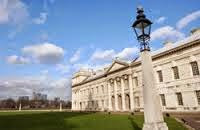
_______________Queen Anne Building, University of Greenwich____________

The Chagos Litigation: A Socio-Legal Dialogue Conference will be taking place on 29th June 2015 at the School of Law, University of Greenwich.@UoGLaw #ChagosDialogue

See Conference Schedule here.

24 June 2015

"The Chagos Islanders and International Law"- Book by Stephen Allen


Stephen Allen is a Senior Lecturer in Law at Queen Mary, University of London.


In 1965, the UK excised the Chagos Islands from the colony of Mauritius to create the British Indian Ocean Territory (BIOT) in connection with the founding of a US military facility on the island of Diego Garcia. Consequently, the inhabitants of the Chagos Islands were secretly exiled to Mauritius, where they became chronically impoverished. 

This book considers the resonance of international law for the Chagos Islanders. It advances the argument that BIOT constitutes a 'Non-Self-Governing Territory' pursuant to the provisions of Chapter XI of the UN Charter and for the wider purposes of international law. 

In addition, the book explores the extent to which the right of self-determination, indigenous land rights and a range of obligations contained in applicable human rights treaties could support the Chagossian right to return to BIOT. 

However, the rights of the Chagos Islanders are premised on the assumption that the UK possesses a valid sovereignty claim over BIOT. The evidence suggests that this claim is questionable and it is disputed by Mauritius. Consequently, the Mauritian claim threatens to compromise the entitlements of the Chagos Islanders in respect of BIOT as a matter of international law. 

This book illustrates the ongoing problems arising from international law's endorsement of the territorial integrity of colonial units for the purpose of decolonisation at the expense of the countervailing claims of colonial self-determination by non-European peoples that inhabited the same colonial unit. The book uses the competing claims to the Chagos Islands to demonstrate the need for a more nuanced approach to the resolution of sovereignty disputes resulting from the legacy of European colonialism.


08 April 2015

Chagos islanders ‘betrayed’ by UK failure to decide on their return


The Guardian

Supporters of Chagossians’ return to the Indian Ocean atolls condemn the government’s postponement and ‘lack of political courage’


Supporters of the inhabitants of a British overseas territory deported from their homeland are furious that the government has reneged on a promise that it would decide before the election on whether they could return.


Shortly before parliament disbanded, the government said it would delay confirming whether the Chagossian people could go back to the Chagos Islands, a series of atolls in the Indian Ocean. The main island, Diego Garcia, has been leased to the US military since 1966. That agreement expires next year. 

Novelist Philippa Gregory, secretary of the UK Chagos Support Association, branded the delay “another serious betrayal of the Chagossian community”. She added: “Chagossians have suffered in exile for years, and it is disgraceful the government has failed to deliver a small measure of justice by supporting return.” Television presenter and author Ben Fogle will hand a petition to Downing Street after the election urging the next government to let the Chagossians go back.

READ THE FULL ARTICLE IN THE GUARDIAN .


27 February 2015

Deadline approaches for Petition Supporting Chagos Repatriation


Petition


UK Prime Minister, Deputy Prime Minister and Leader of the Opposition,

We implore you to make amends for the 'crime against humanity' (Article 7 of the International Criminal Court), which was carried out by your predecessors, both Tory and Labour. In the early 1970s, the British government forcible implemented the secretive transfer of Chagossians to a life of extreme poverty in Mauritius and the Seychelles in order to accommodate a military base for the USA. Many of these displaced people still suffer in poverty and those now in Crawley and Manchester, UK, live on the margins of British society, continuing to live in sadness, longing to return to their homeland. Many have died in misery, living in the hope of going home.

Honourable Sirs, we ask you to let British justice prevail by doing all in your power to undo this injustice and actively pushing for the islanders to be resettled in their homeland as soon as possible.


*************


Give the Chagos islanders the right to return home!


Why this is important

A Displaced and Forgotten People

The Chagos archipelago is situated in the Indian Ocean, mid-way between India and Africa. Some 2,000 people lived on the archipelago, the majority on the largest island of Diego Garcia. Their ancestry on the islands went back to the 18th century.

During the 1960s and 1970s British governments, both Labour and Tory, tricked and expelled the entire population of the Chagos, a British colonial dependency, so that Diego Garcia, the main island of their homeland, could be given to the United States as the site for a military base. This act of mass kidnapping by the British government was carried out in high secrecy, along with the conspiracy that preceded it. The last islander was deported in 1973. The 'deportation or forcible transfer of a population...a crime against humanity', is according to the words of Article 7 of the Statute of the International Criminal Court.

These displaced people still in Mauritius and the Seychelles continue to suffer in poverty to this day and continue to exist in sadness, longing to return to their homeland. Many have died in misery, living in the hope of going home.

In 2002, travelling with their new British passports, many of the Chagossians began to arrive in Britain, to bring their campaign to London and to escape the poverty of Mauritius. All of them wanted to return to the Chagos Islands rather than be in England. It is estimated that more than 2,000 Chagossians now live on the margins of UK society mainly in the town of Crawley, with a smaller community in Manchester. In both places they struggle to reconstruct their lives.

Meanwhile dozens of jobs on Diego Garcia are being advertised in the Philippines, including posts for electricians, cashiers, mechanics, stock clerks, janitors, welders, firefighters, engineers and massage therapists. There have been no reports of these jobs being advertised in Mauritius, the Seychelles or the UK, where most of the Chagossian community live. We can’t help but wonder why.they have not been given priority for these positions in their own land. Since being illegally evicted, very few Chagossians have been able to get jobs at the foreign base in their homeland despite many trying.

The hope is that the islanders be allowed to return to their islands as soon as possible before more of them die in a British imposed exile, never to see their homeland again.


How can I help this month?


Reach the 2000 mark on the petition! By now most of you have already signed the petition (I hope!) but we are less than one hundred names away from the 2K mark now-lets get 2000 by next Ftiday! Share the petition on social media, or simply print it out and collect signatures amongst your friends, family or stangers-you can enter the details online later. We've had 500 signatures in the last two months, many thanks to you all.


Send this (or something like it) to your MP- We've updated our template letter to Parliamentarians to make it easier to write to your MP. Please do feel free to change it around though as MPs tend to respond to a personal touch. You can send it online here, or a postal address will be available online. Contact us if you'd like to discuss your letter further, and do let us know about any responses.

Tell Avaaz, 38 Degrees and Change.org to push our campaign to their members- Last month we asked you to tell campaign group 38 Degrees to support the Chagossian cause and many thanks to all of you who did. Apologies though to those of you outside the UK who could not. Avaaz are a global campaign group and work on a variety of topical issues, in part in response to popular demand. So scroll the bottom of this page and tell them how much Chagossian return means to you.

Read & Share our New Campaign Pages- Our 'Perfect Opportunity' page summarises the main arguments why 2015 is the perfect time for the UK Government to give Chagossians a measure of justice. Our Realities of Return Article, meanwhile, proves resettlement will not be a burden on UK taxpayers, as some in the media and politics have claimed.

Come to the Architecture and Activism Event- Find out about Chagossian history, the return campaign and the chance for resettlement at 7:30 PM Friday 13th at Royal College of the Arts, Kensington. Free to attend and details here.


*****

Coordinator’s Summary: Meeting of the Chagos Islands APPG , 23 February 2015


Please find the below a summary of the recent All-Party Parliamentary Group on the Chagos Islands, kindly provided by voluntary Group Coordinator David Snoxell

The Chagos Islands (BIOT) All-Party Parliamentary Group held its 47th meeting on 23 February. It was followed by a meeting in the Foreign and Commonwealth Office with Hugo Swire, Minister of State.
Photo: Gail Johnson, via Flickr


Members considered Parliamentary Questions and Answers since the last meeting on 14 January. They noted the positive tone of the Government towards the review of policy which follows the KPMG study. The Group also considered the letter from the Chairman of the Foreign Affairs Committee indicating that an oral session with the Foreign Secretary was scheduled for March which might provide an opportunity for the FAC to explore the potential for resettlement.

The Group was informed of developments in the two Chagos cases before the Supreme Court. Members took the view that litigation should be regarded as quite separate and independent of the political and practical considerations concerning resettlement and should not be a delaying factor.

The Group discussed KPMG’s final report and conclusions. They agreed that in principle there were no longer any impediments to resettlement and that even cost could be overcome. It was clear from correspondence that the Government wanted to consider all options carefully, regarding the future of BIOT and also the aspirations of the Chagossians, and that this would involve the PM and Ministers across Government.

Members discussed sources of funding – the aid budget, US, EU, international organisations, and private sector. They were informed of an oral answer from the European Commission, given just prior to the APPG meeting, to a Question from Linda Mc Avan, chair of the Development Committee of the European Parliament. The answer reiterated earlier statements by the Commission that there was no obstacle to EU funding (either through the European Development Fund or indeed the European Investment Bank) should an application be made by HMG.

Members decided to press for a debate in both the Commons and the Lords which would probably be in the second half of March. It was agreed that should there be a need for a further meeting before the dissolution of Parliament (30 March) it would take place on 23 March.

An encouraging and positive meeting with Hugo Swire and officials followed at the FCO. Many aspects of BIOT were discussed including the KPMG study, costs, sources of funding, accommodation in the MPA of Chagossian artisanal fishing, current US recreational fishing (48 tons pa), renegotiation of the UK/US Agreement, Chagossian employment on the base and in the management of the MPA, future funding of the BIOT patrol vessel, future constitutional arrangements for BIOT providing for parliamentary oversight, sovereignty and a parliamentary visit after the election. The Group decided to put their views to the Prime Minister in a letter from the Chairman.

29 July 2014

Mauritius Lobbies to Regain Control Of Diego Garcia, Site of U.S. Base

w


The Washington Diplomat

By Larry Luxner 

Diego Garcia, a remote speck of land in the middle of the Indian Ocean, rarely makes news. But in recent months, the coral atoll has grabbed the attention of online conspiracy theorists who claim the missing Malaysian Airlines jet secretly landed there as part of some clandestine U.S. military operation.
A7.IR.diegogarcia.aerial.story
Photo: SRA Sarah E. Shaw / U.S. Air Force
This 1998 aerial view shows the U.S. Naval Station on Diego Garcia, a remote speck of land in the Indian Ocean administered by Great Britain, which signed a 50-year treaty with the United States in 1966 allowing it to build a military outpost there.
The obscure island even got a mention in the latest installment of the Fox TV show “24,” as super-agent Jack Bauer rushes to thwart terrorists who’ve hijacked a group of American drones at the exact time that the U.S. president is trying to convince Britain to extend a treaty allowing the use of drones on its base in Diego Garcia.
As dramatic as these references are, they do hint at the island’s strategic value just as the United States, Great Britain and Mauritius prepare for talks on the future of the Chagos archipelago, which includes Diego Garcia.
At issue: Who, exactly, owns this tiny island 1,000 miles east of Mauritius and 2,900 miles northwest of Australia?
In 1965, three years before Mauritius won independence, Great Britain detached the Chagos archipelago from the rest of its then-colony and created the British Indian Ocean Territory to administer the islands from London. The following year, it signed a 50-year treaty with the United States that allowed Americans to establish a military outpost on Diego Garcia; in return, it secured a discount on U.S. Polaris missiles. In the process, Britain kicked out about 2,000 native Chagossians to make way for the American outpost.

READ FULL TEXT HERE

04 December 2012

Chagos Islanders continue their fight to return home


The UK Chagos Support Association


 November 25th, 2012 

by Robert Bain 

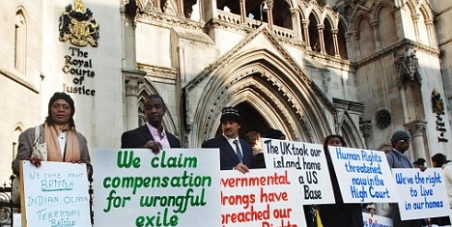
Royal Courts of Justice / Photo: Ell Brown (via Flickr)
The High Court will consider new evidence on the Chagos islanders’ historic fishing rights and the government’s flawed feasibility study of resettlement, when it hears a judicial review of the Chagos marine reserve next year.
The marine reserve, put in place in 2010, effectively bans the Chagos islanders from returning home. The islanders are challenging it in the courts, arguing that the consultation that preceded the decision was flawed. The case was originally due to be heard this month but has now been put back.
The new evidence comes from recently uncovered documents about the 2002 feasibility study (which the Foreign Office had previously said did not exist) and newly released evidence from Foreign Office archives about historic fishing rights in Chagos.
Judges have also asked the consultant that conducted the feasibility study for the government to release all documents they hold that relate to it.
US diplomatic notes released by Wikileaks suggest that preventing the islanders from going home was in fact one of the government’s intentions when it created the marine reserve. The Foreign Office officials named in the leaked cable will be cross examined as part of the judicial review.
A case by the Government of Mauritius at the International Tribunal on the Laws of the Sea will be heard in July.

See also:  

Senior Government officials to face cross-examination over Wikileaks cable

10 February 2012

British MP calls for action on repatriation of Chagossians

David Snoxell: Ministers recognise the injustice done to the Chagossians. But it's time for action, not words.

Conservative Home

David Snoxell is Coordinator of the Chagos Islands (BIOT) All-Party Parliamentary Group and was British High Commissioner to Mauritius, 2000-04, and Deputy Commissioner of BIOT, 1995-97.

Screen shot 2012-01-12 at 18.07.44In 1965, the UK excised the Chagos Archipelago from Mauritius to create a new colony, the British Indian Ocean Territory (BIOT), so that the largest of the 55 islands, Diego Garcia, could be developed as a US base. In the process the population of 1,500 Ilois were removed from their homeland and dumped in Mauritius and Seychelles. Since the 54 outer islands have never been required for defence purposes what is stopping the Government allowing Chagossians to return for visits or to resettle there?

Since 1999 their case for doing so has trailed through the courts. At each stage the Chagossians won. But at the last hurdle in 2008, the Law Lords gave a qualified 3:2 verdict in favour of the Government. However, the case is now before the European Court of Human Rights. If it decides the case is admissible the Chagossians are likely to win since the UK is manifestly in breach of one or more of the articles of the European Convention on Human Rights.

The case should never have had to go this far. The right to return was restored in November 2000 by Robin Cook, following the High Court judgment in favour of the Chagossians, but this was overturned in June 2004 by Orders in Council. Jack Straw was to admit in 2009 that by not consulting Parliament he had sacrificed legitimacy for speed. It is inconceivable that Parliament would have agreed to deprive the Chagossians of the most fundamental of all human rights – the right to return to one’s homeland. It would be far better if the FCO were to withdraw from the case and settle out of court, as already suggested by Strasbourg. This would avoid fuelling the campaign of those who see its judgments as an attack on the independence of our courts.

Over the past decade there has been a systemic failure – a lack of political will and foresight  set against a background of international crises, low level handling of the issues in the FCO, lack of ministerial engagement, buying time, the inevitable face-saving, the defence of past mistakes and mounting legal bills, (about £3 million), exacerbated by the turnover of staff and ministers. This was not a planned strategy, rather a failure to grasp the nettle.  Since 2002, Ministers have signed off on keeping the Chagossians in exile, deploying largely disproved arguments, such as the security of the base, "treaty" obligations to the US, feasibility and cost of resettlement, conservation and the recently created Marine Protection Area.

The Chagos Islands (BIOT) All Party Parliamentary Group, whose purpose is "to help bring about a resolution of the issues concerning the future of the Islands and the Chagossians", was established in the wake of the 2008 defeat by the Law Lords and has wrestled with these arguments in the course of 26 meetings over more than three years. The group has currently 41 members. Several of its members are in the Coalition Government and four were FCO Ministers. The Group has had meetings with FCO Ministers on four occasions, with leaders of the Chagossian groups, the US Embassy and Mauritius High Commissioner, conservation groups and the UK Chagos Support Association whose Patrons are Philippa Gregory, Ben Fogle and Benjamin Zephaniah. The FAC has noted: “We conclude that there is a strong moral case for the UK permitting and supporting a return to BIOT for the Chagossians. The FCO has argued that such a return would be unsustainable but we find these arguments less than convincing”.

Before the election both parties expressed strong support for the Chagossians and William Hague promised “to ensure a fair settlement of this long standing dispute”. Nick Clegg’s office said: “Nick and the Lib Dems believe that the Government has a moral responsibility to allow these people to at last return”.  Then in a letter to a constituent Vince Cable announced in September 2010 that the Government was withdrawing from the case, opting instead for a friendly settlement. He noted that William Hague was “also committed to a fair settlement and that steps had already been taken to ensure their return”. A week later he was forced to recant, but added that “I am sure that the Chagossian cause will continue to be championed by my colleagues within the Liberal Democrat party.”

Why, then, in the 21 months of this Government has nothing happened?  There has been an abject failure of politicians to carry through the commitments they made on several occasions in parliamentary debates. A tiny group of FCO officials and legal advisers have continued to run policy towards Chagos.  Whilst being more sympathetic than the previous government, ministerial answers to parliamentary questions, interventions and letters have simply reiterated standard FCO lines. True, Ministers' public and parliamentary stance comes over as positive and anguished but the reality is, so far nothing has changed.  In a recent meeting with members of the Chagos APPG, the Foreign Secretary referred to FCO positions and policy rather than his own. The gap between what politicians feel and what officials "recommend" has never been so obvious. Yes, the climate has changed - but not yet the tide.

In a major speech last year, the Foreign Secretary said: “My ambition is a Foreign Office in which ideas thrive and the status quo can be challenged fearlessly...our diplomats excel at finding deft, realistic and workable solutions”.  There is not much evidence that Ministers are succeeding in challenging the status quo on Chagos and applying political will and compromise to finding workable solutions - though, unlike the previous government, it is pretty clear that they would like to do so. They give the impression of being unwilling passengers bound and gagged in the backseat of a car driven doggedly by their officials.

The UK remains in violation of several UN human rights instruments and decisions. Our international reputation continues to be badly damaged by accusations of double standards. In the same speech, the Foreign Secretary said: “We cannot ride roughshod over international opinion or neglect to ensure that our actions are seen to be as legitimate as possible in the eyes of the world”.  What better year than 2012, when the eyes of the world are on London for the Olympic Games and the Diamond Jubilee, to restore the human rights and the dignity of the Chagossian people? What better way to mark the Queen’s long reign, which has seen the transition of the British Empire to a Commonwealth of Nations, by bringing to an end this tragedy and relic of Empire in the Indian Ocean? Jeremy Corbyn, the Chairman of the APPG, has asked for a debate early in the session. This will be the opportunity for the Foreign Secretary to tell Parliament about the progress that he is making towards a settlement of the issues.

18 January 2012

Chagossian human rights defender joins the ancestors

Lisette Aurélie Talate - the departure of a freedom fighter


Chagos International Support

When in the 70's, Talate was dumped in Mauritius along with her children and other Chagossians, she immediately embarked on a relentless struggle to go back home to Diego Garcia. During her lifetime she undertook several hunger strikes to draw attention to the legitimacy of her cause and, in the process, became an icon of the Chagossian diaspora.

She was a frail woman in physical appearance but, like an iron fist in a velvet glove, she constantly told the authorities concerned that her land has been robbed. When finally she was “allowed” to visit Diego Garcia, everyone still cherishes the vivid image of how she kneeled down to kiss the soil and screamed “Diego, my land!” while the military who "occupy" the island, witnessed the scene unfazed. It was, sure, only a short visit, like being on transit -- not to say a humiliating way to be asked to come and look at your home from far and then politely be invited to sleep outdoors !

At the funeral service, Olivier Bancoult paid tribute to Talate in very emotional terms. He recalled how one day he was with Talate in London fighting for their case when she found herself with some British MP who sympathised with her cause, at the Cafetaria of the House of Commons. When invited by the MPs to have a coffee and eat a bite with them, she flatly refused. She would later tell Olivier how could she be eating and drinking in the very institution that had decided to deport her from her island home. For her, the Houses of Parliament represented a dramatic symbol. She was a woman of conviction, who always got her message across forcefully in the creole language.


Read the full article here.

07 July 2011

Chagos representatives meet British Foreign Secretary; Rights of displaced people raised

*****
 William Hague meeting Chagos representatives
Photo: United Kingdom Foreign and Commonwealth Office


In a historic meeting on Monday the British Foreign Secretary met representatives of the Chagos people who were expelled from their islands more than forty years ago.

Foreign Secretary William Hague invited the Chagos representatives to a meeting following May’s Chagos Regagné conference on the possibility of a science station and eco-village on Chagos. Ben Fogle and Philippa Gregory, patrons of the UK Chagos Support Association, accompanied chair Roch Evenor and vice chair Marcus Booth to the Foreign Office where they were welcomed by Conservative MP Andrew Rosindell, who expressed his support for their cause.

Read full article here.


WHAT HAPPENED TO THE CHAGOS ARCHIPELAGO ?

by
Chagos International Support

Very few people in the world seem to be aware of the manner in which the inhabitants of Diego Garcia, Peros Bahnos and Salomon Islands – all part of the Chagos Archipelago – were deported in the 1970s. These inhabitants, who number a few thousands, were forcibly gathered and placed aboard the ship Nordvaer and sent to Seychelles and Mauritius. They were left on their own and have lived in poverty since then.

However, shortly after the deportation of the Chagossians, the island of Diego Garcia was ceded to U.S.A pursuant to an Agreement between UK and USA, to be used as a communication station, which, soon after, was rapidly transformed into a military base harbouring highly modern and sophisticated armaments.

Many at the time believed that in the context of the cold war that there was a need to install and maintain a military presence in the Indian Ocean. The era of the cold war is today over. We should therefore all be looking into a broader perspective and we should ask ourselves how could a legitimate population that number a few thousands, pause a threat to anyone in the area?

The exiled Chagossians are to-day spread in several groups and live mainly in Mauritius, Seychelles and London. Almost single-handedly they have been struggling to return to their native islands and are now awaiting a decision of the European Court of Justice for Human Rights over their right to live in their homeland. The Government of Mauritius has, after 40 years, finally woken up to the plight of the Chagossians and has recently challenged Britain's decision to create a Marine Protected Area (MPA) in the British Indian Ocean Territory (BIOT). It has taken the British Government to the United Nations Tribunal for the Law of the Sea over the matter. A decision from the Tribunal is expected by 2013.

As the Chagos saga unfolds, we are witnessing today the rise of an unprecedented worldwide awareness of the case. Chagos International Support basic purpose is to support at the international level the legitimate aspiration of Chagossians to return and live in their homeland.

To-day we move in an ever changing world where democracy permeates societies and nations. The Chagos Archipelago case can be solved peacefully through the fostering of a good spirit of dialogue and goodwill amongst all the stakeholders and endeavouring to lift all obstacles that impede in the way of the legitimate right of Chagossians to live in their homeland.

This is a legitimate aspiration that nobody should deny them in the 21st century. The great powers active in the region should understand that the right to live in one’s homeland is a fundamental basic human right and come to terms with it.