Showing posts with label military. Show all posts

20 June 2019

UNITED KINGDOM FLAUNTS INTERNATIONAL RULE OF LAW AFTER INTERNATIONAL COURT OF JUSTICE DECISION ON CHAGOS


Elena Katselli, Senior Lecturer in Law
 Newcastle University


A nation’s military and geo-strategic interests cannot, under international law, prevail over the sovereign rights of other states. State sovereignty, self-determination and decolonisation are fundamental legal principles the UK should honour as it refuses, despite widespread international condemnation, to hand back control of the Chagos Islands in the Indian Ocean.
Indeed, Britain’s expressed policy that it will protect its interests at any cost, even at the expense of international law and fundamental human rights, has unwelcome echoes of colonialism and discrimination that should have no place in the 21st century.
On May 22, a UN General Assembly resolution calling for the complete decolonisation of Mauritius by ending the UK’s administration over the islands was voted for by 116 nations. Only six – the US, Hungary, Israel, Australia, the Maldives and the UK – voted against it, with 56 abstaining.

06 February 2019

CARIBBEAN WARNED OF DUTCH RE-COLONIZATION AND MILITARIZATION AS THE CRISIS IN VENEZUELA INTENSIFIES


"These major developments are contributing to re-establishing colonial regiments back in the Caribbean and these re-colonized territories are misused as this Venezuela case and crisis is unfolding to destabilize the region and vision towards a united and integrated Caribbean."
- James Finies, Foundation We Want Bonaire Back.


_______________________________________________________________________________

OPEN LETTER TO SECRETARY-GENERAL OF CARICOM

James Finies, President Foundation We Want Bonaire Back

H.E. Ambassador Mr. Irwin La Rocque
Secretary-General and Chief Executive Officer of the Caribbean Community
Caricom Secretariaat
Turkeyen, Greater Georgetown
Guyana

Bonaire, February 6th, 2019

Subject:  Urgent appeal from the people of the Dutch Caribbean islands to the CARICOM and Latin America.


Excellency,

I would like to congratulate your excellency and the secretariat on attending the upcoming meeting in Montevideo, Uruguay. In reference to the escalating Venezuela crisis and our previous letters of June 11, 2018 urging the CARICOM and the Caribbean region to intervene and object to prevent an armed conflict in the Caribbean and recent letter dated January 29th, 2019, as the crisis and conflict is deepening we herewith would like to request your urgent attention and call to action on behalf of the peoples of Bonaire, Sint Eustatius, Curacao and Aruba.

By now it is very clear and obvious that the provocation and escalation is initiated and led by mayor world powers headed by the UK, France and the Netherlands and backed by the US as we witnessing a continuing military build up in Curacao, the ABC islands. We the people of the ABC islands highly object to be dragged into this conflict.

As the discussion is fundamentally based on the issue of democracy and human rights, the so-called ultimatum headed by these colonizing powers is directed towards a new election to re-elect a democratic president and government for the peoples of Venezuela we would like to illustrate herewith the hypocritical position taken by the government of the Netherlands (member of the UN Security Council) a front-runner in this provocation and escalation of this crisis.

The autonomous democratic Caribbean islands forming the country Netherlands Antilles in the Dutch Kingdom was dissolved and disintegrated on October 10, 2010. The Netherlands which maintained ultimate unilateral legislative and judiciary powers in the Dutch Kingdom abused these powers to continue with colonialism in the Caribbean region.

The more dense populated islands Aruba, Sint Maarten and Curacao, something what is not so obvious to outside world, they were all stripped from their autonomy and are back under Dutch control and rule. The Dutch which controls and decides on the budget (and judiciary) of the Curacao government, headed by the Secretary of State Mr. Knops, a ex-military and ex-lieutenant active in the Iraq war,  forced the prime minister of Curacao, Mr Rhuggenaath which is subordinated to the Hague powers to escalation of the crisis. 

Curacao Prime Minister Rhugenaath publicly sided with the ultimatum for a new election causing a direct interference in the sovereign neighboring country Venezuela internal affairs. Curacao which as Aruba, the closest Caribbean islands to Venezuela, are equipped with a full US military forward base and with international harbors and airports of military standards  are at the moment converted in the most strategic war-campaign-bases. War planes are already landing and troops are deployed from the Netherlands towards the ABC islands under guidance of Dutch brigade-general Peter Jan de Vin which was deployed to Curacao to overseer this military operation along with State Secretary Mr Knops.


Dutch troops patrol in Kralendijk, capital of Bonaire (December 2018) 
The less populated in-defensive islands of Saba, Sint Eustatius and Bonaire were annexed, integrated and incorporated in the Dutch constitution without equal rights, with all administrating, democratic, judiciary, powers unilaterally re-positioned  under the Dutch parliament in the Hague and at the moment are being governed in a colonial status against the free will of the peoples and not of their choosing.

As the Dutch government is preaching or claiming to support democracy and human rights in Venezuela meanwhile Bonaire is in a heavy humanitarian crisis by neutralizing and erasing their democratic and human rights. Imposing unilaterally laws for a systematic institutionalized ethnic cleansing of the local population, explosion of the crude death rate over 60% and massive immigration over 400%  increase of non-Bonerians. At the moment in a short period the local Bonerians became a minority on their own island and there is no stopping to this displacement and extermination process.

On Sint Eustatius the democratically elected local government were un-democratically removed from power, with claims of corruption without proof or formal investigation by the Dutch government with abusive use of legislative , military and police powers. The Dutch appointed a non-democratic ruler to govern and erased the peoples democratic rights by stopping elections on the island till further notice. Note that the government of Sint Eustatius is the only Dutch Caribbean island which stood up against the Dutch government because illegal annexation on October 10, 2010 and presently are in court-proceedings against the Dutch  government.

These major developments are contributing to re-establishing colonial regiments back in the Caribbean and these re-colonized territories are misused as this Venezuela case and crisis is unfolding to destabilize the region and vision towards a united and integrated Caribbean.

Our urgent call to attention and action is towards the Caricom countries and our Caribbean and Latin American brothers and sisters for supporting our islands of Bonaire and Sint Eustatius in our quest to get re-inscribed back on the list of the Non-Self-Governing-Territories of the United Nations and fall back under the scrutiny of the international community on our way back to regain and restore our fundamental human and democratic rights.


Yours sincerely,
James Finies, President 
Foundation We Want Bonaire Back 


31 August 2018

"Guam Veteran Vote Proposal Confuses" - former U.S. legal advisor

By Howard Hills
Former counsel on territorial status affairs in the Executive Office of the President, National Security Council and U.S. State Department, and author of "Citizens Without A State"

Honoring Veterans with Truth


The Governor of Guam, Eddie Calvo, recently sent a letter to President Trump requesting that U.S. military veterans in Guam be given the same federal voting rights as Americans in the States of the Union.
In doing so the Governor did not make it clear if this was just a symbolic gesture, or if he really believes the president or even Congress and the federal courts can simply extend federal voting rights under the U.S. Constitution outside a state, for persons born in a U.S. territory.
If the latter he may not be getting fully accurate historical and constitutional background information from his advisers. If instead the Governor seeks to illustrate and arouse sympathy for the veterans and other U.S. nationals and citizens in territories who can’t vote in federal elections, then in a real sense it creates confusion about the legal, political and moral context for honoring the sacrifice of veterans.
READ THE FULL REPORT HERE.

09 August 2018

Okinawa Governor, known for his opposition to US Bases, Passes away at 67


Governor Onaga sends congratulations to U.S. President-elect Trump, hopes to break deadlock


OKYO – The governor of Japan’s Okinawa prefecture, who came to power in 2014 on a campaign platform of opposition to US military bases, passed away on Wednesday at the age of 67 years.

Takeshi Onaga, who was recovering after undergoing pancreatic cancer surgery in April, had been hospitalized, according to public broadcaster NHK.

At a press conference earlier in the day, Vice Governor Kiichiro Jahana had said he would be taking over Onaga’s duties so that he could focus on his recovery.

The governor had been openly confrontational with Japanese Prime Minister Shinzo Abe over the relocation of one of the biggest US bases in the area, which also led to massive protests in Okinawa and a legal battle initiated by Onaga.

At the end of July, the governor announced that he intended to exhaust all legal options to stop the relocation of the Futenma base from its present location to Henoko Bay, north of the prefecture’s main island.

Japan and the US had agreed to move the military facilities to Henoko, an area much less populated than the current base in Futenma, in order to reduce its impact on local population.

The local government, however, rejected the shift on the grounds that it posed a threat to the area’s environment and might prove to be detrimental to the local population.

Onaga tried to revoke the approval for the transfer given by his predecessor, even taking the case to court, which has ruled in favor of Tokyo.

A majority of citizens of Okinawa – which is home to over 70 percent of US military facilities in the country and half of the nearly 47,000 troops that the US maintains in Japan – are opposed to the relocation of the Futenma base and have asked that it be moved outside its territory.

SEE ALSO:

15 June 2018

DUTCH COLONIES IN CARIBBEAN ASK CARICOM FOR URGENT HELP


James Finies
President
We Want Bonaire Back Foundation

Open Letter

 Urgent call to CARICOM and the Caribbean region to intervene, object and prevent armed-conflict in the Caribbean


HE Ambassador Mr Irwin LaRocque

Secretary-General and Chief Executive Officer of the Caribbean Community
CARICOM Secretariat
Turkeyen, Greater Georgetown, Guyana

June 11, 2018

Subject: Urgent call to CARICOM and the Caribbean region to intervene, object and prevent armed-conflict in the Caribbean


Excellency,

We herewith would like to bring your attention to a urgent situation emerging in the Caribbean. The peoples of our islands, Bonaire, Curacao and Aruba are worried and fearing that the Netherlands is using our ABC islands to start provocation that can lead to a armed conflict or war in the Caribbean and South America region. Last week many of heavy war machinery and vehicles were offloaded in the Curacao port.

As the CARICOM and the Caribbean region is pursuing Caribbean integration and unity and has maintained itself as one of the only regions in the world free of war and conflicts. The Caribbean nations’ major economy and livelihood depends on tourism, the presence of the Dutch with a re-born aggressive re-colonization agenda launched on October 10, 2010, with the dissolution of the Netherlands Antilles and annexation and re-colonization of the smaller in-defensive smaller islands of Bonaire, Saba and Sint Eustatius could lead to a mayor Caribbean crisis and apartheid states.

The new elected Dutch government in March 2017, appointed Mr Knops as States-Secretary of Kingdom Relations. Mr Knops, who is an experienced ex-military lieutenant colonel active in the Iraq war, with warfare credentials and seemingly for his military experience to carry out the Dutch agenda in the Caribbean. February this year, through an undemocratic decision by the Dutch parliament, Mr Knops headed this abusive undemocratic action, landed with 40 policemen and a navy vessel in the harbor of Sint Eustatius on standby, and overthrew the local legitimate democratic elected local government and appointed an non-democratic ruler and governor to govern the island of Sint Eustatius.

Last week, on June 5, the Dutch parliament decided on a motion and instructed the minister of defence Mrs Bijleveld to consult and seek support from France, Great Britain and the USA, which also have interests in the Caribbean, to build up a “robust defense” and start militarization of the ABC islands. There is already heavy military equipment arriving in Curacao and military exercises experienced by the population as not normal are being conducted and our peoples on the islands fear being dragged into a possible major armed conflict or war between the world powers.

The Netherlands campaigned actively to secure a seat in the United Nations Security Council in 2016, for the period of 2017 and 2018 but, due to a contested vote, with the possibility to lose to Italy, decided to strike a deal with Italy and to share the seat and was appointed this year and is currently a UN Security Council member.

In April 2018, a Bonaire and Sint Eustatius delegation visited the CARICOM Secretariat Headquarters in Guyana where we met with Ambassador Colin Granderson, Assistant Secretary-General, when we denounced the Netherlands for a continuation of colonialism in the Caribbean by annexation through embedding of the islands of Bonaire, Saba and Sint Eustatius in the Dutch constitution in October 2017 under unequal rights and against the wishes of the Bonaire and Sint Eustatius peoples, who rejected the imposed status in their 2014 and 2015 referenda. Ambassador Granderson pledged to make a report of our visit and to distribute it along with our White Paper and Green Paper to all CARICOM members.

Our cases and present undemocratic situations of our islands have been brought forward to Caribbean nations during our Bonaire and Sint Eustatius visit to United Nations Headquarters in New York; 2016 visit: UN Ambassadors of Antigua and Barbuda, Cuba, St Vincent and the Grenadines and Venezuela and yours truly Mr Finies, spoke and denounced our situation in the June International Week of Solidarity with the Peoples of UN-NSGT; 2017 visit: UN Ambassadors of Dominica, Saint Kitts & Nevis, Saint Lucia and other UN C24 member nations; in 2018 we had audiences in Guyana and Grenada with the Minister of Foreign Affairs, in Suriname with the Suriname government and spoke to the Honourable Ambassador Mr LaRocque, Secretary-General of CARICOM at the CARICOM-COFCOR conference in Nassau, Bahamas.

A historical note is that October 10, 2010, when our peoples were sent back under Dutch colonial rule, ironically, is Columbus Day, the commemoration of the discovery and colonization of the American continent.

Is all of this coincidence or are we facing another era of re-colonization of the Americas in the making and henceforth urge the CARICOM and Caribbean nations, through the upcoming CARICOM heads of states summit in July in Jamaica, to discussion and urgent action, to avoid further provocation and escalation of this unwanted situation and crisis in our peaceful Caribbean.


20 April 2018

GUAM, OKINAWA COLLABORATE AGAINST US MILITARY EXPANSION


FOREIGN POLICY IN FOCUS


Guam and Okinawa have a shared history of exploitation by their governments — and a shared threat from new military installations.


In January, three residents from the U.S. territory of Guam visited Japan to express their solidarity with Okinawans struggling to block construction of new U.S. military facilities on their island.
During their 10-day stay, the members of Prutehi Litekyan: Save Ritidian — Monaeka Flores, Stasia Yoshida and Rebekah Garrison — participated in sit-in demonstrations and gave a series of lectures explaining the similarities between Guam and Okinawa.
The Japanese prefecture of Okinawa is host to 31 U.S. bases, which take up 15 percent of the main island. On the U.S. territory of Guam, the Department of Defense owns 29 percent of the island — more than the local government, which owns only 19 percent. And if the U.S. military gets its way, its share there will soon grow.
Currently, the Japanese and U.S. governments are planning to relocate roughly 4,000 marines from Okinawa to Guam — a move, the authorities assert, that will reduce the military burden on Okinawa. Tokyo has also started to return land currently used by the U.S. military — but only if new facilities are built elsewhere on the island.
During their visit to Japan, the three Guam residents saw firsthand the problems local residents are facing.

READ THE FULL REPORT HERE.

14 March 2018

"OKINAWA IS NOT A COLONY" - PREFECTURAL ASSEMBLY


Prefectural Assembly repeats request for closure of Futenma stating, “Okinawa is not a colony”
In response to a recent incident in which a piece of Osprey fuselage dropped to the ground, on February 21 the Prefectural Assembly adopted a written statement and protest resolution requesting the immediate closure of Futenma Air Station.

 On February 21, the Okinawa Prefectural Assembly unanimously adopted a written statement and protest resolution requesting the immediate closure of Futenma Air Station.
These were adopted in response to a Futenma Air Station MV-22 transport Osprey’s engine intake cowling that dropped to the ground on February 8.
The Assembly pointed out that the repeated U.S. military aircraft accidents constitute extremely unusual circumstances.

Furthermore, the Assembly stated that airborne training exercises continue while there are no signs of improvement to the U.S. military’s safety management systems.
It asserted that it absolutely cannot approve of the U.S. military’s contemptuous attitude toward Okinawans, and that the voices calling for the withdrawal of the Marines from Okinawa are becoming louder.
Moreover, the Assembly severely criticized the U.S. and Japanese governments, reminding them that Okinawa is not a colony.

In response to aircraft based at Futenma Air Station repeatedly experiencing trouble and emergency landings, on February 1 the Prefectural Assembly adopted a resolution calling for the immediate closure of Futenma Air Station and the relocation of the U.S. Marine Corps out of Okinawa or even out of Japan.
The resolution from February 1 and the new resolution are alike in that, for the first time since Okinawa was returned to Japanese sovereignty, they include the words: “Okinawa is not a colony.”]
This more recent protest resolution in response to the Osprey fuselage piece dropping to the ground asks for, (1) a thorough inspection into the cause of the accident and a public announcement regarding the results, (2) a halt to flights and training involving aircraft based at Futenma Air Station over private land, (3) the immediate closure of Futenma Air Station, and (4) a drastic revision of the U.S.-Japan Status of Forces Agreement.

The U.S. Marines in Okinawa did not report the fallen aircraft part until the Okinawa Defense Bureau made an inquiry about it.

This protest resolution states that the lack of notification from U.S. military to the Japanese government about the accident calls into question whether there was intent to conceal the incident.
The protest resolution is addressed to Prime Minister Shinzo Abe and the U.S. Ambassador to Japan William Hagerty, among others.

14 January 2018

GUAM TOURISM AFFECTED BY U.S-NORTH KOREAN TENSIONS

Newsweek

NORTH KOREA NUCLEAR MISSILE THREAT WRECKS GUAM’S HOPE FOR 2018 TOURISM BOOM

North Korea’s threats to launch a nuclear missile strike against the U.S. territory of Guam are expected to take a toll on the island’s tourism industry in 2018.
At least 40,000 fewer tourists are expected to visit Guam in the year ahead compared with 2017, according to local media reports confirmed by the Guam Visitors Bureau.
The fiscal year of 2017 was deemed to be the island territory’s best year in tourism, with as many as 1.56 million visitors from South Korea and Japan alone.
That number is expected to drop significantly, however, in the wake of North Korean leader Kim Jong Un’s renewed threats to target the Pacific island.
READ FULL ARTICLE IN NEWSWEEK 

03 January 2018

U.S. TO INVESTIGATE IMPACT OF CHINESE ECONOMIC INFLUENCE IN FORMER TRUST TERRITORY OF THE PACIFIC ISLANDS

The $700 billion 2018 National Defense Authorization Act, signed by President Trump in mid December, calls on the Department of Defense (DOD) to investigate the growing role of China in former US territories in the Pacific. That is a recognition both of the islands’ importance to US global strategy, as well as the latest indicator that America’s decades long relationship with its former dependencies is a partnership under stress.
Strung across the Western Pacific, today’s Republic of Palau (ROP), Federated States of Micronesia (FSM), and Republic of the Marshall Islands (RMI) were liberated from the Japanese in the Pacific War and governed by the US as a UN authorized “trust territory” until the early 1980s. Since that time, these sovereign nations have enjoyed a unique status of “Free Association,” with the US, which provides for their defense as well as sending US bilateral aid that sustains public sector driven economies in the isolated, under-resourced, islands and atolls. Locals can, and in large numbers do, enlist in the US military.
The Compacts of Free Association (COFA) also provide easy entry for islanders coming to study, work, or simply live in the US. Their “eligible non-citizen status” affords them most rights, privileges -and even entitlements- otherwise reserved for native born Americans.
Because of their strategic location at the crossroads of the Pacific, the islands have a history of foreign rule, changing from Spanish to German to Japanese to US hands over the first five decades of the twentieth century. Today they are a defining feature of the Chinese “Second Island Chain” strategic concept of area denial, just as they once comprised the outer ring of imperial Japan’s similar pre-war “Line of Advantage.”
While DOD planners have long sought to control, or at least deny others access to, the islands, in practice US development policies have been criticized by Congressional watchdogs as wasteful, shortsighted, and ineffective. US funding, small compared to US foreign aid provided to other nations -but massive when tallied on a per-person basis for the tiny islands- mostly consists of block grants overseen by the Office of Insular Affairs at the US Department of the Interior.
Critics maintain the monies don’t always build local capacity, but rather tend to foster dependency by sustaining public services (and jobs) year-to-year. That has lead to frustration, even resentment, on both sides. Increasing aid and investment by the Chinese, on the other hand, is given with few obvious strings attached, and framed as a way for islanders to trade in “U.S. government handouts, which are scheduled to end in 2023 [for Micronesia and the Marshalls,] for the wide-open promise of Chinese-style capitalism.” The massive increase in migrants from these Freely Associated States (FAS) to Guam and Hawaii are seen as an indicator of the lack of educational, employment, and healthcare opportunities throughout the FAS.
“Congress and the Administration are to be commended,” said Neil Mellen, founder of Habele, a US educational nonprofit operating across Micronesia. “America is best served when her allies’ support comes from a position of strength, sovereignty, and real partnership, rather than mere dependency. Careful examination of our nation’s track record in the post-war Pacific, as well as the increasingly caustic role played by others, is long overdue.”
---30---
DOD Budget Sec 1259D -- "Study and assessment of United States security and foreign policy interests in the Freely Associated States of the Republic of Palau, the Republic of the Marshall Islands, and the Federated States of Micronesia."

01 January 2018

AGENT ORANGE USE BY U.S. MILITARY IN GUAM TO BE INVESTIGATED


RNZ

Soil tests for Agent Orange in Guam to start early 2018


The United States' joint military command in Guam is to begin collecting soil samples in early 2018 to investigate recent claims Agent Orange was used on the island.
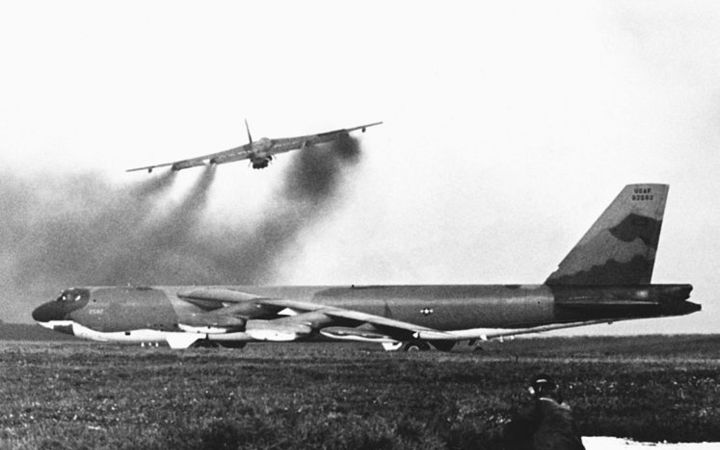
A U.S. Air Force Boeing B-52G-125-BW Stratofortress (s/n 59-2582) from the 72nd Strategic Wing (Provisional) waits beside the runway at Andersen Air Force Base, Guam (USA), 15 December 1972.

The Guam Daily Post reports officials from the Government Accountability Office visited the territory last week to speak with veterans and Guam's Environmental Protection Agency about the allegations that the highly toxic herbicide was used and or stored by the military on Guam during the Vietnam War.
Guam's Environmental Protection Agency had also been gathering information from veterans about where Agent Orange might have been used in order to pinpoint sampling sites.
A spokesperson for the joint US military command Lt. Ian McConnaughey told the Guam Daily Post the US Department of Defense keeps historical records of all its testing and storage of Agent Orange and none of the information indicates its storage or use on Guam.
However, he said Joint Region Marianas was working with the Guam Environmental Protection Agency and the US Environmental Protection Agency to investigate the claims that it was.
The Government Accountability Office findings are expected by May 2018.

18 September 2017

KNOWLEDGE-BASED ECONOMY NEEDED FOR GUAM - UNIVERSITY PRESIDENT


by


Robert Underwood
for the 
Pacific Daily News


Robert Underwood is president of the University of Guam and Guam’s former delegate in the U.S. House of Representatives

Guam’s economic future is dependent upon many factors, most of them external. For decades, we believed we were the tail end of trends from other places. Our economic life was decided elsewhere. We were the tail and the dog was either in travel bureaus in Japan or Pentagon planners near Washington, D.C. All we could do was try to reactively plan.

The most obvious disjuncture in this economy is that these two drivers are in conflict. Located in Guam is a huge military platform from which power and influence can be projected into Asia without having to consult anybody in Guam. We are the tip of the spear, but we are not guiding the spear and to date we have little influence over the spear holder. In fact, we usually ask for spear enhancements to grow our economy.

Is being the tip of the spear a tourist attraction? As a result of the North Korean threat, visitor numbers declined. Of course, tourism hasn’t increased tenfold, as suggested by President Trump.

There are other effects of being a target. Businesses on island have lost out in recruiting professionals who have decided that living at the tip of the spear is not attractive. The University of Guam’s English Adventure Program, which attracted 6,000 young people annually from Korea and Japan last year, has experienced a dip.

When you watch news accounts in Asia and you see military hardware is coming your way from Guam, you may feel comforted or you may be angered. I have experienced both as I have watched these reports with fellow educators in China and Korea. What you don’t experience is a desire to spend your family vacation on Guam.

America’s military strategic posture is to reinforce stability and the status quo. When there is instability, the military posture increases. It only ramps up in places like Guam, where we do not have a voice in negotiating a presence.

When a region is experiencing instability, travel suffers. We are left to make strategic coherence out of countervailing trends. While we procure sirens to warn ourselves, we send delegations to Asia to tell others there is nothing to worry about. The tail is wagging furiously and frankly getting tired.

We have to plan for an economic future that is more sustainable. We must plan for a knowledge-based economy that brings together research capabilities, capital and entrepreneurship to explore the creation of companies in information technology, biotechnology, agriculture and health care. This is the model that has been followed when government, businesses and higher education work together to create economic activity based on advanced knowledge. This is what made Silicon Valley and the Research Triangle in North Carolina possible.

We have that potential on a small, but beginning scale. We need to stop looking at higher education in Guam as simply providing a workforce for existing businesses. We have to start looking at research and private-sector connections via intellectual property protections and the power of Guam’s young minds. Instead of pushing more tax credits toward older forms of economic activities, let’s explore a knowledge based economy.

In this way, we can be our own dog. Not quite a big dog, but I am tired of being the tail. 


23 August 2017

Guam wanted diplomacy, got wild statements


Image result for Guam
britannica.com
____________________________________

by Robert Underwood 

Robert Underwood is president of the University of Guam and Guam’s former delegate in the U.S. House of Representatives.


An old joke from childhood features a mother telling her son, “I told you a million times, don’t exaggerate!” Given fake news, alternative facts and the instantaneous nature of social media and news coverage, I suppose we should just get used to the fact that people exaggerate. This is a polite way of saying people lie.

President Donald Trump told Gov. Eddie Calvo he was behind us (Guam) 1,000 percent, in an effort to reassure us the U.S. has our back. This was after Kim Jung Un responded to Trump’s “fire and fury” comment with a specific threat on our island. Later in the conversation, Trump told the governor our tourism would go up tenfold, which is another way of saying 1,000 percent.

This is 2,000 percent worth of overstatement designed to make us feel good. Imagine if the conversation had gone four minutes.


The problem is these are mathematical impossibilities. While some say these things in ordinary conversation, it seems less dignified for a president to say them. Sure, there is banter and overstatement. But when wild statements are repeated, the wildness overtakes everything else. If the head of a government or business consistently spoke this way, it would create instability.

It was inevitable the conversation would become an object of humor. This isn’t because what we are experiencing is funny. It’s because the wild exaggeration about increasing tourism was silly.

Having people come to Guam to report on impending doom is not the right kind of attention getter. It was featured in cartoons saying Guam is a “blast.” Some pundit’s conversations referred to it, not because reassuring Guam is a joke, but because the exaggerated statement overwhelmed the seriousness of the moment.

Words do matter. Tone does matter.

Some people have found comfort in those words. Others sigh and say this is how Trump treats all people. A few have become enraged at the cavalier treatment of our island.

We wanted to hear diplomacy was at work and that armadas were on their way or already here. Many are tired of being the “tip of the spear,” especially when the person holding the spear uses wild language.

Kim makes wild statements all of the time. He uses language which may carry punch in Korean but seems bizarre in English. I heard the other day the U.S. is a lump and North Korea will turn it into jelly. I guess if we are wilder (fire and fury the likes of which has never been seen before), it tips the scale in our favor.

But Trump just praised Kim for his “wise decision” to stand down. Earlier this year Trump called Kim a “smart cookie.” I don’t know whether this is another exaggeration by Trump or he thinks Kim is really a wise man.

I am just glad we got through the week with no missiles. We will await next week’s exaggerations. In the meantime, enjoy the ride of international media attention. It could increase the value of your property tenfold. One fold would be sufficient.

I know the military understands the value of the property called Guam. Maybe we should start getting a relationship equal to our value.

15 August 2017

GUAM SEEKS U.N. MISSION AMID MILITARIZATION OF THE TERRITORY


MARIANAS VARIETY


 By Manny Cruz - For Variety

Guam Governor Eddie Calvo

HAGÅTÑA (The Guam Daily Post) — Gov. Eddie Calvo approved a letter addressed to the United Nations requesting a visiting mission by the United Nations, ahead of a U.N. Fourth Committee meeting in October.
“Despite Guam’s being one of the 17 non-self-governing territories recognized by the United Nations, our administering power, the United States, has yet to facilitate a visiting mission to our island,” the letter reads. Calvo agreed to sign the document at a Commission on Decolonization meeting ...

Commission members also requested the inclusion of an appendix detailing recent developments in the struggle for decolonization, such as a ruling by Chief Judge Frances Tydingco-Gatewood of the District Court of Guam, in favor of Arnold “Dave” Davis, which deemed the island’s prospective plebiscite unconstitutional; and the subsequent appeal by Attorney General Elizabeth Barrett-Anderson.

“While the court ruling currently hinders the ability of the native inhabitants of Guam to conduct a plebiscite on the island’s political status, we feel a visiting mission will draw attention to Guam’s current obstacles in achieving self-government,” the letter further states.

The Fourth Committee of the U.N. meets each October to take up the issue of the non-self-governing territories. Commission members encouraged Calvo to attend this year’s meeting to emphasize the island’s request for such a mission.

“This year is important because there is certain language in the Guam resolution which is far more critical about the U.S. militarizing Guam and interfering with the process of decolonization through the Davis case,” said commission member Michael Bevacqua. “It is important that we use that language to build a strong case for more international engagement about Guam, and in particular convince the U.N. to send a visiting mission to Guam to help expose our plight to the rest of the world.”

Calvo likewise expressed a desire to expedite the sending of the letter, so that international processes of approval can begin “as soon as possible,” he said.

“He’s planting an important seed,” said commission member Victoria Leon Guerrero.

The Commission on Decolonization also discussed the possibility of the creation of a curriculum writer position to spearhead efforts to bring political status education to Guam Department of Education classrooms as Guam edges closer to a long-delayed vote on self-determination.

“A DOE curriculum wouldn’t be too difficult to create, since all of the information is already there,” commission member Lisa Natividad said. “But we need someone who can compile and adapt the data to suit the needs of different grade levels.”