Showing posts with label Ghana. Show all posts

13 July 2017

Ghana launches its first satellite into space


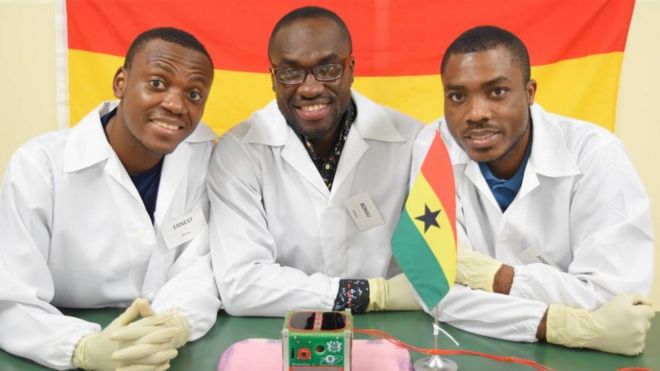
The development team behind the satellite

Ghana has successfully launched its first satellite into space.

GhanaSat-1, which was developed by students at All Nations University in Koforidua, was sent into orbit from the International Space Centre.

Cheers erupted as 400 people, including the engineers, gathered in the southern Ghanaian city to watch live pictures of the launch. The first signal was received shortly afterwards.

It is the culmination of a two-year project, costing $50,000 (£40,000).

It received support from the Japan Aerospace Exploration Agency (JAXA).

The satellite will be used to monitor Ghana's coastline for mapping purposes, and to build capacity in space science and technology.

Project coordinator Dr Richard Damoah said it marked a new beginning for the country.

"It has opened the door for us to do a lot of activities from space," he told the BBC.

He said it would "also help us train the upcoming generation on how to apply satellites in different activities around our region.

"For instance, [monitoring] illegal mining is one of the things we are looking to accomplish."


30 March 2017

Denmark's Statements to the United Nations on its Slave History

Republished from 11 September 2008 Overseas Territories Review


____________________________________________________

Denmark's Statement on its Slave History

On 3rd July 2008, the 160th anniversary of the abolition of slavery was commemorated in the former Danish West Indies (now the US Virgin Islands). Activities were held on the islands of St. John and St. Thomas, with the main events conducted in Frederiksted, St. Croix consistent with established practice. Simultaneously, the Government of Denmark released a statement marking the historic day which was welcomed, but which also fell short of the 'apology' sought by many in the territory. Below is the unofficial translation of the statement:
________________________________________

Declaration by the Government of Denmark at the 160 th anniversary of the abolition of slavery in the former Danish West Indies (now US Virgin Islands) 

On 3 July 2008 160 years have passed since slavery was abolished in the former Danish West Indies (now US Virgin Islands), thus closing a dark chapter in Denmark’s role as colonial power on the Islands. 

The use of slaves was then legal. Fortunately the international society has moved a long way since then. Slavery is rightfully recognized as a crime against humanity, including by the UN World Conference Against Racism in 2001, and is today one of the crimes under the jurisdiction of the International Criminal Court. 

The period of slavery was a grim period, but it remains regrettably a fact, which we – like other countries – need to acknowledge as a part of the past and our common historical heritage. Therefore it is not a period to be forgotten. Thus a major outcome of the UN World Conference Against Racism in Durban in 2001 was the decision that we have a collective responsibility to remember the atrocities of slavery and its victims and to seek reconciliation and healing with the descendants of the slaves. 

The Government has therefore supported and will continue to support activities, which aim to gather information about the period of slavery and provide information about it, including through UNESCO. 

In relation to the Virgin Islands the Danish Ministry of Culture initiated in 1999 a framework for cooperation with the Islands on archives and museum activities with the purpose to explore the common past during the slavery period and to develop cultural cooperation. The Government recognizes civil society’s interest for the common history and is examining if it is possible to strengthen further the cooperation in the fields of culture and history. 

The Government is very much aware, that even in our days there are people, who live under forms of modern slavery or similar conditions, including as victims of trafficking in women and children, child labour and recruitment of child soldiers. The Government strongly condemns these practices. Therefore Denmark actively participates in cooperation at regional and international levels to fight these modern forms of slavery. 

Copenhagen 3 July 2008
____________________________________________________

One year prior, the United Nations General Assembly by its Resolution 61/19 decided to designate 25 March 2007 as the International Day for the Commemoration of the Two-hundredth Anniversary of the Abolition of the Transatlantic Slave Trade. The Assembly also "urged Member States that had not already done so to develop educational programmes, including through school curricula, designed to educate and inculcate in future generations an understanding of the lessons, history and consequences of slavery and the slave trade." The resolution also requested governments to submit a report on initiatives taken to implement paragraphs 101 and 102 of the Durban Declaration of the World Conference against Racism, Racial Discrimination, Xenophobia and Related Intolerance aimed at countering the legacy of slavery and contributing to the restoration of the dignity of the victims of slavery and the slave trade. Below is the report submited by the Government of Denmark to the Secretary General of the United Nations:
_______________________________________________

Denmark
[Original: English]


1. Denmark is deeply concerned with the legacy of slavery and the restoration of the dignity of the victims of slavery and the slave trade, and thus wholeheartedly supported the adoption of General Assembly resolution 61/19.


2. At the World Conference against Racism, Racial Discrimination, Xenophobia and Related Intolerance in 2001, the European Union was pleased to join international consensus in acknowledging that slavery and the slave trade are a crime against humanity and should always have been so.

3. On 25 March 2007, the day designated by the General Assembly as the International Day for the Commemoration of the Two-hundredth Anniversary of the Abolition of the Transatlantic Slave Trade, the European Union issued a statement reiterating the position that the barbarism of transatlantic slave trade constitutes one of the darkest chapters of our history, in terms of its magnitude, its organized nature and particularly its negation of the human dignity of the victims.

4. The statement also underlined the commitment of the European Union member States to fight various forms of modern slavery, such as bonded labour and human trafficking.

5. In May 2007, Denmark pledged a contribution of $10,000 towards the proposed permanent memorial to the victims of the transatlantic slave trade and slavery, which would be placed in the halls of the United Nations, an initiative led by member States of the Caribbean Community.

6. On 3 July 1848, slavery was abolished in the Danish West Indies (today the United States Virgin Islands). The Danish Government is currently considering an appropriate way to commemorate the 160-year anniversary in 2008, taking into account the sentiments of the descendants of the slaves living today in the United States Virgin Islands and Ghana, from where the majority of slaves originated.

7. It should also be mentioned that the Danish National Museum on 8 October 2007 will be opening the main building at the former slave-plantation “Frederiksgave” in Ghana to a public audience, following the renovation of the plantation. This project is part of the National Museum’s ongoing research into the Danish slave trade and other activities related to the Danish colonies in Africa and the West Indies. The Danish Minister for Cultural Affairs will be participating in the opening. The renovated museum at “Frederiksgave” will provide audiences with information about the cultural background and history of the slave trade, including about the transatlantic slave trade and the use of slaves in the Danish colonies in the West Indies.

8. Furthermore, a total of 19 Danish schools under the United Nations Educational, Scientific and Cultural Organization Associated School Project will commemorate the two-hundredth anniversary of the abolition of the transatlantic slave trade on 23 August 2007, as part of the transatlantic slave trade education project.

24 March 2017

Canada’s role in the overthrow of Kwame Nkrumah

Home


OAU


Friday, February 24 (was) the anniversary of the 1966 coup against leading Pan-Africanist Kwame Nkrumah. Canada played a key role. Following the coup, the Canadian High Commissioner in Accra C.E. McGaughey, wrote that “a wonderful thing has happened for the West in Ghana and Canada has played a worthy part.”

A half-century and one year ago... Canada helped overthrow a leading Pan-Africanist president. Ghana’s Canadian-trained army overthrew Kwame Nkrumah, a leader dubbed “Man of the Millennium” in a 2000 poll by BBC listeners in Africa.

Washington, together with London, backed the coup. Lester Pearson’s government also gave its blessing to Nkrumah’s ouster. In The Deceptive Ash: Bilingualism and Canadian Policy in Africa: 1957-1971, John P. Schlegel writes: “the Western orientation and the more liberal approach of the new military government was welcomed by Canada.”

The day Nkrumah was overthrown the Canadian prime minister was asked in the House of Commons his opinion about this development. Pearson said nothing of substance on the matter. The next day External Affairs Minister Paul Martin Sr. responded to questions about Canada’s military training in Ghana, saying there was no change in instructions. In response to an MP’s question about recognizing the military government, Martin said:

“In many cases recognition is accorded automatically. In respective cases such as that which occurred in Ghana yesterday, the practice is developing of carrying on with the government which has taken over, but according no formal act until some interval has elapsed. We shall carry on with the present arrangement for Ghana. Whether there will be any formal act will depend on information which is not now before us.”


READ THE FULL REPORT IN PAMBUZKA

.

14 March 2016

West Papuans seek African support on quest for self-determination


The people of West Papua are sending desperate calls on government officials and leaders of Ghana to assist them in their bid to join the United Nations.


Nobel peace prize nominee and Spokesperson for the United Liberation Movement for West Papua (ULMWP), Chief Benny Wenda joined Ghanaians to mark Ghana's 59th independence anniversary on 6th March, 2016. 

During his stay, he interacted with prominent people in the country, including Reverend Dr Fred Deegbe, former head of the Christian Council of Ghana (CCG), and former presidents Kufuor and Rawlings.

Reverend Deegbe prayed for the people of West Papua and Chief Benny Wenda for his visit to Ghana. "God made people and wants people everywhere to be free". He also promised to raise the issue of West Papua at an upcoming church meetings in the USA.

Rev Deegbe who is a Senior Pastor at the Calvary Baptist Church served the CCG as General Secretary from July 2003 until April 2013. 

In a meeting with former President John Agyekum Kufuor and former AU Chair, the former president pledged support for the liberation of the people of West Papua. "It is important that humanity should be central to everything. As a human being you are entitled to humanity. 

In due course humanity will prevail and you will be free." "The whole world will support you. Not even Indonesia can stop it" "Ghana was once a colony for 100 years, Nkrumah was our liberator, he was a pan africanist and you see yourselves as Africans. What you are doing is the right way. 

The photos of your people bear witness to a true leader of your people. Some of our paramount chiefs wear feathers. The same but eagle feathers. Despite the distances between our places we are the same. Clearly you are not Indonesian."

Former President Jerry John Rawlings has also pledged his support to fight for the independence of the West Papuans. He said "we are honoured to fight for your people. We share a similar history."

"It is no surprise to me that you had support from Ghana at the UN in 1969 and that we accepted West Papuan refugees in the 1980's. West Africa has seen slavery, colonial struggles and independence"

"Chief you find yourself in a very painful situation. I suggest that you contact and lobby every congressman, senator and parliamentarian. The European Commission, the AU and all organisations. Keep knocking and knock again, don't let them sleep"

"We will contribute by reminding them who is still colonised"

"Keep fighting"

Flt Lt Jerry John Rawlings, former President of Ghana made the statements when he met with Chief Benny Wenda, spokesman for the United Liberation Movement for West Papua (ULMWP) and Nobel Peace prize nominee.

All across Africa and around the world people are finding out about Indonesia's Genocide and illegal colonisation of West Papua. West Papua has a legal right to self determination, de colonisation and independence. 

West Papua is the western half of the Melanesian island of New Guinea, in the Pacific Ocean, bordering the independent nation of Papua New Guinea (PNG). It lies just 200km north of Australia and the indigenous Melanesian people have lived there for over 40,000 years. 

West Papua was colonised by the Dutch in 1898 and always administered as “Dutch New Guinea” separate from their “Dutch East Indies” which is now Indonesia. With the promise of independence on 1st December 1970 and on 1st December 1961, the West Papuan national flag was raised with the beginnings of a democratically elected government formed, announcing a 9 year period of peaceful transition towards independence. 

Politics before Papuans But within months the dream was dead. The newly independent state of Indonesia wanted access to West Papua's vast wealth and the military promptly invaded West Papua. Conflict broke out between the Netherlands, Indonesia and the indigenous population regarding control of the territory.

Due to US' fear that failing to appease Indonesia could result in the spread of South East Asian communism, the US government intervened and engineered an agreement between Indonesia and the Netherlands, which in 1962 gave control of West Papua to the United Nations and one year later transferred control to Indonesia. 

The Papuans were never consulted and after a sham referendum in 1969 with 1026 people handpicked Papuans being forced to vote for Indonesian sovereignty, West Papua officially became part of Indonesia. 

The military occupation and secret genocide The West Papuan people never accepted Indonesia in their country and ever since 1963, have resisted Indonesian rule, first with bows and arrows and what little guns they could and then with peaceful civil resistance.

The people of West Papua have regularly organise mass protests for self determination and independence and continue to appeal to the international community from speaking out through media to diplomatic pleas by exiled Papuans.

Through a vast wealth of natural resources, like the largest goldmine on Earth (Grasberg), West Papua has become Indonesia’s largest GDP contributor, and with the prospect of an independent West Papua looking with international support, Indonesia does not want Papuans telling the outside world the truth.

Not only has the Indonesian government banned all foreign journalists and human rights groups from West Papua but the Indonesian military and police also systematically target any West Papuans campaigning for independence and brands them as “separatists” and “terrorists”.

05 November 2013

US Virgin Islands Legislature conducts hearings on Danish Slavery

"The economies of Denmark and other European nations were built on the backs of centuries of uncompensated forced labour of enslaved Africans. It is the same racist mindset which sustained this massive "crime against humanity" which now denies any culpability." - a Virgin Islands historian     

www.nigerianmuse.com 


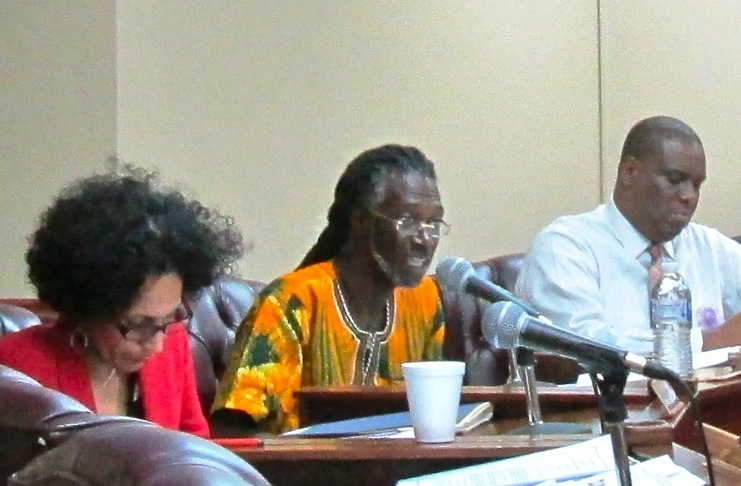
Sens. Nereida Rivera-O'Reilly, Terrence Nelson and Kenneth Gittens at Wednesday's hearing on a reparations related bill.

A small, far-left Danish political party has called on the government of Denmark to apologize for its role in the transatlantic slave trade, St. Croix slavery reparations activist Shelley Moorhead told a Senate panel Wednesday.

Moorhead was testifying to the Culture, Historic Preservation, Youth and Recreation Committee in opposition to a resolution asking the U.S. Congress to set up a truth and reconciliation committee on the topic.

"Today's headlines in Denmark read that the Unity Party asks Denmark to apologize for its slave past,” Moorhead testified. It is the first Danish political party to do so, he said.

The party, a coalition of several smaller parties called "Enhedslisten" or "Unity Party," or Red-Green Alliance, controls 12 seats in the 175-seat Danish parliament, making it the fifth largest party in parliament, and the fourth largest left of center party. It is a member of the current governing coalition of parties.

The party is acknowledging the V.I. Legislature taking up the question of slavery apologies and reparations, Moorhead said.

Reports in Danish newspapers, including the English version of the largest Danish paper, The Copenhagen Post, quote party officials saying the Danish government should weigh in before the V.I. Legislature votes on the bill.

"Denmark has a gruesome history with active involvement in slave trade," Unity Party foreign affairs spokesperson Nikolaj Villumsen said in a Danish radio interview, according to the Post. "An official apology is important for two reasons. One is to pay sympathies to the descendants of slaves and the other reason is to have a debate in Denmark about our slavery past," the Post quotes him as saying.

But that view is not universal. The far right party, Dansk Folkeparti, which has 22 seats in parliament, said that Denmark shouldn't be held responsible for something that happened "200 years ago."

"That is completely nuts. You could say that these people should feel lucky that they are now American citizens in a free country and not in Ghana," DF spokesperson Soren Espersen told Politiken newspaper in Denmark. (wow...)

The Copenhagen Post reported that Denmark has previously declined to address reparations "because it could affect ties with the U.S." 

The committee was hearing testimony on a bill, sponsored by Sens. Sammuel Sanes and Judi Buckley, that would urge Congress to establish a truth and reconciliation commission. [Bill 30-0196]

Moorhead and several other testifiers, including Dr. Chenzira Kahina and former Sen. Usie Richards, said they opposed the bill partly because it asks Congress to act instead of creating a local commission, and because it is weaker than past resolutions approved by the Legislature.

The bill's intent "is both contradictory to reparations for the people of the U.S. Virgin Islands and in direct contravention of the Legislature's expressed intent and action" in a 2005 resolution "to condemn the institution of slavery and seek reparations from Denmark," Moorhead said.

He said he objects to Congress setting up the commission, reading from his prepared remarks that "it can and should be argued that "THIS is OUR effort," and, WE the descendants of the enslaved, those who suffered (and continue to suffer) for the establishment and administration any such relevant commission. As for your governor .. well, I gon leave ahyou mek da argument." (Note: The spelling here is from Moorhead's written testimony)

Richards said "we should not be encouraged to go to the United States Congress to create an entity to speak on our behalf." Instead the Legislature could create a commission and name its members, he suggested.

Sanes said he developed the bill over the past decade, working with St. Croix activist Edward Browne, and he asked Browne to explain why it called for asking Congress to act. Browne testified that Danish government officials had told him in no uncertain terms they would not speak or negotiate with any nongovernmental entity or any component part or territory of another sovereign nation, but only with that sovereign government.

Sen. Terrence "Positive" Nelson asked Richards if he agrees it is appropriate to go to Congress or not. Richards replied that nongovernmental organizations could not negotiate with the government of Denmark, but the government of the Virgin Islands could act and he sees "no reason to wait."

Several testifiers suggested the territory needs a single, unified strategic plan for reparations and that the Legislature should get more input from local organizations while preparing the plan.

Senate President Shawn-Michael Malone joined the meeting toward the end, saying he would speak to his fellow senators and the governor and "see if a comprehensive approach can be worked out."

"Whether we agree or disagree that this is the way to get there it is important that we are sitting down to have this discussion," Malone said.

Nelson moved to hold the bill for further discussion and amendment. Voting to hold the bill for amendment were Nelson, Malone, Sens. Kenneth Gittens, Nereida "Nellie" Rivera-O'Reilly and Myron Jackson. Sens. Tregenza Roach and Janette Millin Young were absent.

Jackson and Malone said there would be further hearings on the topic in both districts.

**********

This is about centuries of forced labour of enslaved Africans. This free labour made an enormous contribution to building the economy of Denmark (as well as France, U.K., the Netherlands, Spain, the U.S. and others). When slavery was ended, it was the former slaveholders - not the former enslaved - who were compensated, with the former enslaved left to fend for themselves under new forms of oppression such as colonial governance which has inevitably led to the political underdevelopment of dependencies. The organic link between slavery and colonialism is well established. 

The world has rightly condemned slavery and the horrific Trans-Atlantic Slave Trade as crimes against humanity. This is why the Caribbean countries have taken three of these E.U. countries to the International Court of Justice on the basis of just claims for reparation. 

This is not simply a request for an apology for the crimes perpetuated by someone's ancestors. Rather, this is a call for reparation for past crimes committed by European and North American nations whose people now enjoy a standard of living built on man's inhumanity to man.

Lest we forget.

OTR 

******

29 May 2011

Gil Scott Heron joins the Ancestors

*****
Sign of the Ages
 Gil Scott Heron

It’s the sign of the ages
Markings on my mind
Man at the crossroads
At odds with an angry sky
There can be no salvation
There can be no rest
Until all old customs
Are put to the test
The gods are all angry
You hear from the breeze
As night slams like a hammer
And you drop to your knees
The questions can’t be answered
You’re always haunted by the past
The world’s full of children
Who grew up too fast
Yea, but where can you run
Since there a’int no world of your own
And you know that no one will ever miss you
When you’re finally gone
So you cry like a baby
Or you go out and get high
But there ain’t no peace on earth
Maybe peace when you die
Yea…


We will miss you, my brother
Rest well
Peace.


11 September 2008

Denmark's Statement on its Slave History

On 3rd July 2008, the 160th anniversary of the abolition of slavery was commemorated in the former Danish West Indies (now the US Virgin Islands). Activities were held on the islands of St. John and St. Thomas, with the main events conducted in Frederiksted, St. Croix consistent with established practice.

Simultaneously, the Government of Denmark released a statement marking the historic day which was welcomed, but which also fell short of the 'apology' sought by many in the territory. Below is the unofficial translation of the statement:


Declaration by the Government of Denmark at the 160 anniversary of the abolition of slavery in the former Danish West Indies (now US Virgin Islands)

On 3 July 2008 160 years have passed since slavery was abolished in the former Danish West Indies (now US Virgin Islands), thus closing a dark chapter in Denmark’s role as colonial power on the Islands.

The use of slaves was then legal. Fortunately the international society has moved a long way since then. Slavery is rightfully recognized as a crime against humanity, including by the UN World Conference Against Racism in 2001, and is today one of the crimes under the jurisdiction of the International Criminal Court.

The period of slavery was a grim period, but it remains regrettably a fact, which we – like other countries – need to acknowledge as a part of the past and our common historical heritage. Therefore it is not a period to be forgotten. Thus a major outcome of the UN World Conference Against Racism in Durban in 2001 was the decision that we have a collective responsibility to remember the atrocities of slavery and its victims and to seek reconciliation and healing with the descendants of the slaves.

The Government has therefore supported and will continue to support activities, which aim to gather information about the period of slavery and provide information about it, including through UNESCO.

In relation to the Virgin Islands the Danish Ministry of Culture initiated in 1999 a framework for cooperation with the Islands on archives and museum activities with the purpose to explore the common past during the slavery period and to develop cultural cooperation. The Government recognizes civil society’s interest for the common history and is examining if it is possible to strengthen further the cooperation in the fields of culture and history.

The Government is very much aware, that even in our days there are people, who live under forms of modern slavery or similar conditions, including as victims of trafficking in women and children, child labour and recruitment of child soldiers. The Government strongly condemns these practices. Therefore Denmark actively participates in cooperation at regional and international levels to fight these modern forms of slavery.

Copenhagen 3 July 2008

____________________________________________________________________________


One year prior, The United Nations General Assembly by its Resolution 61/19 decided to designate 25 March 2007 as the International Day for the Commemoration of the Two-hundredth Anniversary of the Abolition of the Transatlantic Slave Trade. The Assembly also "urged Member States that had not already done so to develop educational programmes, including through school curricula, designed to educate and inculcate in future generations an understanding of the lessons, history and consequences of slavery and the slave trade."

The resolution also requested governments to submit a report on initiatives taken
to implement paragraphs 101 and 102 of the Durban Declaration of the World
Conference against Racism, Racial Discrimination, Xenophobia and Related
Intolerance aimed at countering the legacy of slavery and contributing to the
restoration of the dignity of the victims of slavery and the slave trade.

Below is the report submited by the Government of Denmark to the Secretary General of the United Nations:


Denmark
[Original: English]


1. Denmark is deeply concerned with the legacy of slavery and the restoration of
the dignity of the victims of slavery and the slave trade, and thus wholeheartedly
supported the adoption of General Assembly resolution 61/19.

2. At the World Conference against Racism, Racial Discrimination, Xenophobia
and Related Intolerance in 2001, the European Union was pleased to join
international consensus in acknowledging that slavery and the slave trade are a
crime against humanity and should always have been so.

3. On 25 March 2007, the day designated by the General Assembly as the
International Day for the Commemoration of the Two-hundredth Anniversary of the
Abolition of the Transatlantic Slave Trade, the European Union issued a statement
reiterating the position that the barbarism of transatlantic slave trade constitutes one of the darkest chapters of our history, in terms of its magnitude, its organized nature and particularly its negation of the human dignity of the victims.

4. The statement also underlined the commitment of the European Union member
States to fight various forms of modern slavery, such as bonded labour and human
trafficking.

5. In May 2007, Denmark pledged a contribution of $10,000 towards the
proposed permanent memorial to the victims of the transatlantic slave trade and
slavery, which would be placed in the halls of the United Nations, an initiative led
by member States of the Caribbean Community.

6. On 3 July 1848, slavery was abolished in the Danish West Indies (today the
United States Virgin Islands). The Danish Government is currently considering an
appropriate way to commemorate the 160-year anniversary in 2008, taking into
account the sentiments of the descendants of the slaves living today in the United
States Virgin Islands and Ghana, from where the majority of slaves originated.

7. It should also be mentioned that the Danish National Museum on 8 October
2007 will be opening the main building at the former slave-plantation
“Frederiksgave” in Ghana to a public audience, following the renovation of the
plantation. This project is part of the National Museum’s ongoing research into the
Danish slave trade and other activities related to the Danish colonies in Africa and
the West Indies. The Danish Minister for Cultural Affairs will be participating in the opening. The renovated museum at “Frederiksgave” will provide audiences with
information about the cultural background and history of the slave trade, including
about the transatlantic slave trade and the use of slaves in the Danish colonies in the West Indies.

8. Furthermore, a total of 19 Danish schools under the United Nations
Educational, Scientific and Cultural Organization Associated School Project will
commemorate the two-hundredth anniversary of the abolition of the transatlantic
slave trade on 23 August 2007, as part of the transatlantic slave trade education
project.