Showing posts with label slavery. Show all posts

25 August 2017

On Day of Remembrance, UN says history of slave trade can help combat social injustice

U.N. NEWS CENTRE


Shackles used to bind slaves. UN Photo/Mark Garten

23 August 2017 – Remembering the universal demand for freedom that led to the 1791 insurrection by slaves in what is now Haiti, the head of the United Nations cultural and educational agency today marked the International Day for the Remembrance of the Slave Trade and its Abolition by underscoring the importance of teaching this history to young people.
“We are counting on the teaching of this history to place tomorrow's citizens on the path to peace and dignity,” said Irina Bokova, in a message to mark the Day, which is observed annually on 23 August.
Ms. Bokova is the Director-General of UN Educational, Scientific and Cultural Organization (UNESCO), which has played a leading role within the UN system in fostering understanding and recognition of the slave trade.
“Everyone must know the scale of the crime of the slave trade, the millions of lives broken and the impact on the fate of continents up to this very day. Everyone must be fully informed of the struggle that led to its abolition, so that together we can build societies that are fairer, and thus freer,” the senior UN official said.
She pointed to modern slavery and human trafficking, as well as ongoing social injustices, racism and racial discrimination, and said the legacy of the 1791 insurrection offer hope to eradicating those scourges.
Ignorance is our enemy: it is used as an alibi by the indifferent who state that 'we cannot change anything'UNESCO chief Irina Bokova
“Freedom of rights, hardwon by force, must be translated into real freedom through public policies that guarantee to people of African descent the full exercise of economic, social and political equality, and full and equal participation in society,” Ms. Bokova said.
“The 1791 uprising, like so many others across the world, shows us the way, but the path ahead is still long, she said, adding: “Ignorance is our enemy: it is used as an alibi by the indifferent who state that 'we cannot change anything,' and sanctions the lies of those who claim that 'they did not know.'”
Everyone, continued the UNECSCO chief, must know the scale of the crime of the slave trade, the millions of lives broken and the impact on the fate of continents up to this very day. “Everyone must be fully informed of the struggle that led to its abolition, so that together we can build societies that are fairer, and thus freer.”
To honour the history of the slave trade and its abolition, UNESCO earlier this year added to its World Heritage List the Mbanza Kongo, Vestiges of the Capital of the former Kingdom of Kongo (Angola) and the Valongo Wharf Archaeological Site (Brazil), as an acknowledgement of their “outstanding universal value.”
In 2015, the Valongo Wharf Archaeological Site was recognized as a site of memory associated with the UNESCO Slave Route Project: Resistance, Liberty, Heritage. Recognition of this heritage is decisive in raising the awareness of the general public, educating young people and in the processes of conciliation and social cohesion.
The Slave Route project, established in 1994, consists of creating opportunities to promote mutual understanding and international reconciliation and stability through consultation and discussion. It also raises awareness, promotes debate and helps build consensus on approaches to be taken on addressing the issue of the slave trade and slavery.
This year, the International Day for the Remembrance of the Slave Trade and its Abolition is also part of the International Decade for People of African Descent, which began in 2015, and seeks to help boost political commitments in favour of people of African descent.

05 April 2017

DANISH PRIME MINISTER: "THERE IS NO JUSTIFICATION FOR SLAVERY"

Danish Prime Minister Lars Lokke Rasmussen (r) is greeted by U.S. President Donald J. Trump at the White House. The Prime Minister visited Washington before his visit to the U.S. Virgin Islands to participate in the activities associated with the 100th anniversary of the transfer of the Danish West Indies to the United States on 31st March 1917 (gettyimages.com)


31 March 2017


(Check against delivery)

Your excellency, Governor Mapp. 
Your excellency, Secretary Zinke. 
Your excellencies. 
Ladies and Gentlemen.

It is an honour for me to be here today. And a great pleasure to visit your beautiful island for the third time.

My wife and I have been greeted by sincere hospitality from the moment we arrived. For this, I am truly grateful. We are very pleased to be back.

On this exact day – a hundred years ago – the Stars and Stripes of America replaced the Danish Dannebrog as the official flag for the Virgin Islands.

A hundred years. It is a long time ago.

But the preceding years under the Danish flag are not forgotten. Neither in Denmark nor at the Virgin Islands.

Still today city names such as Frederiksted and Christiansted remind us of our common past. And so do the many houses and buildings, that still bear the marks of Danish presence.

I’m pleased, that thousands of my fellow countrymen visit your beautiful island every year – and this year in particular.

They feel a special bond of friendship with you and your home. So do I, as I stand here on this historic day. A touch of common destiny that time cannot erase.

But although we share a common past – we have not always shared the same story about that past.

When I was a child – the popular Danish story about the West Indies, was a romantic one. Exotic islands. Peaceful coexistence.

I even remember the tales of the Danish king, who was the first in the world to ban slave trade. A pioneer of humanity, we were told. A hero.

But most of you were told and lived a different story. The true story.

A story of how slavery continued after the ban. How too often conditions only improved on paper. And of how many of your ancestors continued to suffer.

The true heroes were the men and women who stood up to the injustice.

Over the years our history has been explored and questioned.

And today we can study the millions of historic documents and pictures from the Virgin Islands. They are now available online thanks to the Danish National Archives. Many of them so precious, they have been proclaimed as world heritage by UNESCO.

Sure, it is important to get the facts right.

But I suggest we also look somewhere else: In our hearts and minds.

I suggest we ask ourselves: Is there any justification for suppression? Any argument for treating people brutally?

We all know the answer.

The answer is no!

There is no justification – what so ever – for the exploitation of men, women and children that took place in these islands under Danish flag.

There is no justification for slavery. It is unforgiveable.

Unforgiveable.

It is a dark and disgraceful part of Danish history.

So when I search my heart. My mind. There is no doubt: The true heroes of the past are the men and women of the Virgin Islands who defied suppression.

They were not given their freedom. They took it back. Led by brave souls. Who risked their own lives to set their fellow countrymen free.

Men like General Buddhoe.

Who led the rebellion of 1848. Riding on a white horse. Fighting for emancipation. Imprisoned. Deported. But at the end successful – fulfilling his mission.

Fierce women like Queen Mary, Queen Agnes and Queen Mathilda.

Who rebelled against the appalling living conditions, healthcare, education and wages. Imprisoned in Denmark, right next to the Danish parliament!

Patriots like David Hamilton Jackson.

A teacher and idealist. Who dedicated his life to improve the conditions for the people of St. Croix. By peaceful but passionate means.

The story goes, that when David Hamilton Jackson once criticized the Danish Governor in a harsh tone, the Governor replied by calling Jackson a dreamer.

This was probably meant as an insult – but isn’t it rather a badge of honor?

Only when we dare to dream of a brighter future will the beacons of freedom be at sight.

This was the case for Mr. Hamilton Jackson. And that is the case for us all.

Dear friends.

We must acknowledge that what happened in the past has affected where the islands are today. We cannot undo the past. What we can do is to improve the future.

Only by freeing ourselves from the nightmares of the past can we make our dreams of the future come true.

This is the lesson from the true heroes of the past. Despite overwhelming obstacles, their ideals of liberty, equality and dignity prevailed.

Today, the people of Denmark and the people of the Virgin Islands share common historic bonds.

Today, we share the same view of history.

And today, we share the same heroes.

And hopefully, we shall also share a bright future.

Tomorrow, I will make a visit to the University of the Virgin Islands, where I will launch a five year scholarship program.

It is my hope, that this new program will pave the way for further development in both our countries. And bring new hope and opportunities to young people in the Virgin Islands.

The youth of our countries are the future. They must keep their dreams alive. Take destiny into their own hands.

Just as the heroes of the past did. And this time around, we will not hold them back. We will push them forward.

I wish you all a meaningful and memorable Transfer Day.

Thank you.

30 March 2017

Denmark's Statements to the United Nations on its Slave History

Republished from 11 September 2008 Overseas Territories Review


____________________________________________________

Denmark's Statement on its Slave History

On 3rd July 2008, the 160th anniversary of the abolition of slavery was commemorated in the former Danish West Indies (now the US Virgin Islands). Activities were held on the islands of St. John and St. Thomas, with the main events conducted in Frederiksted, St. Croix consistent with established practice. Simultaneously, the Government of Denmark released a statement marking the historic day which was welcomed, but which also fell short of the 'apology' sought by many in the territory. Below is the unofficial translation of the statement:
________________________________________

Declaration by the Government of Denmark at the 160 th anniversary of the abolition of slavery in the former Danish West Indies (now US Virgin Islands) 

On 3 July 2008 160 years have passed since slavery was abolished in the former Danish West Indies (now US Virgin Islands), thus closing a dark chapter in Denmark’s role as colonial power on the Islands. 

The use of slaves was then legal. Fortunately the international society has moved a long way since then. Slavery is rightfully recognized as a crime against humanity, including by the UN World Conference Against Racism in 2001, and is today one of the crimes under the jurisdiction of the International Criminal Court. 

The period of slavery was a grim period, but it remains regrettably a fact, which we – like other countries – need to acknowledge as a part of the past and our common historical heritage. Therefore it is not a period to be forgotten. Thus a major outcome of the UN World Conference Against Racism in Durban in 2001 was the decision that we have a collective responsibility to remember the atrocities of slavery and its victims and to seek reconciliation and healing with the descendants of the slaves. 

The Government has therefore supported and will continue to support activities, which aim to gather information about the period of slavery and provide information about it, including through UNESCO. 

In relation to the Virgin Islands the Danish Ministry of Culture initiated in 1999 a framework for cooperation with the Islands on archives and museum activities with the purpose to explore the common past during the slavery period and to develop cultural cooperation. The Government recognizes civil society’s interest for the common history and is examining if it is possible to strengthen further the cooperation in the fields of culture and history. 

The Government is very much aware, that even in our days there are people, who live under forms of modern slavery or similar conditions, including as victims of trafficking in women and children, child labour and recruitment of child soldiers. The Government strongly condemns these practices. Therefore Denmark actively participates in cooperation at regional and international levels to fight these modern forms of slavery. 

Copenhagen 3 July 2008
____________________________________________________

One year prior, the United Nations General Assembly by its Resolution 61/19 decided to designate 25 March 2007 as the International Day for the Commemoration of the Two-hundredth Anniversary of the Abolition of the Transatlantic Slave Trade. The Assembly also "urged Member States that had not already done so to develop educational programmes, including through school curricula, designed to educate and inculcate in future generations an understanding of the lessons, history and consequences of slavery and the slave trade." The resolution also requested governments to submit a report on initiatives taken to implement paragraphs 101 and 102 of the Durban Declaration of the World Conference against Racism, Racial Discrimination, Xenophobia and Related Intolerance aimed at countering the legacy of slavery and contributing to the restoration of the dignity of the victims of slavery and the slave trade. Below is the report submited by the Government of Denmark to the Secretary General of the United Nations:
_______________________________________________

Denmark
[Original: English]


1. Denmark is deeply concerned with the legacy of slavery and the restoration of the dignity of the victims of slavery and the slave trade, and thus wholeheartedly supported the adoption of General Assembly resolution 61/19.


2. At the World Conference against Racism, Racial Discrimination, Xenophobia and Related Intolerance in 2001, the European Union was pleased to join international consensus in acknowledging that slavery and the slave trade are a crime against humanity and should always have been so.

3. On 25 March 2007, the day designated by the General Assembly as the International Day for the Commemoration of the Two-hundredth Anniversary of the Abolition of the Transatlantic Slave Trade, the European Union issued a statement reiterating the position that the barbarism of transatlantic slave trade constitutes one of the darkest chapters of our history, in terms of its magnitude, its organized nature and particularly its negation of the human dignity of the victims.

4. The statement also underlined the commitment of the European Union member States to fight various forms of modern slavery, such as bonded labour and human trafficking.

5. In May 2007, Denmark pledged a contribution of $10,000 towards the proposed permanent memorial to the victims of the transatlantic slave trade and slavery, which would be placed in the halls of the United Nations, an initiative led by member States of the Caribbean Community.

6. On 3 July 1848, slavery was abolished in the Danish West Indies (today the United States Virgin Islands). The Danish Government is currently considering an appropriate way to commemorate the 160-year anniversary in 2008, taking into account the sentiments of the descendants of the slaves living today in the United States Virgin Islands and Ghana, from where the majority of slaves originated.

7. It should also be mentioned that the Danish National Museum on 8 October 2007 will be opening the main building at the former slave-plantation “Frederiksgave” in Ghana to a public audience, following the renovation of the plantation. This project is part of the National Museum’s ongoing research into the Danish slave trade and other activities related to the Danish colonies in Africa and the West Indies. The Danish Minister for Cultural Affairs will be participating in the opening. The renovated museum at “Frederiksgave” will provide audiences with information about the cultural background and history of the slave trade, including about the transatlantic slave trade and the use of slaves in the Danish colonies in the West Indies.

8. Furthermore, a total of 19 Danish schools under the United Nations Educational, Scientific and Cultural Organization Associated School Project will commemorate the two-hundredth anniversary of the abolition of the transatlantic slave trade on 23 August 2007, as part of the transatlantic slave trade education project.


22 March 2017

100TH ANNIVERSARY OF TRANSITION FROM DANISH WEST INDIES TO U.S. VIRGIN ISLANDS TO BE OBSERVED ON 31ST MARCH


"It was the Danish King Christian V who granted the Danish West India and Guinea Company permission to establish the colonies under the Danish flag."(The West Indian Heritage)


_____________________________________________________


ST. THOMAS — As the formal representative of Denmark, Prime Minister Lars Løkke Rasmussen will be among the distinguished guests attending the ceremonies to commemorate the 100th anniversary of the territory of the United States Virgin Islands, Government House announced this afternoon. Mr. Løkke Rasmussen will participate in the Transfer Centennial programs to be held on St. Croix and St. Thomas on March 31, 2017.

“The U.S. Virgin Islands makes up an important part of the Danish history and the Centennial stands for a significant milestone,” the prime minister said in an official statement. “Through my participation and my presence, I look forward to meeting the people and politicians on the islands and show them our respect for them and the history.”

Governor Kenneth Mapp said the people of the Virgin Islands will be pleased to welcome Mr. Rasmussen, his delegation, and dignitaries from around the world to take part in ceremonies and events associated with the transfer.

“This is an important chapter in our history and we deeply appreciate the participation of Prime Minister Løkke Rasmussen,” Mr. Mapp said. “I have asked the people of the U.S. Virgin Islands to treat the occasion of the Transfer Centennial as a time of both serious reflection and preparation. Together we must determine how, given our unique status and history, we can best set a path forward over the next 100 years.”

In the prime minister’s New Year’s Day address to the nation of Denmark, he made mention of this year’s Centennial commemoration and noted that many Danes are expected to take part in this year’s events.

Mr. Løkke Rasmussen has served as prime minister of Denmark since June 2015. He was previously prime minister from April 2009 to October 2011. He is the leader of the Venstre political party. He will be accompanied to the territory by his wife, Sólrun Jákupsdóttir Rasmussen.
_____________________________________


31 January 2017

African Union criticises US for ‘taking many of our people as slaves’ and not taking refugees


Trump has suspended all US refugee programmes and banned immigration from seven Muslim-majority countries, three of which are AU members


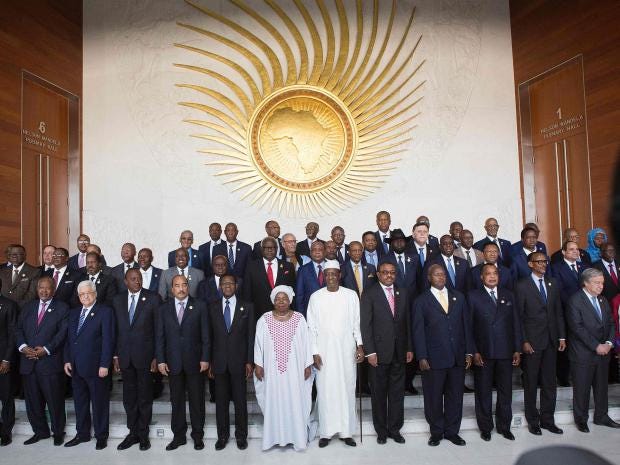
African Heads of State pose for a group photo ahead of the start of the 28th African Union summit in Addis Ababa on 30 January, 2017 AFP


The head of the African Union has criticised Donald Trump’s ban on immigration from some Muslim-majority countries, saying it presents “one of the greatest challenges” for the continent.

As representatives of the AU’s 53 member states met in Addis Ababa for a two-day summit, the chief of its commission said the bloc was entering “very turbulent times” after the US President’s election.

“The very country to which many of our people were taken as slaves during the transatlantic slave trade has now decided to ban refugees from some of our countries,” said Nkosazana Dlamini-Zuma.

_______________________________


ADDIS ABABA – A top African Union official denounced on Monday the United States’ recent travel ban affecting seven Muslim-majority countries, saying that the same country that once took African slaves by the million was now denying entry to refugees from the continent.

Chairperson of the AU Commission Nkosazana Dlamini-Zuma said that the ban decreed by US President Donald Trump was one of the greatest challenges to Africa’s unity and solidarity.

“The very country to which many of our people were taken as slaves during the transatlantic slave trade has now decided to ban refugees from some of our countries,” said Dlamini-Zuma at the AU’s annual summit held in the Ethiopian capital, Addis Ababa.

“What do we do about this?” she added.

The travel ban, which was issued on Friday, affects three African countries (Libya, Somalia and Sudan) as well as four nations in the Middle East (Syria, Iraq, Yemen and Iran).

Dlamini-Zuma declared that Trump’s executive order heralded “very turbulent times” for the continent.

United Nations Secretary-General Antonio Guterres, who was also present at the summit, said that African countries host the largest refugee populations in the world.

“African borders remain open for those in need of protection when so many borders are being closed, even in the most developed countries in the world,” said Guterres, to the applause of the plenary assembly.

The executive order, titled “Protecting the nation from foreign terrorist entry into the United States,” has caused domestic waves of outrage manifested in multitudinous protests across dozens of US airports.

It also drew sharp rebukes from various members of the international community, including several key US allies such as Canada and Germany.

11 November 2015

Danish slavery and colonialism discussed at Virgin Islands Workshop

PRESS RELEASE

GOVERNMENT OF THE U.S. VIRGIN ISLANDS 
DEPARTMENT OF PLANNING AND NATURAL RESOURCES 


 The Scandinavian Atlantic and the Caribbean Exchanges Workshop at the Charles W. Turnbull Regional Library Commissioner Dawn L. Henry, Esq. is pleased to announce that the Charles W. Turnbull Regional Library is the host venue for The Scandinavian Atlantic and the Caribbean Exchanges Workshop to be held on November 10th and 11th, 2015.
The extensive two-day workshop is organized by the research network GlobArch (www.globarch.org) and financed by Riksbankens jubileumsfond of Sweden. The free workshops will highlight the important role that the Caribbean played in the triangular slave trade that was tightly entangled with the rest of the world as with other Atlantic regions such as the Gold Coast and the Slave Coast in Africa and North-Western Europe. 

Caribbean Islands created a physical space of human displacement and constant movement of goods, ideologies and ideas. Scandinavians were active participants in these exchanges. Sweden and Denmark made repeated colonial claims throughout Africa, America and the Caribbean. 

The workshop agenda follows: 

TUESDAY, NOVEMBER 10th 

9:00-9:15 Introduction Magdalena Naum & Jonas M. Nordin 9:15–10:00 

Contact, Colonialism, and other Tropes in the Archaeology of Atlantic Africa Christopher R. DeCorse (Syracuse University) 10:00–10:45 

Awkward Encounters. The reconstruction of a former Danish plantation in Ghana Nathalia Sofie Brichet(Copenhagen University) 10:45–11:30 

Framing the Texts of Two African Christians: Sites of Encounter in the Scandinavian Atlantic and in Atlantic Africa in the Eighteenth Century. Ray A. Kea (University of California at Riverside): 12:45–1:30 

Johan Lorentz Carstens and the strategy of leaving a Caribbean colony Louise Sebro (Danish National Museum) 1:30–2:15 

Danish Colonial Healthcare Policy and Afro-Caribbean Healing Practices, St. Croix, US Virgin Islands Meredith Reifschneider (Stanford University) 2:15–3:30 

Colonialism in the Danish West Indies and in Relation to the Caribbean Douglas Armstrong: 3:30–4:30 Discussion (moderator Neil Price) 

WEDNESDAY, NOVEMBER 11 

9:15–10:00 Swedish Iron and Africans in the Age of Atlantic Slavery Chris Evans (University of South Wales) 10:00–10:45 

Metals in the Danish Trans-Atlantic Slave Trade. Commodities Brought from Copenhagen, 1700-1754 Göran Rydén(Uppsala University): 10:45–11:30 

War and Trade in Gustavia, 1793-1815 Victor Wilson(Åbo Akademi University) 12:45–1:30 First Attempts in the Danish West Indies: Slave Law and Slave Trials During Company Rule from 1670s to 1730s Gunvor Simonsen (Copenhagen University) 1:30–2:15 

Creo[law]zation. A Caribbean Legal Archipelago Around the Year 1800 Fredrik Thomasson (Uppsala University) 2:15–3:15 Discussion (moderator Neil Price) 

For more information, please contact Ingrid Bough, Director of Libraries, Archives and Museums at 773-5715 or Sean Krigger, Director of the Virgin Islands State Historic Preservation Office at 776-8605 or the Charles W. Turnbull Regional Library at 774-0630. To read more information about the Scandinavian Workshops visit www.virginislandspubliclibraries.org

24 October 2015

Former Jamaican Prime Minister takes British to task for failure to apologize for centuries of slavery

Home
Demands for reparations in Brixton. Peter Marshall/Demotix. All Rights Reserved.
This letter was originally released on 8 October 2015 under the title "Open letter to the Rt. Hon. David Cameron, M.P. Prime Minister of the United Kingdom and Northern Ireland".
Dear Prime Minister Cameron,
We who belong to the Commonwealth Parliamentary Association and cherish the value of the Westminster tradition should seek continually to foster rather than diminish it.
Given the honour which you were afforded to address the Joint Sitting of Jamaica’s Parliament on Tuesday, September 30, 2015, the traditional Parliamentary right of debate and reply could not be exercised by any of our Members who were in attendance. As I watched your presentation, knowing them on both sides of the aisle as I do, their good behaviour which you commended ought not to be interpreted as acquiescence in everything you said.
The gifts you presented in Gordon House were both welcome and timely. Only the shrewdest observers of Parliamentary custom would have noticed that the package you offered discreetly omitted any mention of a £25 million contribution for the building of a Prison.
That was understandable, as what exists constitutes no more than a Non-binding Memorandum of Understanding. You rightfully appreciated that its inclusion would have been premature as the framework Agreement has to be followed by further intensive negotiations and then the requisite legislation.
You wisely chose instead to add there the announcement of £30 million to make our hospitals more resilient to natural disasters. Given our vulnerability and the danger of climate change, this donation was highly appreciated.
Despite your recognition of not being “the only show in town”, the words of strengthening the bonds of friendship and the down-payment you brought would have been well received throughout the entire Caribbean.
Prime Minister,
The most noble intentions were jarred by those portions of your address which asserted that slavery was a long time ago, in the historical past and “as friends we can move on together to build for the future.”
Your host, The Most Hon. Portia Simpson-Miller, in her gracious welcome referred to the difficult issue of reparation which should be discussed in “a spirit of mutual respect, openness and understanding as we seek to actively engage the UK on the matter.”
You chose instead to throw down the gauntlet.
Mere acknowledgement of its horror will not suffice.
Mere acknowledgement of its horror will not suffice. It was and still is a most heinous crime against humanity—a stain which cannot be removed merely by the passage of time.
Those who perished in the Middle Passage and the fatal victims on the sugar plantations were victims ofgenocide. This is a crime in accordance with International Law.
The attempt to trivialise and diminish the significance of 300 years of British enslavement of Africans and the trade in their bodies reflect the continued ethnic targeting of our ancestors and their progeny for discriminatory treatment in both the annals of history and in the present.
The 180 years of slavery in Jamaica remain fresh in living memory. There are people alive in Jamaica today whose great grandparents were a part of the slavery system and the memory of slavery still lingers in these households and communities.
Those 180 years were followed by another 100 years of imposed racial apartheid in which these families were racially oppressed by British armies and colonial machinery. The scars of this oppression are still alive in the minds and hearts of million Jamaicans.
To speak of slavery as something from the Middle Ages is insufficient. For our communities its legacies are still present in their memory and emotions. To reject this living experience is to repudiate the very meaning and existence of these people’s lives.
How can we simply forget it and move on to the future? If there is no explicit admission of guilt now, when will be the proper time?
You argue that Britain abolished the slave system and the credit for this resonates in the British Parliament today and shows British compassion and diplomacy.
Where is the prior confession that Britain fashioned, legalised, perpetuated and prospered from the slave trade?
Indeed, the facts speak to a different explanation. In Jamaica the enslaved led by Sam Sharpe tried to abolish slavery themselves three years before your Parliament acted. The British army destroyed these freedom fighters and executed their leaders.
This attempt to destroy the seed of freedom and justice in Jamaica continued for another hundred years. In 1865 the peasants sought to occupy Crown lands in order to survive widespread hunger. The British government sent in the army and massacred those people, executing Paul Bogle, George William Gordon and other Leaders.
Furthermore, the British Act of Emancipation reflected that the enslaved people of Jamaica were not human but property. The 800,000 Africans in the Caribbean and elsewhere were valued at £47 million. The government agreed to compensate the slave owners £20 million, and passed an Emancipation Act in which the enslaved had to work free for another four to six years in order to work off the £27 million promised to slave owners. It was they who paid for their eventual freedom.
The enslaved paid more than 50 percent of the cost of their market value in compensation to slave owners. This is what your Emancipation Act did. The enslaved got nothing by way of compensation. The Act of Emancipation was self serving and was designed to support British national commercial interests alone.
You have refused to apologise. Yet your Government has apologised to everyone else for horrid crimes. Are we not worthy of an apology or less deserving?
Mere acknowledgement of the crime is insufficient. The international community and international law call for formal apologies when crimes against humanity are committed. The UN has deemed slave trading and slavery as crimes against humanity. The refusal to apologise is a refusal to take responsibility for the crime. In a law abiding world this is not acceptable.
Recently you urged your own nation to keep the memory of the Jewish experience alive in memorials and education curricula. We urge you to do the same for the black experience which remains before us all. It is precisely because we all want to move on that the reparatory justice movement is alive and growing. We all want to move on, but with justice and equality.
Contrary to your view, the Caribbean people will never emerge completely from the “long, dark shadow” of slavery until there is full confession of guilt by those who committed this evil atrocity.
“The resilience and spirit of its people” is no ground to impair the solemnity of a privileged Parliamentary occasion and allow the memory of our ancestors to be offended once again.
The Caribbean people have long been looking to the future. This is what we do in our development visions, but these legacies are like millstones around our necks. We look to reparatory justice as the beginning of shaping a new future. We invite Britain to engage in removing this blot on human civilisation so that together we can create a new and secure future.
ONE LOVE.
Yours sincerely,
P.J. Patterson
Former Prime Minister, Jamaica (1992-2006)

26 August 2015

Curacao - Commemoration Slave Revolt And The Leader Tula


Tula Monument
WILLEMSTAD – A slave revolt took place in Curaçao on August 17, 1795 led by Tula, a local slave, and resulted in a month-long conflict on the island between escapees and the colonial government. This revolt was commemorated yesterday at the slave monument at Rif.

The western side of the island called Bandabou had between 4,000 and 5,000 inhabitants in 1795, mostly enslaved.
The slave Tula had been preparing the insurrection for some weeks. On the morning of August 17, 1795, at the Knip plantation of slave master Caspar Lodewijk van Uytrecht, Tula led an uprising of 40 to 50 people. The enslaved met on the square of the plantation and informed van Uytrecht they would no longer be his slaves. He told them to present their complaints to the lieutenant governor at Fort Amsterdam. They left and went from Knip to Lagun, where they freed 22 slaves from jail.
From Lagun, the liberators went to the sugar plantation of Santa Cruz, where they were joined by more rebels under Bastian Karpata. Tula then led the liberated people from farm to farm, freeing more people.
The slave owners had now retreated to the city, leaving their plantations unprotected. At the same time, a confederate French slave, Louis Mercier, led another group of freed slaves to Santa Cruz, where he took the commandant, van der Grijp, and ten of his mixed race soldiers as prisoners. Mercier also attacked Knip, where he freed more slaves and took some weapons. He then rejoined Tula, locating him by following the trail of destruction Tula had left behind.
slave revolt
The rebels began a guerrilla campaign, poisoning wells and stealing food. On September 19, Tula and Karpata were betrayed by a slave. They were taken prisoner, and the war was effectively over. (Louis Mercier had already been caught at Knip.) After Tula was captured, he was publicly tortured to death on October 3, 1795, almost seven weeks after the revolt began. Karpata, Louis Mercier and Pedro Wakao were also executed. In addition, many slaves had been massacred in the earlier repression. After the revolt had been crushed the white Curaçao government formulated rules that provided some rights to slaves on the island.

August 17 is celebrated each year to commemorate the beginning of the liberation struggle. When the race based system of slavery was finally abolished on the island in 1863, there were fewer than 7,000 slaves.
The commemoration took place at the monument dedicated to Tula and the rebels. This monument is located near the Holiday Beach Hotel. It is the site where Tula was executed.

08 April 2015

International Reparations Summit to Convene in New York

ibw-logo-header
31-35 95th  Street, East Elmhurst, NY 11369 ♦ 718.429.1415 ♦ info@ibw21.org  ♦ www.ibw21.org
FOR IMMEDIATE RELEASE
Contact:Don Rojas
Tel: 410-844-1031
Email: donjbrojas@gmail.comWeb: www.ibw21.org

International Black Reparations Summit to Meet in New York


Organized by The Institute of the Black World (IBW)


New York, March 26—The Institute of the Black World 21st Century IBW), a leading research, policy and advocacy group with offices in New York and Baltimore, announced today that it is holding an International Reparations Summit at various sites across New York City, from April 9 to 12, 2015.
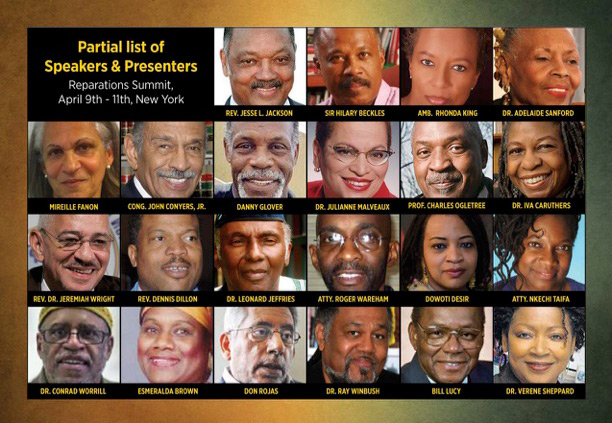
Speakers at the conference include Prof. Sir Hilary Beckles, Vice-Chancellor of the University of the West Indies and chair of the Caribbean Community’s (CARICOM) Reparations Commission; civil rights leader Rev. Jesse Jackson, Prof. Charles Ogeltree of Harvard University and Mireille Fanon Mendes France, President of the Frantz Fanon Foundation and Chair of the UN Working Group of Experts on People of African descent and daughter of Frantz Fanon, the Black liberation theoretician and psychiatrist from Martinique.
During the Summit, U.S. Rep. John Conyers Jr. (D-Mich.), the most senior member of Congress and the dean of the Congressional Black Caucus, will be honored for authoring HR 40, the “Commission to Study Reparation Proposals for African Americans Act” and for his 50 years of service on Capitol Hill.
“We are delighted that the Institute of the Black World can be a clearinghouse for ideas and strategies on how to pursue reparations for historical crimes and injustices against people of African descent in the US and across the Americas,” said Dr. Ron Daniels, the Institute’s President. “The courageous decision by nations in the Caribbean to demand reparations from the former European colonialists for Native Genocide and African enslavement and the formation of a CARICOM Reparations Commission is re-energizing the Reparations Movement in the U.S. and throughout the Pan African world.”
Scores of reparations advocates, Pan-Africanists and social justice activists from across the USA, Canada, Europe, Latin America and the Caribbean will take part in the New York summit. Leaders of national reparations commissions, committees and task forces from 11 CARICOM nations will interface with leaders of the recently formed European Reparations Commission and with members of the National African-American Reparations Commission (NAARC) which will be formally launched during the conference.
The NAARC will comprise of some of the leading scholars, activists, attorneys, economists and historians in Black America. In the months ahead, the NAARC will hold a series of town hall meetings across the country designed to solicit ideas from African-American communities on what should constitute a comprehensive program that advocates for reparations for the historical crimes of slavery and segregation.
“The main purpose of the International Summit is to advance the public discussion and debate around reparations issues and to provide a platform for advocates from around the world to dialogue, learn from each other, strategize collectively, support and reinforce each other’s campaigns, build bridges across geographical and linguistic barriers and co-ordinate action plans,” said Don Rojas, IBW’s director of communications. “The international nature of this summit is unprecedented in the long (and all too often ignored and marginalized) history of the reparations movement in the Americas.”
The conference, whose opening and closing public sessions are to be Webcast and audiocast live by WBAI-Pacifica Radio and Sirius XM Satellite Radio, will be held in three of New York City’s five boroughs—Manhattan, Brooklyn and Queens.
The conference begins at the historic Mother AME Zion Church in Harlem, the oldest black church in New York State and a center for the Underground Railroad back in the 19th Century. The business sessions will be held at York College in Queens and the summit will conclude with a public rally at the First AME Zion Church in Central Brooklyn, home to the largest Caribbean community in the United States.
One of the highlights at the closing rally will be inspirational music sung by a newly formed ‘Reparations Choir’, composed of members from several black churches in Brooklyn.
The three-day meeting will honor pioneers in the fight for reparations for Black Americans, including Callie House (1861-1928), a former slave who demanded that $68 million in taxes on Confederate cotton seized by the North be given to Blacks as reparations, and Queen Mother Moore (1898-1997), a longtime Harlem activist who popularized the reparations idea in the middle 20th century. It will also pay tribute to the tireless work over many years of The National Coalition of Blacks for Reparations in America (N’COBRA).
“Reparations is not an issue of the distant past,” said Dr. Daniels. “The Japanese-American community demanded—and got—reparations in the late 1980s for how they were treated by the American government—their own government—during World War II,” he said, referring to the internment of those Japanese by the United States.
“And in 2015, the parliaments of Russia and Greece are voting to demand Germany pay them for the damage inflicted on them by the Nazis,” he added. “So this issue is not, and should not, go away, particularly when African-descended people are concerned.”
Reparations is an issue that has occasionally flared up in Black political circles since the end of slavery in the mid-19th Century. It has been publicly opposed by several U.S. Presidents and dismissed by most white Americans but it has always found a place on the Black political agenda.
At the UN’s Conference on Racism in Durban, South Africa in 2001, the Atlantic slave trade and chattel slavery was declared a “crime against humanity” and was described as the greatest holocaust in human history. Hundreds of reparations activists from the USA and the Caribbean participated actively in the Durban conference, which helped to infuse the reparations movements with new energy at the beginning of the 21st Century. But that energy petered out in the first decade of the new century.
IBW, however, believes that today this pattern is changing. A June 2014 cover story in The Atlantic magazine, “The Case for Reparations,” by prominent journalist Ta-Nehisi Coates, generated much discussion in African-American communities as well as within elite white American intellectual and political circles.
IBW maintains that the work of the National African-American Reparations Commission will have to be resourced by black communities across the country. “Black people and those sympathetic to the cause will have to finance this initiative,” Dr. Daniels explained. “We can’t expect corporations or foundations to underwrite a campaign for Reparations for Black people. In the spirit of the Honorable Marcus Mosiah Garvey, IBW is counting on contributions from the people to finance the work of the commission.”
The IBW International Reparations Summit comes two years after the 15-nation CARICOM group decided unanimously to form a reparations commission and to demand that the former European colonial and slave-trading powers pay the debt owed to African people in the Caribbean region for the enormous wealth made off of their forced and uncompensated labor during the centuries of African enslavement.
And in January 2014 CARICOM issued a 10-point program for “Reparitory Justice” that frames their reparations demands as a “development strategy”. The program’s stated goal is “to use reparations payments to deal collectively with pressing economic and educational problems facing the citizens of the Caribbean that trace their origins to the underdevelopment imposed by slavery, slave trading, native genocide, and economic exploitation by the European nations”.
CARICOM’s 10-Point Program enjoys the unanimous support of all the member countries in the Community of Caribbean and Latin American States  (CELAC) and the Bolivarian alliance for the Peoples of the Americas  (ALBA).
For more information on IBW’s International Reparations Summit, please visit www.ibw21.org.
About The Institute of the Black World
The Institute of the Black World 21st Century (IBW) is committed to enhancing the capacity of Black communities in the U.S. and globally to achieve cultural, social, economic and political equality and an enhanced quality of life for all marginalized people. The Institute was conceived as a resource center and engine for capacity-building and empowerment of Black organizations and communities, utilizing cooperative and collaborative methods and strategies.
The group emerged as an outgrowth of the State of the Black World Conference which attracted some 2,500 African American scholars, activists, organizers and concerned individuals to Atlanta in 2001. Convened by a core group of veteran social and political activists led by Dr. Ron Daniels (former Executive Director, National Rainbow Coalition; Deputy Campaign Manager, Jesse Jackson for President, 1988 and Executive Director, Center for Constitutional Rights), the birth of IBW was more than a decade in the making.
Research ♦ Policy ♦ Advocacy
ibw-summit-speakers


23 February 2015

U.N. to unveil Permanent Memorial to Victims of SlaveTrade

frontal view of the Memorial | Rodney Leon Architects PLLC

Monument to victims of slavery to open at UN Headquarters 
in March


slavery_monument.jpg


Rodney Leon (second left), winner of the design competition, ‘The Ark of Return’, to be erected as a permanent memorial to the victims of slavery and the transatlantic slave trade at the United Nations (UN) Headquarters in New York, explains his concept to (from left), prime minister of Jamaica Portia Simpson Miller; former prime minister of Antigua and Barbuda, Baldwin Spencer and Jamaica's permanent representative to the United Nations, Ambassador Courtenay Rattray, at the unveiling at the UN. JIS File Photo


By Athaliah Reynolds-Baker


KINGSTON, Jamaica (JIS) -- The permanent memorial to the victims of slavery and the transatlantic slave trade is to be erected in March on the grounds of the United Nations headquarters in New York.


Jamaica’s minister of foreign affairs and foreign trade, Senator A.J. Nicholson, who made the disclosure on Tuesday, said the UN initiative to erect the monument, entitled ‘The Ark of No-Return’, was Jamaican-inspired and CARICOM and African Union endorsed.

He was addressing members of the diplomatic corps at the University of the West Indies (UWI) Regional Headquarters in Kingston, as part of Diplomatic Week 2015 activities.

“I express profound gratitude to those countries, which have contributed to the fund-raising efforts and encourage those who have not yet done so to use the window, which remains open, to meet the amount required for its completion,” he said.

The monument, designed by Haitian-American, Rodney Leon, will be triangular in shape and made from gleaming white marble panels supported by a stainless steel structural frame.

It was selected from an initial 310 entries by an international panel of five judges. The trust fund established to build the Permanent Memorial has to date raised US$1.4 million.

Meanwhile, Nicholson informed that the International Decade for People of African Descent will run from January 1, 2015, to December 31, 2024.

The decade aims to underline the important contribution made by people of African descent to the wider society and to propose concrete measures to promote their full inclusion and to combat racism, racial discrimination, xenophobia, and related intolerance.