06 June 2016

Norfolk Island's Relationship with the United Nations & Australia


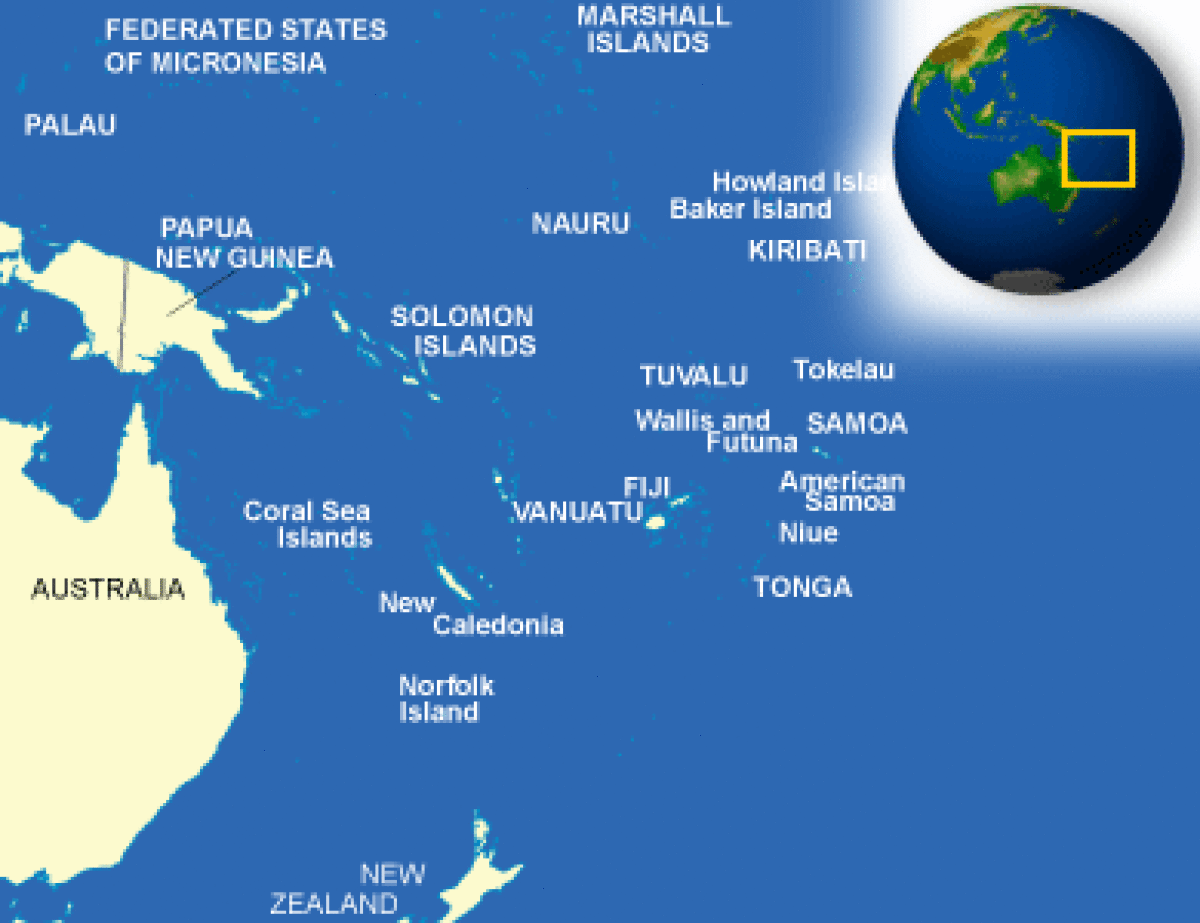
                                        Norfolk Island -The Website


Norfolk Island appears nowhere on the United Nations' maps of the world. Although Australia signed the UN Charter as a foundation member on November 1, 1945, it did not pass onto the UN the fact that at that time Norfolk Island was a non-self-governing territory, although it was required to do so under the Charter's Article 73e. Thus the UN views Norfolk as a territory of Australia when it is not. It is a separate and distinct Colony of the British Crown placed under the authority of the Commonwealth of Australia.

In 1972 Australia ratified the International Covenant on Economic, Social and Cultural Rights. PART I, Article 1 states:

"1. All peoples have the right of self-determination. By virtue of that right they freely determine their political status and freely pursue their economic, social and cultural development.
...
3. The States Parties to the present Covenant, including those having responsibility for the administration of Non-Self-Governing and Trust Territories, shall promote the realisation of the right of self-determination, and shall respect that right, in conformity with the provisions of the Charter of the United Nations."

Australia has not applied the Covenant to Norfolk Island, and has, in fact, acted at times in direct opposition to the rights espoused by the Covenant.

In 1977 the Norfolk Island Council, an elected body having no legal power or authority, was advised of the Australian Government's plans to incorporate Norfolk Island into an Australian electorate. The Council appealed to the UN for protection from these plans after specifically being denied the right of referendum on the issue by the Australian Government. Australia successfully lobbied other UN members to prevent the appeal's being heard.

In 1978 the United Nations Association of Australia issued an extensive report about the status of Norfolk Island in relation to Australia and the UN. It concluded that the official Australian stance on Norfolk Island is "patently ludicrous", and that the Australian Department of Foreign Affairs clings to the claim that Norfolk Island is not a non-self-governing territory, but rather a part of metropolitan Australia, on the basis that no other member state of the UN has ever proposed otherwise. And to continue the litany of head-scratching actions, Australia has made 34 declarations to the International Labour Organisation denying that Norfolk is part of metropolitan Australia, stating instead that it is a dependent territory under Australia's authority.

In 1980 the Commonwealth of Australia ratified the International Covenant on Civil and Political Rights but neither has that Covenant been applied to Norfolk Island. And again the Australian Government has acted in direct opposition to it in dealing with Norfolk.

Norfolk Island is thwarted in bringing these matters to the attention of the United Nations' General Assembly by the power that Australia holds over neighbouring Pacific nations in the form of foreign aid. Norfolk cannot afford, either, to have its case heard by the International Court of Justice or even to have its constitutional status clarified by Australia's High Court, the later of which is not liable to view the situation impartially.

countryreports.org

                      Norfolk Island's relationship with Australia
The history of Norfolk Island's relationship with Australia is scattered with actions that are at best headscratching and at worst immoral and illegal. Australia has gathered more and more of the island to itself - wiping out Norfolk culture and robbing the islanders of their birthrights.

In 1856 Her Majesty Queen Victoria's Order-In-Council declared that Norfolk Island was to become a distinct and separate settlement; the affairs of which be administered by the Governor of the Colonies of NSW and Norfolk Island. Her Majesty's instructions to the Governor were that he should preserve the Pitcairner's laws and usages including those relating to the possession, use and enjoyment of land. Today the islanders have to apply to the Australian Administrator for permission to put a driveway onto a road.

The Pitcairners were advised that Norfolk was to be theirs to divide as they wished, but in the years following their arrival this promise was reneged upon and they succeeded in gaining title to only a quarter of the island's land. This was the first of many promises broken by those with the power of administering Norfolk Island.

In 1896 the promise of self-government was reneged upon. The Governor of the day, Viscount Hampden, sailed from New South Wales (where he had decided that the islanders were incapable of governing themselves) and upon his arrival on Norfolk he read a prepared speech abolishing all the Laws of Norfolk Island and proclaimed new laws transferring all authority to New South Wales. He also removed the island's Chief Magistrate - the traditional head of the government - and made it an appointed position never again to be held by an islander.

In 1908 the Norfolk Islanders living in Quality Row (a street in Kingston) were evicted from their homes of 52 years by Governor Harry Rawson when they refused to sign lease documents saying that their homes were the property of the Crown. The Crown, of course, did not own the land. In a rare display of defiance the evicted islanders burnt down some of the houses. The Australian Government still perpetuates the myth that the islanders were evicted because they burnt down the houses.

In 1935 the Australian Government enacted, by virtue of their power of administration, the Norfolk Island Printers and Newspapers Ordinance. This made it illegal to publish any newspaper, newsletter or pamphlet without the approval of the Australian Administrator. This ordinance remained in force for 29 years: effectively banning free speech on the island - a right the islanders had, until 1935, put to good use in making known their unhappiness with the Administrator's treatment of island affairs.

In 1948 the Australian Government passed a law forcing Norfolk Islanders to discard their British Passports and apply for Australian ones. Norfolk was, and is, a Colony of the British Crown. The residents of Norfolk Island were not Australian citizens, but were forced, without consultation, to become so.

The ludicrousness of Norfolk Island's position in relation to Australia is nowhere more obvious than in the following. In 1957 the Australian Parliament passed the third of its Norfolk Island Acts. It repealed the Acts of 1913 and 1935, but failed to make provision for the continuance of the section by which it accepted authority over Norfolk Island. The result is that for almost 40 years, Australia has enforced laws in relation to Norfolk Island's administration which have no constitutional basis.

During the 1970s a number of geological reports were issued concluding that the waters around Norfolk Island have a 95% chance of containing natural gas and/or crude oil at commercially viable depths. The Australian Government acted quickly to claim, as its own, Norfolk Island's 200-mile economic zone. Under what power this claim was made is a mystery.

1979 saw Australia pass the fourth of its Norfolk Island Acts. The 1979 Act provided for limited self-government, the continuance of which is dependent upon Norfolk Island supporting itself from its own resources. Norfolk has remained debt-free since the arrival of the Pitcairners and continues this tradition today - despite Australia selling and pocketing the fishing rights in Norfolk's territorial waters: an amount the Australian Government will not disclose, but in all likelihood is more than $1 million annually. During the 17 years since limited self-government was granted, more public works have been completed on the island than during the whole time Australia enforced its autocracy.

The Norfolk Island Act reserves many powers to the Australian Government, which promised to release them within five years to the Government of Norfolk Island. Another promise broken - 17 years later and Australia still retains much of what it promised to release.

In 1987 an Australian Government advisory committee reported to the Australian Government Norfolk Island's wish to have a "free association" status with Australia, whereby Australia would retain the powers of external affairs and defence. The report also outlined the method by which this could be achieved under the Australian Constitution. In 1991, however, the Australian Government took the opposite tack and announced that Norfolk was to be incorporated into the Australian Federal electorate of Canberra. Strenuous objections by the Norfolk Island Government and two referenda with 82% and 80.2% of votes against the Australian Government's proposal were dismissed by the Australian Government as "irrelevant".

1994 saw the Pitcairners declare themselves as the indigenous people of Norfolk Island and the discovery of their genetic uniqueness. Australia today denies that Norfolk has an indigenous population; yet at the same time it has no accepted definition of indigenousness. The Australian Government also denies that the Pitcairners are a separate and distinct people, even in the face of scientific evidence to the contrary - the Pitcairners of Norfolk Island can only receive successful organ transplants from another Pitcairner.

The Australian Government perpetuates the myth that Norfolk Island is part of Australia by constantly declaring that it is so, without any foundation in fact. It is not. The myth is perpetuated even on the island itself, where the Australian Government, which has responsibility for the educational curriculum, sets essay topics such as "Why I am proud to be an Australian." This is part of Australia's declaration that is it dedicated to "strengthening the Australian identity in the external territories." As far as the Pitcairners of Norfolk Island are concerned, Australia's declaration is a dedication to bloodless genocide.

04 June 2016

Anguilla Leader looks forward to 50th anniversary of 'Revolution'


My fellow Anguillians,

One year ago to this day, you bestowed on our party the honor and privilege of leading our nation. It is an awesome responsibility, one that as Leader of the party I do not take lightly.

A year ago our country was at a crossroads. It was a hard fought contest, and at the end of it, the Anguillian people entrusted us with a mandate to lead our country in the direction we articulated in our campaign and outlined in our Manifesto.

We were humbled by this tremendous vote of confidence. You placed your trust in me and in my administration, and I pledged that I would work every day to make a difference in your lives, to right the ship and to ensure a brighter future for our children.

We have spent this first year working diligently to chart a new path for our nation, and to lay the foundation for the next four years. There is no quick fix to the issues we face, and our successes will not emerge overnight. However, we firmly believe that with your support, if we harness the resilience and creativity of the Anguillian people, we will be well on our way to creating a new and prosperous future for our island.

I believe that it is important that we all understand not only what the government is doing in terms of policy, but also why we have made this particular set of choices. We welcome a healthy debate on the issues, as we had over the banking crisis. It is our hope that as we move forward, we do so in unison, on the basis of a shared vision of what we need to do to achieve our common goals.

This is what I wish to do today, to share with you some of our successes, outline where we are heading, and ask for your involvement and constructive engagement. We cannot do this alone.

Our first and most pressing priority when we assumed the leadership of the country was the resolution of the many critical issues facing the banking sector. Over the past 12 months my administration has focused on creating a resilient, sustainable and affordable solution to Anguilla’s banking difficulties, and safeguarding the life savings of small investors in over 22,000 accounts. Restoring stability to the financial sector will enable us to move forward on a host of other priorities, including attracting much needed foreign direct investment into Anguilla.

READ FULL ADDRESS IN THE ANGUILLIAN.

02 June 2016

Former Virgin Islands Official Named United Nations Expert


Former Virgin Islands Government Representative for External Affairs Dr. Carlyle Corbin has been named an Independent Expert to the United Nations (U.N.) Pacific Regional Seminar which convenes from 31 May to 2nd June in Managua, Nicaragua. The Seminar brings together representatives of governments of United States, British, French and New Zealand territories worldwide, and includes the governments of the U.S. territories of American Samoa, Guam, and the U.S. Virgin Islands. Both U.S. Pacific territories are participating in the conference but the U.S. Virgin Islands is absent. Representatives of United Nations member states and agencies, decolonisation experts, and civil society are also in attendance.


The Seminar is being convened under the auspices of the U.N. Special Committee on Decolonization under the theme “Commitments and Actions for Decolonization in the Non-Self-Governing Territories”. The current seventeen territories on the U.N. list are American Samoa, Anguilla, Bermuda, British Virgin Islands, Cayman Islands, Falkland Islands (Malvinas), French Polynesia, Gibraltar, Guam, Montserrat, New Caledonia, Pitcairn, Saint Helena, Tokelau, Turks and Caicos Islands, United States Virgin Islands and Western Sahara. The administering Powers are France, New Zealand, the United Kingdom and the United States.

The purpose of the seminar is to review the situation with respect to the seventeen territories, including the issue of support from various organizations within the U.N. system and other organizations. The Seminar’s conclusions and recommendations will be considered by the U.N. Special Committee at its June substantive session, transmitted to the Fourth Committee of the General Assembly in October, and finally to the General Assembly in December.

Dr. Corbin's presentation before the seminar is entitled Decolonisation: The Unfinished Agenda of the United Nations He began his government service as an advisor to Governor Cyril E. King, and later served as the Washington Representative of Governor Juan Luis. He went on to serve as Representative for External Affairs where he represented the territory in U.N. and other international bodies under Governors Alexander A. Farrelly, Roy L. Schneider, and Dr. Charles W. Turnbull  before finishing his government service.

He presently lectures widely, and writes extensively, on political and constitutional development issues, with specific reference to small island territories, autonomous countries and integrated jurisdictions in the Caribbean and the Pacific. 


01 June 2016

Decision set to change Bougainville future


The Bougainville Referendum for Independence has moved a step closer after a historic decision made by the Papua New Guinea Government and Bougainville leaders to set a target date.


The target date is June 15, 2019, one year before the window for Referendum determined by the Bougainville Peace Agreement closes.

The target date agreement was reached at last Friday’s Joint Supervisory Board meeting in Port Moresby.

Bougainville President John Momis said he was “very pleased” at the outcome.

“Although the date for the Referendum cannot yet be finally set (because of various legal steps required to be taken first), it would be impossible to plan the Referendum without a target date. With that date now agreed, we can plan the steps required to hold the Referendum, and the time and the funding and personnel needed to carry out each step.”

Momis also expressed his pleasure that the National Government had committed to provide the funding needed to carry out the Referendum preparations, beginning with the 2017 National Budget.

“The joint agreement...is a huge step forward,” he said. “It demonstrates once and for all the total commitment for the Papua New Guinea Government to full implementation of the Bougainville Peace Agreement and the associated Constitutional provisions.

“As a result there should no longer be any doubt among Bougainvilleans whether or not the Referendum will be held.”

The announcement will pave the way for complete weapons disposal in Bougainville. Some factions and individuals are still holding weapons due to suspicions that the National Government would refuse to hold the Referendum, Momis said, adding that those suspicions must now end and all groups must work towards complete weapons disposal.

“I call now for full disposal of weapons by the Me’ekamui Defence Force elements, the armed groups associated with Noah Musingku at Tonu and various former BRA and BRF members and groups that have retained weapons.

“Only then will Bougainville be able to be Referendum ready. The Bougainville Peace Agreement requires that the Referendum be free and fair.”

He said the legitimacy of the Referendum result would be in doubt if weapons remained in the Region.

The President applauded the clear commitment by the Prime Minister and other ministers to implementing the Peace Agreement.

“Once again, Papua New Guinea is providing a lead to other countries. I salute the Prime Minister for his very positive contribution to this historic outcome,” Momis said.

The unpaid funds to Bougainville by the National Government were discussed during the meeting and progress was being made.

Meanwhile, the South Bougainville by-election will start this week as announced by the PNG Electoral Commission at a cost of K2.5 million (US$789,000).

The by-election writ will be issued on Thursday and nominations close on June 2.

Polling will start on June 18 and end on July 1 and the writ returned on July 22.

Electoral Commission delegate John Kalamoroh said that the Finance Department has released funding of K2.5 million for the by-election last week. He has appointed John Itano, who is a district officer at the Buin district office, as the returning officer for the South Bougainville by-election.

Kalamoroh said the nomination period is seven days while campaign period is four weeks, adding that polling will be for 14 days and counting will be for 21 days.

The South Bougainville Open Seat was left vacant following the demise of the late MP Steven Kama Pirika who succumbed to illness whilst seeking medical attention in Singapore earlier this year.

By law, all by-elections must be conducted before July 27, 2016.

This is to comply with the 12 months anniversary rule as per s.105(1)(b) of the Constitution which requires all by-elections to be conducted prior to the 12 months period before the fifth anniversary of the date fixed to the return of writ of the previous (2012) general election which were returned on 27 July 2012.

The Nabak Rural LLG president seat by-election which was left vacant following the death of the president last year has been planned to run concurrently with the South Bougainville Open seat.


31 May 2016

UN Secretary-General calls for concrete actions in advancing the decolonisation agenda

31 MAY 2016
SG/SM/17807-GA/COL/3289


Following is UN Secretary-General Ban Ki-moon’s message, delivered by Rie Kadota, Senior Political Affairs Officer, Decolonization Unit, Department of Political Affairs, to the Pacific Regional Seminar on Decolonization, in Managua today:

I am pleased to send my greetings to all who have gathered in Managua for the 2016 Pacific Regional Seminar on Decolonization, in the Week of Solidarity with the Peoples of Non-Self-Governing Territories. I thank the Government and the people of Nicaragua for their generous hospitality in hosting this important Seminar for the second time in two years.

This Managua Seminar also marks the twenty-fifth Regional Seminar of the Special Committee since 1990. I welcome this year’s focus on the Pacific region under the theme of “Commitments and Actions for Decolonization in the Non-Self-Governing Territories”, within the framework of the third Decade for the Eradication of Colonialism.

According to the Charter of the United Nations and relevant General Assembly resolutions, a full measure of self-government can be achieved through independence, integration or free association with another State. The choice should be the result of the freely expressed will and desire of the peoples of the Non-Self-Governing Territories. The Special Committee on Decolonization supports this decolonization process. I also count on the administering Powers to continue to fulfil the obligation to promote the well-being of the peoples under their administration.

This annual Regional Seminar provides a key opportunity for the Special Committee to hear directly from representatives of Non-Self-Governing Territories about their unique situations and problems. It also facilitates informal exchanges between administering Powers, other stakeholders, Non-Self-Governing Territories, the Special Committee, experts, civil society organizations, regional organizations and others.

Let us seize this opportunity to identify concrete actions to advance the decolonization agenda. I wish you success in your deliberations. Thank you.

MERCOSUR condemns UK attempts to usurp Malvinas petroleum resources

*****

The Presidents of the MERCOSUR States parties and associated States, being aware of the presence of a semi-submersible platform on the Argentine continental shelf that is carrying out hydrocarbon exploration activities that are unauthorized by the Argentine Republic, 

Firmly reject this new unilateral action by the United Kingdom of Great Britain and Northern Ireland, which violates international law and Argentine domestic legislation; 

Recall the ongoing mandate set forth in United Nations General Assembly resolution 31/49, which calls upon both parties in the sovereignty dispute over the Malvinas Islands, South Georgia Islands and South Sandwich Islands and the surrounding maritime areas to refrain from taking decisions that would imply introducing unilateral modifications in the situation, as such decisions are in no way conducive to the attainment of a definitive solution to the sovereignty dispute, a solution which the international community has called for repeatedly; 

Reaffirm, in particular, the special communiqué on hydrocarbon exploration on the continental shelf, which was approved by the Heads of State and Government at the Latin American and Caribbean Unity Summit held in Cancún, Mexico, on 23 February 2010, and the commitments made with respect to illegal hydrocarbon and/or mining activities on the Argentine continental shelf, including the sharing of information, and the prevention of the entry into their ports of vessels flying the illegal flag of the Malvinas Islands; 

Ratify the statements of other regional and bi-regional organizations and forums that have taken a position on this question, most recently the Group of 77 and China, the Latin American Energy Organization and the Latin American Integration Association, which expressed the view that the operations carried out by companies not authorized by the Argentine Government in the Malvinas Islands area relating to the exploration for natural resources, especially hydrocarbon resources, were seriously detrimental to the sovereign rights of the Argentine Republic over its continental shelf. Those forums have also recognized the right of the Argentine Republic to take administrative and legal action, with full respect for international law and relevant resolutions, against the unauthorized hydrocarbon exploration and exploitation activities that the United Kingdom is carrying out in the aforementioned area; 

Take note of the legal action taken by the Argentine Republic against companies involved in unauthorized hydrocarbon exploration and exploitation activities on the Argentine continental shelf. Asunción, 21 December 2015.


25 May 2016

Puerto Rican Mayor to call for self-determination at United Nations


SAN JUAN – The mayor of San Juan, Carmen Yulín Cruz, confirmed she will appear before the United Nations’ Special Committee on Decolonization in June to testify on the island’s territorial status.

The mayor said she intends to call for Puerto Rican people’s “right to self-determination” and that political prisoner Oscar López Rivera be freed. On May 29, he will have spent 35 years in prison, 12 of them in solitary confinement, her statement adds.

Cruz also said she has withdrawn her endorsement of Democratic presidential frontrunner Hillary Clinton because of her position in favor of the proposed fiscal oversight board the U.S. Congress “intends to impose” on the commonwealth government.

“I’m not a Democrat; I’ll never be a Republican. I have never voted in presidential primaries nor ever will, although I don’t criticize those who consider it a way to contribute,” she said.

Hillary supports, Bernie condemns, benevolent colonialism for Puerto Rico via unelected control board for U.S. territories


SAN JUAN – Democratic presidential candidate Hillary Clinton released the following statement about the proposed bill in the House of Representatives on the Puerto Rican debt crisis:

“The House Natural Resources Committee reached an agreement on a bipartisan bill to address the Puerto Rican debt crisis. While I have serious concerns about several provisions in this bill, including the creation of an oversight board that would exert substantial control over Puerto Rico, I believe that we must move forward with this legislation. Otherwise, without any means of addressing this crisis, too many Puerto Ricans will continue to suffer.


“However, as this bill moves forward, I will work to ensure that concerns about the oversight board are addressed and any such entity includes members that will act in the best interest of Puerto Ricans – protecting their health, their pensions, and their well-being. We can no longer sit idly by while hedge funds seek to maximize their profits at the island’s expense. That’s why I will continue to stand with the Puerto Ricans to ensure that they can put their economy back on a path of stability and prosperity, including the steps I am committed to take as President to provide equality in critical federal programs.”

READ THE HILLARY STATEMENT OF HERE.

******

STATEMENT OF BERNIE SANDERS

We must never give an unelected control board the power to balance Puerto Rico’s budget on the backs of children, senior citizens, the sick and the most vulnerable people in Puerto Rico while giving the people of Puerto Rico absolutely no say at all in the process,”

“We cannot allow Senate Majority Leader McConnell and Speaker Ryan to determine the fate of Puerto Rico by handpicking a majority of the control board’s members, while the people of Puerto Rico would be in charge of choosing none. That may make sense to groups representing Wall Street, but it makes absolutely no sense to me.

“Among other efforts, what Congress should do is to act immediately to give Puerto Rico the same authority granted to every municipality in this country to restructure its debt under the supervision of a bankruptcy court.

“The billionaire hedge fund managers on Wall Street cannot get a 100 percent return on their bonds while workers, senior citizens and children are punished. Wall Street vulture capitalists must not be allowed to get it all.

“Today, I am proud to stand in strong opposition to this bill not only with the people of Puerto Rico, but the AFL-CIO, UAW, SEIU, AFSCME, UFCW and other unions that recognize just how bad this bill would be.

“We must stop treating Puerto Rico like a colony and start treating the American citizens of Puerto Rico with the respect and dignity that they deserve.”

23 May 2016

Guam panel series to explore non-colonial political status options


Illustration: The World CIA Factbook
**************

Office of the Governor


PRESS RELEASE


Pacific Islanders and Local Experts 
to examine our path to decolonization

(Hagatna, Guam) The Governor (Eddie Calvo) encourages residents and FestPac (Festival of Pacific Arts) delegates to participate in the Decolonization Discussion Series over the next week at the University of Guam.

Guam’s experts and activists for statehood, free association with the United States, and independence will join experts from islands that are and once were colonies as well.

“It’s not very often we have this many people from almost all the nations and communities of the Pacific here at one time. These are places that either struggle with their colonial status just as we do, or already overcame their struggle. We can learn a lot from them. They can help us, and we welcome that.” – Guam Governor Eddie Calvo.

Below is information on each of the panel discussions that will take place:

Decolonization Discussion Series

Sponsored by the Festival of Pacific Arts Workshops Committee, Guam Community College (GCC), and the University of Guam (UOG) 
_________________________________

Panel Discussion 1:

Statehood and Integration in the 21st Century Pacific: Realities, Advantages, Struggles, and Lessons Learned” 

May 24th, 6PM 
CLASS Lecture Hall, 
University of Guam

Description: This panel discussion presents an examination of the political status option of statehood and integration into an independent state. As Guahan prepares for its exercise of the right to self-determination, a deeper look into statehood’s realities, advantages, struggles, and lessons learned will be explored. In addition, the critical question of statehood’s impact on cultural survival and indigenous nation building will be discussed.
Panelists: Former Senator Edward Duenas (Chairperson, Guam Statehood Task Force), Dr. Ron McNinch (Professor, University of Guam), Attorney Melody Mackenzie (Ka Huli Ao Center for Excellence in Native Hawaiian Law, Hawai’i), and Dr. Carlyle Corbin (International Advisor on Governance and Decolonization Expert, US Virgin Islands)

Moderator: Professor J. Peter Roberto


*****

Panel Discussion 2

 “Case Examples of Free-Association in the 21st Century Pacific: Realities, Advantages, Struggles, 
and Lessons Learned” 

May 26th, 6PM
 CLASS Lecture Hall
 University of Guam

Description: This panel discussion presents an examination of the political status option of being freely associated with an independent state. As Guahan prepares for its exercise of the right to self-determination, a deeper look into free association’s realities, advantages, struggles, and lessons learned will be explored. In addition, the critical question of free association’s impact on cultural survival and indigenous nation building will be discussed.

Panelists: Mr. Joe Garrido (Chairperson of the Guam Free Association Task Force), Attorney Roman Bador (Republic of Belau), Attorney Mark Short (Cook Islands), and Dr. Carlyle Corbin (International Advisor on Governance and Decolonization Expert, US Virgin Islands)

Moderator: Ms. Deeann Choffat

*****

Panel Discussion 3 

Case Examples of Political Independence in the 21st Century Pacific: Realities, Advantages, Struggles, 
and Lessons Learned” 

May 31st,  6PM, 
CLASS Lecture Hall
University of Guam

Description: This panel discussion presents an examination of the political status option of becoming a sovereign, independent state. As Guahan prepares for its exercise of the right to self-determination, a deeper look into political independence’s realities, advantages, struggles, and lessons learned will be explored. In addition, the critical question of independence’s impact on cultural survival and indigenous nation building will be discussed.

Panelists: Ms. Victoria-Lola Leon Guerrero (Co-chair, Guam Independence Task Force), Mr. Matiu Matavai (Samoa), Consulate General Marciano R. De Borja (Philippines Consulate Office, Guam), Dr. Carlyle Corbin (International Advisor on Governance and Decolonization)

Moderator: Mr. Raymond Lujan

*****

Panel Discussion 4

 Independence, Free-Association, and Statehood: Implications of Status Options for Guahan” 

June 2nd, 6PM
 CLASS Lecture Hall
 University of Guam

Description: This panel discussion presents an examination of the three political status options of statehood or integration; free-association with an independent state; and becoming a sovereign, independent state. As Guahan prepares for its exercise of the right to self-determination, a deeper look into the advantages and struggles of each of these options will be explored. In addition, the critical question of the status options’ impact on cultural survival and indigenous nation building will be discussed. 

Panelists: Former Senator Edward Duenas (Chairperson, Guam Statehood Task Force), Mr. Joe Garrido (Chairperson, Guam Free Association Task Force), Ms. Victoria-Lola Leon Guerrero (Co-chair, Independence Task Force), and Dr. Carlyle Corbin (International Advisor on Governance and Decolonization Expert, US Virgin Islands)


Moderator: Drs. Lisa Marie Baza and LisaLinda Natividad

******

Read "Guam’s Political Status" 

by Dr. Robert A. Underwood in Guampedia


20 May 2016

Am. Samoa Government, Congressional Delegate oppose automatic U.S. citizenship birthright in U.S. Supreme Court case

"A unilateral extension of U.S. citizenship could have important implications to the ability of American Samoans to control their own affairs in future. This has been strongly opposed by the elected governor and Congressional delegate of the territory which is already struggling to maintain their natural resources (fisheries) from U.S. incursion under their present 'U.S. national' status. It is amazingly disappointing that some political leaders in several other territories have been convinced to support such a federal intrusion against the wishes of the elected leadership of American Samoa who argue that any decision on citizenship is for the people to decide in the context of the exercise of their legitimate right to self-determination. Why would any leader in another territory oppose such a fundamental principle which also applies to them? There was a time when territorial solidarity would not have allowed for such divergence. That time clearly needs to come again."  - A territorial scholar.


*****


Government, Congresswoman oppose birthright citizenship

Samoa News
By Fili Sagapolutele

PAGO PAGO, American Samoa  Samoa News – The Attorney for the American Samoa government and Congresswoman Aumua Amata all contend that arguments advanced by plaintiffs and their supporters in the US citizenship lawsuit case amount to a plea for the Supreme Court of the United States to extend US citizenship "to the people of American Samoa, whether they like it not."

ASG and the Congresswoman’s office are ‘amicus curiae’, or ‘friends of the court’ in the citizenship lawsuit case, in which five plaintiffs — led by local resident Leneuoti Fiafia Tuaua— had argued in lower court, that because they were born in American Samoa they should have automatic US citizenship in accordance with provisions of the US Constitution.

However, the lower court ruled — and the appeals court in D.C. agreed — that only the US Congress can grant citizenship to persons born "in outlying territories" such as American Samoa. Defendants in the case include the US State Department and the Secretary of State.


READ THE FULL REPORT HERE.


19 May 2016

La "Promesa" de tratarte como colonia


PUERTO RICO
Ver foto galeríaVisita la foto galería (2)
Perfil de Autor
ccotto@claridadpuertorico.com 


La “promesa” de tratarte como Colonia. Ésa es la reafirmación que hace el borrador del proyecto de ley Puerto Rico, Oversight, Management and Economic Stability Act (PROMESA, siglas en inglés) del Comité de Recursos Naturales de la Cámara de Representantes de Estados Unidos dirigido a imponer una Junta de Control Fiscal (JCF) en Puerto Rico.

“Vamos a ponerlo de esta manera, este proyecto sin duda retoma por así decirlo –porque nunca fueron entregados totalmente– retoma muchos de los poderes que se habían autorizado a través de la constitución del Estado Libre Asociado (ELA) que fue aprobada por el Congreso de Estados Unidos”, describió a Claridad el profesor de Derecho Constitucional, doctor Carlos Ramos González, sobre el citado proyecto. 

Aunque a diferentes niveles el borrador del proyecto sobre la Junta de Control Fiscal que se ha dado a conocer por el presidente del Comité de Recursos Naturales, Rob Bishop, ha recibido el rechazo de todos los sectores políticos de la isla, movimiento sindical, asociaciones profesionales y otros grupos de la sociedad civil. 

Ramos González expuso sobre el retroceso en derechos que representa el proyecto presentado el que por ejemplo la junta, cuyos miembros serían nombrados por el Presidente de EE UU altera o sustituye en un alto grado el proceso de aprobación de presupuesto que establece la constitución del ELA. Se supone que la aprobación del presupuesto de la isla es uno que se inicia en la Cámara de Representantes, continúa en el Senado y luego de aprobado por ambos cuerpos es firmado por el gobernador, quien a su vez lo había sometido inicialmente conforme a las prioridades que establece el Ejecutivo. 

“Esta Junta para todos los efectos le establece las prioridades al gobierno y le indica al gobernador y a las ramas legislativas que si no actúan según lo establece la Junta pues se impone sobre ellos por lo tanto está sustituyendo un gobierno interno”, reparó el profesor de Derecho Constitucional de la Facultad de Derecho de la Universidad Interamericana de Puerto Rico (UIA). Advirtió, además, el que todavía se desconocen detalles de cuál o cómo será el funcionamiento de la junta ya que es ésta la que debe establecer su propio reglamento. Además de reglamento se supone que la JCF tenga su propia oficina para reclutar personal y gran parte de su funcionamiento será sufragado por el gobierno de Puerto Rico. 

Ramos González censuró también la facultad que tendría la Junta de reclutar funcionarios del gobierno de Puerto Rico e incluso la capacidad de imponerle una multa al funcionario que no quiera “trabajar” , seguir sus órdenes. En un primer borrador se incluía hasta reclusión al funcionario que se negara a seguir las directrices de la junta. La multa- dijo Ramos González - tiene el propósito de ser un elemento disuasivo para obligar al funcionario a obedecer sus órdenes lo que también puede provocar un cambio de lealtad. 

A juicio del entrevistado la JCF manejará al gobierno de Puerto Rico a través del presupuesto, comenzando con el gobernador y la Asamblea Legislativa y las agencias ligadas al presupuesto como el Departamento de Hacienda, la Oficina de Presupuesto y Gerencia; la Junta de Planificación, el Banco Gubernamental de Fomento, la Oficina del Contralor, la Oficina de Administración de Infraestructura, hasta capacidad para entrar en procesos de alianzas público privadas. 

Ramos González expresó que frente a este organismo se tiene que sentir indignación, la que describió como una indignación histórica. “Uno no puede estar indignado en contra de esta Junta sin recordar cómo lo estuvieron muchos contra el gobierno militar de 1898, contra la Ley Foraker, los que protestamos como hicimos con la Ley 600 ésa es una objeción histórica que hemos tenido porque atenta contra el derecho a la libre determinación. Dentro de ese contexto ésta es una ley más cruda”.

Frente a lo anterior destacó que otro problema particular que tiene la junta y que hace recordar al gobierno militar estadounidense y hasta bajo el dominio español es quién supervisará a la junta. “Nadie”, apuntó Ramos González. Expuso que el proyecto no especifica y dado a que sus miembros serán nombrados directamente por el Presidente, “éste, el Presidente, tú sabes que está pendiente a otras cosas”.

Acotó que aunque el proyecto establece que si hay alguna objeción a una decisión de la JCF se podrá apelar al Tribunal Federal en Washington DC esto representa un problema de acceso y encima de eso el término para presentar una objeción será sólo diez días. A la luz de estas disposiciones describió la junta como una dictatorial ya que las probabilidades de que puedan corregirse sus errores, dijo serán muy pocas. 

Un aspecto que señaló no se ha discutido es que la Junta se lleva por el medio la independencia judicial de Puerto Rico debido a que según el proyecto de haber un problema de interpretación de una ley puertorriqueña la controversia se podrá llevar al Tribunal Supremo de EE UU, el cual estará obligado a emitir una interpretación. 

Desde la óptica del Derecho Internacional, Ramos González apuntó a que se puede decir que el proyecto viene a agudizar la denuncia histórica, de que se trata de un acto más en contra del derecho de autodeterminación de los pueblos. Descartó, además, el que de alguna manera el Congreso permita alguna gestión de consentimiento por parte de Puerto Rico y comparó que la acción del Congreso en estos momentos es una exactamente igual a la exhibida durante la aprobación de la Ley 600 en la cual el Congreso hizo gala de su poder territorial. Más allá resaltó que la conducta del Congreso, del Presidente Obama e incluso de los gobernantes de Puerto Rico, los cuales han dicho que tiene que haber “respeto a la autonomía”, en el fondo lo que están diciendo es que hay que cuidar la forma, “como lo hicieron con la Ley 600 cuidaron la forma hasta el punto de que engañaron a las Naciones Unidas”. 

Un poder colonial del Siglo XVIII


En tanto la copresidenta del Movimiento Independentista Nacional Hostosiano (MINH), licenciada Wilma Reverón Collazo, describió el proyecto como el de “un ejercicio legal de un poder territorial que está basado en una constitución del siglo 18 que es contraria a los principios internacionales de los derechos humanos vigentes”. 

En ese sentido explicó que hay que recordar que cuando Estados Unidos adoptó su constitución en ese momento los poderes europeos entendían que tenían el derecho de invadir, ocupar, explotar y expoliar otros pueblos y otros países lo que era la norma en aquel momento, por lo cual se dieron los procesos coloniales tanto en África, Asia y los que se estaban dando en toda América Latina y el Caribe.

Reverón Collazo criticó el que Estados Unidos haya mantenido esa cláusula territorial en su constitución lo que para todos los efectos es una anomalía en el siglo XXI porque en el 1960 la Corte Internacional dijo clara y de manera diáfana que el colonialismo era un crimen contra la humanidad y que ningún país o estado tenía derecho a sujetar bajo su dominio a ningún otro territorio o nación.


“Así que el primer análisis que hay que hacer es que esta junta de control fiscal está invocando el poder para administrar, imponer reglas y reglamentos dentro de la constitución de Estados Unidos. Así que empezamos de entrada con un ejercicio que dentro del derecho internacional y específicamente desde el 1960 es totalmente ilegal y contrario al derecho internacional. Ése es el primer problemita que enfrenta esa junta, eso de por sí es suficiente para denunciarla, reprocharla como un ejercicio de dominio colonialista y por lo tanto un crimen contra el pueblo de Puerto Rico”. 

Cuestionada sobre si en efecto se llega a implementar la JCF las repercusiones que pueda tener este hecho en las próximas vistas del Comité de Descolonización de la ONU sobre el caso de la isla, la copresidenta del MINH quien fue coordinadora del Comité de Puerto Rico en la ONU, reparó en que por parte del independentismo siempre llevará un mensaje claro y diáfano contra cualquier ejercicio bajo la cláusula territorial. Pero advirtió que el problema que se tiene es la contradicción que presenta los llamados representantes del pueblo de Puerto Rico que fueron electos de que a la vez que gritan contra la junta, a la misma vez están negociando para que se le hagan enmiendas y cambios. 

Dado a este escenario Reverón Collazo vaticinó que “habrá una marcada diferencia en junio 20 entre el independentismo que lo que va a hacer es reiterar la situación colonial y los colonialistas que lo que van es probablemente a quejarse de que se les quitó un poquito de poder aquí y un poquito de poder allá pero no van a cuestionar y confrontar el ejercicio colonialista que estamos padeciendo”. 

En lo que respecta a las acciones en la ONU Reverón Collazo trajo a colación que el gobernador Alejandro García Padilla tuvo oportunidad de plantear la situación colonial y no lo hizo, cuando le escribió una carta al secretario general Baki Moon, al quejarse de la postura del Ejecutivo de EE UU en el caso de Sánchez Valle. 

“Obviamente éste es momento de que todo el mundo cierre fila en contra de esa junta de control fiscal”, expresó. En esa línea Reverón Collazo exhortó al pueblo a participar de una manifestación en contra de esta junta y cualquier otra junta de control fiscal que no sea una avalada en un ejercicio democrático del pueblo de Puerto Rico. 

“Me parece que una manifestación contundente multitudinaria sobre todo de los trabajadores mandaría un mensaje bien importante al gobierno de Estados Unidos de que aquí hay pueblo, que todavía hay capacidad de organizarnos, de hacer resistencia como hicimos en Vieques”. 

Una expresión flagrante de colonialismo


“Ciertamente es una expresión flagrante de colonialismo, mi contención es que Estados Unidos nos está tratando peor de lo que Inglaterra trató a esas 13 primeras colonias”, expresó a CLARIDAD el presidente del Colegio de Abogados y Abogadas de Puerto Rico (CAPR) licenciado Mark Anthony Bimbela. 

Para atender la situación el licenciado Bimbela reveló que le encomendó a la Comisión de Desarrollo Constitucional del CAPR que evalúe el proyecto y presente sus recomendaciones para hacerlas parte del informe que la institución se propone presentar en las próximas vistas del Comité de Descolonización de la ONU. “Aprovecharemos ese foro internacional para denunciar el atropello que se está realizando en contra del pueblo de Puerto Rico”.


18 May 2016

Dutch plan for full annexation of its Caribbean colonies opposed in Bonaire


Letter to The Minister of the Interior and Kingdom Relations, R.H.A. Plasterk 

Kalendijk, 

May 4, 2016


Subject: Intention Hague take-over island tasks 
BES islands

Dear Mr Plasterk,

We have learned through the media of your plans and intentions of your draft cabinet response to the report Spies, where you are proposing to take over the rest of the island-tasks by the RCN.

It is incomprehensible to us how you and your government intend to stand above democracy and above the law. You are completely ignoring the fundamental rights and the democratic voice of the people of Bonaire and you show no respect for our people that you intend to compare with a municipality in the Netherlands. 

It is very clear that you lack any moral or humane base and are forcing your own agenda on this humble and hospitable people.  Again, Bonaire is not a municipality but a nation, same like your nation, As the Netherlands where you belong to, Bonaire has its own culture, language, traditions, norms and values and identity and acquired people's self-determination rights that you have to respect.
                 
The discussion about the legality of this structure is outdated since December 18th last year, when the people of Bonaire rejected your annexation or forced illegal integration in your Dutch state and now there is no legal base  anymore for your keep forcing your take-over and occupation and administration of our people. The people have never chosen for this structure and have officially and legally rejected it in the december referendum.

Your task is now as responsible government to respect your own agreements in the United Nations and higher international law and stop this Illegal state-structure.  
             
Your influence on our island is already too much and you ignore all surveys, protests, letters etc. which clearly indicate that the population of Bonaire is unhappy because of this structure and you are now directing towards a total takeover of our local administration tasks by your RCN.

This will actually leave us with no other option at this time to inform you that 'No is No', that this is unacceptable, that we have the right to stand up for our rights, and that your RCN and neocolonial staff and policy are no longer welcome on our Bonaire. It becomes time to dismantle, transfer and repatriate.

With kind regards,
James Finies, Nos Ke Boneiru Bek. 


Cc. Governor of Bonaire, E. E. Rijna, Directors of Public Body Bonaire,Island Council of the Public Body Bonaire, the Permanent Committee members, Members of the Permanent Committee of the 1st and 2nd Chamber.

14 May 2016

Curacao law protects national labour force

Labor Minister: “Soon We Will Implement 80/20 System”

cecilia-larmonie
WILLEMSTAD – According to the Minister of Social Development, Labor and Welfare (SOAW) Ruthmilda Larmonie Cecilia (PS), the 80/20 system will enter into force soon.

This means that each company on the island must have 80% of their employees come from the local force. The other 20% can be foreigners.
According to the Minister this will improve the social situation on the island.
This is because local workers get jobs and then be able to stand on their own feet and be independent.
The Minister believes that one must first provide work for their own people and then for someone of a different nationality.
The moratorium on work permits for foreign nationals in positions where little training is required and for which the SOAW-ministry thinks that there are enough local forces to for these types of jobs, will generate many jobs, according to the Minister.
The moratorium on work permits for foreign nationals will enter into force on May 1 this year.
The moratorium on 34 types of jobs, which is a law to safeguard employment, will apply for one year.