14 April 2016

Cayman Premier calls for transfer of police to elected government

UK should hand police over to Cayman government


Cayman News Service.com

Cayman News Service
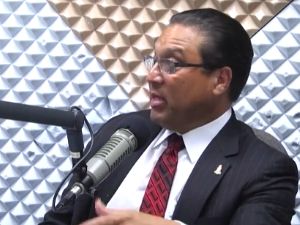
Premier Alden McLaughlin speaking on Radio Cayman Monday, 11 April 2016
(CNS): The premier believes the United Kingdom would be better off and the Cayman Islands would be further ahead if the Foreign and Commonwealth Office relinquished control of national security and the management of the police service to the Cayman government via a police authority. Speaking on Radio Cayman, Alden McLaughlin said the current arrangement was not working and has become extremely political, even though the politicians have no say at all in the management of the RCIPS. He also criticised the National Security Council, which, he said, was not functioning as it was envisaged during the 2009 constitutional talks.
“The UK are crazy having responsibility here for national security … It would be far better if the people could hold me or another elected member responsible,” the premier said, noting that over the last decade or so Cayman had hounded four police commissioners out of office because the post has “become so political”.
The premier was speaking about the current arrangements within the constitution regarding the police and crime during his appearance Monday on Radio Cayman’s morning show, For the Record, with Orrett Connor.
In light of the recent resignation of Police Commissioner David Baines, the perceived rise in crime and the pressure from the opposition for an entire review of the police service, McLaughlin raised his concerns about the motion that was filed by the opposition members calling for a no confidence debate in the RCIPS. He said he supported a review of the governance and management structure of the service but thought the motion was irresponsible as it was seeking a declaration that parliament has no confidence in all of the police officers, which was wrong.
Talking about the best way to address the police management, McLaughlin said he still believed, as he had during the talks with the UK over the 2009 constitution, that Cayman needed a local police authority to take control locally. He said that during those talks the idea was discussed with the UK, but with Opposition Leader Mckeeva Bush and his UDP team at the time opposed to it, the UK would not agree and retained the responsibility of national security with the governor.
The only local responsibility for the Royal Cayman Islands Police Service is its budget, which is in the hands of the home affairs ministry, now led by McLaughlin. The creation of a National Security Council was supposed to give the elected arm more say in policy, but noting that everything to do with police policy remains with the governor, McLaughlin said the NSC did not “function the way it should”.
However, he said the public still looks to the politicians for answers, even though they are not responsible and can do very little to influence what happens with the police.
“The construct does not work and the UK would be well advised to agree to allow a police authority,” he said. “Cayman, the UK and the governor will all be better off if we had a police authority responsible for the police service and the commissioner, instead of the post being line managed by the governor.”
Concerned that it will become increasingly difficult to fill the post of commissioner because of the strength of public feeling that there should be more local control over the police, he said that management of the police had become a “poisoned chalice” but one that he would take on nonentheless, as it “was critical to Cayman”. He pointed out that Cayman had enjoyed a long, peaceful history and when one heard of three armed robberies in one weekend, “those things are chilling”.
Welcoming the discussion and debate, which is now expected to take place in the Legislative Assembly on Thursday, 28 April, McLaughlin said he was happy to debate the issues but was concerned that the motion as it stands now, which calls for a declaration of no confidence in the entire police service, will not improve what is already a difficult situation.

13 April 2016

U.S. bill would remove financial management from Puerto Rico


on April 12, 2016
SAN JUAN – The U.S. House Committee on Natural Resources released Tuesday H.R. 4900, the Puerto Rico Oversight, Management, and Economic Stability Act (PROMESA), which if passed as is will impose a seven-member financial oversight board over Puerto Rico that would be appointed by the president and will have broad encompassing powers over the island.

The Financial Oversight & Management Board’s members would be selected from a list of candidates submitted by the U.S. House speaker, Senate majority leader, and minority leaders of the House and Senate. The board, which will have offices in Puerto Rico and anywhere else needed, will appoint an executive director.

The governor of Puerto Rico would be an ex-oficio member without voting powers.

READ THE FULL REPORT HERE .

******
Compañeros Unidos para la Descolonización de Puerto Rico: Cita Patriótica ONU Junio 2012

This year, 2016, marks a new era in Caribbean colonialism.
The US Congress is preparing a "Financial Control Authority," which will supervise the finances of the entire government of Puerto Rico -- its legislature and courts, public authorities, pension system and all leases, union contracts and collective bargaining agreements. The authority will also restructure the entire public workforce (including teachers and police), freeze public pensions and ensure "the payment of debt obligations." Then it will issue its own debt, spend the funds as it sees fit and leave Puerto Rico to pay the bill.

Congress can veto any law passed in Puerto Rico

The authority will also have prosecutorial powers. It will be empowered to "conduct necessary investigations" into the government of Puerto Rico, or in other words, be empowered to hold hearings, secure government records, demand evidence, take testimony, subpoena witnesses and administer oaths -- under penalty of perjury -- to all witnesses.

Any witness who fails to appear or to supply information will be subject to criminal prosecution and removal from office. This includes any elected official on the island: even the governor and attorney general.


All of these powers are enumerated in the 157-page Senate Bill 2381, also known as the "Puerto Rico Assistance Act of 2015," which is currently under review in the US Senate.


DUTCH ADMIT SPYING ON BONAIRE POLITICIAN JOPIE ABRAHAM

 by 


Intelligence service AIVD unjustly collected information on Bonaire former minister and deputy Jopie Abraham while he was negotiating Bonaire joining the Netherlands, Minister Ronald Plasterk of Home Affairs admitted in a letter to Abraham, NRC reports. 
(Bonaire became a Dutch 'public entity' under partial integratiion. A subsequent referendum on the island rejected the status after the five year period ending in 2015 - OTR)  
The CTIVD, the committee that oversees and supervises the intelligence services in the Netherlands, launched an investigation after Abraham filed a complaint last year. The complaint regarded the AIVD’s actions between 2005 and 2010. Abraham believes that the AIVD spied on Bonaire politicians while they negotiated with the Dutch government on joining the Netherlands Bonaire became part of the Netherlands in 2010.
According to Plasterk, the CTIVD advised him to declare Abraham’s complaint “partly justified and partly unfounded”. The reasons behind this advice are confidential. Plasterk states that the CTIVD found the AIVD’s actions “largely just”. “However, in respect of a short period, the CTIVD came to the conclusion that no investigation should have been carried out, so that part of the investigation is unlawful.” the Minister wrote to Abraham.
Exactly why the investigation was unlawful during that “short period”, the Minister does not say. But he does add that “measures” were now taken to prevent similar circumstances in the future.


****************************


The Daily Herald
Sint Maarten

THE HAGUE--The Dutch intelligence and security service AIVD acted partially on illegal grounds when it gathered information on the now retired Bonaire politician Jopie Abraham in the period 2005-2010, concluded the Committee of Supervision on the Intelligence and Security Agencies CTIVD recently.

The Dutch newspaper NRC revealed on Friday that Minister of Home Affairs and Kingdom Relations Ronald Plasterk sent a letter to Abraham of the Bonaire Democratic Party PDB on Tuesday in which he informed the former Minister of the Netherlands Antilles, and Commissioner and Member of the Island Council of Bonaire, of the results of the investigation by the CTIVD.

Abraham had filed a formal complaint in August and September 2015 against the conduct of the AIVD in the period January 2005 to October 2010. Abraham accused the AIVD of spying on Bonaire politicians during the negotiations with the Dutch Government in the process to dismantle the Netherlands Antilles and to make Bonaire part of the Netherlands. 

Plasterk’s letter dated March 29, 2016, a copy of which has been supplied to The Daily Herald, stated that the CTIVD had advised to declare Abraham’s complaint “partially founded” and “partially unfounded.”

However, the Minister couldn’t supply the motivation of the CTIVD because the committee’s report is filed as classified. The law states that data that can give an indication as to the identity of a source, an ongoing investigation or investigation method cannot be made public. As such the CTIVD report will remain classified. “I cannot send you the report,” Plasterk informed Abraham.

The Minister stated that he was unable to divulge whether the AIVD investigation, which he said was based on its legal task description, was carried out in the Netherlands or outside. “I can also not provide information on the way the investigation was carried out.”

Plasterk remained unclear as to the period that the AIVD investigation covered. However, the CTIVD concluded that no investigation by the AIVD during a “short period,” and as such this part of the investigation should be considered “illegal.”

In concluding, Plasterk stated that Abraham’s complaint for the largest part of the period in question was unfounded. This means, explained the Minister, “that in this period no investigation was carried out of your person, be it that this investigation largely took place legally.” 

Plasterk stated that “measures” were taken in the meantime. He pointed out to Abraham that the latter had the right to turn to the National Ombudsman regarding the handling of his complaint. When contacted by The Daily Herald for a reaction, Abraham responded that at this moment he had no comment as he was considering what his possible next step would be.

Abraham did supply his March 17, 2016 letter to Plasterk in which he urged the Minister to immediately respond to his complaint. “The handling of my complaint is starting to turn into a comedy,” stated the retired Bonaire politician.

In his letter, Abraham pointed out that in January he was informed by the CTIVD that its advice had been forwarded to the Minister. “It is now nine weeks later, and you repeatedly ask for postponement. In February you again ask for a postponement of four weeks. This was five weeks ago, and still I haven’t received a reaction,” stated an obviously irate Abraham. 

Abraham’s struggle to get more information about his suspicions that he had been the subject of investigation dates back to September 2014, when requested to see his AIVD dossier. He received confirmation from Plasterk that there was information on him at the AIVD, but that this could not be supplied to him.

Abraham filed a complaint, and was able to elucidate on his grievances during a hearing with the AIVD in May 2015. In July 2015, Plasterk again refused Abraham to see his AIVD dossier, for “reasons of national security.” Initially, Plasterk refused to take Abraham’s complaint about the working method of the AIVD into consideration. This decision was retracted shortly after. A hearing with the CTIVD took place in October 2015.

In 2013, the NRC newspaper disclosed that the AIVD from 2005 to 2010 had spied on several Bonaire politicians: Ramonsito Booi and Burney El Hage, both of the UPB party, and Abraham.

NRC reported that it concerned an illegal operation which was kept secret from the then Netherlands Antilles Government. It turned out that the AIVD didn’t have the required permission of the Prime Minister of the Netherlands Antilles at the time, Emily de Jongh-Elhage.

12 April 2016

Nos Ke Boneiru of Bonaire rejects participation in Dutch referendum on EU-Ukraine Association Agreement

(Translations below)

James Fines
Nos Ke Boneiru Bek  

Letter To: The Minister of the Interior 
and Kingdom Relations, R.H.A. Plasterk
and to the
gezaghebber di Bonaire, E. E. Rijna


Kalendijk, 4 april 2016

Tema: invitashon pa 1e referendum konsultativo riba diarason 6 april 2016

Apresiabel senjoresnan,

Segun boso kampanja di informashon nos a konstata ku boso ta invita e poblashon di Karibe Hulandes pa partisipa na un referendum konsultativo riba 6 april benidero riba  “lei di aprobashon di akuerdo di asosashon entre Komunidat Oropeo i Oekraine” Pa e referendum aki boso servisio a parti karchi di vota bao di e poblashon Boneriano ku e intenshon ku e poblashon pa bai vota riba 6 april benidero ku si nan ta di akuerdo o kontra e lei aki.

En konekshon ku ariba menshona nos lo kier trese lo siguiente na boso atenshon:

Ta ironiko ku boso ta invita e poblashon Boneriano ku korto tempu pasa, 18 desember ultimo, den un referendum jama pa nos representashon di pueblo, esnan demokratiko skohe pa e pueblo Boneriano, nos raad, e referendum tabata “riba e posishon estatal di Boneiru”i ku nan ta “eens o kontra e kontenido ku a wordu duna na laso direkto ku Hulanda” na 10-10-10 di aktual ilegal strukturaestatal, e islan BES su integrashon-partial-den konstealshon Hulandes, i ku a wordu rechasa (5040= 65% No-kontra-voto).                                                                              
Mesun resultado tabatin ku e referendum di St Eustatius riba 17 desember 2014, kaminda na tambe ja kaba a rechasa e laso aktual ku Hulanda i a skohe pa un proseso-di-autonomia o gobernashon propio.

Ta inkonprendibel kon boso komo gobernantenan responsabel i kontra boso mes akuerdonan internashonal i kontra lei internashonal i e fundamento legal di nos estado di derecho, e bos di e pueblo Boneriano i di e pueblo si Sint Eustatius, ta neglisha e rechaso legitimo i boso okupashon i administrashon ilegal di e pueblonan humilde aki i ta presenta un otro stunt demokratiko i kier enbolbi o maniobra nos den boso proseso demokratiko Hulandes-Oropeo. 

Por ta boso ta di opinion pa den futuro bagaletisa i overrule e bos demokratiko di e pueblonan aki dor di e derecho di vota aki? Pues ku nos por a partisipa den boso proseso i mekanismo demokratiko, boso referendum-konsulktativo?
Pa medio di esaki ami ta deklara ofisialmente di no ta parisipa den boso referendum Oropeo-Hulandes pasobra ami segun fundamento legal internashonal ta pertenese na e isla o teritorio i pueblo Boneiru komo parti di Reino Hulandes i no ta pertenese na teritorio i pueblo Hulandes na Oropa ku tambe ta pertenese na Reino Hulandes i ta wordu goberna pa 1ste i 2de Kamer.

Pero boso ta duna nos e oportunidat ku refrendum aki si pa ilustra o kompara e situashon politiko entre Okraina -Krimea i esun Hulanda -Boneiru.

Pa nos komparabel kaminda boso kontra boso mesun akuerdonan i lei internashonal bao di intimidashon abierto i publiko di nos gobernantenan a forsa nos den e struktura aki i anexa e teritorionan di islanan-BES, pues Boneiru riba 10-10-10.                                                             

Un biaha mas nos kier menshona ku boso a hasi e pueblonan humilde di Boneiru i Sint Eustatius hopi infelis desde 10-10-10 i ku boso tin ku realisa ku esaki mester stop i ku boso mester respeta i juda realisa e deseo di e pueblonan aki.

Na final nos kier mustra boso riba un investigashon di boso mes ekspertonan, esaki los for di e raport-Spies ku a pone lus riba e BES-pesadia i a konklui su frakaso kompleto, ku boso Koninklijk Instituut voor Taal-, Land- en Volkenkunde (KITLV) su investigashon riba e pregunta di boso representashon i presensia Hulandes riba Boneiru, ku 73% di e poblashon Boneriano ta negativo riba esaki i ku esaki ta prinisipalmente dor di e aktual relashon konstitushonal-estatal ku Hulanda. 

Pues nos konseho na boso ta pa respeta e bos di e pueblo Boneriano, e referendum di 18 desember 2015 i e diferente investigashonan ku ta papia palabra kla i pone komienso na e proseso pa garantisa nos derechonan di autodeterminashon, de-kolonisashon i derechonan humano i juda nos re-establese i realisa esakinan. Pues retrosede boso aktual maneho ku ta indika klaramente riba re-populashon i neokolonisashon Hulandes di e humilde pueblo Boneriano.

Atentamente,
James Finies, Nos Ke Boneiru Bek
_____

To: The Minister of the Interior and Kingdom Relations, R.H.A. Plasterk The Governor of Bonaire, E. E. Rijna

Kale Dijk, April 4, 2016

Subject: Call for 1st consultative referendum on Wednesday, April 6th, 2016

Dear Sirs,

According to your information campaign we have observed that the invites the people of the Caribbean Netherlands to participate in an advisory referendum on 6 April, the "Law for approval of the Association Agreement between the EU and Ukraine" This referendum has your service voting passes distributed among the population of Bonaire with the intention that the population will vote on April 6 as whether they are for or against.

In connection with the above, we bring the following to your attention:

It is extremely ironic that you Bonairean people invite to recently, on 18 December in our representative democracy, our island council voted referendum "on the constitutional position of Bonaire" and whether they "agree or against the implementation of the direct link with Netherlands' per 10-10-10 this current illegitimate and illegal state, the BES islands partial integration-related condition, have rejected oficieel (5040 = 65% No-against-votes). The same result was St Eustatius referendum on 17 desember 2014, who also rejected the current relationship with the Netherlands and has opted for autonomy process. 


It is almost incomprehensible how as responsible drivers your international conventions and to international law and the legal basis of our democratic state, the voice of the Boneriaans people and the people of St Eustatius, the legitimate rejection of your Illegal occupation and administration of these humble people ignore and relist an Illegal democratic stunt, would involve or inluizen by us in your own Dutch-European democratic process. Are you perhaps planning to bagalitiseren the democratic voice of the peoples in the future and to overrule this franchise ?, so that we may have condensed dissipation in your democratic process and mechanism, your consultative referendum?

Herewith I declare officially not to participate in your Euro-Dutch referendum because I under international law according to the overseas territory and people of Bonaire in the Kingdom of the Netherlands belong and not to the territory and people of the Netherlands in Europe controlled by your first and second chamber.

You offer it the opportunity with this referendum to draw the political situation and comparing our view with Ukraine-Crimea and Netherlands-Bonaire. For us similar to that Bonaire at your own arrangements and conventions and international law our drivers under open and public intimidation in this state context, and forced the territories of the BES islands Bonaire on 10-10-10. 

Once again we inform you that you these humble people, the Bonairean and Statian made miserable since and you have to realize that this must stop and should respect and help meet the needs of these peoples. Finally, I would point to a study conducted independently of the Spies report by your own Eksperten by light throughout BES nightmare and concluded the complete failure of this, the Royal Institute of Southeast Asian and Caribbean Studies (KITLV) research, the question about your Dutch representation and presence in Bonaire, 73% of the population Boneriaans be negative about this and that it is primarily by the current constitutional state context and structure.

So our advice to you is to respect the voice of the Boneriaans people, the referendum of 18 desember 2015 and various studies speak clearly and to initiate the process to ensure our self-determination, de-colonization and human rights, repair and help realize. Thus, withdrawal of your current policy denoting visible on Dutch re-population and neo-colonization of the Boneriaans people.

With kind regards,

James Finies, Nos Ke Boneiru Bek.

Cc. Directors of Public Body Bonaire Island Council of the Public Body Bonaire Members of the Standing Committee Member of the Standing Committee of the 1st and 2nd Room

11 April 2016

Could fall-out from "Panama Papers" disclosures result in British takeover of "self-governing" Caribbean territories?


"The issue is not whether direct rule from London is possible or not - we only have to look at the British takeover of the Turks and Caicos Islands several years ago to conclude that the British have no problem instituting direct rule over its colonies to replace the delegated power it grants to these dependencies through the constitutional orders -  all the while preaching to the world, and to the territories themselves, that the territories are 'self-governing'. 

Thus, the call for direct British rule by the 'progressive anti-colonial leader' of the U.K. Labour Party should convince the territories that their self-government is an illusion. The reply by the chair of the British Overseas Territories and Crown Dependencies All Parliamentary Group that a U.K. takeover would be unnecessary and unjust' because the territories are 'self-governing' belies the reality that a takeover can occur at any time, for whatever reason." - OTR 

UK could impose direct rule on tax havens, says Jeremy Corbyn

the guardian

The government should consider imposing direct orders on British overseas territories and crown dependencies to stop them acting as tax havens, Jeremy Corbyn has argued.
The Labour leader, speaking to the BBC in Harlow, Essex before a speech to launch the party’s local election manifesto in which he will accuse the prime minister of “pussyfooting” on tax matters – said the Cameron family’s own tax affairs should form part of an investigation into offshore avoidance.
Corbyn argued that the government should tell administrations in places like the Cayman Islands and British Virgin Islands: “Hang on, you are a government of a British dependent territory, a crown territory, you must obey UK tax law, you must not become a harbour for tax avoidance and tax evasion.”


There was precedence for direct rule to be imposed, Corbyn argued, and it should be done. He said: “The point is that they are not independent territories. They are self-governing, yes, but they are British crown dependent territories. Therefore, surely, there has to be an observance of UK tax law in those places.
“If they have become a place for systematic evasion and short-changing the public in this country, then something has to be done about it. Either those governments comply or a next step has to be taken.”
This could be done “almost immediately”, Corbyn said.
READ THE FULL ARTICLE HERE.

10 April 2016

Virgin Islands Governor opposes U.S. proposal to control how U.S. dependencies spend their own revenue


ST. CROIX — (U.S. Virgin Islands) Governor Kenneth Mapp on Tuesday expressed strong concern to Congressional leaders in regard to proposed changes to language in the Puerto Rico debt restructuring bill released last week by Committee on Natural Resources in the U.S. Congress, which has jurisdiction over U.S. territories.

Mr. Mapp contends that the legislation, if enacted, would likely adversely affect the ability of the Virgin Islands to access capital markets and would raise the territory’s cost of borrowing.

READ THE FULL STORY IN:


08 April 2016

Guam Commission Agrees on Political Status Education Programme


A less contentious meeting was held yesterday as the resumption of Tuesday's Commission on Decolonization meeting. Rather than a defensive back-and-forth with the governor, discussions focused on the "education" component of the process and the funding that comes with taking on the task.

Some $30,000 was allotted to each task force during the last fiscal year. An additional $150,000 in local funds is available to draw down according to the Calvo administration before a $300,000 grant from the federal government is made available.

During the meeting yesterday, members rallied behind the education process as the primary discussion focused on a motion by Sen. Rory Respicio on Gov. Eddie Calvo's proposal that the education component of the decolonization process be undertaken.

"I move that the commission adopt the education plan presented by Gov. Calvo, and amended by the commission, which sets a very aggressive political status education campaign in which the commission approves all educational materials about the respective status option," stated Respicio.

READ THE FULL ARTICLE HERE.


05 April 2016

Governor of Guam's Plan for November Referendum Challenged

Fallout from Gov. Eddie Calvo's pronouncement last week that a vote on the island's political status could be held as soon as November continued yesterday during a meeting held of the Commission on Decolonization.
The commission recessed the meeting after two hours and will resume today at 3 p.m. in the governor's large conference room at Adelup.
During yesterday's meeting, Calvo held his ground as he responded to critics who took him to task for what was described as a "unilateral" announcement during his State of the Island address last Thursday. Calvo announced in the address that he intended to initiate the process to schedule a vote regarding Guam's political status as soon as the island's 2016 general election on Nov. 8.
"After years of talking and planning the plan and planning the plan for the plan, I'm finally putting as governor – for the first time, a plan. You may like it or you may not like it, but it is a plan," he said.
Speaker Judith Won Pat and Sen. Rory Respicio, both commission members, reminded Calvo that he was the leader of the commission. Respicio wanted Calvo to commit to ensuring that further action outside of commission decisions would not take place.
"As vice chair of this commission, I want to make sure that your efforts as an individual doesn't conflict with your responsibilities as chairman," Respicio said. He lauded Calvo's efforts to set a timeline and prioritize the self-determination vote. However, Respicio said that going forward, the commission needed to make the decisions. "I want to ask you, if it's possible that you hold off on trying to do a plebiscite before that itself is defined," Respicio said.
READ THE FULL ARTICLE IN THE GUAMDAILYPOST

04 April 2016

West Papuans object to Indonesian envoy idea


The United Liberation Movement for West Papua has objected to a move by Indonesia to commission an envoy to the Pacific on behalf of its Melanesian population.


Indonesia's Coordinating Political, Legal and Security Affairs Minister Luhut Pandjaitan said he would propose assigning a Foreign Ministry official to engage with Pacific neighbours and advance Indonesia's commitment to resolving complicated issues surrounding Papua.

Minister Pandjaitan made the call this week on his Pacific regional tour which included visits to Fiji, New Caledonia and Papua New Guinea.

His tour was described by Indonesian officials as a bid to suppress regional support for the Liberation Movement which was recently granted observer status at the Melanesian Spearhead Group.

Explaining the need for an envoy, Pandjaitan said it was crucial that Jakarta start to “aggressively” inform the international community on its many undertakings in Papua.

However, the Liberation Movement's ambassador for Oceania and the Pacific Islands region, Amatus Douw, pointed out that he already serves the role as envoy for Papuan interests in the Pacific.

The Australia-based diplomat warned that Indonesia's envoy plan was about expanding its colonialist agenda and nothing to do with representing the interests of Papuans.

The Liberation Movement was established in 2014 by a unification process involving all the major West Papuan political representative groups.

Its admission into the MSG fold was an acknowledgment by the MSG full members (PNG, Fiji, Solomon Islands, Vanuatu and New Caledonia's indigenous Kanak movement) of West Papuan rights to regional representation.

Douw said Indonesia should not interfere with the representations of Papuan interests in Melanesia and the wider Pacific region.

“We never interfere over Asian affairs in your region,” said Douw. “Indonesia is not real Pacific or Melanesian states.”

However the Fiji-based Pacific Conference of Churches (PCC) warned that donors and foreign governments must not attach conditions to relief efforts, amidst concern that Indonesia is using financial inducements to ensure silence among other governments regarding Papua.

PCC General Secretary, Reverend Francois Pihaatae, said Minister Padjaitan had been “extremely vocal against groups seeking self-determination in Papua” and had publicly called for West Papuan activists to be removed from the country.
This comes after signs as early as 2014 that Fiji authorities were doing the bidding of Indonesia on the West Papua question.

“By accepting conditional aid," Reverend Pihaatae said, “regional governments do their people a great disservice.”

This sentiment was echoed by Amatus Douw who said that the support for West Papuan rights and self-determination efforts was very strong in Fiji.

“I strongly oppose Indonesia's use of natural disaster momentum to promote (its) political stand on West Papua's Independence movement in the Pacific region,” he said.

“If Indonesia really provide humanitarian aid, you must do with your good and pure heart without any dirty political motivation,” he said.


*****

THE JAKARTA POST/PACNEWS


Indonesia is looking to strengthen its diplomatic ties with South Pacific countries by appointing a special envoy to the region.
Coordinating Political, Legal and Security Affairs Minister Luhut Pandjaitan on Wednesday said he would propose assigning an official from the Foreign Ministry to engage with the easterly neighbors and underscore Indonesia’s commitment to resolving complicated issues surrounding Papua.
Luhut said Jakarta’s eastward gaze was part of its wider efforts to counter the separatist narrative that had thus far prevented the government from developing Indonesia’s easternmost province.
“I will propose this to the President [Joko “Jokowi” Widodo] and the Foreign Minister [Retno LP Marsudi]. It is important that there is an envoy who can deliver our message to the Pacific island countries,” he told The Jakarta Post aboard an Indonesian Air Force aircraft en route to New Caledonia.
Luhut is in the region to consolidate support from member states of the Melanesian Spearhead Group (MSG), which have struggled to balance their growing ties with Jakarta with ongoing support for regional grassroot movements dedicated to protecting the rights of indigenous people of Papua and West Papua during decades of separatism.
The MSG is a sub-regional grouping in the Pacific, comprising Papua New Guinea, the Solomon Islands, Vanuatu, Fiji and New Caledonia. Indonesia is an associate member.
Luhut said it was crucial that the government start to “aggressively” inform the international community on its many undertakings in Papua, with support from MSG members a crucial factor of success.
To this end, Luhut invited a number of Papuan regional heads and representatives of other provinces with a large Melanesian presence — Maluku, North Maluku, East Nusa Tenggara and West Papua.
“We have to thoroughly explain what’s being done — and we’re doing a lot,” he said.
According to him, the government is supporting Papua on a number of fronts, starting with increased regional funds, a renewed focus on health and education initiatives, the promise to resolve past human rights abuses and plans for more infrastructure and logistics projects.
Kicking off a three-day tour to countries in the region, Luhut will be in Fiji for bilateral meetings with Prime Minister Voreqe Bainimarama, Foreign Minister Ratu Inoke Kubuabola, and Agriculture, Maritime Development and Disaster Mitigation Minister Inia Seruiratu.
Luhut’s advisor Djauhari Oratmangun said the visit aimed to strengthen Indonesian ties with Fiji, consolidating the Pacific Island country’s continued support of Indonesia in the MSG forum.
Fiji, along with Papua New Guinea, has supported Indonesia’s role in the sub-regional forum as the country with the largest population of Melanesians.
Djauhari said the trip also had humanitarian goals, with Indonesia providing Fiji with US$5 million in disaster relief as well as a container of supplies from the Indonesian Army’s engineering directorate.
Meanwhile, General Elections Commission (KPU) chairman Husni Kamil Manik is set to sign a memorandum of understanding with the Fijian government on the transfer of knowledge on election organising.
After Fiji, Luhut and his entourage plan to visit Papua New Guinea before returning to Jakarta.


03 April 2016

St. Thomas Senator calls for intensified pursuit of self-government


VIRGIN ISLANDS TRANSFER DAY MESSAGE 

The Honorable Tregenza A. Roach, Esq. 
Senator, 31st Legislature 


"On the occasion of the Transfer, we should reflect on the need to grow further in our pursuit of self-government."


The sale and purchase of the Danish West Indies, transferring sovereignty from Denmark to the United States of America, in March of 1917 was several years in the making. It took several treaties and many years of informal negotiations to bring about the sale of these three islands with provisions to protect the civil rights for the inhabitants. 

The Treaty of 1867 for the sale and purchase of St. Thomas and St. John was drafted and signed by the King of Denmark, but was not favorably regarded by the United States Senate. The asking price was $7.5 million and incorporated a plebiscite, religious and civil liberties, and citizenship provisions. 

The US Senate, however, was recuperating from the Civil War and wanted to focus on that conflict rather than acquiring overseas territories. The Treaty of 1902 which was drafted by the US Senate differed from the previous treaty. It included all three islands; it did not hold the US responsible for any debt resulting from the islands’ failing economy; and it counter offered $5 million. 

Additionally, the civil rights and political status of the people would be determined by the United States of America. The Danish Rigsdag or Senate did not favor this treaty and was still embittered by the US Senate’s rejection of their 1867 Treaty. The Monroe Doctrine which prohibited further European colonization of the Americas gave the United States leverage with the Treaty of August 4, 1916. 

Under the treaty, the US would have been the preferred body to purchase the Territory. This would defeat the aspirations of Germany which saw the islands as a way to gain a strategic military advantage, a reality which the US could not afford. Finally, the Treaty of August 4, 1916 was ratified by the Danish Rigsdag and signed by the King of Denmark on December 22, 1916, after negotiating the purchase price of $25 million in gold. 

The United States President Thomas Woodrow Wilson signed and the US Senate ratified the treaty in January of 1917. The Transfer Day Ceremonies took place on St. Thomas and St. Croix at 4:00 pm on March 31, 1917. 

On the occasion of the Transfer, we should reflect on the need to grow further in our pursuit of self-government. We should as well act always to encourage the aspirations of our people in ways which support their diverse talents and unlimited potential. 

Transfer Day gives us the opportunity to reflect on our rich heritage even as we aspire to a bright and promising future. 

01 April 2016

Guam Governor proposes 2016 referendum on political status

Image result for eddie baza calvo
Excerpts


Governor Eddie Baza Calvo
Territory of Guam
.....
"...It’s time we confronted the fact that, for nearly 400 years, the state of the island has also been colonial. It is the unchanged and unrepentant shadow cast upon our unshackled destiny.
Confidence may be the one trigger that can change our colonial state once and for all.
.....
I know that we can do this. We can determine for ourselves the course we will take to achieve the dreams we set. In a sense, that truly is self determination.
But it is incomplete until we exercise our right of political self determination.
Are we ready to determine our future? Are we mature enough to decide for ourselves? It’s funny that no one asked us these questions when they took our determination from us.
  • We survived a wave of disease, war, and genocide brought by the Spanish conquest. Of course we are ready!
  • We adapted 300 years of cultural and political change, together with a Catholic heritage that runs through our veins. Of course we are ready!
  • We sacrificed our identity throughout the 20th Century so that we could be patriotic Americans. We’ve paid our dues, and our time has come.
There’s this thinking among some that Guam is not ready. That we need a guiding hand because, all too often, we fail at what we’re supposed to do. Ask yourselves this, though. What was it that we failed to do? What rules did we fail to follow? And then ask yourselves, who made those rules?
I get it. I understand that we failed as a local government to do some important things in following federal laws. But could it at least have been a partnership for improvement and progress, rather than a parent slapping his child? Could there have been a conversation of two people at the table, instead of a command from the master to his subject? Better yet, could we at least have had a say in those federal laws – laws that we are paying for - with even one vote in Congress? And how about a check mark at the ballot box that counts to elect the President, who sends our sons and daughters to war?
These inalienable rights have been denied us. Yet, even if granted a voice in the U.S. political process, one inalienable right remains and blankets all others. Before you include us, can you ask us if that’s what we want? Because, it has been nearly 400 years since anyone asked us that. It’s been centuries since we had a choice.
Colonial sympathizers are now hopping off their seats to point out that we made a choice in 1949 when the elected Guam Congress petitioned President Truman and Congress for citizenship. Let me explain this for those of you who don’t know the history of these things.
Before the Organic Act, the Chamorro people did not have the freedom of speech or religion in three centuries. The supremacy of colonizers over what we could say and where we could say it was so great that the very language we spoke was forbidden and systematically brought to the brink of extinction. All it took was a paragraph on a piece of paper signed by a Naval captain, and his will be done. But these weren’t the only rights deprived from us. We neither had rights to privacy, trial by jury, property, education, nor the plenary power of local law established by a legislature of our election. We were subjects.
What the Guam Congress of 1949 petitioned the federal government for wasn’t a political status choice. It was recognition of our human rights and dignity, and the application of the law to protect our rights. For what is an island of people and no citizens? It is a colony of subjects.
President Truman, at the will of Congress, transformed us from a colony of subjects to a colony of citizens with human rights. The key part there is, ‘at the will of Congress.’ So, as things go in this world, we should be thankful that in 1949 Congress was populated by enough progressive thinkers, who determined that the Indios of its outlying possession deserved human rights. It was possible then, as it is possible now, that a majority of its members can press a button in the House and Senate chambers and take all our rights away. We are not citizens by virtue of the Constitution. We are citizens by virtue of a benevolent Congress. And what Congress giveth, Congress can taketh away. Some people want to build a wall to keep non-Americans out of the country. I’ve oftentimes wondered whether that wall already exists, and we’re the ones stranded outside the fort. What more if another wall goes up? Will we be considered Americans when we knock at the gate?
The progressive movement of 1949 was seven decades ago. We’ve since established local governance. We manage our finances far better than our federal parent. As measurements of maturity go, we care for one another, we carry the burdens of the downtrodden on our shoulders, we are masters of industries that sustain our economy and propel our workforce, and now, we are confident. Manelu’hu yan manaina’hu… man’mapos manaina’ta… ekunguk yu yan in komprendi este todu i Lina-lot-ta… after almost 400 years, it is time we make a choice.
If we are committed to our self determination, then there’s no reason to wait for another election to pass. There are two triggers to conduct the political status plebiscite, according to Guam law. The first is that an education campaign should be conducted before the vote happens. But in order for the vote to be scheduled, the law says 70 percent of the native inhabitants eligible to vote must be registered to vote.
We can certainly conduct a massive registration drive, but it won’t matter. How do you determine 70 percent of the eligible voters if 100 percent of them aren’t already registered? There is no mathematical way of determining how many native inhabitants must register to vote to meet the 70 percent requirement.
If the Legislature would like to change this law, I welcome it. But this has been a known problem to all of us who served as senators. It is just too controversial an issue to touch. We have to get over that. We need to do what is right. It’s been 20 years!
As the Chairman of the Commission on Decolonization, I have ordered its staff and my office to design a massive education campaign. We will not create any content. We leave that to the academics at UOG, in partnership with the three status task forces. But we will do something that we do well: carry out a winning campaign. Our strategy starts with a major information campaign that helps people understand what self determination is, why it’s important, our history, and the facts and myths of the different status options.
If, by mid-July, indications are strong that voters will be ready to choose, I will ask the Commission on Decolonization to release equal portions of funds to the task forces. The task forces then will have a four-month period, with equal resources, to make their case. This is a realistic timetable for an education campaign. We just have to be committed to it.
As for the changes needed to law in order for the plebiscite to take place in the November General Election, I will not hold my breath. There’s an old saying that if the mountain won’t come to Muhammad, then Muhammad must go to the mountain. And go I shall.
Tomorrow morning, I, registered native inhabitant Eddie Calvo, will submit, a draft measure to petition for the referendum of the political status plebiscite. I have organized a campaign to secure the required signatures. I’m not changing any of the status options or even the wording and order of the plebiscite question and choices. A second question will appear below the status choices. It will ask the voter whether he or she was made a U.S. Citizen by virtue of the Organic Act of Guam, which is the definition of “Native Inhabitant.”
We will aggressively seek the required number of signatures, making this a grassroots decolonization effort. If, by mid-July, we determine that the education campaign is succeeding, I will file the petitions, and we will vote – FINALLY – on our political status.
Some may fear this issue or feel removed from it. Look at me, and look at my name. I am the great grandson of an Scotch-Irish-American named John Francis McDonald. The Calvo name? It came from my great great great grandfather, Felix Calvo, a Spanish officer in Manila, whose Philippine-born son married a Chamorrita. Baza didn’t come from the Chamorro language either. I am proud of my heritage as a Filipino, a Spaniard, and an American. I do love America, very much.
But I’m also the descendent of Hurao. His words here, spoken in this city to Chamorro warriors who did not submit to their colonizers, reverberate through my heart. While we all claim pride in heritages and cultures throughout the world, we all owe our lives in paradise to the Lord and to the ancestors of this land. Self determination isn’t about loving or hating the United States. It’s about our right to be part of something, or to be on our own. It’s a choice that was taken from us with the blood of this great man and all those who died so that we could choose. This unfinished business looms upon our heritage. It is our legacy.
The burden of this duty looms heavily on my conscience. I would like to recognize that there are many leaders, past and present, who have taken this mantle. Besides our former governors, the late Speaker Ben Pangelinan – for all that we disagreed on – I bow my head in prayer and reverence for his leadership on this issue. It is something that Speaker Won Pat and Sen. Respicio have been lobbying me to focus on.
But I came to this idea after I had a meeting with Victoria Leon Guerrero, Melvin Won Pat Borja, and Moneka De Oro. They were upset with me a few months ago because of my statements in support of the military buildup. Their point was that if we, as an island community, were to embrace the buildup of a sovereign power in our land, should we not – at the least – determine that this was by the consent of the governed? Should we not at least self-determine how this should move forward in the context of a political status?
Here’s the part that weighs on me, and I’ll never forget it. They said, “You are our Maga Lahe. You are the one we look to first, who should be standing at the front of this.”
They are right. I’m not simply the governor of Guam. I am the descendent of Hurao – I am the Maga Lahe. And while my duty is to the administration of government, my allegiance belongs to Guam and the inalienable rights of her people.
What I’m saying, my dear people, is that, I love America, lao hu guiaya Guahan mas.
Si Yu’us ma’ase yan Hita I man taotao tano!..."