12 March 2015

Seeking a course: forum to discuss self-determination for Okinawa


Seeking a course: forum to discuss self-determination for Okinawa
In the afternoon of February 15, at the Okinawa International University in Ginowan City, intellectuals discussed Okinawa’s future at a panel forum "Seeking a course" to confirm Okinawa's right to self-determination.


On February 15 at the Okinawa International University, Ryukyu Shimpo and the Okinawa International University Institute of General Industrial Research held a forum called “Seeking a course-discussions of Okinawa’s right to self-determination.”
Intellectual panelists talked about the vicious cycles of discriminatory and colonial situations following the annexation of the Ryukyu Kingdom, known as the Ryukyu disposal in 1879, and World War Two, in which Okinawa was sacrificed. They claimed that now is the time for Okinawa to claim the right to self-determination and peace. They added that Okinawa could be a hub of conversations and exchanges in Asia.
Kang Sang-jung, president of Seigakuin University, suggested Okinawa declare itself as a demilitarized autonomous zone in Asia. Other intellectuals suggested Okinawa should make use of business opportunities with Asia and develop a cosmopolitan hub of human resources for Okinawa’s economic self-sufficiency.

Kang delivered a keynote speech with the title of “Ryukyu and Asia-debates over sovereignty.” Kang explained that the role of the U.S. military in Okinawa will diminish if Okinawa can build a security framework among Asian countries and regions. He said, “In order to do so, we need to overcome the issue of the divided Korean peninsula which is a symbol of the disjuncture of Asia.” Kang continued, “We need to stop the Cold War in the Korean peninsula, and strengthen the ties of solidarity in Asia.”

The first session was a discussion on the theme of “Lessons from history, and looking to futures.” Professor Hideaki Uemura of Keisen University pointed out the annexation of the Ryukyu Kingdom is internationally illegal based on treaties such as the 1854 Ryukyu-U.S. Treaty of Amity.
Beijing Normal University Associate Professor Kyo Ko claimed, “If East Asia is not at peace, Okinawa is not peace. If Okinawa is not at peace, there will be no peace in East Asia.” He said he hoped to promote exchanges between Okinawa and China.
Referring to the issue of the relocation of Futenma Air Station to Henoko, Professor Tsuneo Namihira of the University of the Ryukyus stated, “Now is the time to claim our self-determination and peace.”
Professor Jun Shimabukuro of the University of the Ryukyus said, “First of all, it is crucial to create the Bill of Rights for Okinawa. For that, it is important for people in Okinawa to be aware that we are subjects who hold the rights to self-determination.”
In the second session “Rights to Self-determination and the Economy of Okinawa,” Professor Moritake Tomikawa of Okinawa International University (OIU) explained that business expansion in Asia has started. Professor Ken Nakachi of OIU suggested promoting medical tourism. Chokei Taira, Kariyushi Group CEO, said, “Okinawa needs to decide on its own tourism infrastructure development and acquire the right to control relaxation of regulations.” Ryo Okada of Naha Business Incubate Office stated, “Transferring the latest information technology to Okinawa is very important.”
About 600 people audited the panel discussions.
(English translation by T&CT and Megumi Chibana)

11 March 2015

International Monetary Fund (IMF) Published Report on Aruba

Aruba: Concluding Statement of the 2015 Article IV Mission

February 13, 2015
A Concluding Statement describes the preliminary findings of IMF staff at the end of an official staff visit (or ‘mission’), in most cases to a member country. Missions are undertaken as part of regular (usually annual) consultations under Article IV of the IMF's Articles of Agreement, in the context of a request to use IMF resources (borrow from the IMF), as part of discussions of staff monitored programs, or as part of other staff monitoring of economic developments.


The authorities have consented to the publication of this statement. The views expressed in this statement are those of the IMF staff and do not necessarily represent the views of the IMF’s Executive Board. Based on the preliminary findings of this mission, staff will prepare a report that, subject to management approval, will be presented to the IMF Executive Board for discussion and decision.
The economy is recovering from a double-dip recession caused by the global financial crisis and the shutdown of the oil refinery. These shocks have substantially increased public debt—over 80 percent of GDP in 2014—and eroded fiscal space. To address these fiscal challenges, the authorities have undertaken major entitlement reforms and are aiming to reach a small fiscal surplus in 2018. Without further measures, however, the pace of fiscal consolidation is expected to slow and public debt will continue to rise over the medium term. The authorities emphasized that their medium-term fiscal adjustment plan contains the necessary measures needed to meet their targets. Increasing labor market flexibility and reducing the costs of doing business would improve Aruba’s competitiveness and help its resilience to external shocks. The authorities’ growth pillar anchored around renewable energy offers promising potential.

The economy is set to recover gradually
1. Aruba is recovering gradually from a severe double-dip recession. After a strong recovery in 2013 with growth above 4½ percent, the pace of activity moderated in 2014. Despite very strong tourism growth, the loss in momentum reflected a broad-based contraction in domestic demand due to waning confidence, fiscal policy uncertainty, and investment delays. Headline inflation has recently been hovering below 1 percent. The current account (CA) deficit is estimated to have narrowed to –7½ percent of GDP in 2014 with the non-oil CA in surplus, largely reflecting developments in the tourism sector.
2. Growth is projected to rise to 2¼ percent in 2015. The tourism sector—the mainstay of the Aruban economy—is expected to continue to grow, albeit at a slower pace than over the past two years. At the same time, domestic demand is slated to recover appreciably as policy uncertainty subsides and a few key public-private partnership (PPP) projects move forward (Green Corridor, Ring Road 3).
3. Risks to the near-term outlook are mainly external. The closure of the oil refinery implies a narrower economic base and even greater dependence on tourism. This concentration risk is compounded by the fact that about 60 percent of tourism originates from the United States, implying that the Aruban economy is highly sensitive to economic activity in the U.S. A deepening of Venezuela’s economic crisis is also a risk given that it is Aruba’s second most important source of tourism. Over the medium-term, while renewable energy investments could boost growth prospects, the lifting of the U.S. travel ban to Cuba could have lasting adverse effects on Aruban tourism.
Ambitious measures needed to rebuild fiscal policy space
4. Following a rapid deterioration during 2009-2012, the fiscal deficit narrowed to 5¼ percent of GDP in 2014. While revenue performance was largely in line with expectations, expenditure restraint in the purchase of goods and services together with the APFA pension reform yielded important savings. Nevertheless, public debt surpassed 80 percent of GDP last year.
5. The authorities undertook major structural reforms in 2014 to address the fiscal challenges. First, as a result of the general (AOV) pension reform, premiums were raised and a gradual increase in the minimum retirement age (to 65 years) was initiated. Second, the capital shortfall of the public administration (APFA) pension system was made whole, the accrual period and franchise contributions were modified and, as with the AOV, the retirement age will gradually increase. Third, a levy was introduced to partially offset the fiscal costs of the health care system (AZV).
6. Meaningful fiscal consolidation is planned to take hold this year. The authorities’ proposed budget plan aims to reduce the 2015 deficit to 3¾ percent of GDP. Savings are expected to come mostly from entitlement reforms, supported by a reduction in the number of public sector employees.
7. Ambitious structural measures and determined implementation are needed to reverse the adverse debt dynamics over the medium term. Aruba’s exposure to external shocks, a narrow economic base, a fixed exchange rate regime, and sizable interest burden call for the creation of fiscal space to improve resilience against shocks. The authorities’ ambitious medium-term adjustment path (culminating with a small surplus in 2018) is therefore welcome. Indeed, fiscal efforts should be sustained at least until 2020 to attain a surplus of 1½ percent of GDP, which will help bring public debt down to about 70 percent of GDP. However, these objectives will most likely not be achieved with current measures. Without additional measures, deficits would remain elevated, and debt would continue to rise over the medium term. Expeditiously establishing a strong and effective medium-term fiscal framework would enhance the credibility of these plans. The authorities emphasized that their medium-term fiscal adjustment plan contains the necessary measures needed to meet their targets.
8. Achieving these fiscal targets will require both revenue and expenditure measures, including additional entitlement reforms. Additional revenue measures are needed given the size of the authorities’ planned adjustment. In particular, international comparison suggests that there is scope for increasing revenue from indirect taxes. On the expenditure side, given the large size of the wage bill (50 percent of tax revenue), a key priority is to introduce measures to reduce wage-related expenses. Steadfast adherence to the consolidation plan would also appreciably reduce interest expenses. Further measures are needed to ensure that the health care system (AZV) becomes self-financing.
Monetary policy should continue to support the recovery
9. The current accommodative monetary stance remains appropriate. Credit growth continues to be anemic with low demand and tighter lending standards. Aruba’s foreign exchange reserves, which cover about 3¾ months of imports and 35 percent of broad money, seem adequate to safeguard the pegged exchange rate. Therefore, given projected low inflation and moderating growth rates, as well as evidence of slack, there is no need for reducing monetary accommodation at this juncture. Should demand pick up and signs of overheating appear (such as rapid credit growth, though this is a very low risk at this point), the authorities should stand ready to mop up excess liquidity by increasing the reserve requirement ratio.
10. The banking sector has withstood the double-dip recession well. Commercial banks’ return on equity was 18½ percent in 2014, afforded by sizeable interest rate margins which reflect, in part, an oligopolistic market structure. The capital adequacy ratio has been on the rise since 2011 and surpassed 24 percent as of 2014, well above the regulatory minimum of 14 percent. The non-performing loans (NPL) ratio declined to around 6 percent in 2014. After significant efforts to enhance the Anti-Money Laundering/Combating the Financing of Terrorism (AML/CFT) framework, Aruba was removed from the Financial Action Task Force (FATF) follow-up process.
A steady recovery needs safeguarding competitiveness
11. Aruba appears to have maintained its competitiveness in tourism. Its Caribbean market share in stay-over tourism has been growing which, along with Aruba’s reputation as a high-end destination and the predominance of time-share participants, continues to provide revenue stability. In addition, the authorities’ marketing efforts, access to new U.S. hubs, and additional airlift capacity from South America have improved resilience. Increasing labor market flexibility and reducing the costs of doing business would not only further improve Aruba’s competitiveness, but would also help its adjustment to external shocks and facilitate diversification.
Continued efforts are needed to raise Aruba’s growth potential and diversify its sources
12. After a strong performance in past decades, each major recession was characterized by structurally lower growth. In the aftermath of the latest double-dip recession, Aruba’s growth trend decreased markedly again, mainly because of a structural decline in productivity, partly reflecting the closure of the oil refinery. Aruba faces several headwinds to longer-term growth, including population aging and rigid labor market regulations.
13. The looming demographic challenges and declining productivity call for labor market action. Aruba needs comprehensive labor market reform to increase both participation and productivity. But even with reforms that increase labor market flexibility (and reduce the costs of doing business), bleak demographic prospects imply a need to rely on migrant workers, arguing for the development of sustainable migration policies.
14. Developing the renewable energy sector offers potential. Given Aruba’s natural resources, a growth pillar anchored around developing the renewable energy sector offers a plausible long-term path for economic diversification. However, skilled-labor shortages may pose a challenge to the success of this initiative. These projects should be financed through FDI as much as possible.
The mission team is grateful to the authorities and other counterparts for their gracious hospitality and for the highly cooperative and candid discussions.

10 March 2015

Bougainville President supports independence for PNG province

Bougainvillenews.files.wordpress.com


PNG LOOP/PACNEWS

Of all the provinces in Papua New Guinea, Bougainville alone stands at the threshold of a new social, economical and political order, says the ABG president John Momis.

He said when the Bougainville Peace Agreement was negotiated, the constitution of Papua New Guinea was amended to state that Bougainville alone can have full autonomy and independence if it is the wish of Bougainvilleans.

However, chief Dr John Momis stressed that there are certain conditions that Bougainville must meet and added “but are Bougainvilleans prepared to meet the conditions’’?

“The conditions that are set out are not hard and can be met by Bougainvilleans,” he said.

Chief Momis said: “This joint agreement says that if Bougainville wants to become independent, independence can be achieved only through peaceful means.

“Therefore in this fight of ours, we must have the courage and strength to stand up for perennial principles and values as governance is also very important,” he said.

The president stressed strongly that Bougainville will not get full autonomy or independence when there is no good governance, no rule of law, no fiscal self-reliance and no weapons disposal.


09 March 2015

Territories/Autonomous Countries eligible to participate in World Conference on Disaster Risk Reduction to be held in Japan

(14-18 March 2015) 


The third United Nations World Conference on Disaster Risk Reduction will be held from Saturday, 14 to Wednesday, 18 March 2015, in the Sendai International Centre, Sendai, Japan, pursuant to General Assembly resolution 68/211 of 20 December 2013. 
_________________________


Rule 65 Associate members of regional commissions

"Representatives designated by the associate members of regional commissions listed in the footnote may participate as observers, without the right to vote, in the deliberations of the Conference, the Main Committee and, as appropriate, any other committee or working group"

Eligible Associate members: American Samoa, Anguilla, Aruba, British Virgin Islands, Cayman Islands, Commonwealth of the Northern Mariana Islands, CuraƧao, French Polynesia, Guadeloupe, Guam, Martinique, Montserrat, New Caledonia, Puerto Rico, Turks and Caicos Islands and United States Virgin Islands.


______________________

Also, the Preparatory Committee for the Conference will hold its third session on 13 March 2015 in Sendai. A note by the Secretariat containing information for participants has been issued as document A/CONF.224/INF/1.

List of speakers for the plenary meetings Inscription on the list of speakers for the plenary meetings of the Conference (item 8 of the provisional agenda (A/CONF.224/1), “General exchange of views”) is open.

All delegations wishing to inscribe are kindly requested to contact the Secretari at, in writing, by e-mail (Ms. Antonina Poliakova (poliakova@un.org) indicating the name and title of the speaker. For questions on the list of speakers, please call 1 (212) 963 - 5063.

The list of speakers for the general exchange of views will be established on a first-come first-served basis, with the customary protocol that ensures that Heads of States or Government speak first, followed by other heads of delegation. It is proposed that a time limit of five minutes be established for each statement.

All delegations prior to delivery of the statement are kindly requested to email a copy of their statement to wcdrr2015@un.org, indicating in the subject line, “Statement and Name of Country or Organization”. Where possible, statements should be provided one day in advance of delivery or at least 3 hours before delivery of statement.

In addition to the representatives of States participating in the Conference and the representative of the European Union, representatives of the following organizations may, time permitting and without setting a precedent, make a statement under agenda item 9 (Statements by inter-governmental and other organizations) and item 10 (Statements by non-governmental organizations) of the provisional agenda in accordance with the provisional rules of procedure of the Conference (A/CONF.224/3): (a) intergovernmental organizations and other entities that have received a standing invitation from the General Assembly to participate in the capacity of observer in the sessions and work of all international conferences convened under its auspices; (b) specialized agencies and related organizations; (c) other intergovernmental organizations; (d) interested United Nations organs; and (e) associate members of regional commissions.

The representatives of the non-governmental organizations and other major groups may also be added to the list of speakers. Representatives of these organizations and entities may contact the Secretariat (Ms. Maria Pamela Portillo (e-mail portillo@un.org; tel. 1 (212) 963-5139) to be inscribed in the list of speakers. Ministerial roundtables The topics of the five ministerial roundtable Ministerial roundtables

The topics of the five ministerial roundtables are “Governing Disaster Risk: Overcoming Challenges”; “International Cooperation in support of a Post-2015 Framework for Disaster Risk Reduction”; “Reducing Disaster Risk in Urban Settings”; “Reconstructing after Disasters: Build Back Better” and “Public Investment Strategies for Disaster Risk Reduction”. The roundtables will be interactive and multi-stakeholder in nature, with 45 seats each: up to 40 for Government delegations and at least 5 for other participants, including representatives of observers, entities of the United Nations system and other accredited intergovernmental organizations and major groups. Member States and other participants are encouraged to be represented at the roundtables at the highest possible level.

In a Note Verbale dated 28 November 2014, delegations were requested to submit three choices, in order of preference, together with the name, title and email address of the participating minister and delegate to the Secretariat (e-mail palm@un.org, with a copy to goldfinch@un.org).

Concept notes on the ministerial roundtables are available on the Conference website. High level multi-stakeholder partnership dialogues The topics of the three high-level multi-stakeholder partnership dialogues are “Mobilizing Women’s Leadership in Disaster Risk Reduction”, “Risk Sensitive Investment: Public-Private Partnerships”, and “Inclusive Disaster Risk Management: Governments, Communities and Groups Acting Together”.

The high-level multi-stakeholder partnership dialogues will be interactive and open to all conference participants. There will be no prepared list of speakers. At the discretion of the Chair or Chairs, priority in the order of speakers will be given to those speaking at the level of Head of State or Government or at the ministerial level, followed by high-level representatives of other stakeholders.

The dialogues will aim to achieve a balance among speakers from all stakeholders. In order to provide for maximum participation, interventions should not exceed three minutes. Representatives of States are invited to indicate to the Secretariat by e-mail (palm@un.org, with a copy to goldfinch@un.org) if they will be represented in a partnership dialogue at the level of Head of State or Government or at the ministerial level.

Concept notes on the high -level multi-stakeholder partnership dialogues are available on the Conference website. Credentials In accordance with rule 3 of the provisional rules of procedure of the Conference, the credentials of representatives and names of alternate representatives and advisers should be addressed to the Secretary-General of the United Nations, and delivered to the Office of Legal Affairs located on the 36th floor of the Secretariat Building (Attn. Ms. Tomoko Iwata, Room 3-3606; or Mr. Keiichiro Okimoto, Room S-3639). The credentials shall be issued either by the Head of State or Government or by the Minister of Foreign Affairs or, in the case of the European Union, by the President of the European Commission. 

Accreditation

Accreditation of official delegations of States, intergovernmental organizations and associate members of regional commissions, as well as specialized agencies and related organizations, is handled by the United Nations Protocol and Liaison Service via the online system “eAccreditation”.

Submission of online accreditation requests for members of the delegations via “eAccreditation” system must be handled by permanent/observer missions and offices in New York, who have already been registered and provided with secured login credential (password).

Delegations wishing to attend the conference are advised to coordinate with their missions/offices in New York for timely submission of accreditation requests. For detailed guideline on accreditation to the conference, please refer to the Protocol note verbale of 13 January 2015 (PRO/NV/WCDRR 2015/ARRANGEMENTS) posted on the protocol website www.un.int/protocol.

Additional information on the Conference is also available on the conference website (click here).

04 March 2015

Forced annexation of Okinawa seen as violation of international law


Ryukyu Shimpo


ACSILs demands an apology for annexation of Ryukyu, calling it a “Violation of International Law”

ACSILs demands an apology for annexation of Ryukyu, calling it a ā€œViolation of International Lawā€
On February 3, Yasukatus Matsushima, the delegate of ACSILs, handed the request to Shunji Yamada, Senior Coordinator at the Okinawa Office of Ministry of Foreign Affairs of Japan in Naha.

Yasukatsu Matsushima and three co-leaders of the Association of Comprehensive Studies for Independence of the Lew Chewans (ACSILs) visited Senior Coordinator Shunji Yamada at the Okinawa Office of Ministry of Foreign Affairs of Japan. 
They protested that the forced annexation of the independent nation of the Ryukyu Kingdom by Yamato (Japan) is an obvious violation of international law. The group demanded from the Japanese government an apology and “immediate cessation of the colonization of Ryukyu.” The delegates also requested retrocession of the original copies of three treaties between Ryukyu Kingdom and the United States, France, and the Netherlands, signed with each country during the 1850s. The Diplomatic Archives of the Ministry of Foreign Affairs of Japan is currently holding the treaties. The group members stated that these treaties were disregarded in the forced annexation of the Ryukyu Kingdom.
This is ACSILs’ first direct action taken against a government-related agency. Matsushima and co-leaders argue that Ryukyu was a sovereign nation at the time of annexation of the kingdom or the so called Ryukyu disposal in 1879, on the ground of the three treaties. The delegates further argue the “forced annexation” is a failing of article 51 under the Vienna Convention that forbids “Coercion of a Representative of a State.”
Matsushima and co-leaders also requested immediate cessation and cancellation of construction of a new military base in Henoko and helipads in Takae, Higashi. They argued that imposing an unreasonable U.S. base-hosting burden on Okinawa is discrimination against Ryukyuan people. The delegates plan to mail the request document to President Barack Obama. They will also mail a letter to ask the Okinawa Prefectural Government and the Prefectural Board of Education to create and expand opportunities to teach Ryukyuan history, nature, and language for students.
Matsushima and co-leaders held a press conference after the protest. They announced the delegates appeal to the United Nations to help them raise their voice against discrimination toward the Ryukyu, in collaboration with the indigenous people of Chamorro in Guam.
(English translation by T&CT and Sayaka Sakuma) 

03 March 2015

Guam legislation would boost cultural and sports programs

Press Release

Senator Morrison’s Bill Aims to Strengthen Guam’s Image Abroad Through Cultural and Sports Ambassadors Program


Senator Morrison’s Bill Aims to Strengthen Guam’s Image Abroad Through Cultural and Sports Ambassadors Program


Senator Tommy Morrison recently introduced Bill No. 39-33 (LS), which would create a Cultural and Sports Ambassadorship Program Fund. If enacted, the measure would require that a portion of the Tourist Attraction Fund be deposited into the new Fund. Proceeds would be used to support opportunities for cultural organizations and sports teams to promote Guam’s rich and unique culture abroad - through their participation in fairs, competitions, and activities that are duly approved by the Guam Visitors Bureau. The measure was co-sponsored by Senator Tina MuƱa-Barnes, legislative tourism committee chairperson.

Learning from their many years of experience as athletes, Senators Morrison and MuƱa -Barnes know all too well the challenges many of Guam’s athletes deal with in order to pay for airfare and other expenses involved in competing abroad. They are also very familiar with the difficulties cultural groups have in raising enough funds to participate in regional and international fairs and cultural presentations.

According to Senator MuƱa -Barnes, “from events like the Festival of the Pacific Arts to the Summer Olympics, cultural groups and sports teams have and continue to serve as wonderful ambassadors of our beautiful island paradise. The information they provide about Guam, the wonderful stories they share, and the flag they carry with great pride and honor before thousands of people in communities across the world - are all part of the responsibility they naturally have as representatives of Guam. Bill No. 39-33 (LS) seeks to acknowledge their contributions as integral members of Guam’s tourism industry.

“Many of our athletes, both youth and adults, work very hard every year to raise funds so they can compete in off-island competitions. They fundraise in addition to keeping busy practice schedules and while maintaining their primary obligations at home or work. Like sports teams, cultural groups share very similar challenges in their desire to represent Guam to the best of their abilities. I believe it is time for our government to finally step up to the plate and support our cultural and sports ambassadors,” concluded Senator Morrison.

For additional information regarding information contained in this Press Release, please contact Senator Morrison’s office at 478-8669 or send an e-mail to tommy@senatormorrison.com .

02 March 2015

U.N. Secretary-General: Decolonisation must be guided by the United Nations Charter and U.N. General Assembly resolutions


SG/SM/16538-GA/COL/3274


File photo: Secretary-General Ban Ki-moon (left) greets members of the Special Committee on Declaration prior to the opening of the first organizational meeting on 24 February 2011.


In Message to Special Committee, Secretary-General Urges International Community to Find Innovative Ways of Decolonization in Remaining 17 Territories


Following is UN Secretary-General Ban Ki-moon’s message, as delivered by Jens Toyberg-Frandzen, Interim Assistant Secretary-General for Political Affairs, to the opening of the 2015 session of the Special Committee on Decolonization, in New York today:

*****

I would like to convey my warmest greetings to the members of the Special Committee today as it begins its session in 2015. This year marks the fifty-fifth anniversary of the Declaration on the Granting of Independence to Colonial Countries and Peoples, as well as the midpoint of the Third International Decade for the Eradication of Colonialism.

The success of our efforts continues to depend on the political will of all involved. Throughout the year 2014, the Committee undertook important steps to pursue its work on decolonization. In March, the Committee dispatched a visiting mission to one of the Non-Self-Governing Territories, namely New Caledonia, the first such mission since 2007.

The rounds of dialogues that were initiated in 2013 between the Bureau of the Committee and each of the four administering Powers, as well as various other stakeholders, were successfully repeated last year. Productive cooperation among all concerned, particularly the Committee, the administering Powers and the Non-Self-Governing Territories, is on the rise. Let us seize this momentum and move the decolonization agenda forward.

Today, 17 Non-Self-Governing Territories across the globe remain under the purview of this Committee. I call on the international community to address the issue of self-government and find innovative and practical ways to implement the decolonization process. In this endeavour, we shall be guided by the principles enshrined in the United Nations Charter and the relevant General Assembly resolutions.

As we celebrate this year the seventieth anniversary of the United Nations, we also mark 70 years in advancing the Organization’s historic decolonization mandate. Yet this process is still not complete. Please rest assured that the Secretariat will continue to assist the Special Committee in its important work. I wish the Special Committee every success in the year ahead.

27 February 2015

Deadline approaches for Petition Supporting Chagos Repatriation


Petition


UK Prime Minister, Deputy Prime Minister and Leader of the Opposition,

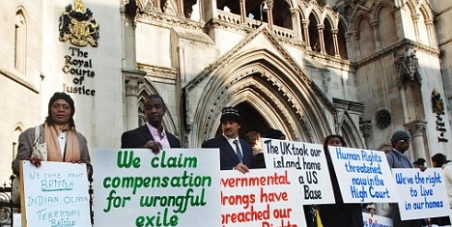
We implore you to make amends for the 'crime against humanity' (Article 7 of the International Criminal Court), which was carried out by your predecessors, both Tory and Labour. In the early 1970s, the British government forcible implemented the secretive transfer of Chagossians to a life of extreme poverty in Mauritius and the Seychelles in order to accommodate a military base for the USA. Many of these displaced people still suffer in poverty and those now in Crawley and Manchester, UK, live on the margins of British society, continuing to live in sadness, longing to return to their homeland. Many have died in misery, living in the hope of going home.

Honourable Sirs, we ask you to let British justice prevail by doing all in your power to undo this injustice and actively pushing for the islanders to be resettled in their homeland as soon as possible.


*************


Give the Chagos islanders the right to return home!


Why this is important

A Displaced and Forgotten People

The Chagos archipelago is situated in the Indian Ocean, mid-way between India and Africa. Some 2,000 people lived on the archipelago, the majority on the largest island of Diego Garcia. Their ancestry on the islands went back to the 18th century.

During the 1960s and 1970s British governments, both Labour and Tory, tricked and expelled the entire population of the Chagos, a British colonial dependency, so that Diego Garcia, the main island of their homeland, could be given to the United States as the site for a military base. This act of mass kidnapping by the British government was carried out in high secrecy, along with the conspiracy that preceded it. The last islander was deported in 1973. The 'deportation or forcible transfer of a population...a crime against humanity', is according to the words of Article 7 of the Statute of the International Criminal Court.

These displaced people still in Mauritius and the Seychelles continue to suffer in poverty to this day and continue to exist in sadness, longing to return to their homeland. Many have died in misery, living in the hope of going home.

In 2002, travelling with their new British passports, many of the Chagossians began to arrive in Britain, to bring their campaign to London and to escape the poverty of Mauritius. All of them wanted to return to the Chagos Islands rather than be in England. It is estimated that more than 2,000 Chagossians now live on the margins of UK society mainly in the town of Crawley, with a smaller community in Manchester. In both places they struggle to reconstruct their lives.

Meanwhile dozens of jobs on Diego Garcia are being advertised in the Philippines, including posts for electricians, cashiers, mechanics, stock clerks, janitors, welders, firefighters, engineers and massage therapists. There have been no reports of these jobs being advertised in Mauritius, the Seychelles or the UK, where most of the Chagossian community live. We can’t help but wonder why.they have not been given priority for these positions in their own land. Since being illegally evicted, very few Chagossians have been able to get jobs at the foreign base in their homeland despite many trying.

The hope is that the islanders be allowed to return to their islands as soon as possible before more of them die in a British imposed exile, never to see their homeland again.


How can I help this month?


Reach the 2000 mark on the petition! By now most of you have already signed the petition (I hope!) but we are less than one hundred names away from the 2K mark now-lets get 2000 by next Ftiday! Share the petition on social media, or simply print it out and collect signatures amongst your friends, family or stangers-you can enter the details online later. We've had 500 signatures in the last two months, many thanks to you all.


Send this (or something like it) to your MP- We've updated our template letter to Parliamentarians to make it easier to write to your MP. Please do feel free to change it around though as MPs tend to respond to a personal touch. You can send it online here, or a postal address will be available online. Contact us if you'd like to discuss your letter further, and do let us know about any responses.

Tell Avaaz, 38 Degrees and Change.org to push our campaign to their members- Last month we asked you to tell campaign group 38 Degrees to support the Chagossian cause and many thanks to all of you who did. Apologies though to those of you outside the UK who could not. Avaaz are a global campaign group and work on a variety of topical issues, in part in response to popular demand. So scroll the bottom of this page and tell them how much Chagossian return means to you.

Read & Share our New Campaign Pages- Our 'Perfect Opportunity' page summarises the main arguments why 2015 is the perfect time for the UK Government to give Chagossians a measure of justice. Our Realities of Return Article, meanwhile, proves resettlement will not be a burden on UK taxpayers, as some in the media and politics have claimed.

Come to the Architecture and Activism Event- Find out about Chagossian history, the return campaign and the chance for resettlement at 7:30 PM Friday 13th at Royal College of the Arts, Kensington. Free to attend and details here.


*****

Coordinator’s Summary: Meeting of the Chagos Islands APPG , 23 February 2015


Please find the below a summary of the recent All-Party Parliamentary Group on the Chagos Islands, kindly provided by voluntary Group Coordinator David Snoxell

The Chagos Islands (BIOT) All-Party Parliamentary Group held its 47th meeting on 23 February. It was followed by a meeting in the Foreign and Commonwealth Office with Hugo Swire, Minister of State.
Photo: Gail Johnson, via Flickr


Members considered Parliamentary Questions and Answers since the last meeting on 14 January. They noted the positive tone of the Government towards the review of policy which follows the KPMG study. The Group also considered the letter from the Chairman of the Foreign Affairs Committee indicating that an oral session with the Foreign Secretary was scheduled for March which might provide an opportunity for the FAC to explore the potential for resettlement.

The Group was informed of developments in the two Chagos cases before the Supreme Court. Members took the view that litigation should be regarded as quite separate and independent of the political and practical considerations concerning resettlement and should not be a delaying factor.

The Group discussed KPMG’s final report and conclusions. They agreed that in principle there were no longer any impediments to resettlement and that even cost could be overcome. It was clear from correspondence that the Government wanted to consider all options carefully, regarding the future of BIOT and also the aspirations of the Chagossians, and that this would involve the PM and Ministers across Government.

Members discussed sources of funding – the aid budget, US, EU, international organisations, and private sector. They were informed of an oral answer from the European Commission, given just prior to the APPG meeting, to a Question from Linda Mc Avan, chair of the Development Committee of the European Parliament. The answer reiterated earlier statements by the Commission that there was no obstacle to EU funding (either through the European Development Fund or indeed the European Investment Bank) should an application be made by HMG.

Members decided to press for a debate in both the Commons and the Lords which would probably be in the second half of March. It was agreed that should there be a need for a further meeting before the dissolution of Parliament (30 March) it would take place on 23 March.

An encouraging and positive meeting with Hugo Swire and officials followed at the FCO. Many aspects of BIOT were discussed including the KPMG study, costs, sources of funding, accommodation in the MPA of Chagossian artisanal fishing, current US recreational fishing (48 tons pa), renegotiation of the UK/US Agreement, Chagossian employment on the base and in the management of the MPA, future funding of the BIOT patrol vessel, future constitutional arrangements for BIOT providing for parliamentary oversight, sovereignty and a parliamentary visit after the election. The Group decided to put their views to the Prime Minister in a letter from the Chairman.

26 February 2015

U.S. territorial Governors participate in meeting of U.S. state governors in Washington, D.C.


Feb. 21— American Samoa Governor Lolo Matalasi Moliga (left) and Virgin Islands Governor Kenneth Mapp attend the National Governors' Association (NGA) Annual Winter Meeting in Washington, D.C. The five governors of the U.S. territories of American Samoa, Guam, the Northern Mariana Islands, Puerto Rico and the U.S. Virgin Islands participated in the NGA cmeeting along with the governors of the 50 U.S. states. (photo by NGA).


Feb. 22— Puerto Rico Governor Alejandro Garcia-Padilla participates in NGA session. (photo by NGA).


25 February 2015

Overseas Countries and Territories Association convenes in the Virgin Islands

Special Week For OCTS And EU 
In The BVI
Over 150 top government officials from the Overseas Countries and Territories Association (OCTA) will gather in the Virgin Islands for the Annual OCTA Ministerial Conference on February 26 and the 13th Annual Overseas Countries and Territories (OCTs) European Union (EU) Forum on February 27.

Led by the Chairman of OCTA and Premier and Minister of Finance, Dr. the Honourable D. Orlando Smith, OBE, the OCTs will engage with the European Commission at the highest level. The European Commissioner for International Cooperation and Development will be represented by Mr. Neven Mimica at the meetings.

In reflecting on the upcoming meeting, Premier Smith stated, “I look forward to this meeting as the OCTs consider how they have unlocked their value by leveraging their special relationship with the EU and other international and regional partners, to create regional hubs and centres of excellence.”

He added, “OCTs will also reaffirm their commitment to the sustainable use of natural resources and emphasise the importance of coastal marine management and climate change adaptation.”

During his year-long tenure as Chairman, Premier Smith has represented over 20 Countries and Territories, under the theme “Unlocking the Value of the OCTs: Sustainable Development through innovation, competitiveness and green growth”.

In this regard, he has lobbied for strategic development in areas such as green growth, innovation, and access to funding for programming. In relation to programming, the Territory and all other OCTs who are members of the OCTA group, are participating in the Territorial Strategies for Innovation (TSI) Project currently being implemented. 

Additionally, the Regional Small and Medium Enterprise Development project is currently managed by the Virgin Islands, with funding from the 10th European Development Fund (10th EDF), has the participation of 12 Caribbean OCTs including the British, Dutch and French territories. 

The OCTs also recognise their economic, environmental, scientific and strategic value to the EU and the wider region can be developed through EU support for research and development in renewable energy, climate change, biodiversity, conservation, science and technology and other areas.

In observance of the OCTA Ministerial Conference, the Government of the Virgin Islands will hold an educational exhibit under the theme, “Unlock the Value of the OCTs: Sustainable Development Through Innovation, Competitiveness and Green Growth”.

The Exhibition will be showcased in the parking lot of Maria’s By the Sea Hotel on Wednesday February 25 and Thursday February 26 starting from 10:00 a.m. to 3:00 p.m. each day. The BVI community is invited to come and view featured displays from the Virgin Islands and other Overseas Territories and learn more about the role of OCTA. 


Nadia James-Harris
Information Officer II
Premier’s Office
Telephone: 468-3701 ext. 2076

Thomas Sankara & Amilcar Cabral documentaries to be shown at Africa Diaspora International Film Festival in New York

African Leaders: Thomas Sankara & Amilcar Cabral
Sat, Feburary 28 @ 1PM

  TICKETS HERE


Thomas Sankara
In the former Upper Volta, known today as Burkina Faso, a group of men decided to launch a revolution that would enable the country to accept the responsibility of its reality and its destiny with human dignity. Captain Thomas Sankara, the leader of the resulting Burkinabe Revolution, would go on to belong to a group of African leaders who desired to give their respective countries and the African continent a new socio-political dimension. (RDC, 1991, 26 min, Balufu Bakupa Kanyinda, dir., Biography, French with English subt.)
 

Amilcar Cabral
Amilcar Cabral was the leader of the Liberation Movement of Cape Verde and Guinea Bissau and the founder of the African Party for the Independence of Guinea Bissau and Cape Verde (PAIGC). From Cabral's birth to his tragic assassination, this documentary reveals the revolutionary giant in several dimensions—as a man, father, politician, humanist and poet—while delving into a wealth of rare archive footage, varied testimonies of important African figures and the recreation of notable episodes of Cabral's life.
(Cape Verde/Portugal, 2001,  52 min, Ana Ramos Lisboa, dir., Biography, French with English subt.)


24 February 2015

Guam Governor: "Any (political) status better than the status quo"


Gov. Eddie Calvo delivers his annual State of the Island address at the Guam Legislature on Feb. 16.


GOVERNOR EDDIE BAZA CALVO


"Whatever the case, I believe the question of our political status needs to be answered NOW!!!

Any status is better than the status quo – an unincorporated territory. Whether it’s statehood, free association or independence, I believe that a change will put us in control of our destiny."


February 16, 2015

6 percent. That’s where I’d like to see unemployment numbers by the end of this year.

4.5 percent. That’s where I’d like to see unemployment numbers by the end of my term.

We haven’t seen numbers that low since 1993. Getting them back there is going to take a lot of work.

Madam Speaker, Mr. Chief Justice, Archbishop Apuron, senators and mayors, distinguished guests, and most importantly, my fellow Guamanians, I’m honored to stand here before you and grateful that you could join me here tonight.

This speech reflects my agenda for the next four years. It’s about jobs, jobs, jobs!!! It’s about building a future for our children and their children – giving them a proper foundation, a solid foundation on which they can enjoy a prosperous life.

Four years goes by so quickly. But that’s all the time Ray and I have as a team to finish the work we started.

I stood on these steps four years ago as your newly elected governor. We faced a myriad of challenges. The biggest were finances and the ramifications of two decades of instability.

Today, we have the ambulances that our island needs. Our public school students have buses. And we have more police officers on the streets with police reserves and CAPE volunteers working with them.

GMH has an urgent care clinic, and a larger emergency room. We are modernizing the GMH maternity ward. Northern and southern public health centers are able to help more people with their extended hours. Health care is on the rise for our people and our veterans. Investors are bringing business and more jobs to Guam.

All fire stations have a fire truck. This is the way it should be.

Tax refunds are timely. Before, people were resigned to waiting for years. The people are getting their money back. Last week, 500 taxpayers received about $1.8 million in tax refund checks. This is the way it should be.

Today we start a new day. Now we’re going to push the bar higher. We’re going beyond the standard. Set a new standard for our children. That’s how you build a stronger future.

In March 2014, Guam had a 7.4% unemployment rate — an improvement over the previous rate of 8.4% in December 2013.

According to the Economic Outlook for Fiscal 2016, Guam will see more businesses, investors and opportunities for growth. Guam has two engines powering our economy: Tourism and the military.

In the next few years, Guam will see public utilities and infrastructure improvements — these will provide high-octane fuel for our engines.

TOURISM

Tourist arrivals have been at record-breaking numbers in recent years. Arrivals for 2014 ended with 1.342 million, which is about 8,000 more visitors than we received in 2013. That’s three years in a row we’ve seen steady growth.

While the number of Japan visitors has been declining recently, revenue from Japan remained nearly unchanged due to GVB’s work to raise quality, rates and yield. Japan is still our number one market, but growth from all other major markets including Korea, Taiwan, Philippines, and China are contributing to maintaining high and increasing tourist arrival numbers. Guam is expanding its tourist market. We’re not putting all of our eggs in one basket.

Tourism sales are at $1.47 billion. We’re working to increase that to $2.64 billion in the next several years.

Jeju Air recently launched its new twice-weekly non-stop flight service between Busan, South Korea and Guam. From now until the second week March, Guam will welcome nearly 3,000 visitors from China who will fly in on Dynamic Airways. The Asian airline is introducing 15 charter flights from 5 major Chinese cities for the 2015 Chinese Lunar New Year.

Also, to ensure this growth continues into the next decade, I signed into law a measure that would help investors in tourism increase capacity at their hotels. Ken Corporation recently announced plans to build a new hotel with 348 rooms. Construction on the $120 million hotel is scheduled to start this year and has a completion date of 2018. There is no doubt this investment will also provide hundreds of jobs for our people.

Let’s talk about diversification in tourism. Coming to Guam is not just about sight seeing. There’s a new market emerging: sports tourism. More people are coming to Guam to run, bike and swim in our 10Ks, marathons, triathlons and other races. Golf, tennis, off-road racing baseball, soccer and rugby are also other reasons for visitors to flock to our island paradise.

The Ko’ko’ Half Marathon & Ekiden Relay in 2014 welcomed runners from Guam, Japan, Korea, Taiwan, Hong Kong, Australia, Papua New Guinea, and Russia … among others. Millions in tourism dollars were generated. International media covering these events, meant increased exposure for Guam. In fact, this April, the third Guam International Marathon is expected to draw about 2,000 off-island runners to experience this signature event.

The cover of the United Airlines’ magazine Hemispheres’ features an article: “Three perfect Days on Guam.” The nine-page cover story featured in the in-flight magazine’s February 2015 edition. An estimated 11 million travelers will see pictures of people kayaking; read about hiking adventures, tax-free shopping, and relaxing with a drink and some food at The Beach bar and grill. The article asks the question: Is Guam the next Pacific hot spot for tourists?

And you know my answer: “Yes.” Especially if it’s winter and I’m shoveling snow from my driveway.

With the help of our private partners, Guam is building a reputation as a safe and family friendly destination. That reputation is opening the door to other forms of tourism.

Education tourism is a budding industry. I’ve engaged the Guam Visitors Bureau to work closely with the University of Guam and the Guam Community College to expand our educational exchange programs. The University of Guam’s English Language Institute and English Adventure Programs bring more than 4,000 visiting students to Guam for up to a full semester. Students learn about our culture and participate in popular local sports. A majority of students come from Japan and Korea, but we’ve also seen students from Russia. Leo Palace Resort and other local hotels host many of these young men and women.

Like many sports events, education tourism programs not only increases our tourism numbers, they also promote our island’s attractiveness and its culture of hospitality.

BUILDUP/INFRASTRUCTURE

Soon we’ll see the official record of decision for the military buildup. Many eyes, the eyes of investors, are focused on Guam because of the United States’ commitment to its allies in the Asia Pacific region.

Guam has about 6,000 active military personnel and about 7,000 military dependents. Those numbers are going to grow over the next few years – by about another 6,000 when the Marines come to Guam. In addition, we’re seeing growth in the Army, Navy and Air Force presence, such as the more than 200 soldiers here with the THAAD battery, and about 200 sailors and family members who will soon be on Guam with the new submarine USS Topeka.

The military buildup is projected to generate $8.7 billion in economic contributions in the next 10 years. We have already seen millions of dollars in infrastructure improvements at the Navy wharf; our bridges and primary roads have seen major improvements

In the last few years, we’ve cut the ribbon on dozens of road projects. Just two years ago, driving down Marine Corps Drive in HagĆ„tƱa was rough. Now that’s one of the smoothest stretches of road on island.

Recently completed and ongoing road repairs and construction total $160 million in investments. In the next few years, we’re looking at another $126 million in road improvements.

We’re also looking at millions of dollars in improvements with both the Guam Waterworks Authority and the Guam Power Authority. The water agency is looking at a $400 million investment into its infrastructure to meet federal requirements.

GPA is investing up to $850 million to build its alternate energy sources, including solar and wind energy, in addition to LNG generators. It’s also creating a new niche in the business sector. Guam is seeing private businesses increase our island’s solar power capacity – helping us reduce our reliance on fuel that is shipped to Guam and reduce our carbon footprint.

Lt. Gov Ray Tenorio and General Manager Joanne Brown announced the Port’s acquisition of an X-ray machine. It is part of the Port’s overall security enhancement program. The nearly $1 million project is just one of the Port’s several dozen modernization and security enhancement projects totaling more than $60 million.

The Guam International Airport has completed $82.1 million in modernization, including renovation work and improvements to accommodate new shops and boutiques. Moving forward, they are anticipating $166 million in additional capital improvement projects over the next 4 years.

The work has just begun. These investments are growing our economy and providing more jobs for Guamanians. Guam has seen an increase in private sector jobs, particularly in the construction, transportation, retail and services industries. In all, the private sector grew by nearly 1,000 jobs — from 46,430 in September 2010 to 47,030 in September 2014.

And there are more jobs ahead. Guam Regional Medical City, Dusit Thani and retailers like Forever 21 are hiring. Guam Regional Medical City will eventually employ about 700 people. Under the terms of the QC that I signed, 75% of all employees must be US citizens or Permanent Resident Aliens. That employee number doesn’t include housekeeping and other ancillary services. Dusit Thani recently held a job fair to fill 350 positions, and Forever 21 is looking for up to 70 people. That’s more than 1,000 jobs available to Guamanians in the next few months.

HOUSING

Since becoming your governor, I’ve said the working middle class in our community, the backbone of our economy, must be able to afford homes.

While those in the middle class, particularly those who earn too much to receive welfare, but don’t quite make enough have to make tough choices. Come payday they have to decide between buying school supplies and paying for utilities. People were worried that the military buildup would price the middle class wage earner out of apartments and homeownership. I told you back then that this administration wouldn’t let that happen. And I am still committed to that promise.

There have been more than 5,600 civilian construction projects totaling $1.4 billion in the last four years. Of that amount $250 million were for apartments and homes.

When I first took office, my goal for the administration was to build 3,000 affordable homes by 2017. Today, we are 1,967 affordable homes closer to that goal.

The Guam Housing Corps First Time Homeowners Assistance Program provided 283 new homeowners with $2.1 million in down-payment assistance and closing cost funding. This doesn’t include homeowners who qualified for traditional financing, which totals $43 million in mortgage loans at various financial institutions. And when people buy homes, they buy furniture, appliances, pay utility bills, and further stimulate our economy.

I encourage the leadership of the 33rd Guam Legislature to fund this program annually and to support the passage of the various funding sources outlined in the Housing Trust Fund. This will help GovGuam fund and manage local housing programs and projects.

All of these improvements mean nothing when we see fellow Guamanians and their children in need of a helping hand.

HOMELESS

Last year, we increased the number of emergency housing for homeless people and families. The Guma San Jose Homeless Expansion Program for five single-family homes was completed and those homes are helping families right now.

Another five homes from Lada Gardens that formerly were used as rental units were upgraded and designated as homeless shelters by Guam Housing Corp. We’re continuing to look at additional abandoned housing within the government’s inventory that can be renovated. And our plan to construct basic homes to provide temporary shelter for homeless families is moving forward.

I want to reiterate that this is not a handout. Life sometimes deals tough blows and all we need is a hand to lift us up enough so we can stand on our own two feet. And that’s why we’re here, to help Guamanians who want to take advantage of the opportunity to get their families in a safe home.

We’ve tied housing to other types of assistance. Families placed in emergency shelter are connected with the Department of Public Health and Social Services and Department of Labor, and other agencies that provide services the family might need. We’re making sure they have food, a roof over their head, and either a job or job training so they can get a job.

One family, at one point needed help after the house they were renting was flooded by a passing storm. They sought help and were able to move into temporary housing. It was the Guam Housing Corp employees who realized they could help this family do more, and today they are proud homeowners! Congratulations John Howard and Iumi Mori!

Now let me tell you about someone who, around this time last year, was forced to live in a bus shelter because of a domestic issue. She said she felt safer there than where she used to live. A staffer for the Lt. Governor saw her and asked if she needed help. He called Guam Housing Corp and asked them to help her. Ms. Dungca moved into one of the emergency shelters. Guam Housing and the Department of Public Health and Social Services got her help. All she needed was the listening ear of someone who cares and a helping hand — she got both. Annie Dungca is now self-sufficient and is paying rent for her Dededo home.

It isn’t only adults who find themselves in tough situations. There are so many children who have been left without a home and have no one to care for them. It’s not because they did anything wrong. It’s because the adults in their lives weren’t doing what’s right. Whether it was physical abuse, neglect, or placing their children in dangerous situations because of drug addiction or criminal behavior, these adults are imprisoned or hospitalized and their children are left alone. We have about 40 families who have opened their hearts and their homes to these little ones. But with almost 300 foster children, not every child is able to get a foster family. These homeless foster children are distributed between different non-profits and agencies, like the Department of Youth Affairs. That’s why First Lady Christine Calvo pushed so hard to build Rigalu House, a temporary home – so these children would know there are people in this world who care for them and who are willing to do what is right.

It took a lot of patience and prayer — and there were tears as we waded through the arguments and the naysayers who hid behind politics. But with God’s grace we are almost at the finish line. The Chamorro Land Trust has identified property in Barrigada Heights and, pending the approval of this Legislature; we’re planning to break ground on the Rigalu House this year.

As I stated earlier, there’s a lot of hard work ahead of us. I ask the leadership of this body to roll up their sleeves with me?

Many in our community face challenges, whether it be a lack of a home to keep clean clothes and shower, lack of transportation, or lack of information to get all the things they need to get back on their feet.

Like Annie they need a helping hand. We need to support them on the road to financial stability. And the only way to do this is to help them get a job.

AHRD works with other agencies to assist individuals and families. They connect people with different programs to prepare them for a job, including job training, resume writing, interview techniques and, for those who need it, obtaining their high school diploma. Hundreds more will soon have easier access to that help. AHRD is creating satellite job centers throughout the island, beginning with a Northern Job Center.

AHRD and the Department of Labor share a common goal of helping people find jobs. They want to match people to fulfilling jobs that provide learning opportunities and offer a path to a higher salary.

Perhaps in one of those jobs, they’ll learn skills they can use to build their own businesses, and become their own boss. Programs like the University of Guam’s Small Business Development Center have assisted 109 entrepreneurs to start, expand or buy a business who invested more than $14.4 million in loans and equity injection from 2011 to 2014. The entrepreneurs, in turn, created 278 jobs and retained 174 jobs for their fellow Guamanians.

EDUCATION

If we truly believe education is the key to success, then we need to ensure the next generations of Guamanians receive the education they need to become successful.

Guam’s public schools have a new curriculum standard that, for the first time, marries the skills needed in the work force to what students are learning in the classroom. This is the first full year that Common Core Curriculum is in place since it was adopted by the education board in 2012. The new curriculum reflects a global shift in understanding that our children will be competing against the best in the world for jobs.

Many of those jobs will be in the science, technology, engineering and math fields. That’s why I was excited to learn that the STEM programs at schools are flourishing. Not only are our children studying robotics and engineering; they also are participating in Green Engineering. At George Washington High School, students are testing the pH level of soils to determine what plants grow best in the soil at the Mangilao school. They planted tomatoes and other produce. Whether they eat what they grow or sell it at the soon-to-be-open Farmers Market — what they are learning is important to the future of our island. If we want to decrease our reliance on foods shipped to Guam and have healthy, fresh, locally grown fruits and vegetables on our dinner tables, then we need to encourage these programs that can boost sustainability and agriculture on our island.

We also need to support the educational needs of men and women in uniform. Guam has a large population of soldiers and airmen in the National Guard. Together with the administration and the National Guard, the Guam Community College created a program that teaches our soldiers and airmen the skills to secure a well-paying civilian job. Keep your Guard Up, which is the only program of its kind, has helped about 200 Guardsmen.

Other commands and colleges from the U.S. mainland now are looking to Guam to learn more about this program, about how it was created, about how in its first year we helped veterans learn valuable, employable skills.

HAGƅTƑA REVITALIZATION

Many of you know that I enjoy reading about history. I think it’s important to know our history. Because when you know where you come from and understand the lessons of the past, they become landmarks as we chart our way to a better future for Guam.

HagƄtƱa has been the heart of our island for centuries. It reflects the different eras of Guam, and the efforts to rebuild as we moved forward after Spanish colonialism, the war between America and Japan into which our people were swept, and our efforts to determine our political future. We are rebuilding this historic city once again as we move to a better understanding of our place in this world and who we are as a people.

This will likely be the last State of the Island address given in this building. If all goes according to plan, the old Guam Congress Building will be renovated this year. And by this time next year, I fully anticipate apprising Guamanians on the state of the territory from the hallowed halls of that historical building.

Now, as we prepare for the Festival of Pacific Arts, or FestPac, next year, we’re going to open HagĆ„tƱa to them. A revamped Paseo Park will be the center of the festival, which we anticipate will host about 2,500 artisans along with an estimated 10,000 supporters from more than 27 countries in the Pacific region.

As our guests tour HagĆ„tƱa, they’ll see the Cathedral, the new Guam museum at Skinner Plaza. In the corner between them, is the site of the old Plaza De EspaƱa — restored to become a glowing reminder of Sunday afternoons when musicians played in the courtyard of the palasio, while families strolled by listening to the music.

Festival participants also will be able to walk to the soon-to-be completed Fishermen’s Co-op Fishing Platform and see the site where our fishermen are growing our fishing industry – while also teaching the next generation this important tradition.

TECHNOLOGY

We must embrace technology to move our government into the 21st century. Guamanians today can register their vehicles, pay taxes and even file tax returns online. I’ve directed line agencies to make more government services available to Guamanians.

We’re going to start with our libraries. I’ve directed the Chamorro Affairs director to increase efforts to turn our public library system into centers of education and technology. The Guam Public Library Extension project will add a new children’s library and cyber cafĆ©.

Next, they’ll be partnering with Americorps, non-profit organizations and corporate sponsors, to open our village libraries later, and we’re updating and adding to their computer inventory.

But such a library has to be so much more. Our goal is to help teach students how to use the computer to do academic research, and how to process and critically assess the barrage of information flowing through the Internet. When a student or other library patron checks out a book, it may be an e-book they check out online. The library will host community discussions on the dangers of sexting, or cyber-bullying.

Also, public school students and parents can learn more about the various Common Core Curriculum apps that are available to help children and parents. And at Appy Hour, students and parents can speak with a technology aide about the different educational, literacy, and life apps available for Apple and Android devices.

This re-imagined library system will ensure our children have a safe place to study and learn outside of school; a place where they are connected to the Internet and the world; and where they can learn how to harness the flow of information for their education.

The Office of Technology is working on other Apps to improve Guamanian’s interaction with their government and community.

I have one of these apps on my phone, this app allows me to view land related data. In later phases of this app, you’ll be able to download documents, such as a property titles and order a certified copy of the same.

We have other apps coming. In the next several weeks, a traffic app will become available and will show traffic routes and any congestion at various times of day. The Office of Technology will ensure that future iterations of this app include information about accidents, traffic light outages, and road construction.

COMMISSION ON DECOLONIZATION

Another of those apps you’ll see, will help plug educational outreach on the question of our political status. Ensuring that eligible voters have the information they need to make an informed decision is critical.

The Office of Decolonization has an additional $120,000 in the current fiscal year to help fund the education outreach. Also, we continue to wait for the Department of Interior to make good on the funding promised to us. I’ve written a letter to Assistant Secretary for Insular Areas Esther Kia’aina asking for her help – at the very least to match the money we’re putting into the education program.

Having said that, the law requires us to register 70 percent of eligible voters for the plebiscite to occur. GEC only has 7,192 registered voters in the Decolonization Registry that falls short of the necessary voter numbers. There are some questions on the language of the law that we need to settle in order to give us a clearer understanding of the actions we need to pursue. This may require us to go to the Attorney General, or even the Court, for interpretation.

Whatever the case, I believe the question of our political status needs to be answered NOW!!!

Any status is better than the status quo – an unincorporated territory. Whether it’s statehood, free association or independence, I believe that a change will put us in control of our destiny.

Our youth of today show us that we can’t be afraid to move forward, to take that leap of faith.

Keandra McDonald, daughter of Chris and Stacy Flores, is a junior at Squalicum High School, in Washington State. In her freshman year, just two weeks after she started at her new school and being the only Guamanian student, she made a bid for the vice presidency of her Freshman Class Council. As part of her campaign, she talked about Guam and the beauty of our island, its culture and diversity. She became known as the Guam Girl. Incidentally, she won that election. Today, she is the president of the school’s Diversity Club.

Her perseverance and determination changed the mindset of a community. She took a leap of faith, trusting that her cause was just and fair, and she committed to the uphill battle.

Ladies and gentlemen, we cannot be afraid to push an agenda that is based on what is just and what is fair. We are a small island, but history has shown us that we are significant. And whether we come from a large or small community – it behooves us to do what is right, no matter how big our Goliath.

UNFUNDED MANDATES AND COLONIALISM

For over a century the federal government has dictated how we do business, how we are able to care for our people.

I’ve heard the naysayers and the critics. If it wasn’t for the federal government pumping money into our economy, we would still be living in thatch huts. Federal officials have recently stated in court that the government of Guam is too incompetent to be entrusted with the welfare of its public. That if it wasn’t for the federal government taking over our agencies and running them for us, things would be running at a higher cost and with less efficiency.

It is ironic that they praise the fiscal management capabilities of a federal government that over the last six years has been running an average annual deficit of over a billion dollars per year, and that has a current national debt of over $18 trillion dollars.

On Guam, the federal government forces us to sign blank checks and give carte blanche to receivers that build a solid waste system that is operating at a deficit, that is over-budget by tens of millions of dollars, that is paying exorbitant fees to consultants and employees, and that is NOT self-sustaining but instead is draining over $12 million dollars per year out of our General Fund.

Am I missing something? Aren’t these the very same reasons we were told that the federal government needed to take over our solid waste system to begin with? When was the last time you heard anyone say the federal government was the epitome of fiscal prudence?

The federal courts have the luxury of focusing on one capital project at a time — a landfill, a mental health facility, a prison — without any consideration for the other government expenses, including education, public safety or island infrastructure. Or the cost of other federally imposed mandates, such as Compact Impact. They can force us to spend more than we have available to cover all the other necessary expenses of the government — not because they’re right, but because they can.

Make no mistake about it, this is colonialism in the 21st century — it is the forced will of the federal government on our people through unfunded mandates enforced by the federal courts. The History Channel recently showed a 3-part mini-series, the Sons of Liberty, depicting how the seeds of the American Revolution were sown. Of course I am not advocating a revolution, but I want to remind us all, federal and local alike, that the criticisms and aspersions being cast at the people of Guam as ungrateful money grubbers who lack the ability to govern themselves, is always the rejoinder of those claiming to be a more “enlightened” citizenry, who are only exerting natural paternalistic oversight to “take care” of those unable to take care of themselves.

Yet, it was the rejection of these same characterizations, and the recognition of the right to participate in the creation of the laws of their government that founding fathers established the foundation for the greatest democracy in the history of the world.

Does GovGuam face some culpability in letting some of its institutions and facilities deteriorate? Of course it does, primarily because of political gridlock. But that does not make us unique. The most recent Congress was so gridlocked that it passed fewer laws than at any other time in modern history. Last year was the first time Congress passed a full-fledged budget since 2009.

So, who gets to step in to take over the federal government and impose a receivership on it when it’s not living up to its mandates? No one, and yet by the standards that are applied to GovGuam, the federal government doesn’t appear to be any less deserving of receivership.

My fellow Guamanians, just because our local government failed in the past to provide services doesn’t mean we can’t question the decisions being made for us now. It doesn’t mean our concerns shouldn’t be heard. It doesn’t mean we can’t keep pointing out to the federal government and the courts the cost of other – necessary – projects. I think, if anything, this administration’s track record of providing services, fulfilling promises – even those made by our predecessors – should allow us a seat at the table AND I’M NOT talking about the servants’ table.

We should be able to come together as equals to discuss issues that impact the lives of the people we are all supposed to be serving. But to be denied even the most basic right of having legal representation in a court proceeding, an issue we’ve appealed that is being heard by the Ninth Circuit Court of Appeals this week, only reminds us that this government, and I as Governor, have the responsibility to the people of Guam to make sure that even federal edicts and mandates are not left unchecked, unchallenged, or unquestioned.

Having said that, we will be re-introducing a bill originally submitted to the Legislature last year. The bill will authorize this administration to hire lawyers, possibly through the Attorney General’s Office, to represent Guam in a possible suit against the federal government and hold them responsible for dumping toxic waste and other contaminated material into the Ordot Dump for years. Yes, Ordot dump was a problem and this administration acknowledges that the closure of the toxic site is necessary. But the federal government also should acknowledge its part in the creation of the dump and be held accountable for it. The people of Guam didn’t start that mess. We shouldn’t be expected to bear the full burden of its closure.

I’m asking that this new Legislature consider this bill carefully. Consider that we have a new Attorney General who has agreed to work with us to forge a path for our people, in a way that incorporates best practices with what is best for Guam. I’m also grateful that the Legislature is of the same mind and is pushing the federal government to consider outside of the box solutions to help address how our people have been shortchanged.

My friends, my neighbors, my family, my people of Guam, I hope you know and understand that we, as a single team and with a single voice, have the power to do what is right for our people today and for future generations of Guamanians.

This single focus will be aimed, not just at the dump issue, but also on other federal policies that restrict our economy and impede on our efforts to become a more self-sustaining people.

Policies like the Jones Act weren’t meant to have a negative impact on the economy, but it has. And despite many requests for this to be repealed, the federal government hesitates. And in its hesitation, our people are made to pay higher costs for goods that have to be shipped in a jagged line from Asia to the west coast of the United States, to Hawaii, to Guam and the Micronesian region.

I’m going to marshal our friends and supporters to help us address this cause. I’m meeting with federal officials in a trip that I’ll be taking to Washington D.C. soon. Among the things I’ll be discussing is this decades-old act that has increased not only the cost of doing business on Guam, but the cost of everything from rice to furniture. It’s also created a monopoly.

President Obama said during his State of the Union Address just last month that he’d like to ease laws and policies that hinder growth of the nation’s economy. I believe this may be the opportune moment to free our island and our region from this policy.

As I said earlier, we’re in the start of the tax season and as of last week, about 15,000 tax returns were filed. If the trend holds true, we’ll pay about $130 million in tax refunds. EITC would make up about 40 percent of that amount. EITC is something every qualifying U.S. taxpayer can receive. The difference is, the California and New York state governments don’t pay this amount from their state coffers – the federal government pays for it. On Guam, we pay it out of our General Fund.

One mandate that has been the topic of disagreement for decades is Compact Impact reimbursement. For several years, we received $16 million a year for providing health, education and safety services to migrants from the Freely Associated States. In Fiscal 2015 that amount decreased to $14 million. It remains the same in Fiscal 2016.

Let me make it clear, this debate is with the federal government, which forged an agreement with the FAS governments without any input from us or other states and territories that host our Micronesian neighbors. The disagreement on Compact Impact costs is based on the federal government’s inability to live up to its promise to help us provide services to the increased population.

Last year alone, we’ve calculated $144 million is owed to us – that’s 10 times what we’re actually receiving. The federal government says the disparity in numbers is due to a faulty formula. Despite repeated requests they have yet to provide a formula they would accept.

I don’t know if discussion is something we can continue to do on this front. We need to be more aggressive. We need to push the federal government to recognize that their failure impacts the lives of everyone on Guam. If necessary, and if legally sound, we’ll be working with our Attorney General to take this matter to court – to force the hand that signed this policy to live up to its side of the agreement.

Just this afternoon, I issued an Executive Order, amending an earlier Executive Order establishing the Guam First Advisory Commission, to expand that Commission’s authority to advise me on federal issues. I will send a letter to convene the Commission in March. I am asking the Commission to establish separate committees or task forces to initially deal with the Guam buildup and with Compact Impact.

It was in February 1870 that Congress ratified the 15th Amendment to the U.S. Constitution, guaranteeing the right of citizens to vote, regardless of race, color, or previous condition of servitude. 145 years later, we’re still waiting for the right to vote.

On February 1917, my great grandfather Tomas Anderson Calvo, petitioned the federal government to treat the people of Guam as equals.

“It is high time that there be granted to the people, respectful, loyal and devoted to the great American nation, the same rights that have been granted to the different states, territories, and possessions; and we censure no one although we be the last to be remembered and granted our rights. Our ideals are realized by the giving of that which by right should be granted, that is to say, the defining of the status of the Chamorro people, in a word, that we may know whether we are to be members of the American people or their servitors …”

He delivered that speech at the opening of the First Guam Congress in February 1917. It’s almost 100 years later and we’re still left at the mercy of unilaterally imposed policies placed on the backs of our people.

My grandfather ended with “I have spoken.” These three words indicated the end of his speech – but they also reflected the level of energy, passion and commitment he gave to the words he spoke.

Make no mistake, this advisory commission has a tough task ahead of it. Helping to ensure that we as a people are able to participate in the formulation of the laws and policies that bind us will not be easy. It first requires that we agree on a single focus. This is a meeting of the heart and of the mind. It is a metamorphosis of our political will. It’s going to be an uphill battle. But like the Howards, Ms. Dungca, and young Keandra we can’t be afraid to pick up the gauntlet and sword, and face this battle.

We can’t walk away. To do so would be an injustice, a disservice, to our people – those who came before us and to our children and their children. If we don’t stand up for what is right, what do we say to the children who ask why their fathers, and mothers paid the ultimate sacrifice while serving the American flag?

It’s going to mean tough decisions, and some of those decisions may not be politically correct but we mustn’t be swayed. We must come together in this fight for what is true and what is right. We must come together as elected leaders, we must rise as a people, as Guamanians rooted in our community, and in our shared belief that we deserve to be treated equally and with respect, and dignity.

And in the words of a man who a century ago, who dared to believe in the Guamanian dream:

I have spoken.