02 December 2014

Pressure heightens for reparatory justice for Slavery and Colonialism

Reparations discussed at the United Nations


(OTR Reading List)


The general Debate of the 69th session of the United Nations general Assembly was held in New York from 24 to September 30, 2014. During the Debate some delegates from Jamaica, Saint Lucia, Saint Vincent and the Grenadinesand Trinidad and Tobago demanded reparations for the genocide of the native people and slavery; this request was also supported by the delegate of Cuba. The request was submitted for the first time last year during the general debate of the 68th session of the United Nations general Assembly.

The second regional Conference on reparations was then held in Bolans, Antigua and Barbuda, from 12 to October 14, 2014 with the attendance among others of the former Prime Minister of Jamaica P. J. Patterson, of the prime minister of Antigua and Barbuda Gaston Browne, of the President of the "CARICOM reparations Commission" Hilary Beckles, of some delegations of the "national Commissions on reparations" and of other delegations from Guadeloupe, Martinique and the British Virgin Islands. The work was focused on the involvement of the academic world and the community mobilization regarding the CARICOM's Ten Point Plan for reparatory justice.

To date, the "national Commissions on reparations" are present in twelve of the fifteen member States: Antigua and Barbuda, Bahamas, Barbados, Belize, Dominica, Guyana, Jamaica, Saint Kitts and Nevis, Saint Lucia, Saint Vincent and the Grenadines, Suriname and Trinidad and Tobago. The "CARICOM reparations Commission" provided for theirestablishment even in other countries through the involvement of the Caribbean diaspora .

Colonialism Reparation supports the request for reparations for the genocide of the native people and slavery submitted to the United Nations general Assembly by the member states of the Caribbean Community (CARICOM) and calls on the former colonizers (the United Kingdom, France, Spain, Portugal, the Netherlands, Norway, Sweden and Denmark) to apologize and pay compensation for the colonial period.

01 December 2014

'Black Pete' deemed appropriate in Netherlands Kingdom

'Black Pete' controversy stirs up Netherlands


By Michael Pearson, CNN


Police detain an anti-Black Pete demonstrator in Gouda, Netherlands, on Saturday.
Police detain an anti-Black Pete demonstrator in Gouda, Netherlands..

(CNN) -- The Dutch version of festive St. Nicholas is once again landing on the naughty list for some in the Netherlands, who say his Black Pete sidekick is a racist throwback to the colonial era.


Protesters gathered Sunday at Amsterdam's festival honoring St. Nicholas -- or Sinterklaas as he is known in Dutch -- a day after 90 people were arrested in demonstrations surrounding his ceremonial arrival in country at the Dutch city of Gouda.


They carried signs reading, "Black Pete is racism."


Only one person was arrested in Sunday's event, according to CNN affiliate RTL and Dutch national broadcaster NOS.


Actors dressed as Black Pete arrive on a boat  in Antwerp, Belgium, on Saturday.


Dutch blackface tradition debated

In the Netherlands, Sinterklaas is accompanied by a dark-skinned figure, often played by whites in black face who wear curly afro-style wigs and red lip coloring.

The character sometimes visits private home and hands out candy to children but also is reputed to take away the naughty ones.

The tradition has grown increasingly contentious in recent years, with the United Nations arguing last year in favor of a national dialogue on the practice.

Experts working under the auspices of the Office of the High Commissioner for Humam Rights last year said people of African descent found the character's depiction "rooted in unacceptable, colonial attitudes that they find racist and offensive."

The Dutch government replied that it was aware that the practice was offensive to some, and that it had received dozens of complaints a year concerning Black Pete since 2011.

Last week, a high-level Dutch court declined to rule on the controversy.

*****


And The War For Black Pete Continues


Black Pete
WILLEMSTAD, THE HAGUE – The war between those who are in favor of the traditional Dutch Black Pete and those who are against it continues. A war that basically started last year is still fierce this year.

Now the Dutch political party PVV wants a law that indicates how the Black Pete is supposed to look like. The so-called Zwarte Piet-law was introduced last night by the party. The law further provides that municipalities may only participate in a Sint Nicolaas parade if the Petes are black or dark brown.

It is not yet clear how other parties feel towards the bill.

PVV MP Martin Bosma believes that there is an ongoing war against Zwarte Piet. “Ministers and Mayors are committed to giving these loyal helpers a different color. That should not happen. Our culture should not be affected from above.” The PVV believes that Zwarte Piet has nothing to do with racism.

In the bill, the PVV is very specific about the appearance of Zwarte Piet. “A Black Piet has a solid black or dark brown face, red painted lips, black curly hair and gold earrings, and is dressed in a velvety suit with knickerbockers and wears a hat with a colored feather,” as it reads.

Sint Nicolaas and his helpers, the Black Petes, will enter Willemstad, this Saturday while the war continues. Since a few years now, the Petes have had various face colors.

The Netherlands role in Bonaire's right to self-determination

Minister Plasterk: double moral?
(Papiamentu, Dutch translation below)

James Finies
 Nos Ke Boneiru Bek

Minister Plasterk have earlier this year declared that we as Bonaire peoples are free to let our voices be heard through a referendum and if we choose a new constitutional relationship with Netherlands in the Kingdom that they will respect this, and will cooperate and negotiate with us to realize it. 

Despite the continuous call and protest-actions, letters, support-petitions(more than 3000 signees, comparable to 3 million Dutch in Holland) etc, from the people to organise a referendum by our government has so far only led to a power outing by the coalition-block in the islands council and further no consensus or intention thereto by the political leadership. For the people it is leading slowly towards a critical point where any democratic intervention by the Bonerian people will be a major risk or become impossible.

Minister Plasterk refuses to get involved, that it is an issue of the Island Council. But is this true? Or is there double moral or hidden agenda?

Summation of some factual points to Minister Plasterk, ultimately responsible for the welfare of the Bonerian citizens thru the “guarantee- function” of the Kingdom, who raised no question or motivations or take initiative to promote dialogue or intermediation to surpass the impasse:

-Annulment of the referendum law by the Kingdom's representations, Lt. Governor Thode and Governor Goedgedrag, a law that has been realised by a legitimate legal democratic process and decision by our Island Council.

-Recent letter August 13, 2014, that Plasterk is leaning towards violation of the international self-determination laws and resolutions by considering that the result of a “corruption, bribery and re-population immigration of European Dutch vote” tinted Island Council elections has not rejected the illegal status as public entity and would legitimize it.

-Not taking it seriously that the current population-shift , re-population by European Dutch immigrants, by international law is considered “illegal and criminal”, considered cultural imperialism, that influences permanently our cultural identity and disturbs and influences our local political scenario and neutralizes our democratic voice as Bonerians peoples and pushes us back in the direction of a minority group, and will eliminate a fair democratic process and voice of the Bonerian peoples in the near future.

Double moral? 

Recent interventions, instructions through Kingdom decisions in Curacao, Aruba and Sint Maarten trespassing their democratic autonomy. Respect of democracy? When is a Kingdom instruction convenient? And looking the other way to the Bonerian corruption and public secrets? 

Mr. Booi, Island Council member, corruption case and absolution just before establishing the referendum law and boycott hereof by him in the Island Council. The general view and experience is that it has been arranged from higher powers by Holland. 

After that Mr. Santana, Island Council member, public threats by colleague and coalition Island Council member Levenstone to denounce to Public prosecutor corruption cases with the aim to boycott the referendum, and Santana withdraw of support to it, and without any reaction or action of Minister Plasterk or any other authority?

Plasterk promotes publicly the Island Council elections over the referendum, and refuses to question what is really taking place in his municipality Bonaire democracy, and is not interested in any facts or public secrets, of political movements and parties that are already involved with corruption, bribery, intimidation and reprisal elections-campaigns practices for the elections of March 2015 that will not provide reflection of a fair democratic expression of the people.

The “evaluation” of the illegal status of 'public entity' also is illegal, does not have legal basis, and does not contain the possibility to correct the current status, violation of the international law self-determination resolution. Instead the evaluation is used continuously by local politicians and government in power to mislead our people to wait for the evaluation before a referendum is possible, and Plasterk refuses to acknowledge and correct this misleading information. 

Prof. Soons, who is now part of the evaluation committee has declared previously that the process of integration of the BES islands is not according to United Nations resolutions and international law and is illegal because the BES islands has never ratified this through a referendum.

It is a fact and maybe this is Minister Plasterk agenda not to try anything, because after Bonaire heading towards the “corruption-bribery-repopulation European Dutch voters” elections of coming March and the illegal evaluation of October 2015, reflecting a misleading democratic and political situation of Bonaire. After that, the 1st and 2nd Chamber of the Netherlands are withholding action waiting for the evaluation. This would be followed, without any fair Bonerian democratic voice or vote, by the anchoring and repossessing of Bonaire for eternity in their (Dutch) Constitution without any way out for the people of Bonaire.

*****

Minister Plasterk: moraal dobel?

James Finies
 Nos Ke Boneiru Bek

Minister Plasterk, na komienso di e anja aki a deklara ku nos komo pueblo Boneiru ta liber pa laga tende su stem mediante un referendum i ku un eskoho nobo estatal ku Hulanda den Reino ku nan lo respete i lo kopera i negosha pa realise.

Sinembargo e grito konstante i akshonan di protesta, kartanan, petishon i firmanan(mas ku 3000 firmante, komparabel ku 3 millon Hulandes na Hulanda) etc, di e pueblo pa un referendum prome ku elekshon dor nos gobernantenan te asina lew solamente a kondusi na wega di poder dor di e bloke-di-koalishon den konseho insular i mas alew niun consensus o intenshon pa esey dor di e liderazgo politiko. E pueblo poko ta bayendo direkshon di e momento kritiko kaminda intervenshon demokratiko dor di e pueblo mes lo ta un risiko grandi o lo ta imposibel.

Plasterk ta bisa ku e lo no mete den esaki i ta un asuntu di nos konseho insular, pero esaki ta klopt? O tin moral dobel o agenda skondi?

Algu hechosnan pa Minister Plasterk, responsabel pa bienestar di e habitante di Boneiru pa medio di su “funshon di garantia” di Reino ku no a lansa niun pregunta o motibu pa promove o inisiativa pa dialogo o intermediashon pa kibra e impasse:

-Destrukshon di ley di referendum dor representantenan di Reino, gezaghebber Thode i gobernador -Goedgedrag, ley ku a wordu realisa dor di un proseso legitimo legal demokratiko disidi den konseho insular.

-Karta resien 13 augustus, ku Plasterk ta insunua pa viola regla i ley internashonal di autodeterminashon dor di asumi ku resultado di elekshon lo por nifika di no ninga e status pa medio di un elekshon ku tin tinta di intimindashon, soborna i korupshon i voto di repopulashon di imigrashon di Hulandes Oropeonan i asina hasi legitimo e status di OLB.

-No ta hanja importante e aktual “population-shift” sin limite di imigrashon di Hulandes Oropeonan, ta un internashonalmente ilegal i kriminal, considera imperialismo kultural, pues ku ta influencia permanente nos identidat kultural i desbalansa nos arena politiko i neutralisa nos bos demokratiko i pusha nos bek komo minoría, pues lo elimina un proseso demokratiko honesto den futuro serkano. 

Moral dobel? 

Intervenshonan resiente, instrukshon, pa medio desishonan di Reino, na Korsow, Aruba i Sint Maarten pasa riba demokrasia i autonomia. Respet pa demokrasia? Ki ora un aanwijzig o KB ta oportuno? I Oostindisch doof pa hechosnan di korupshon Boneriano i sekretonan publiko? Sr Booi, miembro di raad,kaso di korupshon i abosolushon net prome ku pasa e ley di referendum den konseho insular ku e pueblo ta eksperensia komo ta di alt mando, di Hulanda, pa boykot e referendum. Despues Sr. Santana, miembro di raad, menasa dor di miembro di raad Levenstone ku keho na Ministerio Publiko di kasonan di korupshon, pasobra e la sostene referéndum, i Santana ta hala patras su apoyo i boykot e referéndum sin niun pregunta o akshon di Plasterk o otro outoridatnan?

Plasterk ta promove elekshon pa konseho insular riba referendum, i no ta hasi niun pregunta kiko ta pasando realmenta ku e demokrasia na Boneiru, i no sa di niun hecho o sekreto publiko, ku moveshonan i partidonan politiko ta kaba full bezig ku korupshon, soborna, kumprament di voto, represalla pa kampanja di elekshon di maart 2015 i esey lo no ta un refleho di un ekspreshon demokratiko justo di e pueblo.

Ku e evaluashon di status illegal di entidat publiko , e evaluashon tambe ta illegal, i no tin pia huridiko pa para riba, i no ta duna posibilidat pa korigi e violashonnan di derecho di aotodeterminashon. Pero si ta wordu publikamente usa dor di politikonan lokal i gobernantenan na poder pa enganja e pueblo pa warda después di evaluashon prome ku pone un referéndum, i Plasterk ta inga di rekonose i korigi e informashon aki. 

Profesor Soons ku ta den e komishon di evaluashon a deklara anterior ku e proseso di integra e islanan BES no ta konforme reglana di Nashonan Uni i ta ilegal pasobra e no a wordu ratifika nunka dor di e pueblonan pa medio di un referendum.

T a un hecho i por ta ku Plasterk su agenda di no kier hasi nada, pasobra despues di Boneiru sigui rumbo pa elekshon tinta ku korupshon i voto di repopulashon di hulndesnan Oropeonan, benidero di maart i e evaluashon ilegal di oktober 2015, pues un refleho enganjoso di demokrasia i situashon politiko di Boneiru, despues 1ste i 2de kamer, e ley pa ankra nos ku ta wanta te ku evaluashon, nan lo ankra Boneiru sin niun stem demokratiko justo den konstitushon Hulandes pa eternidat i sin ningún perspektiva pa sali bek hamas. 


*****

Minister Plasterk and Holland; dubbel moraal?

James Finies
 Nos Ke Boneiru Bek


Minister Plasterk , heeft begin dit jaar verklaard dat wij als Bonaire vrij zijn om onze stem als volk te laten horen middels een referendum en dat een nieuwe keuze voor een nieuwe staatsverband met Nederland in het Koninkrijk deze zal respecteren en mee zal werken en onderhandelen om te realiseren.

Ondanks de constante roep en protest-acties, brieven, steun-petities(meer dan 3000 firmanten, vergelijkbaar met 3 miljoen Nederlanders in Nederland) etc, van het volk om een referendum te organiseren door onze bestuurders heeft tot zover alleen tot een machtsvertoon van de coalitie-vormende-blok in de eilandsraad geleid en verder geen consensus of intentie daartoe door de politieke leiderschap. Voor het volk loopt het langzamerhand op tot een kritieke moment waar enige democratische interventie door het volk zelf een groot risico word of onmogelijk wordt.

Plasterk zegt niet ermee te bemoeien maar dat het een kwestie is van de eilandsraad is, maar klopt dit wel ? of is er dubbel moraal of verscholen agenda?

Een aantal feiten aan Minister Plasterk, uiteindelijke verantwoordelijk voor het welzijn van de Boneriaanse burgers middels het ‘waarborgfunctie” van het Rijk die geen enkele vraag of beweeg-redenen bezit om iniatief te nemen om idem dialoog of intermediatie aan te bevelen om de impasse te doorbreken:

-Vernietiging van de referendumwet Rijks- vertegenwoordigers, de gezaghebber Thode en gouverneur Goedgedrag, wet die tot stand kwam door een legitieme legale democratische process en beslissing van onze eilandsraad 

-Recente schrijven 13 augustus, dat Plasterk bereid is internationale volkenrechterlijke afspraken en regels te schenden door aan te nemen dat de uitslag van niet afwijzen van de status dmv een ‘omgekochte en repopulatie immigratie van Europese Nederlanders stem” getinte eilandsraadsverkiezing de illegale status van Bonaire als OLB in het Nederlands staatsbestel kan legitimeren. 

- Niet belangrijk vinden dat de huidige “population-shift” onbeperkte immigratie van Europese Nederlanders , internationaal rechterlijk gezien “illegaal en crimineel “ is, beschouwd als culturele imperialisme die onze kulturele en politieke identiteit en scenario definitief beinvloeden en uit balans trekken en onze democratische stem als autochtone Boneriaans volk neutraliseren en richting minderheidsgroep terugdrukken en een eerlijke democratische process en stem van het autochtone Boneriaans volk in de nabije toekomst uitroeit.

Dubbel moraal? 

Recente ingrepen , aanwijzingen, middels Koninklijke besluiten in Curacao, Aruba en St Maarten overrullen van de democratie en autonomie. Respecteren van democratie? Wanneer is een aanwijzing of KB oportuun ? En dan Oostinisch doof voor de Boneriaanse corruptie en publieke geheimen? Dhr R Booi, raadslid, corruptie zaak en vrijspraak net voor de vastelling van referendumwet in eilandsraad die het gehele volk ervaart dat geregeld is van hogere hand, door Nederland, om de referendum te boycotten. Direct daarna Dhr Santana , raadslid, dreigementen door andere coalitie eilandsraadslid Levenstone met Openbare Ministerie aanklagen van corruptieve zaken indien hij de referendum steunde en die zich daarna netjes z terugtrok en de referendum te boycotten zonder enig vraag of actie van Plasterk of enig autoriteit?

Plasterk promoot de eilandsraadsverkiezing over referendum, en zal zich nooit afvragen wat er hier werkelijk afspeelt in de gemeente Bonaire democratie, en weet van geen enkele feit of publieke volksgeheim, van politieke stromingen en partijen die al bezig zijn met corrupte omkopings , intimidatie en represaille verkiezings-campagne praktijken en de verkiezing van maart 2015 die geen weerspiegeling zal bieden van een eerlijke democratische uiting van het volk.

-Dat de “evaluatie” van de illegale status OLB ook illegaal is, en ook geen rechtsbasis bezit en geen mogelijkheid bied om de volkenrechterlijke zelfbeschikkingsrecht overtredingen te kunnen corrigeren maar tochwel continue door de lokale politiek en bestuurders aan de macht onze volk ermee misleiden om deze af te wachten voordat een volksraadpleging mogelijk is, en Plasterk weigert deze misleidende informatie te onderkennen en te corrigeren.

Prof. Soons dat nu in de evaluatie-commisie zit heeft verklaard dat het process van de integratie van de BES eilanden is niet conform Verenigde Naties regels en is illegaal omdat de BES eilanden dit nooit door middel van een referendum hebben kunnen ratificeren.

Het is een feit en kan wel Plasterk agenda zijn om echt niets te willen doen omdat na de afkoersen van Bonaire naar de corrupte verkiezingen van maart aanstaande en dan de illegale evaluatie van oktober 2015 , dus een misleidende weergave van de democratie en politieke situatie van Bonaire, daarna de 1ste en 2de kamer aangehouden wetsvoorstel, de mogelijkheid biedt Bonaire zonder een eerlijke democratische stem in deNederlandse grondwet zal vereeuwigen zonder enig terugweg perspectief. 


28 November 2014

Pro-French government in Tahiti seeks nuclear testing reparations

Nuclear-news.net


"Have the historic achievements of Oscar Temaru's pro-independence Tavini Huiraatira party to internationalize the issue of the effects of French nuclear testing through United Nations resolutions convinced the ruling anti-independence party, (still headed by disgraced former President Gaston Flosse) to reverse its long held position as the historic nuclear testing apologist? 

This is unlikely, as it appears to be an orchestrated political power play by Flosse who now serves as an 'advisor' to the territorial assembly under control of the political party he still heads. Some see the move as a blatant attempt to undermine (French Polynesia) President Edouard Fritch at the precise time he was meeting with French President Francois Hollande in Paris. Amazingly, Fritch has stated that he did not know of the legislative initiative in advance. This speaks to the continued power of Flosse from behind the scenes to dictate political decisions. 

At the very least, the issue of reparations for the inhumane health and other effects of decades of nuclear testing has been brought to light in the international media. But let there be no mistake that the genuine struggle for reparations as a result of the human rights violations caused by the French nuclear testing continues to be led by Temaru and his UPLD coalition."

- a Pacific scholar


**************************************************


Radio New Zealand International

TRANSCRIPT

Moves in French Polynesia to seek a huge compensation payout from France are being met with cynicism by some locals.The French territory's assembly is poised to ask France for US$930 million for environmental damage caused by nuclear weapons testing.
Amelia Langford reports:

The move is being spearheaded by the assembly's new president, Marcel Tuihani, who is seen as a protege of ousted President Gaston Flosse. The publisher of the Tahiti Pacifique monthly, Alex Du Prel, says Flosse is now an advisor employed by the ruling party at the assembly. He says the territory's President, Edouard Fritch, did not know of the assembly's plans and Flosse may be making a power play.
ALEX DU PREL: So Mr Fritch went on television last night and he said he was amazed by this motion, that he didn't know know about it, and how you say, he sabotaged the relationship with Paris, which he just spent six months to build up again.
Richard Tuheiava, who is a pro-independence member of the territorial assembly, is also questioning the motives behind the motion.
RICHARD TUHEIAVA: It has really shown that it was a way to politically undermine the attempt of dialogue that is being reestablished at the moment between our elected president here, Edouard Fritch, and the president of France. There is really something more than strange and we believe that Gaston Flosse is still operating at the back.
Richard Tuheiava says French Polynesia should wait to become independent before seeking compensation.
RICHARD TUHEIAVA: The principle is good but the timing is not fair or proper or relevant and it is just being used and misused by some people, some political interests here - that is not really connected with the real situation and the needs of the people.
The head of the nuclear test veterans organisation in French Polynesia, Mururoa e tatou, Roland Oldham, says it is just a political game.
ROLAND OLDHAM: For us it is a scandal, because they never talk about the victims and their only concern is to get money for the Government.
Roland Oldham says the process of seeking compensation must be done properly and there is still work to be done.
ROLAND OLDHAM: We all agree that there is something to be done about compensation but that has to be talked [through] seriously. There is study to be done about all the people who are sick today, there are all these evaluations to be done.
Roland Oldham says the Government cannot simply wake up one morning and make such a claim. The motion to seek compensation will be put to the vote this week. Between 1966 and 1996, France carried out 193 nuclear weapons tests in the South Pacific.
******************************************************


*****

The Independent


The French Polynesia Assembly is preparing to ask Francois Hollande’s government for nearly a billion dollars in compensation for damage caused to the islands by nuclear weapons tests.


Conservative anti-independence Tahoera’a Huiraatira party committee has apparently taken issue with the French testing regime that saw 210 nuclear tests conducted from 1966 to 1996 off secluded atolls in the south Pacific.

The committee, which is acting independently of Polynesian President Edouard Fritch, is asking for US$930 million for environmental damage, according to daily Polynesian newspaper La Depeche Tahiti.

In addition, the proposed resolution also seeks an additional 132 million for the continued occupation of the Fangataufa and Mururoa atolls.

France detonated its first thermonuclear weapon off the Fangataufa atoll in 1968, after ruling out other locations – such as the Sahara – and the decision was broadly accepted by the Polynesian public at the time.

Last year declassified French defence documents exposed that the islands had been hit with far more radiation than previously supposed. Tahiti - the most populated island - was exposed to 500 times more radiation than recommended.

In 2006 a French medical body found the increase of cancer on the islands were caused by nuclear testing. The French government only acknowledged veterans and survivors in 2010 that they would be legible for compensation - but warned the process would be long and complex thanks to the distribution of the islands.

Environmentally, the islands appear to have been badly affected by the testing. However, for years many scientists and researchers were refused entry to the islands and to this day much of the data on the proliferation of waste remains incomplete or unavailable.

In 1998 one report indicated that more than 3,200 tonnes of various types of radioactive waste had been poured into the Pacific ocean, sinking to depths of 1,000 metres off the coast of Mururoa and Hao island.

Marcel Tuihani, a protégé of the founder of the anti-independence Tahoera’a party Gaston Flosse, is leading the claim.

On Friday Flosse was invited by the chairman of the meeting to work for the commission as a “qualified expert.”

The politician, who is affectionately referred to be in local media as the ‘Old Lion’, was convicted of corruption in 2006 and given a three-months suspended sentence during which time he neither resigned nor gave up his seat in the Polynesian senate. He was reelected to the Senate in 2008.

French Polynesia is an overseas collective of French Republic and is located south of Hawaii in the South Pacific Ocean. Among its 118 islands, 67 are inhabited. Tahiti is the most populous island and contains the capital Pape’ete.

***********************************

The Real Anti-Nuclear Movement

ARCHIVE PHOTO: French Polynesian anti-nuclear demonstrators march through the streets of the Tahitian capital Papeete in protest against the French nuclear testing in the Pacific March 22, 1996 (Reuters)
ARCHIVE PHOTO: French Polynesian anti-nuclear demonstrators march through the streets of the Tahitian capital Papeete in protest against the French nuclear testing in the Pacific March 22, 1996.    (Reuters)/RT
The above demonstration was led by Oscar Temaru (centre), former President of French Polynesia, and longstanding anti-nuclear advocate.

____________________________________________________

Go the links below for additional information: 


27 November 2014

Thanksgiving Day should honor the first freedom-fighters of the Americas – those who resisted the foreign invasion of their lands

Consortiumnews


The Politics of Thanksgiving Day


November 26, 2014

Thanksgiving Day is rooted in a myth of friendly cooperation between Native Americans and European settlers, celebrated a year after the Pilgrims landed in Massachusetts and nearly starved. But the reality was more of one-sided generosity and two-faced betrayal, as William Loren Katz explains.

By William Loren Katz

As family excitement builds over Thanksgiving, you would never know November was Native American History Month. President Barack Obama publicly announced the month, but many more Americans will be paying much greater attention to his annual declaration of thanksgiving with the ceremonial pardoning of a turkey.

Thanksgiving has a treasured place in the hearts of Americans, established as a national holiday by President Abraham Lincoln in 1863 to rouse Northern patriotism for a war that was not going well. Since then, Thanksgiving has often served other political ends.
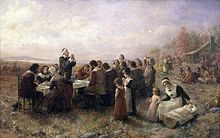
Original Thanksgiving Day as depicted
by Jennie A. Brownscombe
In 2003, in the age of U.S. Middle East invasions, President George W. Bush flew to Baghdad, Iraq, to celebrate Thanksgiving Day with U.S. troops. He sought to rally the public behind an invasion based on lies by having a host of photographers snap pictures of him carrying a glazed turkey to eager soldiers. Three hours later, Bush flew home, and TV brought his act of solidarity and generosity to millions of U.S. living rooms. But the turkey the President carried to Baghdad was never eaten. It was cardboard, a stage prop.

Thus, as an example of hypocrisy and insincerity, Thanksgiving 2003 had a lot in common with the first Thanksgiving Day celebrated in Plymouth, Massachusetts, in 1621. A year earlier, 149 English Pilgrims aboard the Mayflower landed at Plymouth and survived their first New England winter when Wampanoug people brought the newcomers corn, meat and other gifts, and taught the Pilgrims survival skills.

In 1621, Governor William Bradford of Plymouth proclaimed a day of Thanksgiving – not for his Wampanoug saviors but in honor of his brave Pilgrims. Through resourcefulness and devotion to God, his Christians had defeated hunger.

Bradford claimed that Native Americans were invited to the dinner. A seat at the table? Really? Since Pilgrims classified their nonwhite saviors as “infidels” and inferiors — if invited at all, they were asked to provide and serve, not share the food.

To this day, we are asked to see Thanksgiving essentially through the eyes of Governor Bradford (albeit with a nod to the help provided by the Native Americans). Bradford’s fable about stalwart Pilgrims overcoming daunting challenges through God’s blessings was an early example of “Euro think” which cast the European conquest of the Americas as mostly heroic and even noble.

Having survived those first difficult winters, Pilgrim armies soon pushed westward. In 1637, Governor Bradford sent his troops to raid a Pequot village, viewing the clash as mortal combat between devout Christians and godless heathens. Pilgrim soldiers systematically destroyed a village of sleeping men, women and children.

Bradford was overjoyed: “It was a fearful sight to see them frying in the fire and the streams of blood quenching the same and horrible was the stink and stench thereof. But the victory seemed a sweet sacrifice and they [the Pilgrim militia] gave praise thereof to God.”

Years later, Pilgrim Reverend Increase Mather asked his congregation to celebrate the “victory” and thank God “that on this day we have sent six hundred heathen souls to hell.”

School books and scholarly texts still honor Bradford, ignoring his callous brutality. The 1993 edition of the Columbia Encyclopedia [p. 351] states of Bradford, “He maintained friendly relations with the Native Americans.” The scholarly Dictionary of American History [p. 77] said, “He was a firm, determined man and an excellent leader; kept relations with the Indians on friendly terms; tolerant toward newcomers and new religions….”

The Mayflower, renamed the Meijbloom (Dutch for Mayflower), continued to carve its place in history. It became a slave ship carrying enslaved Africans to the Americas.

The Earliest Freedom-Fighters

Thanksgiving Day in the United States celebrates not justice and equality but aggression and enslavement. It affirms the genocidal beliefs in racial and religious superiority that justified the destruction of millions of Native American people and their cultures, extermination campaigns that began soon after the Pilgrim landing in 1620 and continued through the U.S. Army’s punitive campaigns in the West during the late Nineteenth and early Twentieth centuries.

Still, Americans proudly count themselves among the earliest to fight for freedom of the individual and independence from tyranny. In that sense, on Thanksgiving Day, Americans might think to honor the first freedom-fighters of the Americas – those who resisted the foreign invasion of these lands – but those freedom-fighters were not European and their resistance started long before 1776.

Even before the Pilgrims landed at Plymouth in 1620, thousands of enslaved Africans and Native Americans had united to fight the European invaders and slavers. In the early Sixteenth Century during the age of Columbus and the Spanish invasion, these brave freedom-fighters were led by Taino leaders on the island of Hispaniola. One, a woman poet named Anacoana was captured at age 29. Another, a man named Hatuey, led his 400 followers from Hispaniola to Cuba in 1511 to warn the people about the dangers from the foreigners.

The following year, Hatuey was captured, too, and, the next year in behavior fitting with the civilization represented by the European invaders, Anacoana and Hatuey were burned at the stake.

Resistance to the invaders and their reliance on slavery continued to erupt in other parts of the Americas. In 1605, 15 years before the Mayflower reached Plymouth, thousands of runaway Africans, known as “maroons,” united with Indians in northeast Brazil to form the Republic of Palmares, defended by a three-walled fortress. From there, Genga Zumba and his 10,000 people repeatedly threw back Dutch and Portuguese armies. The Republic of Palmares survived until 1694, almost a hundred years, before finally being suppressed.

These early nonwhite freedom-fighters kept no written records, but some of their ideas about freedom, justice and equality found their way into the sacred parchment that Americans celebrate each July Fourth, declaring that all people are created equal and endowed with fundamental rights.

So, the fairest way to celebrate freedom-fighters in what the Europeans called the New World would be to start with the stories of Anacoana and Hatuey resisting the depredations of Columbus and his men and then move to the “maroon” resistance at Palmares.

Looking at the injustice that the victors often meted out to indigenous people and imported slaves, there is little reason to feel grateful for the later arrival of — and encroachments by — the ungrateful Pilgrims.

William Loren Katz is the author of Black Indians: A Hidden Heritage [Atheneum] and 40 other books. His website is: williamlkatz.com. This essay is adapted from the 2012 edition of Black Indians.

25 November 2014

Resisting U.S. Bases in Okinawa - Foreign Policy in Focus


Despite intense crackdowns, activists on the Japanese island of Okinawa continue to resist the construction of new U.S. military bases.


henoko-bay-base-protest-japan-okinawa
(Photo: Ojo de Cineasta / Flickr)


They come in kayaks and canoes to protect the bay, maintain a tent city on the beach, and hold candlelight vigils. From posters to marches, songs, and a petition expressing international solidarity, Okinawan residents have left no question about their fierce opposition to construction of a new military base for the U.S. Marines on their island.

Overriding these emphatic voices, the Japanese and United States governments have begun work on a new facility at the Nago City site of Henoko—initiating offshore drilling, tearing down buildings, and bringing in construction supplies.

The building of this base has broad ramifications: it will destroy local marine life, pollute natural resources, and put residents in danger. Even more disturbingly, it reflects the long-term violation of Okinawans’ democratic rights—namely, their ability to set the policies that affect their lives. And more globally, it signifies Japan’s slippery slope toward further militarization, and solidifies Prime Minister Shinzo Abe’s support of U.S. military activity in Asia.

Nonetheless, despite intense crackdowns to suppress resistance, Okinawan activists remain determined to continue their opposition to this base. 

“Reducing the Burden”

It all began with a violent incident: In 1995, three U.S. servicemen abducted and raped a 12-year-old Okinawan girl. This episode rekindled a fierce opposition movement among Okinawans who had long objected to U.S. bases in their midst.

Facing an angry and mobilized population, in 1996 the United States and Japan set up theSpecial Action Committee on Okinawa (SACO), ostensibly to “reduce the burden on the people of Okinawa and thereby strengthen the Japan-U.S. alliance.” Under SACO, 20 percent of military-occupied land was to be returned to Okinawan control. This included the Futenma Marine Corps Air Station in the city of Ginowan.

READ FULL ARTICLE HERE.


United Nations adopts programme for people of African descent


18 NOVEMBER 2014
GA/11587 


Sixty-ninth session
55th Meeting (AM)

Recognizing the devastating impact of racism on people of African descent, the General Assembly today adopted, without a vote, a draft resolution on the programme of activities to implement the newly launched International Decade for People of African Descent, thus providing focus and synergy needed to address the matter globally.

Sam Kutesa (Uganda), President of the General Assembly, introducing the draft text, said that after decades of slavery, one could only be humbled by how far people of African descent had come. However, discrimination persisted. Many of African descent had limited access to good quality education, employment, housing, healthcare, fair justice systems, and safe living environments. By adopting “recognition, justice and development” as the resolution’s theme, the Assembly could take a bold step towards ensuring the respect, protection and human rights for those people, he said.

The representative of Brazil, noting that his country had the largest population of people of African descent outside of Africa, pointed out that those Brazilians accounted for over a hundred million people in his country. Promoting racial equality translated into rescuing half the national population from the consequences of centuries of slavery to which they had been subjected.

*****

Background

The General Assembly had before it a draft resolution submitted by the President of the General Assembly entitled “Programme of activities for the implementation of the International Decade for People of African Descent” (document A/69/L.3), as well as a report by the Fifth Committee (Administrative and Budgetary) on programme budget implications for that text (document A/69/563). By the terms of the text, the General Assembly would adopt the programme of activities for the implementation of the International Decade for People of African Descent annexed to the resolution, and officially launch the International Decade for People of African Descent, among other measures.

*****

Action on Draft Resolution

SAM KUTESA (Uganda), President of the General Assembly, stating that the Organization was about to embark on an historic moment, introduced the draft resolution on the Programme of activities for the implementation of the International Decade for People of African Descent (document A/69/L.3). Emerging from slavery and the transatlantic slave trade, one could not but be humbled about how far people of African descent had come.

“But we need to go much further”, he said, adding that discrimination against people of African descent continued, manifested in limited access to good quality education, employment, housing and healthcare. They were frequently the most marginalized members of society, often inhabiting the poorest districts, with the most precarious infrastructure. Vulnerable to crime and violence, they often faced discrimination in access to justice, as well.

In 2001, he continued, the Assembly had adopted the Durban Declaration and Programme of Action at the World Conference against racism, racial discrimination, xenophobia and related intolerance. By adopting the theme of the International Decade, “Recognition, Justice, and Development”, the international community was providing an opportunity to have a global conversation about the burdens and accomplishments of people of African descent. Those contributions were irrefutable. The International Decade would raise awareness and ensure the respect, protection and human rights of people of African descent. By adopting the draft resolution, the Assembly would take a bold step towards that objective.

The General Assembly adopted the resolution without a vote.

In explanation of position after the action, the representative of Italy, speaking for the European Union, said the Union was a firm believer in the international fight against racism, xenophobia and intolerance. It was only through ownership and engagement that objectives could be achieved on the local, national, and international levels. However, she voiced concern regarding the budgeting of Programme activities, requesting that such implementation be done carefully.

The representative of Israel said he recognized that the resolution contained important elements. However, he disassociated Israel from certain references in several paragraphs of the resolution. Ten years ago, the majority of countries remained silent while the Durban Conference became a racist expression against the State of Israel. The Jewish people had fought racism throughout their history.

The representative of Canada said that the Durban Conference had degenerated into a politicized forum that did not combat racism. The Durban process remained politicized and unable to distance itself from its past. He said that although he disapproved of the reference to that process, his Government would continue to work in practical ways with Member States in addressing racism and in recognizing and promoting the rights of people of African descent.

Statements

GUILHERME DE AGUIAR PATRIOTA (Brazil), noting that his country had the largest population of people of African descent outside of Africa, pointed out that those Brazilians accounted for over a hundred million people in his country. Promoting racial equality translated into rescuing half the national population from the consequences of the centuries of slavery to which they had been subjected. His Government had implemented affirmative programmes and national policies such as cash transfers and minimum wage legislation, which had contributed to the reduction of inequalities among different racial groups. The 2001 Durban Conference and its review conferences was a landmark in the implementation of national and international laws so as to forbid racism, xenophobia, and related intolerance.


24 November 2014

U.N. General Assembly Presidents join growing global call for implementation of international decolonisation mandate

Special to Overseas Territories Review


CPGA
The Council of Presidents of the United Nations General Assembly (CPGA-UN) has called for the introduction of special mechanisms to implement the self-determination process for the remaining dependent territories presently under annual review by the United Nations General Assembly.

This was one of a series of recommendations adopted by the CPGA-UN during its Fall 2014 Annual Session at United Nations Headquarters in New York. The recommendation was included in the Final Communique adopted at the conclusion of the of the Council meeting. 

Secretary-General Meets Former Assembly Presidents
U.N. Secretary-General  Ban Ki-moon (2nd left) meets with the Council of Presidents of the U.N. General Assembly (CPGA-UN)and its Executive Secretary during the Council's 2014 Session at U.N. Headquarters in New York.  UN Photo/Amanda Voisard


Excerpts from the 2014 Communique

"The Council of Presidents of the United Nations General Assembly, 


Welcomes the adoption by the General Assembly of Resolution 68/97 of 11 December 2013 on the Implementation of the (Decolonization) Declaration, and related resolutions on the question,

Urges the Special Committee on Decolonization to rationalize its method of work so as to speed up the implementation of the Declaration,

Laments that the number of non self-governing territories, rather than decreasing in numbers, has increased by one to include French Polynesia by General Assembly Resolution 67/265 of 17 May 2013, and

Supports the implementation of the 2006 Plan of Implementation for the Decolonization Mandate including, inter alia, the appointment of an independent expert to undertake an assessment of the progress and extent of self-determination in the remaining territories."


Chairman of the Council of Presidents of the U.N. General Assembly (CPGA) and President of the 58th Session of the U.N. General Assembly Sir Julian R. Hunte (2nd right) convenes CPGA meeting with senior U.N. officials during the 2014 Session of the CPGA. From right, President of the 57th Session and CPGA vice chair H.E. Mr. Jan Kavan; Chairman Hunte; President of the 69th Session of the General Assembly H.E. Mr. Sam Kahamba Kutesa; Deputy Secretary-General of the United Nations Jan Eliasson; St. Lucia Ambassador to the United Nations H.E. Menissa Rambally, and Dr. Carlyle Corbin, Executive Secretary of the CPGA-UN.  


Council of Presidents of the U.N. General Assembly (CPGA-UN) pose with Director of U.N. Counter Terrorism of the Department of Political Affairs Dr. Jehangir Khan (left) at the close of the CPGA  2014 Council Session. (Left to right) Dr. Khan, H.E. Mr. Amara Essy, President, Forty-Ninth Session;  H.E. Mr. Sam Kahamba Kutesa, President of the 69th session; H.E. Sir Julian R. Hunte, President of the 58th Session; H.E. Dr. Han Seung-soo, President, Fifty-Sixth Session; H.E. Dr. Srgjan Kerim, President, Sixty-Second Session; Dr, Carlyle Corbin, CPGA executive Secretary; and H.E. Jan Kavan, President, Fifty-Seventh Session.   


The 2014 recommendations on international self-determination and decolonisation process followed earlier conclusions adopted by the Council in its 2013 communique:

*****

                 Excerpts from the 2013 Communique


"The Council of Presidents of the United Nations General Assembly,

Recognises the historic role of the General Assembly in the self-determination process of dependent territories, and that the successful decolonization of over eighty territories since World War II was in large measure as a result of the political, material and other support provided by the United Nations;

Expresses concern that only two territories have successfully been decolonized since the 1990s, and that the that the countries which administer the majority of the remaining territories have withdrawn their cooperation from the Special
Committee on Decolonization resulting in little progress being made in the implementation of the United Nations decolonization mandate contained in the Charter, General Assembly resolutions and human rights instruments;

Takes note that the number of non self-governing territories has been increased by one for a total number of seventeen on the United Nations official list under Chapter XI of the Charter pursuant to the adoption by the General Assembly of
resolution 67/265 of 17 May 2013 on the "Self-determination of French Polynesia", and notes the adoption by the Special Committee on Decolonization last June of its first resolution ever on "The Question of French Polynesia."

Welcomes the participation of H.E. Oscar Temaru, five-time president of French Polynesia, his extensive briefing on the challenges to the decolonization process in his country, his request to the United Nations for assistance in the public education campaign of the territory in order to heighten the awareness of the people of their valid political status options in conformity with the principle of full and absolute political equality, and issues related to the effects of atomic radiation on the people as a result of 30 years of nuclear testing during the Cold War;

Calls for the use of innovative means to give effect to the United Nations decolonization mandate including the use of special mechanisms such as an Independent Expert/Special Rapporteur, expert groups or other relevant modalities to examine in depth the political situation in each of the remaining territories, and to advise the President of the General Assembly and the Secretary-General of suitable means to implement the decolonization mandate in these territories."