21 March 2014

El orgullo negro de Managua

PRESS.  The Journal of Nicaraguans.  Nicaragua

***


  • Se mezclan entre los mestizos de la ciudad. Tienen sus espacios de encuentro y en el hogar se habla el creole o inglés. Aún cocinan rundown (rondón), patí y pan de coco. Son los afrodescendientes de Nicaragua que se han establecido en barrios populares de la capital a partir de 1960

Por Róger Almanza G.

Hooker, Hogdson, Campbell, Tobie, Taylor y Prudo son algunos de los apellidos que en Managua suenan a Costa Atlántica. Son apellidos de negros, de esos casi veinte mil afrodescendientes, que de acuerdo con el Censo Nacional de Población y Vivienda 2005, habitan en el país y de los cuales un buen grupo ha llegado a establecerse a la capital.

Viven en barrios como Las Torres, Pedro Joaquín Chamorro, Jardines de Veracruz y Ciudad Jardín, comenta la antropóloga María Dolores Álvarez, docente de la Universidad Nacional Autónoma de Nicaragua (UNAN).

Pero el sector más popular para los afrodescendientes en Managua es Bello Horizonte. Tanto que su nombre empieza a cambiar como “Negrorizonte”, un apodo que los propios costeños le han dado.

En los barrios como el Pedro Joaquín Chamorro, donde viven algunas de las familias de negros o afrodescendientes, el ritmo no falta. Se cuela por las ventanas de las casas y es el sonido de su música. No precisamente el palo de mayo como en el Pacífico se cree. En sus casas suele sonar Bob Marley con su reggae, o un reggae soul o punta garífuna, entre otros ritmos caribeños. Aquí, en los barrios de negros, algunas familias ofrecen de venta la tradicional empanada de carne llamada patí y el redondo y pesado pan de coco. Sus clientes son los mestizos o españoles como suelen nombrar algunos a los originarios del Pacífico de Nicaragua.

Pero es en Bello Horizonte donde los afrodescendientes se reúnen y encuentran varios espacios donde compartir y mantener la herencia cultural viva: su lengua y la música.

Entre mesas y ritmos caribeños, el inglés creole o el inglés estándar se confunden en las pláticas, el español se pierde y solo uno que otro mestizo del Pacífico que gusta del ambiente costeño habla en español.

Al sur de la rotonda de Bello Horizonte está el bar Bloque Costeño, con casi veinte años de funcionar. Aquí, esta noche se reencuentran amigos de la infancia separados desde hace décadas y dos hermanos, Shelby Chon Ingle y Kerry Chon Downs se encuentran después de tres años de no verse.

El Bloque o Club Costeño como lo llaman los clientes es el espacio donde los negros descendientes de los africanos prefieren ir cada noche, no importa el día. “Siempre hay un negro con quien compartir”, dice Luisa Ortega, caribeña y modelo que radica en Managua y es la dueña del lugar.

EN BUSCA DE EDUCACIÓN


La antropóloga María Dolores Álvarez explica que los negros empiezan a venir a Managua buscando educación. “Hay mayor interés de negros por educarse que de indígenas. Los negros tienen más ímpetu para ser académicos. Es por los años veinte y treinta cuando los negros tienen más acceso a mejor remuneración por su trabajo en las minas y enclaves de bananos y madera. Empiezan a estudiar”, comenta Álvarez.

El Colegio Bautista fue el primero que aceptó a niños negros, en los años sesenta. De acuerdo con los datos recopilados por Álvarez, este fue el único colegio que en esa década aceptó una colonia de afrodescendientes. En la misma década, los antropólogos ubican una de las más importantes oleadas de inmigrantes negros hacia Managua.

“Lo más complicado fue que aquí en el Pacífico no miraban con buenos ojos a los negros, eran vistos como esclavos. La ideología de los años sesenta fue muy discriminatoria. Fue entonces que los negros se esforzaron por destacarse en diversas áreas, además de la académica, cultural y los negocios y muchos en esa época se van a Jamaica, Miami y Nueva York”, comenta Álvarez, quien calcula que en ese entonces al menos cien familias se habían establecido en la capital.

Otros antropólogos destacan que las primeras migraciones en los años sesenta se caracterizan porque fueron familias con alguna solvencia económica y que podían enviar a sus hijos a las universidades.

Hoy por hoy, las generaciones más jóvenes tienen en común la pertenencia de familias que se han mantenido en el tiempo, gozan de un linaje, son la tercera generación de los negros que llegaron a Managua hace medio siglo.

Si bien, la educación fue la principal razón de inmigración de los afrodescendientes a Managua, para Cora Luisa Antonio, superintendente de las iglesias moravas, las fuentes de trabajo son una razón igual de importante y que siguen teniendo peso al momento en que un afrodescendiente decide inmigrar a Managua.

AL ENCUENTRO DE SU GENTE


Álvarez comenta que no existe una identidad clara de afrodescendientes, al menos entre ellos.

“Desde la identidad negra, el ser negro es la forma más digna de identificarse. Se autodenominan negros o black people”.

“Soy africano nacido en Bluefields” se presenta Washington HODSON, de 60 años, y que a los 18 años llegó a Managua como pelotero y representante de la costa Caribe en el campeonato nacional de baseball de los años setenta.

Se quedó viviendo en Managua y su descendencia es mestiza. Extraña su tierra, pero ya siente estar acostumbrado a esta ciudad. “Siempre hubo roce con los del Pacífico, pero siempre he creído que es el resultado de la ignorancia, porque no conocen su realidad ni su propia historia”.

Hoy su casa se ha convertido desde hace 15 años en un punto de referencia para los costeños en Managua. La convirtió en un restaurante de comida costeña, llamado Bambule en el barrio Pedro Joaquín Chamorro.

Aquí las historias surgen solas entre los costeños, la mayoría afrodescendiente, mientras vuelven a sentir el sabor que crearon sus ancestros. Pero no es solo la comida, al costeño le gusta el ambiente, Bambule, construido de madera y decoración caribeña, los encierra en un momento en las tierras de sus abuelos.

Sus dos sobrinos más jóvenes se mudaron con él hace unos meses, Mishelly Budier Taylor de 22 años y Keyshon Dudley Taylor de 17. Han venido a estudiar y no sienten el mencionado “choque cultural” que su tío Washington menciona a veces, cuando recuerda su llegada a Managua.

Los jóvenes originarios de Bluefields no se han topado con discriminación ni con problemas del idioma, más bien se han sabido adaptar con rapidez y no pretenden volver a la Costa Atlántica sin haber terminado la carrera universitaria.

El contacto negro en Managua


Falta una hora para la medianoche y los bares y discos caribeños en Bello Horizonte empiezan a llenarse. Reciben cada noche a grupos de afrodescendientes de la tercera generación que no nacieron en la Costa Atlántica, pero que están orgullosos de sus raíces negras.

En estos centros nocturnos suena el reggae, música soca que anima a los negros y negras jóvenes, quizá mayores de 18 años, pero no pasan la barrera de los 25, en su mayoría. Todos estos lugares ubicados en la rotonda de Bello Horizonte.

Álvarez cree que esta última generación es la que podría desarticular la cultura de los afrodescendientes que viven en Managua.

“La gente de la primera generación vive su nostalgia y su vínculo con su abuela, esta generación ha muerto, es gente que empezó a venir en los años veinte. Por otro lado, los negros que llegaron a Managua en los años sesenta se autodenominan negros y comen su comida tradicional y visitan las iglesias moravas. Los hijos de esta generación ya son nacidos en Managua y son negros con identidad negra total, pero sus hijos, una siguiente generación, empiezan a vincularse más con el mundo mestizo. Están obligados a hablar más el español porque se integran al sistema educativo donde no tienen un enfoque de su cultura e historia”, destaca Álvarez.

Sin embargo, los riesgos de que su cultura se pierda se trata de recuperar en casa, las familias cocinan sus comidas tradicionales y no hablan español.

Los negros en Managua se identifican entre sí no solo por el color sino por la pertenencia a un clan familiar. “Tiene preferencia por la forma de vida urbana, por los alimentos de su tierra y la religión morava y algunos rastros de la cultura ancestral africana y mantienen la creencia en sus ancestros”, comenta la antropóloga María Dolores Álvarez.

Aunque son pocos, el impacto y el aporte a la multiculturalidad en el país es grande. Han logrado destacar en ejes como el deportivo, y las artes como June Beer y en la danza, Gloria Bacon. En la literatura, David Macfields y Carlos Rigby, entre otros.

Actualmente los afrodescendientes ocupan espacios importantes en la política como Francisco Campbell, embajador de Nicaragua en Washington. Humberto Campbell dirige la secretaría para el desarrollo del Caribe. Valdrack Jaentschke , vicecanciller de Cooperación Externa o Bridget Boudier diputada al Parlacen.

Orgullo de “black people”


Al negro o descendiente afro se le puede definir por la persistencia en su cultura y ese sentido de orgullo impregnado por el referente inglés, su lengua y la manera en que se ven.

También existe la magia. Los negros desarrollan magia en los alimentos. “Si una persona te quiere enamorar te pone en la comida “algo”, ellos lo llaman “sontín”, que viene del inglés “something”.

Además hay magia que puede hacer daño. Álvarez explica que “si se hizo un daño, hay una mezcla de autocastigo, como creencia mágica de que lo han hechizado y quitar el hechizo incluye pedir perdón o revertir el daño”.

Los afrodescendientes que inmigraron a Managua siempre tuvieron que afrontar los prejuicios y los estigmas de un pueblo desconocido. Ahora hay mayor multiculturalidad y hay mayor reconocimiento y la nueva generación tiene mayor ventaja, pero no se asimilan totalmente a la cultura del Pacífico. Jamás se desvincularán de la Costa Atlántica de Nicaragua.


20 March 2014

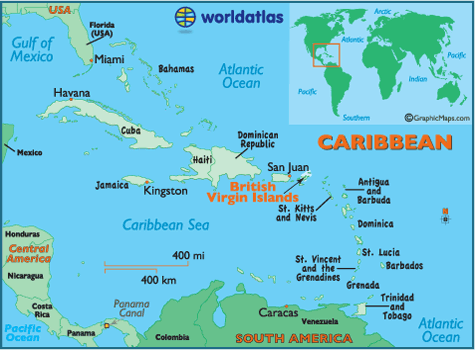
Virgin Islands to participate in Global Partnership for Oceans


Press Release


The Virgin Islands officially joined the Global Partnership for Oceans (GPO) at a ceremony at the US Department of the Interior in Washington, DC held on the margins of the Global Island Partnership Information Day.

bvi.org.uk
At the ceremony held on February 20, the Virgin islands was represented by Deputy Premier and Minister for Natural Resources and Labour, Dr. the Honourable Kedrick Pickering and accompanied by Permanent Secretary, Mr. Ronald Smith-Berkeley and Deputy Director of the BVI London Office Mr. Benito Wheatley. Representing GPO were Interim Secretariat Head and Environmental Scientist at the World Bank Dr. Valerie Hickey, accompanied by Senior Communications Officer (Environment Department) Ms. Elisabeth Mealey.
In remarks made at the ceremony, Dr. Hickey said “We are pleased that the British Virgin Islands has decided to join the Global Partnership for Oceans. We believe the BVI will be an invaluable partner as we take steps toward ocean sustainability.”

The Deputy Premier noted, “The BVI is happy to join the global effort to sustainably management of the world’s oceans, which are a vital resource to the BVI and on which our livelihood and the livelihood of so many others around the world depend. At home we are already taking steps in a number of areas to ensure we are doing our part.”

The BVI’s membership in the GPO comes as Government seeks to gain greater insight on best international practices in managing the marine environment.
The Global Partnership for Oceans was launched in February 2012 spearheaded by the World Bank. The partnership brings together over 140 governments, international organisations, civil society groups, and private sector interests to address threats to the health, productivity and resilience of the ocean. Its main objectives are to advance sustainable fisheries, conserve the coastal and marine environment and reduce pollution of the ocean.

For more information online about the Global Partnership for Oceans, readers can go to http://www.globalpartnershipforoceans.org/about

The Ministry of Natural Resources and Labour strives to effectively manage and administer the Territory’s Natural Resources in a manner that ensures long-term sustainability.


19 March 2014

La Primera Marcha Oscar Mandela en Puerto Rico

Compañeros Unidos para la Descolonización de Puerto Rico: Cita Patriótica ONU Junio 2012


Posted: 19 Mar 2014 05:27 AM PDT

El jueves 20 de Marzo de 2014, habrá una conferencia de prensa para discutir La Primera Marcha Oscar Mandela en Puerto Rico.

La misma será en el Colegio de Abogados en Miramar, Puerto Rico a las 10 AM.

El Comité Timón del Pueblo y Compañeros Unidos para la Descolonización de Puerto Rico le invita a la conferencia de prensa y a la marcha este 22 de Marzo de 2014 a las 2 PM.

¡Tenemos que marchar, porque los que tienen colonias no creen en la justicia para todos!

Support to the CARICOM Reparations Commission

COLONIALISM REPARATION

Starting from the second half of 2013 the Caribbean nations started demanding reparations for the genocide of the native people and slavery, with the creation of reparations Committees and the request to the United Nations General Assembly during the general debate of its 68th session.

On December 9, 2013 the Regional reparations Commission met to define its action plan, asking that the European nations responsible for the transatlantic slave trade, slavery and genocide of the native people, especially the United Kingdom, France, Spain, Portugal, the Netherlands, Norway, Sweden and Denmanrk engage with the Caribbean nations in a restoring dialogue to accommodate the current heritage of these crimes and that the Caribbean nations lead the dialogue in a diplomatic, conciliatory and morally edifying way.
The Commission has then identified six key aspects of the Caribbean conditions that are the direct consequence of the transatlantic slave trade, slavery and genocide of the native people on which diplomacy and restoring actions must focus: public health, education, cultural institutions, cultural deprivation, psychological trauma and scientific and technological backwardness.
Finally, the Commission has met with the law firm Leigh Day, which will provide together with eminent Caribbean lawyers, legal assistance on the request for reparations for the damage caused by the transatlantic slave trade, the slavery and the genocide of the native people.
On January 27 and 28, 2014 the regional reparations Commission again met to end the first interim report to that will be submitted at the next meeting of the Heads of Government of CARICOM on March 10-11, 2014.
In support of the request for reparations of CARICOM some reparations Committees have already been formed inGuadeloupeMartinique and Saint Kitts and Nevis.
Colonialism Reparation supports the path taken by the regional reparations Commission and calls on all Member States of the Caribbean Community (CARICOM) that have not yet done it (Bahamas, Dominica, Grenada, Haiti, Montserrat, Saint Kitts and Nevis, Trinidad and Tobago) to form as soon as possible their own national reparations committee as decided during the thirty-fourth summit of the Heads of Government of CARICOM.


The Caribbean nations are demanding reparations

On July 6, 2013 the thirty-four summit of the Heads of Government of CARICOM decided to promote actions to monitor the reparations for the genocide of the native people and slavery by setting up some "national reparations committees" in each member State and a "regional reparations Commission" composed of the chairmens of the national committees.
The First Regional Conference on Reparations was held in Kingstown, the capital of Saint Vincent and The Grenadines, from September 15 to 17, 2013 with the attendance of twelve Caribbean nations and the presence of representatives from the UK, France, the Netherlands, the United States and Canada. The conference outlined the objectives of the "regional reparations Commission", proposed the relating offices that will be ratified by the Heads of Government of CARICOM, decided to create a web site of the Regional Commission and urged for setting up some national committees where they do not exist yet.
The general Debate of the 68th session of the UN General Assembly was held from September 24 to October 1, 2013 in New York; during the debate the delegates of Antigua and BarbudaBelizeJamaicaSaint Kitts and Nevis, Saint Lucia,Saint Vincent and the Grenadines and Trinidad and Tobago demanded reparations for the genocide of the native people and slavery. In the final press conference of the President of the General Assembly the request for reparations of CARICOM was evoked as well.

Colonialism Reparation supports the request for reparations for the genocide of the native people and slavery presented to the United Nations General Assembly by the members of the Caribbean Community (CARICOM) and calls on the former colonizers (United Kingdom, France, The Netherlands, etc. ) to apologize and pay compensation for the colonial period. This decision will help create a climate of friendship and cooperation among peoples and set an extremely positive precedent in international relations, promoting the supremacy of the "force of law" on the "law of force".

18 March 2014

Deep-sea mining ‘must responsibly respect ecosystems’

 Papua New Guinea Mine Watch


Jonathan Amos | BBC News

Elements such as lanthanum are in high demand for use in hybrid car batteries
Scientists have made an impassioned plea for humanity to pause and think before making a headlong rush to exploit the deep sea.
The researchers said the oceans' lowest reaches had untold riches that could benefit mankind enormously, but not if the harvesting were done destructively.
The scientists called for a "new stewardship" of the deep sea.
This would require effective ecosystem management and sustainable methods of exploitation.
The researchers said the fishing sector had already initiated some very damaging practices, such as the widely criticised use of heavy-rolling, sea-floor nets, but that there was still time for other sectors to take more sensitive approaches.
This includes the imminent development and spread of industrial-scale deep-sea mining.
Technology-driven
The ocean floor is being targeted as a source for a range of metals and minerals.
Part of this is driven by the insatiable appetite for modern technology devices like cell phones and hybrid cars.
The battery in a Toyota Prius hybrid car, for example, requires more than 10kg of lanthanum.
Large tracts of sea bed have now been licensed to permit the prospecting of manganese nodules, cobalt crusts, massive sulphides to produce copper and zinc, and even phosphates to make fertilisers.
Some of these licences are certain to turn into full-mining permissions this decade.
"The deep ocean is a vast repository of resources, and looking over the long term - the next hundreds of years, say - we almost surely are going in there to mine," said Prof Lisa Levin, a biological oceanographer at the Scripps Institution of Oceanography, in San Diego, California.
"Even if some deposits are not currently economically viable, they probably will be in 50 years from now.
"What we're trying to say is that we need to do this in a responsible way, and if we are going to extract these resources, we need to do it with the least amount of harm to ecosystems, and now is the time to start thinking about how we do that," she told BBC News.
The researchers made their call for a new stewardship mentality at the annual meeting of the American Association for the Advancement of Science (AAAS).
Upfront science
Mining of the deep ocean has been talked about since at least the 1970s, but the advance in underwater robotics and rising commodity prices have brought the notion much closer to reality.
The International Seabed Authority has so far issued 19 prospecting licences, covering a combined area about the size of Mexico.
These licences are held by governments and big contractors, such as Lockheed Martin, which operates in the aerospace, defence and civil sectors, and more requests are pending.
Initial surveys have indicated that some of the metal reserves could be very lucrative, producing materials such as copper that would be worth hundreds of millions of dollars on the London Metal Exchange. But before the extraction can begin, thorough environmental assessments had to be done, said Prof Cindy Lee Van Dover, the director of the Duke University Marine Laboratory, in Beaufort, North Carolina.
"The most effective time to do environmental management is before the mining begins. That mining has not yet commenced, and if we want to get really progressive environmental regulations, we need to do it now," she argued.
"That environmental management needs to be informed by science, and that science needs support from international and national agencies to make it happen. It's not cheap to work in the deep sea."

European Union and Pacific Islands Forum Secretariat sign a FJ$90.8m. programme on climate change


JOINT PRESS RELEASE FROM THE EUROPEAN UNION 
AND THE PACIFIC ISLANDS FORUM SECRETARIAT


The European Union (EU) with the Pacific Islands Forum Secretariat (PIFS) have signed a financing agreement for Adapting to Climate Change and Sustainable Energy (ACSE) programme worth FJ$90.8m.


The ACSE programme will help the 15 Pacific ACP countries (Cook Islands, East-Timor, Fiji, Kiribati, , Federated States of Micronesia, Nauru, Niue, Palau, Papua New Guinea, Republic of the Marshall Islands, Samoa, Solomon Islands, Tonga, Tuvalu and Vanuatu) to address three main challenges common to all of them: adapting to climate change; reducing their reliance on fossil fuels; and capacity building.


The total project cost is €37.26 (FJ$95.37) million with the European Union contributing €35.5 (FJ$90.86) million through the European Development Fund (EDF). For the implementation of this programme, the European Union will be working in partnership with the German International Cooperation Agency (Deutsche Gesellschaft furInternationale Zusammenarbeit - GIZ), the New Zealand Government, the Asian Development Bank and the Secretariat of the Pacific Community (SPC).


"I'm thrilled to be here signing this financing agreement. Climate change adaptation and sustainable energy are in the core of EU's support towards the Pacific countries. This project not only illustrates this but it's yet another example of the ever closer cooperation between the European Union and our partners in the Pacific,” says Mr DirkMeganck, European Commission's Director for Asia, Central Asia, Middle East, Gulf and the Pacific whilst signing on behalf of the European Union during the regional programming meeting for the 11th EDF, held at PIFS in Suva, Fiji this week.


"The Forum Secretariat and its partner regional agencies warmly welcome the EU’s commitment to climate change and sustainable energy,” says Tuiloma Neroni Slade, The Secretary-General of the Pacific Island Forum Secretariat. “In almost every Forum communiqué in recent years, Leaders have emphasised the importance of securing access to energy, their commitment to renewable energy, the promotion of efficiency measures and the need for significant progress in diversification by developing domestic renewable energy to reduce their reliance on imported fuels. Similarly, Forum Leaders have given affirmation of the dangers of climate change – to the livelihoods, security and well-being of the peoples of the Pacific.”


The programme aims to strengthen the Pacific island countries' capacity to adapt to the adverse effects of climate change and to enhance their energy security at national, provincial and local/community level. The programmeseeks to deliver the following key achievements:

* Create and/or strengthen national technical expertise on climate change adaptation and sustainable energy;


*  Improved cost-effective and efficient energy systems to reduce fossil fuels dependency; and


*  Improvements in communities’ adaptive capacity to cope with climate change challenges.


Another aim of the ACSE programme is to enhance sustainable livelihoods through the support of government institutional efforts and empowering communities to increase their self-reliance and their ability to cope with the effects of climate change through appropriate practices in agriculture and coastal fishery, by disseminating improved plant varieties which are resistant to salt water, by securing their daily water supply and by improving their access to energy, among other initiatives.


Ends

For further information please contact:


Delegation of the European Union for the Pacific Suva, Fiji, Tel: (+679) 3313-633 Email: Delegation-fiji-media@eeas.europa.eu


Pacific Islands Forum Secretariat: Diane Abad, Communications Adviser (+679) 868 5166 Email:media@forumsec.org


Background


Climate change is already disproportionally affecting the Pacific island states, although islanders have done little to contribute to the cause - producing less than 0.03% of current global greenhouse gas emissions. They are among the first to be exposed, often disproportionally, and with limited means to adequately respond.


At the same time, despite efforts to reduce their reliance on fossil fuels, many small Pacific states remain almost 100% dependent on these imports for power generation and transportation. Sustainable energy and climate change adaptation are therefore top priorities for the Pacific ACP governments as expressed in regionally endorsed frameworks and in national policies and strategic documents.


17 March 2014

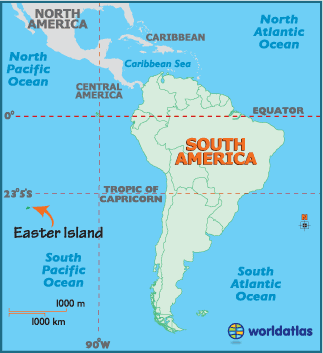
Pacific Network calls for United Nations inscription of Rapanui (Easter Island) as non self-governing territory

Santi Hitorangi
Moana Nui/Rapa Nui


We seek admission to the U.N. list of Non-Self-Governing Territories (NSGT), and join the ranks of our Pacific brothers and sisters from American Samoa, French Polynesia, Guam, New Caledonia, Pitcairn and Tokelau, working to create conditions for self-determination in accordance with UN GA Resolution 1514, “The Declaration on the granting of independence to colonial countries and peoples. “

Unlike Hawaii, and West Papua who seek re-enlistment to the NSGT list, Rapanui was never registered as a territory to the United Nations.

In 1946, when the signers of the United Nations were required to list their territories, the Administering Powers of 74 territories were placed on the NSGT list. The Administering Powers who listed their territories were Australia, Belgium, Denmark, France, the Netherlands, New Zealand, the United Kingdom, and the United States of America.
Worldatlas.com
As an Administering Power, we ask why Chile never reported or listed Rapanui.

In 1946, despite formally replying to the Secretary-General’s questions on the administration of territories as covered by Chapter XI, we ask why Chile did not fulfill their obligation alongside the other Administering Powers, and list Rapanui as a Non-Self-Governing Territory.

We find the knowing omission of this obligation as being akin to fraud, and demand that this knowing omission of facts be corrected.

Chile has violated the trust mandate of the UN Charter, Chapter XI, by not assuming responsibilities for the administration of Rapanui, whose peoples have not yet attained a full measure of self-government.

Chile has failed to recognize the interests of the inhabitants of Rapanui as being paramount, and they have failed to accept as a sacred trust the obligation to promote to the utmost, within the system of international peace and security established by the present Charter, the well-being of the inhabitants of Rapanui, and, to this end:

Chile has failed to ensure, with due respect for the culture of the Rapanui, our political, economic, social, and educational advancement, our just treatment, and protection against abuses;

Chile has failed to develop Rapanui self-government, and failed to take due account of the political aspirations of Rapanui, and to assist us in the progressive development of our free political institutions, according to our distinct culture as Pacific Islanders belonging to Polynesia.

What Chile has done in the past, however, is to promote confusion as to our history and to whether we Rapanui even exist. While even now, they continue to sponsor programs that fabricate our history, as well as claim our ecological and environmental resources and cultural artifacts.

Chilean armed forces continue to be deployed on our island.

Chile is encouraging unchecked immigration to the island.

Chile is promoting unsustainable development on our island, which is a UN world heritage site, while privatizing our customary lands and resources.

Bearing in mind the principles embodied in the Declaration regarding Non-Self-Governing Territories and objectives set forth in Chapter XI of the Charter, we are ready to submit all the factors and criteria to be taken into account in deciding whether Rapa Nui is a territory, whose people have not attained a full measure of self-government.

Moana Nui, a network of Pacific-wide rights-holders focusing on justice issues concerning resources, trade, militarization and indigenous rights.

16 March 2014

Scientists call for tougher treaty to protect the deep ocean

 Papua New Guinea Mine Watch

Oleg Klimov / Panos | Sci Dev Net
  • A new treaty could be used to police the expected rise in deep-sea mining
  • It could also ensure that gains from marine genetic resources are fairly shared
  • Capacity building is needed to help developing nations exploit their resources
A new international agreement is needed to police the exploitation of the deep ocean because of the rising threats of deep-sea mining and bottom trawling for fish, say scientists.
Speakers at a symposium this month (16 February) urged the UN to negotiate a new treaty for the deep ocean to supplement the UN Convention on the Law of the Sea.The symposium took place at the annual meeting of the AAAS (American Association for the Advancement of Science) in Chicago, United States.
“This is an opportunity for scientists to voice their concerns about mounting human impacts on the once-remote deep ocean to those who have the power in their hands to make the changes,” says Kristina Gjerde, high seas policy advisor for the International Union for Conservation of Nature.
The deep sea makes up about two-thirds of the world’s oceans. It begins at a depth of around 200 metres, both within and beyond zones of national jurisdiction.
But deep-sea environments are threatened by “imminent” mining and bottom trawling for fish, said the scientists at the meeting.
“We’re calling for a new treaty to sew the gaps in international law that don’t currently include biodiversity, conservation, marine genetic resources, capacity development and technology transfer for areas beyond national jurisdiction,” says Gjerde.
The UN-sanctioned International Seabed Authority (ISA) was established in 1994 to regulate mineral extraction from the deep seabed outside national zones of jurisdiction. The ISA, based in Jamaica, has so far approved 19 mineral prospecting licences in the deep ocean around the world for companies and government bodies, including China and India, as well as those sponsored by the Pacific island nations of Kiribati, Nauruand Tonga [See map]. The Cook Islands have also applied to explore deep-sea mining opportunities.
The map shows prospecting licences approved so far by the International Seabed Authority. The colour-coded arrows show the approximate location of licences held by larger countries. Several smaller nations, circled in orange, have permission to prospect in the Pacific ocean. Credit: SciDev.Net
But the ISA does not regulate marine genetic resources, which could be valuable to the medical and pharmaceutical sectors, or biodiversity conservation, says Lisa Levin, director of the Center for Marine Biodiversity & Conservation at the Scripps Institution of Oceanography, United States.
“The problem is that the ISA’s mandate is to facilitate the extraction of minerals. They don’t have a mandate to identify which parts of the sea floor are most critical to ecosystem health in the ocean,” says Linwood Pendleton, senior scholar in the Ocean and Coastal Policy Program at Duke University, United States.
The new treaty would ensure that financial gains made from marine genetic resources are shared between all nations, and that new mechanisms are developed to transfer marine technology and developcapacity in this field, says Gjerde.
Significant deep sea resources are often found within the deep seas of the developing world, often within the nations’ exclusive economic zones [that stretch up to 200 nautical miles from their shore] of those countries, says Levin.
“Yet those countries often don’t have the necessary expertise or technology to explore the deep seabed. So they often rely on countries that do have the technology and expertise,” she says.
“It’s very important that we do a lot of capacity building, information sharing and transfer of expertise so that those countries are able to manage their own deep ocean resources.”
The scientists at the meeting also warned that extracting minerals and precious metals from the deep sea could cause catastrophic long-termdamage to marine ecology unless managed carefully.
New technology, dwindling land-based resources and high commodity prices mean that deep-sea mining is not only feasible, but imminent, says Pendleton.
“Precaution is essential,” says Gjerde. “This means rules should be in place before mining begins, including measures such as environmental impact assessments, comprehensive systems of marine protected areas and the mechanisms for monitoring and controlling impacts.”
She adds: “It is important to set and maintain common standards so that a few unscrupulous operators can’t take advantage of countries with weak legal systems, causing irreparable harm in return for very short-term gain.”
New mining ventures are underway off various Pacific islands and off the African coast, as well as on the international seabed area that lies outsidenations’ jurisdiction, says Gjerde.
Canadian company Nautilus Minerals had planned to mine hydrothermal vents in Papua New Guinea, but this has been delayed, says Levin.
And the Namibian government is considering leasing the deep sea bottom in its national waters for phosphate mining, although last September it placed an 18-month moratorium on all mining decisions, while it gathers new information, she adds.
“Because no mining has happened yet [anywhere in the deep sea], there’s time to put some major environmental management in place,” she tellsSciDev.Net.
The key is to identify places where mineral wealth is high and ecological impacts are low and target mining there, says Pendleton.
Deep-sea trawling for fish has already had terrible long-lasting impacts on the deep sea, says Gjerde.
The deep sea fish populations are quickly depleted because the fish aggregate, which makes them easy to catch, and they are slow growing, living over one hundred years, says Levin.
One-fifth of the world’s continental margins, an area the size of the United States and Canada combined, have already been trawled, she adds.