WILLEMSTAD — During the third edition of the International Film Festival Rotterdam
(IFFR), the documentary ‘Frank Martinus Arion: Yu di Kòrsou’ of Cindy Kerseborn will
be premiered. This was recently made known by the organization of the film festival
during a press conference. The festival will take place from April 2nduntil April 6th.

The first film screening will be introduced by Lucille Berry-Haseth and with recital of the poems of the great writer. The festival also makes room for new elements, such as the collaboration with Salt + Pepper (restaurant located in Riffort), which will serve as film café during the festival. In addition, the Youth Orchestra led by Dennis Aalse will be also giving various performances.
There will be also an exhibition with ‘photographica’ from the private collection of Michel van Veldhoven. His exhibition will be in the framework of cameras and projectors in which the development of moving film images of 1903 to around 1970 and the cameras and projectors from the 1920’s until the rise of video that was could be seen in 1980’s.
Next to the exhibition there will be also a space in which four movies by filmmakers
Frank M. Chumaceiro and his partner Tita will be shown. These films were produced
under the name Curafilms between 1951 and 1961.
|
18 February 2014
Premiere documentary about Frank Martinus Arion during International Film Festival Rotterdam (IFFR)


17 February 2014
Nuclear testing films big winners at Pacific Film Festival
RADIO NEW ZEALAND INTERNATIONAL
Films about the struggle for independence and survival after decades of exposure to nuclear testing have been the big winners at the Pacific Documentary Film Festival in French Polynesia.
For the first time a New Caledonian film took out the grand prize of the jury with 'Nickel - the treasure of the Kanaks'.
'Nuclear Savage', about the United States nuclear weapons tests in the Marshall Islands won the Jury Special prize.
 |
| A 1971 photo of a nuclear bomb detonated by the French government at the Mururoa atoll, French Polynesia. (AP Photo) |
The organiser of the Pacific Documentary Film Festival, Miriama Bono, says about 25,000 people attended the festival, which had 14 films in competition. She says as usual, the quality of films was very high, and came from all over, including New Zealand, Tahiti and Australia, but it was a New Caledonian film that captured the grand prize of the Jury. 'Nickel - the treasure of the Kanaks', made by Anne Pitoiset and Laurent Cibien, tells of the way Kanaks in the north managed to take control of the area's main resource, nickel. Miriama Bono says the film is timely, as people in New Caledonia prepare to vote on their independence.
MIRIAMA BONO: The story is a big issue for New Caledonian people because they have to vote and to decide after that if they want to stay French or not, and the nickel is one of the most important economic deals for them so because of the subject and because of the situation in New Caledonia, it was important for the jury to have this film as the winner.
The special prize of the Jury went to 'Nuclear Savage', made by Adam Horowitz, a film described as a heart-breaking and shocking exposé of the United States nuclear weapons tests in the Marshall Islands. Adam Horowitz says the film reveals that the testing of nuclear bombs in the Marshall Islands was a deliberate attempt by the United States to investigate the effects of nuclear exposure on humans. He says he hopes the film will push the United States to release all the information it has on the nuclear tests.
ADAM HOROWITZ: The full extent of the testing and the contamination and the exposure of the people is still secret. So I would say the first thing that I would hope would happen, and many people hope will happen, is that the US government will come clean on what they did and the full extent of the contamination, the full extent of the human experiments.
Miriama Bono says the prize of the public was awarded to Tahitian film 'Annanahi tomorrow', about a famous local reggae group in the Marquesas islands.
MIRIAMA BONO: Marquesas people are very, living the culture. They are speaking their own language. Even in Tahiti, we don't speak Tahitian fluently. They are still singing and talking in Marquesas so I think that's what touched the audience, it's the cultural subject.
A member of the film jury, Emmanuel Tjibaou, says it was a good experience to be part of a film festival that supports Pacific voices.
EMMANUEL TJIBAOU: Especially promote through the movie, the expression of our indigenous people and it's good for me to hear our people talking about their vision of how they want to be seen through the movie.
Meetings were also held with film festival organisers from New Zealand, Australia, Hawaii and New Caledonia, so the Pacific documentaries can be exposed to an international audience.
14 February 2014
Virgin Islands Sports Pioneer joins the ancestors
|


13 February 2014
If Bougainville wants Independence it must challenge the economic orthodoxy
|
‘Until the ABG can raise more of its revenue internally, we will continue to be dictated to by others … It is for this reason that my government in 2010 not only endorsed the previous governments decision to negotiate the reopening of the Panguna mine, but also accelerated [preparations] in the last three years’. President Momis, 31/12/2013
A prophesy on high rotation in the media and social media, claims that Bougainville’s independence and economic resuscitation is directly dependent on the reopening of the Panguna mine, and the possible construction somewhere down the line of a second major mine-pit.
What has not been given much attention by media pundits or academic ‘experts’, is an alternative hypothesis, that has much greater historical evidence to support it.
Rather than facilitating independence – in the sense of Bougainvilleans determining the course of their own economic and political future – mining on Bougainville is the most direct path to dependency.
A large scale mine will, first of all, demand a significant body of industrial materials, and a highly-skilled labour force to operate them. Combined, these necessary inputs will cost many billions to purchase. Although rich in other forms of wealth, no one on Bougainville currently commands the billions in money-wealth needed to buy and manage these assets. Accordingly foreign investment from those who do, will be a necessity.
To woo foreign investors, Bougainville will need to surrender some of its independence. We have already witnessed this. While landowners believe they are the true custodians of the land and all that lies beneath it, the Autonomous Bougainville Government (ABG) has had to draft legislation which assures investors that it, not the people, will be the ultimate one to determine how and when minerals will be used.
Once the investment arrives, it will spark something of construction boom. It is unlikely this will have lasting effects for budding Bougainvillean entrepreneurs. Like with the PNG LNG project, foreign companies with the engineering skills and resources will obtain the lion share of contracts, while a small trickle will go to Bougainvilleans, more out of symbolism than anything else.
The growth of the mine, and mining town, will have a substantial gravitational effect on the formal economy. Those industries that do develop will centre on servicing the mine and its labour force. This happened prior to 1989, as a result when the mine closed Bougainville’s formal economy collapsed, and the much neglected informal economy proved the vital safety net, supplemented to an extent by cash-cropping.
So the reopening of the mine, will give foreign investors direct control over the minerals, and indirect control over the character and fate of the formal economy.
There may be, as some promise, relatively large revenues generated by the mine in the form of taxation and royalties. The ABG will grow in size accordingly, but its growth will be centred on maintaining a governing apparatus that supports the mine and the mine-centric formal economy. Accordingly the ABG will primarily service the interest of a minority, rather than the majority, whose needs will remain serviced by the informal economy and the export of cocoa/copra.
With the ABG financially dependent on the mineral extraction economy, its potential to make independent political decisions will be constrained. Instead it will need to make decisions that suit its foreign bankrollers, to the point where the latter is able to dictate conditions to the ABG. We witnessed this in 1989, as a reluctant PNG state slaughtered its own citizens to appease Rio Tinto, who provided a quarter of the government’s revenues.
This is a very rough alternative hypothesis that challenges the unsupported wisdom currently being championed in the media and by ABG officials, who seem to have drunk the kool-aid supplied by Rio Tinto and the Australian government.
So what is the alternative? First, the tail should not be wagging the dog. The ABG claims it requires a substantial increase in revenues to pay for its existence and only mining can cultivate such revenues.
What about changing the government to suit the economy, not vice versa! Why should the economic structure of Bougainville be taken hostage in order to support a state whose organisational features mimic foreign state-structures, rather than the customary political structures of Melanesia.
Over the next ten years, rather than sacrificing Bougainville’s sovereignty to foreign investors – whether they be of Anglo or Asian origins – perhaps attention could be devoted to inventing a new state structure that harnesses informal sources of political authority, to produce a stable and secure Bougainville, that is less dependent on large sums of taxation.
In order to support the invention of this Melanesian state, attention will need to be devoted to the economic resources Bougainvilleans can command to support its more modest and culturally appropriate structures – i.e. their land, environment, cultural knowledge and labour.
Consideration also needs to be given to the precise economic configurations that could unite these resources – i.e. mixes of agriculture, tourism, and services – so that on the one hand the economic structure of Bougainville is largely owned and managed by Bougainvilleans, while still being buoyant enough to support a Melanesian state structure that could oversee basic forms of social planning and service provision.
Imaginative thinking is clearly needed. Sadly it is not being encouraged. Instead the path to dependency is being advertised in the deceptive garb of mine-fuelled independence, whose true character will become abruptly clear once mining begins, by which time averting course will be impossible without violent upheaval, an outcome nobody wants.
|
12 February 2014
Papiamentu spoken in Curacao Parliament - 56th Annniversary
| Papiamentu spoken in Curacao Parliament since 1958 Amigoe |
WILLEMSTAD — (February 9 was) exactly 56 years ago that the Parliament, at the time the Island Council, of Curaçao was addressed in Papiamentu.
Margaretha Modesto Apostel ‘Chano’ Margaretha (1911-1990) was the first parliamentarian who had the courage to do so, namely on February 8th 1958 in the Island Council of Curaçao. Although lieutenant governor Michael Gorsira had tackled Margareths about this the latter was undaunted and continued to speak in Papiamentu. He was convinced that the people who had voted for him should also understand his points presented in the Island Council. Democracy was pointless to Margaretha if the people were unable to understand his representatives in the Island Council.
 |
In a press report Minister of Education, Irene Dick, and Premier Ivar Asjes mentioned the importance of Margaretha’s move at the time. Both elaborate on it being a turning point in the linguistic usage and accessibility of the public debate. Minister Dick recalled that during the meeting of the Island Council on February 8th 1958 it was decided to allow the use of Papiamentu in public debate. “In 2012, February 9th was subsequently considered as the Day of Papiamentu”, Minister of Education, Irene Dick, said.
Premier Asjes applauded Margaretha’s daring at the time. “Chano Margaretha marked a historic moment in 1958 when he addressed the Island Council in Papiamentu.
We must never forget this courageous heroic deed of a patriot.”
11 February 2014
France fails to act on legislation to return islands it used in French Polynesia for nuclear testing
Radio New Zealand International
A French Polynesian member of the French Senate says the National Assembly in Paris is yet to debate the planned return of the two nuclear weapons test sites to French Polynesia.
60 years ago, the assembly in Tahiti ceded the two atolls Moruroa and Fangataufa to France for free to allow the military to test its weapons.
The atolls were expected to be returned last month.
Walter Zweifel reports.
(Senator) "Richard Tuheiava says the French Senate approved a law change he sponsored two years ago which provided for the return of the atolls on January the first this year. He says to date, the National Assembly has not put the bill on its agenda which he says has stalled aspects of the law providing compensation to those claiming to have suffered poor health. The compensation law was adopted four years ago but is seen as too restrictive, with compensation bids usually being dismissed. Although the last nuclear weapons test was carried out in 1996, the atolls have remained a military no-go zone."
10 February 2014
Former Chair of U.N. Decolonisation Committee joins the ancestors
PNG OPPOSITION/PACNEWS
 |
Papua New Guinea's Opposition is deeply saddened by the loss of the Leader of their Legal team, Ambassador Peter Donigi who passed away due to a massive heart attack... (on January 30th).
A great man who brings out the best in people with his genuine humbleness and achievements as a constitutional lawyer and diplomat the Nation has lost one of its greats.
The Opposition Leader, Belden Namah expressed great sadness and loss at the ambassador’s passing who supported Namah in his fight against Corruption, providing legal advice and whose presence alongside the Opposition Leader boosted the fight against Corruption.
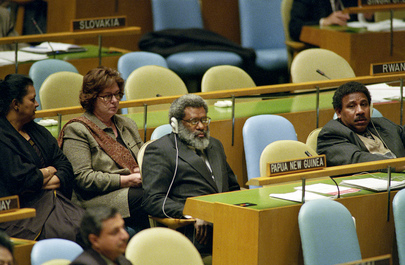 |
| United Nations Photo |
"We lost Ambassador Peter Donigi through a massive heart attack early this morning. He has been the team leader with our legal team. He is great loss to us and the country." said Namah.
We pray for peace and comfort for his family, colleagues and the people of East Sepik it is sad day for the Opposition, he said.
*****
(PNG Edge reported that):
Donigi, from East Sepik province, was among the first batch of lawyers in the likes of Meg Taylor, to pass out from the Legal Training Institute when it was first established in 1973.
His life in public service, he first served as the Foreign Affairs and Trade deputy secretary to the late Sir Anthony Siaguru, who was the first secretary of the department when PNG gained independence in 1975.
Donigi was later appointed ambassador to the United Nations before returning to practicing as a lawyer for most part of his life.
*****
PAPUA NEW GUINEA
STATEMENT
TO
THE 56th UNITED NATIONS GENERAL ASSEMBLY
BY
THE PERMANENT REPRESENTATIVE TO THE UNITED NATIONS
H.E. Mr. PETER DONIGI, CBE.
NEW YORK, NY
15TH NOVEMBER 2001
Decolonization and Human Rights
"...The process of decolonisation will not be completed, until the people of the remaining seventeen Non-Self-Governing Territories have exercised their inalienable right to self-determination and/or achieved self-government.
Papua New Guinea welcomes the cooperation of the Government of France with regards to the progress made in implementing the Noumea Accords, and setting in motion the eventual exercise of the rights of self-determination by the people of New Caledonia, especially the indigenous Kanak people.
We acknowledge the full cooperation of the Government of New Zealand in the progress made so far in respect to the question of Tokelau Islands.
My government notes the progress made in East Timor. We heartily welcome the announcement of 20 May 2002 as the day the people of East Timor will attain independence and nationhood. We look forward to welcoming them as a full member of this family of nations.
Papua New Guinea continues to urge the other administering Powers to cooperate with the Special Political and Decolonization Committee, in implementing and completing its mandate soon.
The future of each of the remaining Non-Self-Governing Territory can only be assured by a positive, constructive and above all, a transparent approach to developing a unique solution, for each of them..."
26 January 2014
Do the people of Bougainville want to be re-colonised by Australia and the US?
Getting Into Resource Rich Bougainville
Islands Business
‘Amazingly, no one cares about asking the people of Bougainville about their perception if they need foreign intervention from the likes of Australia and the United States. Quite clearly, Australian fear mongering and painting a picture of a security threat on its doorstep is intended to give it a reason to get into the resource-rich island before anybody else’
 |
| wikipedia.org |
The pursuit of riches has existed from the dawn of civilisation. Ancient tribes risked their lives by leaving their homes and hearths in search of riches in distant lands. It is the pursuit of wealth and its concomitant greed that led to expeditions across the world, with the more powerful of explorers subjugating vulnerable locals to increase their wealth through all sorts of means—pillaging, sacking cities, overrunning countries and killing hundreds and thousands of people. This they did with a heady mix of superior weaponry, dubious barter deals, worldly guile—and religion. The new world order post-World War II brought new ideas of equality, human rights and egalitarianism, which effectively put an end to institutionalised colonialism. But colonialism survived the onslaught of the new world order. Only the means changed. Overt became covert, hush money replaced weaponry, dubious aid replaced dubious trade and corruption took the place of good old guile.
Colonialism became a thing of the past, surviving only with a prefix like “post” as in “post-colonial” but its spirit has not only survived but continues to thrive in this so called modern age. Commentators and perceptive people term this new avatar of the old colonialism as “neo-colonialism”. It is still very much the pursuit of wealth but is pursued through new channels that are acceptable to the new world order. Such as aid, trade, investment and ideas like social and economic development, inclusiveness, capacity building and, of course, sustainability.
Though the ideals look wholesomely altruistic, and many of them may be genuinely so, scratch the surface and you are more than likely to find the hidden hand of big money behind these initiatives. Just as big multinational corporate money continues to influence government policies around trade negotiations, it forces the hands of governments around geopolitical decisions as well.
And when it does that, its only guiding principle is the pursuit of wealth—it does not matter what it costs in terms of lives, limbs, property of the people concerned and their environments. The scenario is very much from what hapless people suffered in the days of colonialism. Only the means have changed.
The hand of Big Oil in the decades-long conflicts in the Middle East, and more recently, in the African continent, as well as the ongoing large scale destruction of rainforests and the habitats of countless species of wildlife, flora and not least remote human tribes in Middle and South America, South East Asia and even some Pacific Islands are only a few examples of the devastating impact of big money all over the world.
Corporate big money fuelled neo-colonialism has been a part of the Pacific, as it has been in other parts of the developing world for several decades now. The race for resources and the emergence of new populous countries as growing economic powers has seen it rearing its head in the Pacific Islands region again. This is particularly true of the better resourced part of the region—Melanesia, to be specific.
Australia has always remained a big player in Melanesia because of both geographical proximity and historical reasons and Australian big business has gained much from the country’s long involvement in Papua New Guinea, Solomon Islands, Vanuatu and more recently, in Timor Leste. Of these, its involvement in Papua New Guinea and its autonomous region of Bougainville has been of most significance. Its involvement in the Panguna Mine in Bougainville intensified the island’s bitter conflict about two decades ago, where a rebel group was aiming to break away from PNG to form an independent nation. The unrest and conflict caused innumerable deaths and unprecedented destruction. The Australians finally suspended mining operations leaving a huge scar on the pristine island and the people to their own fate.
The island has slowly recovered and restored peace in the years since it was declared an autonomous zone but Port Moresby has not done enough to rehabilitate it and help build its economy, leveraging its many unique natural attributes. More recently, Bougainville is gaining more recognition as an offbeat destination for adventure and nostalgia tourism, given its pristine landscapes and diversity of terrain, not to mention its many onshore and offshore World War II heritage sites. The recent celluloid depiction (Mr. Pip) of an eponymous popular novel authored by a New Zealander has provided a surge of interest in the tourist industry.
Bougainville’s resurgence has apparently rekindled Australia’s old desire to step up its involvement in the substantial island. Last month, it issued warnings that it feared Bougainville may be slipping back into chaos. The Australian Strategic Policy Institute (ASPI) has said Bougainville “could” slip back into civil war unless “we” [read Australia and the United States] act now. In the newfound love between the region’s ANZAC nations and the US, there is a tendency to invite the US to be part of every activity in the region, cocking a snook as it were to China. ASPI’s paper reeks of the trappings of classic neo-colonialism.
In its December report, it says there is a need to flood Bougainville with human resources to bulwark the political apparatus and economic infrastructure in preparation for independence. There are suggestions to invite the US to chip in with aid for Bougainville. The calculation is obviously to send a message to China, that the western powers are in first. That’s not all: other experts are making a case for the reopening of the Panguna Mine by its owners, mining giant Rio Tinto.
Amazingly, no one cares about asking the people of Bougainville about their perception if they need foreign intervention from the likes of Australia and the United States. Quite clearly, Australian fear-mongering and painting a picture of a security threat on its doorstep is intended to give it a reason to get into the resource-rich island before anybody else, using the excuse of bringing in aid, investment, creating jobs and, of course, ushering in “sustainable development” while guiding its activists towards achieving their ultimate goal of independence from PNG.
It is up to the pro-independence activists of Bougainville to see Australia’s offers to get involved for what it is worth without falling for the usual trappings of investment and promises of inclusiveness, capacity building, employment and development at the cost of their real natural wealth and economic independence in exchange for any promised help in gaining political independence.
Subscribe to:
Posts (Atom)