19 November 2013

Social media used to reinforce "modernised" colonial status in British dependent (overseas) territories

The Anguillian


Facebook brings the overseas territories together

Press Release
The UK-Overseas Territories Family is on Facebook ahead of the annual meeting of the territory leaders later this month. It was launched by the Foreign Office.

The UK -Overseas Territories partnership dates from 1609. In the run up to this year’s Overseas Territories Joint Ministerial Council, the partnership aims to highlight the uniqueness and diversity of this community. 

(This period of "partnership" apparently includes several centuries of chattel slavery ending in the 1830s in the British-occupied Caribbean - OTR) 

The annual Overseas Territories Joint Ministerial Council (JMC) brings together political leaders from the Overseas Territories and UK Ministers. It will meet this year in London from 26 – 27 November and will be hosted by FCO Minister for the Overseas Territories Mark Simmonds MP.

Each inhabited territory will be featured on the Facebook page on a particular day in the run up to the JMC. Anguilla will be featured on Wednesday 20 November. Governor Christina Scott commented “I welcome this initiative to celebrate the rich diversity of the Overseas Territories. Each of the UK’s 14 territories has its own unique history and proud traditions, from the five lush Caribbean territories, to the world’s most remote community. They cover hundreds of islands, vast areas of ocean, and thousands of miles. This initiative lets us learn more about them, and to celebrate that diversity.”
*****

18 November 2013

Associated State expands diplomatic relations with neighbors


Japanfocus.org

By Makereta Komai

PACNEWS Editor


Three Smaller Island States have established diplomatic relations with Cook Islands.

The formal signing was held at the margins of the Smaller Island States Leaders meeting in Majuro Tuesday.


Cook Islands issued a joint communiqué after its Prime Minister, Henry Puna signed diplomatic ties with the Presidents of Kiribati, Anote Tong, Marshall Islands, Christopher Loeak and Palau’s Tommy Remengesau.

“The agreement strengthens ties of friendship and co-operation between Cook Islands and the three Smaller Island States, says the agreement signed between the Leaders.

All the four island countries are members of the Smaller Island States (SIS) of the Pacific Islands Forum.


*****


(Majuro, Marshall Islands) – On September 3, at the conclusion of Smaller Islands States Leaders meeting in the Marshall Islands, Palau President and the Cook Islands Prime Minister officially established diplomatic ties, formally connecting the North to the South Pacific.


President Tommy Remengesau Junior and the Cook Islands Prime Minister Henry Puna signed a joint communiqué establishing diplomatic relations between both island nations.

Through the communiqué, both countries agree to “develop and strengthen ties of friendship and cooperation between their countries and people.”

Additionally, the Republic of the Marshall Islands, the new Pacific Islands Forum Chairman, also established diplomatic relations with the South Pacific island nation.

Led by President Remengesau, the Palau delegation includes Minister Umiich Sengebau of the Ministry of Natural Resources, Environment and Tourism, Minister Billy Kuartei of the Ministry of State, First Lady Debbie Remengesau, Thomas Taro and Keobel Sakuma, the Press Secretary for the President’s Office.


15 November 2013

UN expert body urges action to prevent violation of indigenous rights due to business activities


UN NEWS CENTRE | PACNEWS
States and corporations need to do more to prevent the violation of indigenous peoples’ rights as a result of business-related activities, a United Nations independent expert body has said.
 “Indigenous peoples are among the groups most severely affected by the extractive, agro-industrial and energy sectors,” said Pavel Sulyandziga, Chair of the UN Working Group on the issue of human rights and transnational corporations and other business enterprises.
“Negative effects range from indigenous peoples’ right to maintain their chosen traditional way of life, with their distinct cultural identity, to discrimination in employment and in accessing goods and services.”
Other challenges involved land use and ownership, as well as displacement through forced or economic resettlement Sulyandziga said yesterday in his presentation of the Working Group’s report to the General Assembly’s social, humanitarian and cultural committee (Third Committee) on the adverse effects of business activities on indigenous peoples’ rights.
 “Such disruption often leads to serious abuses of civil and political rights, with human rights defenders in particular put at risk,” Sulyandziga said. “Indigenous peoples are also often excluded from agreements and decision-making processes that irrevocably affect their lives.”
The report highlights how the UN Guiding Principles on Business and Human Rights can clarify the roles and responsibilities of States, business enterprises and indigenous peoples in addressing these problems.
 “We call on States and business enterprises to increase their efforts to implement the Guiding Principles. This includes the State’s duty to protect indigenous peoples against business-related human rights abuses and corporate responsibility to respect human rights, and where abuses have occurred, to ensure people can have effective remedy,” said Sulyandziga, while urging interested parties to register for the second annual Forum on Business and Human Rights to be held in Geneva in December.
“It will be an opportunity to discuss challenges in implementing the Guiding Principles, in particular sectors, in operational environments and in relation to specific rights and groups, including indigenous peoples. It will also be a chance to identify good practices and opportunities for dialogue and cooperation toward solutions,” he added.

14 November 2013

The Puerto Rico Nationalist Uprising of 1950

Masthead..top_right
Tuesday, October 29, 2013
PUERTO RICO’S OCTOBER REVOLUTION


JUAN ANTONIO OCASIO RIVERA   

Image

BROTHER VS. BROTHER IN PUERTO RICO


National Guard soldiers, under orders of the United States, occupy the town of Jayuya. The town was partially destroyed by US artillery and martial law was declared throughout the entire island. Since federal agents and communication regulations heavily controlled the media in and out of Puerto Rico, people in the US mainland were mostly unaware of the Nationalist uprising and subsequent retaliation by US armed forces. This silent civil war, although short-lived, had many casualites and consequences in US/ Puerto Rico relations for years to come.


READ THE FULL ARTICLE HERE .


13 November 2013

ELISE DONOVAN APPOINTED DIRECTOR OF BRITISH VIRGIN ISLANDS HOUSE ASIA

Government of the Virgin Islands

The Government of the Virgin Islands today announced the appointment of Ms. Elise Donovan as Director of the BVI House Asia, the BVI’s Asia Pacific regional office, effective January 2014.


bvi.gov.vg
“As we continue to deepen our commercial footprint in Asia, Ms. Donovan will play a crucial role in promoting the BVI business in Asia-Pacific and in supporting the financial services industry and its growth in the region,” said Dr. D. Orlando Smith, Premier of the British Virgin Islands.

Ms. Donovan will take over the post from the current interim director Mrs. Lorna Smith. As the new Director, Ms. Donovan will promote BVI’s financial services, represent the BVI in a diplomatic setting, uphold BVI’s voice with the region’s government authorities, strengthen economic and political cooperation regionally and internationally, and build cultural and educational links in the Asia-Pacific.

Ms. Donovan has a wealth of experience in international affairs, international political economies, diplomacy and public relations. She has worked in the BVI Government and the BVI Financial Services Commission. Ms. Donovan is currently the Executive Director of the BVI International Finance Centre, where she is responsible for promoting and marketing the BVI financial services industry globally.

Ms. Donovan holds bachelor’s and master’s degrees from Carleton University, Ottawa and Columbia University, New York.

About BVI House Asia

BVI House Asia was established in Hong Kong in September 2013 to meet the growing demand for closer ties with the jurisdiction, particularly in the Greater China region. Currently, more than 40 percent of BVI financial services business is from Asia. BVI House Asia is committed to expanding and deepening the British Virgin Islands’ footprint in Asia Pacific with a focus on financial services.

In Asia Pacific, The British Virgin Islands provides a wide range of services including: asset protection, property holding, financial management, trading, copyrighting, bespoke trust services, and investment business. The BVI is also known for providing an efficient, 24-hour turnaround for formation of the widely used Company.

ALSO SEE: 

British Virgin Islands picks Hong Kong to be its Asia 


Small Islands Demand U.N. Protection

Sea level rise threatens Raolo island in the Solomon Islands. Credit: Catherine Wilson/IPS
Sea level rise threatens Raolo island in the Solomon Islands. 
Credit: Catherine Wilson/IPS


UNITED NATIONS, Nov 11 2013 (IPS) - Threatened by rising seas, some of the world’s small island developing states (SIDS) are demanding that the U.N.’s new set of Sustainable Development Goals place a high priority on the protection of oceans and marine resources.


A growing number of SIDS, including Papua New Guinea, Samoa, the Maldives, Tonga, Nauru and Kiribati, are making a strong case for a stand-alone goal for the protection of oceans in the post-2015 development agenda known as the SDGs, which is currently under discussion.

Hassan Hussain Shihab, first secretary of the Maldives diplomatic mission to the U.N., told IPS that oceans are a priority for the Indian Ocean island nation, whose 339,000 citizens are threatened by sea-level rise.

“The establishment of an SDG dedicated to oceans is critical to Maldives as the oceans are our source of life, livelihood and the identity of the people,” he said.

Covering more than 70 percent of our planet’s surface, he said, oceans play a key role in supporting life on earth.

READ FULL ARTICLE HERE.


12 November 2013

Japanese Report Indicates Rising Temperatures and Progressing Ocean Acidification Worldwide

OA_pHtrend_137E_en.jpg Ocean_Acidification_map.jpg
Copyright Meteorological Agency. ALL Rights Reserved.

The Japan Meteorological Agency (JMA) released its 2012 "Climate Change Monitoring Report" on July 12, 2013, which provides observations and analyses of the climate, and oceanographic and atmospheric environments of both Japan and the world. According to the report, the global annual mean temperature in 2012 was the 8th highest since 1891, and is increasing at a rate of 0.68 degrees Celsius per century.

The concentrations of carbon dioxide (CO2) in the atmosphere and ocean have been increasing over the long term. The global average CO2 concentration in the atmosphere was 390.9 parts per million (ppm) in 2011, up 2.0 ppm from 2010. On average, CO2 concentration has been increasing at an annual rate of 2.0 ppm in the past ten years, representing a larger rate of increase than the 1.5 ppm observed in the 1990s. The mean growth rates of oceanic CO2 concentrations from 1984 to 2012 were 1.6 ppm per year.

Ocean acidification, known as the decrease in seawater pH (potential ion hydrogen), is caused by the marine uptake of atmospheric CO2 emitted by human activity. This report also included monitoring results regarding ocean acidification for the first time.

JMA has been conducting oceanographic observations in the western North Pacific for a long time. JMA estimated the pH in surface waters at northern latitudes between 3 and 34 degrees along the 137 east longitude, one of JMA's repeat hydrographic lines, in winter since 1984 using CO2 concentration and related data in surface waters. The results revealed that pH has clearly decreased at all latitudes, and the mean decrease rate of pH was 0.017 per decade, suggesting an increase in ocean acidity. Since ocean acidification is a particular issue of concern because it accelerates global warming by reducing marine capability of CO2 uptake from the atmosphere and affects marine ecosystem, JMA will continue the monitoring of marine environment in the future.


Japan for Sustainability (JFS) is a non-profit communication platform to disseminate environmental information from Japan to the world. We are grateful that people in 191 countries have found an interest in our free e-mail publications, and will continue to do our best to deliver useful information to our readers all around the globe.

Please feel free to forward this message to your colleagues and friends wherever the Internet can reach. If you know colleagues or friends there with an interest in sustainability, please do forward them one of our newsletters and invite them to try our service. To subscribe for JFS Newsletters, visit www.japanfs.org/en/mailmagazine/


***** Support Us *****
If you find our information and activities unique and valuable,
we appreciate your support!

No Safe Havens in Increasingly Acid Oceans

Because many deep-sea ecosystems are so stable, even small changes in temperature, oxygen, and pH may lower the resilience of deep-sea communities. Credit: Courtesy NOAA HURL Archives

UXBRIDGE, Canada, Oct 15 2013 (IPS) - Oil, gas and coal are contaminating the world’s oceans from top to bottom, threatening the lives of more than 800 million people, a new study warns Tuesday.
“It took a year to analyse and synthesise all of the studies on the impacts of climate change on ocean species,” Camilo Mora, an ecologist at University of Hawai‘i in Honolulu and lead author, told IPS.
"We are seeing greater changes, happening faster, and the effects are more imminent than previously anticipated." -- Alex Rogers of the University of Oxford
Mora is also lead author of ground-breaking climate study published in Nature last week.
“It was very sad to see all the responses were negative. We were hoping there might be some safe havens,” he said.
The study found that carbon emissions from burning fossil fuels are overheating the oceans, turning them acidic and reducing the amount of oxygen in seawater. This is happening too fast for most marine species to adapt and ocean ecosystems around the world will collapse.
By 2100, no corner of the oceans that cover 70 percent of the Earth’s surface will be untouched.

READ FULL ARTICLE HERE .

11 November 2013

St. Kitts begins negotiations on its border with "Europe"


gpsnauticalcharts.com

"The consequence of the partial annexation of St. Eustatius (Statia) by the Kingdom of the Netherlands is the ursupation of significant parts of the Caribbean Sea by European Union states. Meanwhile, Statia never voted for such annexation, and is considering a referendum on legitimate political options which would provide for the ownership of the sea resources by the people of the territory. In the meanwhile, it appears the resources grab by EU countries continues unabated while the right of the people to ownership and control of their marine resources is dismissed ."  -  an Eastern Caribbean political scientist


SKNVibes | Click Here For Our Home Page...


November 5th, 2013  --  The first round of discussions to settle the maritime boundary between St Kitts and Nevis and the island of St Eustatius – a special municipality of the Netherlands – have begun in London at the Commonwealth Secretariat.

The Commonwealth is assisting St Kitts and Nevis to resolve its outstanding maritime boundaries with five neighbouring countries in the Caribbean region. Delegations from St Kitts and Nevis and the Netherlands met on Tuesday, 29 October at the Secretariat’s headquarters.


For many small island countries such as St Kitts and Nevis, access to natural resources has and continues to play a critical role in shaping their economic and social development. The demands of growing populations coupled with a desire by governments to reduce dependency on foreign natural resources, particularly oil, gas, and minerals, have compelled many countries throughout the world to renew efforts to explore for and develop their natural resources, including fisheries resources and offshore oil, gas and mineral reserves of the seabed.

By delimiting their maritime boundary, countries are able to manage their areas of ocean without affecting their neighbours’.


09 November 2013

"The Nation" sheds light on forgotten conflict of Western Sahara


Washington, Nov 5, 2013 (SPS) - The U.S. weekly magazine “The Nation” published Monday a lengthy article about the forgotten conflict of Western Sahara, shedding the light on the reality in the Saharawi refugee camps and the occupied territories of Western Sahara.

Written under the title “Letter From Western Sahara, a Land Under Occupation” by the journalist Sharif Abdel Kouddous of Egypt, the article stopped at the life experienced by the Saharawi people in the refugee camps and in the occupied Western Sahara.

The journalist, who took part at the Western Sahara International Film Festival, held last October in the Saharawi refugee camps of Dakhla, made interviews with Saharawi President, citizens, human rights activists and members of the Polisario Front leadership, in addition to some foreign guests, who were present at the FiSahara.

“We are now in the stage of peaceful resistance through an uprising, coupled with ongoing talks with the UN and Morocco,” said Mr. Mohamed Abdelaziz, President of the Republic and Secretary General of the Polisario Front, speaking to the U.S. weekly newspaper.

“We are in a just struggle for liberation. Like previous struggles in Algeria, East Timor and elsewhere, the logic of history always ends with justice,” he added.

The article highlighted that the Sahrawi women played a central role in building the basic structures to house schools, clinics and community centers in the Saharawi refugee camps.

“In all fronts you will find women leading the process, whether in the refugee camps or in the occupied territories,” Ms. Fatma al-Mehdi, Secretary General of the National Union of Saharawi Women, told the Nation.

“As Sahrawi women we are working not only to liberate our country but also to have an equal society,” she underlined.


08 November 2013

As Western Sahara Discussed, Polisario Is Told It Can't Speak on United Nations Television


As W. Sahara Discussed, Polisario Is Told It Can't Speak on UNTV, UNclear

By Matthew Russell Lee, Exclusive

UNITED NATIONS, October 30 -- With the UN Security Council meeting behind closed door Wednesday about Western Sahara, the Frente Polisario complained to Inner City Press that they were told they could not speak at the UN Television stakeout.


In the past, they have, including one time that the then-head of the UN Media Accreditation and Liaison Unit, a Moroccan national, had the cameras turned off. (Click here for that Inner City Press story). But since then, Polisario has spoken at the stakeout, often before or after Morocco's Ambassador Loulichki.


But now something has changed. Inner City Press checked, and learned that UN Security this time was told that Polisario should not be allowed to speak. No one wanted to say where the order came from.

The Media Accreditation and Liaison unit only has jurisdiction on the media side of the railing. UN Television camera-people, those predating the new outside contractor Team People, remembers Polisario speaking. So where did the order come from?

07 November 2013

First Woman Governor for Curacao to take office

NL Times


© REUTERS. Netherlands King  Willem-Alexander receives the new governor of Curacao, Lucille George Wout (M) and her husband George Herman (L) at Noordeinde Palace


King Willem-Alexander swore in Lucille George-Wout as Governor of Curaçao. With this act the island territory once again has a full-fledged governor, just before the introductory royal visit on November 18 and 19.The regulations require that the oath must be taken before the king. Acceptance of the position occurs at a meeting of the States. On return to Curaçao, George-Wout will give a speech during a solemn parliamentary assembly, announced the government of the island Friday, after the appointment of the new governor was approved by the National Council of Ministers.

Lucille George-Wout (63), the first woman to occupy this position, is the successor of Frits dos Santos Goedgedrag. He was also the last Governor of the in 2010 dismantled Netherlands Antilles.

George-Wout served in several public positions, such as member and chairman of the States, representative, and minister.

06 November 2013

Petition at World Conference of Churches would call for West Papua to be included on United Nations Decolonisation list


www,cs.utexas.edu


Pacific Islands News Association


A petition being circulated at the World Council of Churches 10th Assembly will call for West Papua to be included on the United Nations list of territories to be decolonized.

Pacific church leaders from 12 countries have signed the petition which also calls on the WCC to send a fact-finding mission to the Indonesian-controlled territory and establish a specific commission to address the issue.

The petition follows an announcement by West Papuan churches of their intention to join the Pacific Conference of Churches as a full member after the assembly.

Today regional delegates, supported by PCC Secretariat staff, circulated the petition which contains a further two demands:

-    The end to arbitrary arrests, detention, brutality, torture and abuse by Indonesian security forces of West Papuan people.


-    The right of West Papuans to self-determination and their rights to exercise political freedom.

The PCC said it was mindful of the quest by West Papuans for self-determination and freedom since 1969 when Indonesia invaded and annexed the region.

Since then more than 100,000 West Papuans have been killed by Indonesian forces who have been responsible for acts of torture, arbitrary arrest and general brutality on the indigenous population.

“We the delegates and participants of the 10th Assembly of the World Council of Churches support the right of West Papuans to self-determination and freedom from oppression,” the petition said.

The plight of West Papua has been highlighted in a static display at the Busan Exhibition and Convention Centre as well as through advocacy by delegates.

A similar petition at the West Papua display area has been signed by many of the 5000 international participants at the assembly.


SOURCE: PCC/PACNEWS

05 November 2013

US Virgin Islands Legislature conducts hearings on Danish Slavery

"The economies of Denmark and other European nations were built on the backs of centuries of uncompensated forced labour of enslaved Africans. It is the same racist mindset which sustained this massive "crime against humanity" which now denies any culpability." - a Virgin Islands historian     

www.nigerianmuse.com 


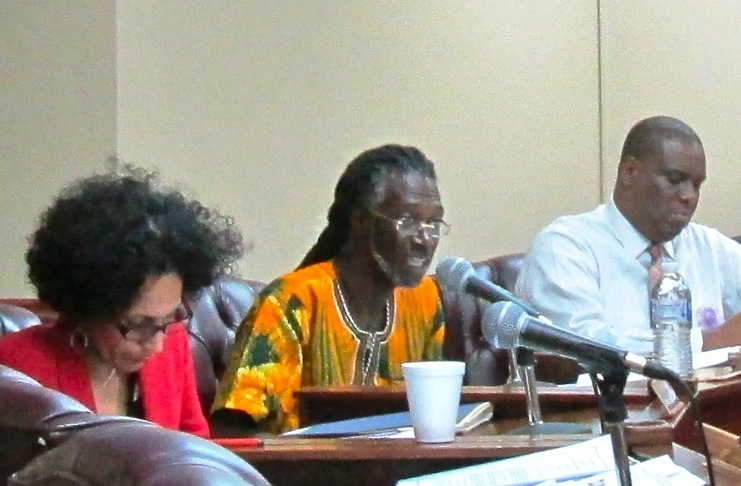
Sens. Nereida Rivera-O'Reilly, Terrence Nelson and Kenneth Gittens at Wednesday's hearing on a reparations related bill.

A small, far-left Danish political party has called on the government of Denmark to apologize for its role in the transatlantic slave trade, St. Croix slavery reparations activist Shelley Moorhead told a Senate panel Wednesday.

Moorhead was testifying to the Culture, Historic Preservation, Youth and Recreation Committee in opposition to a resolution asking the U.S. Congress to set up a truth and reconciliation committee on the topic.

"Today's headlines in Denmark read that the Unity Party asks Denmark to apologize for its slave past,” Moorhead testified. It is the first Danish political party to do so, he said.

The party, a coalition of several smaller parties called "Enhedslisten" or "Unity Party," or Red-Green Alliance, controls 12 seats in the 175-seat Danish parliament, making it the fifth largest party in parliament, and the fourth largest left of center party. It is a member of the current governing coalition of parties.

The party is acknowledging the V.I. Legislature taking up the question of slavery apologies and reparations, Moorhead said.

Reports in Danish newspapers, including the English version of the largest Danish paper, The Copenhagen Post, quote party officials saying the Danish government should weigh in before the V.I. Legislature votes on the bill.

"Denmark has a gruesome history with active involvement in slave trade," Unity Party foreign affairs spokesperson Nikolaj Villumsen said in a Danish radio interview, according to the Post. "An official apology is important for two reasons. One is to pay sympathies to the descendants of slaves and the other reason is to have a debate in Denmark about our slavery past," the Post quotes him as saying.

But that view is not universal. The far right party, Dansk Folkeparti, which has 22 seats in parliament, said that Denmark shouldn't be held responsible for something that happened "200 years ago."

"That is completely nuts. You could say that these people should feel lucky that they are now American citizens in a free country and not in Ghana," DF spokesperson Soren Espersen told Politiken newspaper in Denmark. (wow...)

The Copenhagen Post reported that Denmark has previously declined to address reparations "because it could affect ties with the U.S." 

The committee was hearing testimony on a bill, sponsored by Sens. Sammuel Sanes and Judi Buckley, that would urge Congress to establish a truth and reconciliation commission. [Bill 30-0196]

Moorhead and several other testifiers, including Dr. Chenzira Kahina and former Sen. Usie Richards, said they opposed the bill partly because it asks Congress to act instead of creating a local commission, and because it is weaker than past resolutions approved by the Legislature.

The bill's intent "is both contradictory to reparations for the people of the U.S. Virgin Islands and in direct contravention of the Legislature's expressed intent and action" in a 2005 resolution "to condemn the institution of slavery and seek reparations from Denmark," Moorhead said.

He said he objects to Congress setting up the commission, reading from his prepared remarks that "it can and should be argued that "THIS is OUR effort," and, WE the descendants of the enslaved, those who suffered (and continue to suffer) for the establishment and administration any such relevant commission. As for your governor .. well, I gon leave ahyou mek da argument." (Note: The spelling here is from Moorhead's written testimony)

Richards said "we should not be encouraged to go to the United States Congress to create an entity to speak on our behalf." Instead the Legislature could create a commission and name its members, he suggested.

Sanes said he developed the bill over the past decade, working with St. Croix activist Edward Browne, and he asked Browne to explain why it called for asking Congress to act. Browne testified that Danish government officials had told him in no uncertain terms they would not speak or negotiate with any nongovernmental entity or any component part or territory of another sovereign nation, but only with that sovereign government.

Sen. Terrence "Positive" Nelson asked Richards if he agrees it is appropriate to go to Congress or not. Richards replied that nongovernmental organizations could not negotiate with the government of Denmark, but the government of the Virgin Islands could act and he sees "no reason to wait."

Several testifiers suggested the territory needs a single, unified strategic plan for reparations and that the Legislature should get more input from local organizations while preparing the plan.

Senate President Shawn-Michael Malone joined the meeting toward the end, saying he would speak to his fellow senators and the governor and "see if a comprehensive approach can be worked out."

"Whether we agree or disagree that this is the way to get there it is important that we are sitting down to have this discussion," Malone said.

Nelson moved to hold the bill for further discussion and amendment. Voting to hold the bill for amendment were Nelson, Malone, Sens. Kenneth Gittens, Nereida "Nellie" Rivera-O'Reilly and Myron Jackson. Sens. Tregenza Roach and Janette Millin Young were absent.

Jackson and Malone said there would be further hearings on the topic in both districts.

**********

This is about centuries of forced labour of enslaved Africans. This free labour made an enormous contribution to building the economy of Denmark (as well as France, U.K., the Netherlands, Spain, the U.S. and others). When slavery was ended, it was the former slaveholders - not the former enslaved - who were compensated, with the former enslaved left to fend for themselves under new forms of oppression such as colonial governance which has inevitably led to the political underdevelopment of dependencies. The organic link between slavery and colonialism is well established. 

The world has rightly condemned slavery and the horrific Trans-Atlantic Slave Trade as crimes against humanity. This is why the Caribbean countries have taken three of these E.U. countries to the International Court of Justice on the basis of just claims for reparation. 

This is not simply a request for an apology for the crimes perpetuated by someone's ancestors. Rather, this is a call for reparation for past crimes committed by European and North American nations whose people now enjoy a standard of living built on man's inhumanity to man.

Lest we forget.

OTR 

******