08 November 2013

As Western Sahara Discussed, Polisario Is Told It Can't Speak on United Nations Television


As W. Sahara Discussed, Polisario Is Told It Can't Speak on UNTV, UNclear

By Matthew Russell Lee, Exclusive

UNITED NATIONS, October 30 -- With the UN Security Council meeting behind closed door Wednesday about Western Sahara, the Frente Polisario complained to Inner City Press that they were told they could not speak at the UN Television stakeout.


In the past, they have, including one time that the then-head of the UN Media Accreditation and Liaison Unit, a Moroccan national, had the cameras turned off. (Click here for that Inner City Press story). But since then, Polisario has spoken at the stakeout, often before or after Morocco's Ambassador Loulichki.


But now something has changed. Inner City Press checked, and learned that UN Security this time was told that Polisario should not be allowed to speak. No one wanted to say where the order came from.

The Media Accreditation and Liaison unit only has jurisdiction on the media side of the railing. UN Television camera-people, those predating the new outside contractor Team People, remembers Polisario speaking. So where did the order come from?

07 November 2013

First Woman Governor for Curacao to take office

NL Times


© REUTERS. Netherlands King  Willem-Alexander receives the new governor of Curacao, Lucille George Wout (M) and her husband George Herman (L) at Noordeinde Palace


King Willem-Alexander swore in Lucille George-Wout as Governor of Curaçao. With this act the island territory once again has a full-fledged governor, just before the introductory royal visit on November 18 and 19.The regulations require that the oath must be taken before the king. Acceptance of the position occurs at a meeting of the States. On return to Curaçao, George-Wout will give a speech during a solemn parliamentary assembly, announced the government of the island Friday, after the appointment of the new governor was approved by the National Council of Ministers.

Lucille George-Wout (63), the first woman to occupy this position, is the successor of Frits dos Santos Goedgedrag. He was also the last Governor of the in 2010 dismantled Netherlands Antilles.

George-Wout served in several public positions, such as member and chairman of the States, representative, and minister.

06 November 2013

Petition at World Conference of Churches would call for West Papua to be included on United Nations Decolonisation list


www,cs.utexas.edu


Pacific Islands News Association


A petition being circulated at the World Council of Churches 10th Assembly will call for West Papua to be included on the United Nations list of territories to be decolonized.

Pacific church leaders from 12 countries have signed the petition which also calls on the WCC to send a fact-finding mission to the Indonesian-controlled territory and establish a specific commission to address the issue.

The petition follows an announcement by West Papuan churches of their intention to join the Pacific Conference of Churches as a full member after the assembly.

Today regional delegates, supported by PCC Secretariat staff, circulated the petition which contains a further two demands:

-    The end to arbitrary arrests, detention, brutality, torture and abuse by Indonesian security forces of West Papuan people.


-    The right of West Papuans to self-determination and their rights to exercise political freedom.

The PCC said it was mindful of the quest by West Papuans for self-determination and freedom since 1969 when Indonesia invaded and annexed the region.

Since then more than 100,000 West Papuans have been killed by Indonesian forces who have been responsible for acts of torture, arbitrary arrest and general brutality on the indigenous population.

“We the delegates and participants of the 10th Assembly of the World Council of Churches support the right of West Papuans to self-determination and freedom from oppression,” the petition said.

The plight of West Papua has been highlighted in a static display at the Busan Exhibition and Convention Centre as well as through advocacy by delegates.

A similar petition at the West Papua display area has been signed by many of the 5000 international participants at the assembly.


SOURCE: PCC/PACNEWS

05 November 2013

US Virgin Islands Legislature conducts hearings on Danish Slavery

"The economies of Denmark and other European nations were built on the backs of centuries of uncompensated forced labour of enslaved Africans. It is the same racist mindset which sustained this massive "crime against humanity" which now denies any culpability." - a Virgin Islands historian     

www.nigerianmuse.com 


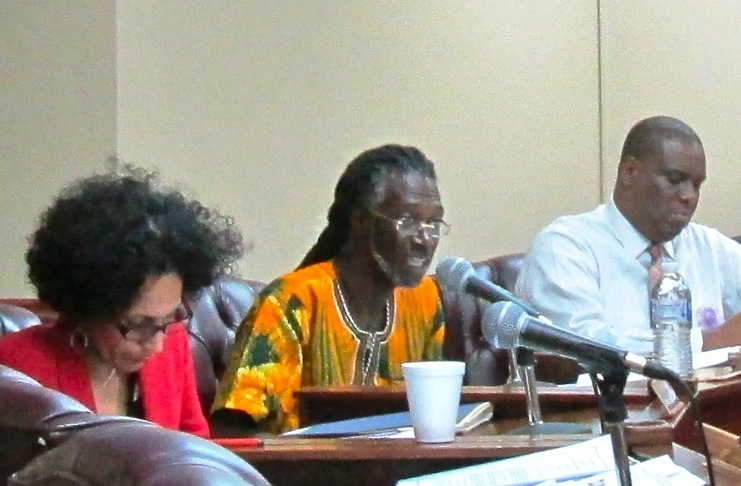
Sens. Nereida Rivera-O'Reilly, Terrence Nelson and Kenneth Gittens at Wednesday's hearing on a reparations related bill.

A small, far-left Danish political party has called on the government of Denmark to apologize for its role in the transatlantic slave trade, St. Croix slavery reparations activist Shelley Moorhead told a Senate panel Wednesday.

Moorhead was testifying to the Culture, Historic Preservation, Youth and Recreation Committee in opposition to a resolution asking the U.S. Congress to set up a truth and reconciliation committee on the topic.

"Today's headlines in Denmark read that the Unity Party asks Denmark to apologize for its slave past,” Moorhead testified. It is the first Danish political party to do so, he said.

The party, a coalition of several smaller parties called "Enhedslisten" or "Unity Party," or Red-Green Alliance, controls 12 seats in the 175-seat Danish parliament, making it the fifth largest party in parliament, and the fourth largest left of center party. It is a member of the current governing coalition of parties.

The party is acknowledging the V.I. Legislature taking up the question of slavery apologies and reparations, Moorhead said.

Reports in Danish newspapers, including the English version of the largest Danish paper, The Copenhagen Post, quote party officials saying the Danish government should weigh in before the V.I. Legislature votes on the bill.

"Denmark has a gruesome history with active involvement in slave trade," Unity Party foreign affairs spokesperson Nikolaj Villumsen said in a Danish radio interview, according to the Post. "An official apology is important for two reasons. One is to pay sympathies to the descendants of slaves and the other reason is to have a debate in Denmark about our slavery past," the Post quotes him as saying.

But that view is not universal. The far right party, Dansk Folkeparti, which has 22 seats in parliament, said that Denmark shouldn't be held responsible for something that happened "200 years ago."

"That is completely nuts. You could say that these people should feel lucky that they are now American citizens in a free country and not in Ghana," DF spokesperson Soren Espersen told Politiken newspaper in Denmark. (wow...)

The Copenhagen Post reported that Denmark has previously declined to address reparations "because it could affect ties with the U.S." 

The committee was hearing testimony on a bill, sponsored by Sens. Sammuel Sanes and Judi Buckley, that would urge Congress to establish a truth and reconciliation commission. [Bill 30-0196]

Moorhead and several other testifiers, including Dr. Chenzira Kahina and former Sen. Usie Richards, said they opposed the bill partly because it asks Congress to act instead of creating a local commission, and because it is weaker than past resolutions approved by the Legislature.

The bill's intent "is both contradictory to reparations for the people of the U.S. Virgin Islands and in direct contravention of the Legislature's expressed intent and action" in a 2005 resolution "to condemn the institution of slavery and seek reparations from Denmark," Moorhead said.

He said he objects to Congress setting up the commission, reading from his prepared remarks that "it can and should be argued that "THIS is OUR effort," and, WE the descendants of the enslaved, those who suffered (and continue to suffer) for the establishment and administration any such relevant commission. As for your governor .. well, I gon leave ahyou mek da argument." (Note: The spelling here is from Moorhead's written testimony)

Richards said "we should not be encouraged to go to the United States Congress to create an entity to speak on our behalf." Instead the Legislature could create a commission and name its members, he suggested.

Sanes said he developed the bill over the past decade, working with St. Croix activist Edward Browne, and he asked Browne to explain why it called for asking Congress to act. Browne testified that Danish government officials had told him in no uncertain terms they would not speak or negotiate with any nongovernmental entity or any component part or territory of another sovereign nation, but only with that sovereign government.

Sen. Terrence "Positive" Nelson asked Richards if he agrees it is appropriate to go to Congress or not. Richards replied that nongovernmental organizations could not negotiate with the government of Denmark, but the government of the Virgin Islands could act and he sees "no reason to wait."

Several testifiers suggested the territory needs a single, unified strategic plan for reparations and that the Legislature should get more input from local organizations while preparing the plan.

Senate President Shawn-Michael Malone joined the meeting toward the end, saying he would speak to his fellow senators and the governor and "see if a comprehensive approach can be worked out."

"Whether we agree or disagree that this is the way to get there it is important that we are sitting down to have this discussion," Malone said.

Nelson moved to hold the bill for further discussion and amendment. Voting to hold the bill for amendment were Nelson, Malone, Sens. Kenneth Gittens, Nereida "Nellie" Rivera-O'Reilly and Myron Jackson. Sens. Tregenza Roach and Janette Millin Young were absent.

Jackson and Malone said there would be further hearings on the topic in both districts.

**********

This is about centuries of forced labour of enslaved Africans. This free labour made an enormous contribution to building the economy of Denmark (as well as France, U.K., the Netherlands, Spain, the U.S. and others). When slavery was ended, it was the former slaveholders - not the former enslaved - who were compensated, with the former enslaved left to fend for themselves under new forms of oppression such as colonial governance which has inevitably led to the political underdevelopment of dependencies. The organic link between slavery and colonialism is well established. 

The world has rightly condemned slavery and the horrific Trans-Atlantic Slave Trade as crimes against humanity. This is why the Caribbean countries have taken three of these E.U. countries to the International Court of Justice on the basis of just claims for reparation. 

This is not simply a request for an apology for the crimes perpetuated by someone's ancestors. Rather, this is a call for reparation for past crimes committed by European and North American nations whose people now enjoy a standard of living built on man's inhumanity to man.

Lest we forget.

OTR 

******

01 November 2013

Fourteen Caribbean nations sue European countries for slavery reparations


Lawsuits seek reparations from Britain, France, Netherlands 

for their roles in Atlantic slave trade


Gonsalves
saint Vincent and Grenadines' Prime Minister Ralph Gonsalves speaks during the 68th United Nations General Assembly at U.N. headquarters.
Mary Altaffer-Pool/Getty Images
Fourteen Caribbean nations are suing the governments of the United Kingdom, France and the Netherlands for reparations over what the plaintiffs say is the lingering legacy of the Atlantic slave trade.
In a speech Friday at United Nations General Assembly, Prime Minister of Saint Vincent and the Grenadines Ralph Gonsalves said the European nations must pay for their deeds.
“The awful legacy of these crimes against humanity – a legacy which exists today in our Caribbean – ought to be repaired for the developmental benefit of our Caribbean societies and all our peoples,” Gonsalves said. “The European nations must partner in a focused, especial way with us to execute this repairing.”
The lawsuits – which are likely to amount to a lengthy battle – are being brought by The Caribbean Community, or CARICOM, a regional organization that focuses mostly on issues such as economic integration. They will be brought to the U.N.'s International Court of Justice, based in The Hague in the Netherlands. It is not immediately clear when court proceedings will begin.
The countries will focus on Britain for its role in slavery in the English-speaking Caribbean, France for slavery in Haiti and the Netherlands for Suriname, a CARICOM member and former Dutch colony on the northeastern edge of South America.
They have hired British law firm Leigh Day, which waged a successful fight for compensation for hundreds of Kenyans who were tortured by the British colonial government as they fought for the liberation of their country during the Mau Mau rebellion of the 1950s and 1960s.
According to Martyn Day, a lawyer from the firm, the first step will be to seek a negotiated settlement with the governments of France, Britain and the Netherlands along the lines of the British agreement in June to issue a statement of regret and award compensation of about $21.5 million to the surviving Kenyans.
"I think they would undoubtedly want to try and see if this can be resolved amicably," Day said of the Caribbean countries, speaking to The Associated Press in July. "But I think the reason they have hired us is that they want to show that they mean business."
Caribbean countries Jamaica, (and) Antigua and Barbuda already have national commissions on reparations, and each country that does not have a commission has agreed to set one up. The 14 Caricom nations voted unanimously to wage the joint campaign, saying it would be more ambitious than any previous attempt.
In the United States, the idea of reparations has surfaced and disappeared numerous times. 
After the end of the Civil War, about 400,000 acres of land along the Florida, Georgia and South Carolina coasts was taken from former slave owners and set aside for freed slaves, who would each be granted a 40-acre plot of land to farm and make a living. It was the first attempt in the U.S. at reparations, and was reversed by President Andrew Johnson after President Abraham Lincoln was assassinated in 1865.
Most recently in 2008, then-candidate Barack Obama said he did not support reparations for the descendants of slaves, which put him at odds with the NAACP, The Urban League, the SCLC and about two dozen members of Congress who sponsored legislation to create a commission on slavery.
The House issued an apology for slavery in July 2008, and the Senate followed suit in 2009, but neither mentioned reparations. 
Caribbean officials have not specified a monetary figure for the lawsuits, but Gonsalves and Verene Shepherd, chairwoman of the national reparations commission in Jamaica, both mentioned the fact that Britain at the time of emancipation in 1834 paid 20 million pounds – the equivalent of 200 billion pounds today – to British planters in the Caribbean.
"Our ancestors got nothing," Shepherd said. "They got their freedom and they were told ‘Go develop yourselves.'"
Dexter Mullins contributed to this report, with The Associated Press.

30 October 2013

Paris court rules Flosse corruption appeal to be heard in Tahiti, but delays trial until mid 2004


France’s highest court has rejected a bid to move a court of appeal case of French Polynesia’s president, Gaston Flosse, away from Tahiti.

His lawyers had claimed that the situation in Papeete would undermine the chance of a fair trial.

In January, the criminal court gave Mr Flosse a five-year prison sentence and a 110,000 US dollar fine for corruption as it did to a French advertising executive, Hubert Haddad.

The businessman had paid about two million US dollars in kickbacks over 12 years to Mr Flosse and his party to get public sector contracts.

Mr Flosse admitted receiving some funds but said it wasn’t for personal use but to pay alimony to former mistresses.

Both men were jailed for weeks during the investigation after the French senate lifted Mr Flosse’s parliamentary immunity.

France’s highest court is meanwhile due to release its verdict in another appeal against a corruption conviction related to Mr Flosse’s four-year suspended jail sentence for being part of an illicitly funded system with so-called phantom jobs to advance the policies of his party.

If the conviction is upheld, there is no more appeal avenue left and Mr Flosse has to quit political office.

Also see: France insists French Polynesia's Gaston Flosse is tried in Tahiti


French Polynesia’s Flosse corruption case deferred until next year


French Polynesia’s court of appeal has deferred a case brought by French Polynesia’s president, Gaston Flosse, to the end of June.

In January, the criminal court gave Mr Flosse a five-year prison sentence and a 110,000 US dollar fine for corruption as it did to a French advertising executive, Hubert Haddad.

The businessman had paid about two million US dollars in kickbacks over 12 years to Mr Flosse and his party to get public sector contracts from the OPT telecommunications company.

Last week, the defendants failed in their bid to get France’s highest court to move the appeal case away from Tahiti after claiming they wouldn’t get a fair trial.

However, they succeeded in putting off the case by eight months, arguing that lawyers based in France were not all available.

Only some of the defendants were present, including the tourism minister, Geoffry Salmon, and Gaston Flosse’s secretary, Melba Ortas, who used to collect the cash payments from Hubert Haddad’s company.

The lawyer acting on behalf of the OPT, James Lau, has meanwhile been relieved of his duties amid suggestions that it was a political decision, reflecting Gaston Flosse’s election win in May.

28 October 2013

Vieques violations brought before Inter-American Commission on Human Rights

Groups claim US rights violations on Vieques


The (U.S.) National Lawyers Guild and other groups have filed a petition with the Inter-American Commission on Human Rights against the U.S. government in a case involving Puerto Ricans living in the island of Vieques, an emerging tourism hub which was once used as a bombing range.

The petition accuses the U.S. of abuses following decades of live-fire training on the island by the U.S. Navy, which left in 2003 after an errant 500-pound bomb killed a security guard in 1999.

Guild attorney Natasha Lycia Ora Bannan told The Associated Press on Tuesday that families on Vieques suffer serious health conditions because of a toxic environment left by Navy bombing. The petition was in part filed to force the U.S. government to release more information about the extent of the military’s activities on Vieques and its impact on people, she said.

“There’s a lot of information that remains unknown regarding toxic contaminants,” she said. “People are unaware of what is causing their health issues and the continuous contamination of the island.”

The petition was filed Monday on behalf of 10 Vieques residents who had cancer or have relatives who are sick. The residents also accuse Puerto Rico’s government of neglecting Vieques after the Navy’s departure.

The groups are asking the commission to determine whether the U.S. violated any human rights, said Annette Martinez Orabona, director of the human rights clinic at Puerto Rico’s InterAmerican University’s law school. If that occurs, the commission would make a list of recommendations that the U.S. government would be bound to follow, she said.

“We’re not asking for specific reparations, but at some point we will,” she said. She said they are not focused on money but rather on changes including improved health care and more efficient transportation from Vieques to Puerto Rico.

Martinez said the main goal is to get the U.S. government to acknowledge that the military’s target practice adversely affected people’s health.
]
“That is something that they have denied over and over again,” she said.

Navy spokesman Jim Brantley did not immediately return a request for comment.

A U.S. agency issued a long-awaited report earlier this year saying it found no proof that decades of military practice bombing on Vieques sickened residents who blame it for high rates of cancer, asthma and other illnesses.

The report was released in March and follows four previous assessments and several updates by the Agency for Toxic Substances and Disease Registry that reached similar conclusions.

Local residents and officials, who blame the military for health problems, have vowed to keep pushing the U.S. government for more studies analyzing the impact of the now-ceased Navy activity on Vieques, which lies east of the U.S. territory’s main island. About 10,000 people live there.

The Navy occupied the island’s eastern and western areas in 1941-2003, using it for warships and aircraft to practice firing live bullets, artillery rounds, rockets, missiles and bombs, according to the report.

The Navy has said its forces accidentally fired 263 rounds of ammunition tipped with depleted uranium in 1999, violating federal law.

That same year, a pilot dropped a bomb on an observation tower and killed a civilian, setting off years of angry protests that led President George W. Bush to end military activity on Vieques in 2003. The property once owned by the Navy is now a national wildlife refuge.

The U.S. has since removed more than 16.5 million pounds of munitions in a cleanup expected to last through at least 2025.

The agency’s director, Dr. Christopher Portier, said the 169-page report reached two conclusions: that there is credible evidence people in Vieques have poorer health than elsewhere in Puerto Rico and that scientists could not find a link between military operations and people’s health.

“That doesn’t mean those linkages don’t exist,” he said. “It means we can’t find credible scientific evidence to support that.”

The agency said that the public water supply was safe and that there were no air contaminants. However, it recommended additional soil testing in residential areas, stating there was still uncertainty about soil contamination because current data were inadequate.

Officials said they found mercury in local seafood, but blamed it on the general presence of the metal worldwide. They also noted that there were no unusually high concentrations of mercury in a fish sampling.

Officials said they did not analyze the possible effect of absorbing a mix of chemicals through food, air and water, saying they did not know the levels of chemicals that residents might have been exposed to.

The agency “recognizes the possibility that this report cannot address accurately the effects of mixtures and cumulative exposures on the health of Viequenses,” the report stated.

During 2001-2003, the U.S. government released four reports stating it found no health hazards in Vieques’ air, soil, seafood and drinking water. Several scientists from the University of Puerto Rico, the University of Georgia and Yale University disagreed, saying residual contaminants were affecting the health of local residents.

In February 2012, a U.S. appeals court upheld a decision to dismiss a lawsuit in which 7,100 residents of Vieques accused the federal government of causing illnesses.


The agency’s report said a higher mortality rate especially from cancer could be partly blamed on a lack of access to adequate medical care.


Caribbean 360
SAN JUAN, Puerto Rico, Thursday October 31, 2013 – Doctors in Puerto Rico have sent a letter to US President Barack Obama requesting him to launch by executive order the decontamination of Vieques and Culebra islands and provide adequate treatment for those harmed by the pollution.

The remedial work in the islands, used for decades as testing grounds by the US Army, would "be the best substantiation of your many times expressed concern for the wellbeing of all the Latino people living in the United States," wrote Eduardo Ibarra, head of the Puerto Rico College of Physicians and Surgeons.

The professional body said it had communicated this same request to President Obama on previous occasions, without receiving an appropriate response.
image
Medical professionals claim that islanders have shown higher incidences of cancer, hypertension, diabetes, cirrhosis and epilepsy as a consequence of exposure to contaminants.
The latest communication reminded the president that an adequate and permanent clean-up was never carried out on Vieques, which was used for experiments with live munitions and as a practice bombing range, and which left significant contamination.

"As is well known around the world, our pristine Islands of Vieques and Culebra were during more than half a century utilized by the armed forces of the United States and the North Atlantic Treaty Organization to practice air to land, water to land and land to land live bombing and also as dumping grounds for military materials," the letter says.The letter adds that a number of scientific studies have shown that "the population of those thin paradisiac islands have been the innocent victims of high exposure to extremely dangerous contaminants, particularly and conspicuously Mercury.

"As a direct consequence of such contamination of their environment, its population has shown unacceptable higher incidence and prevalence of cancer, hypertension, diabetes, cirrhosis and epilepsy," the letter states.

The US Navy left Vieques a decade ago, and since then only five percent of the contaminants are said to have been removed.

25 October 2013

France seeks to exploit the natural resources of its Pacific colonies


Illustration by Hawaii.edu

"Claims by France to the resources of its Pacific territories violate international law which provides that the natural resources of a territory, including its marine resources, are owned by the people of the territory - not the cosmopole. This has been confirmed in rulings of the International Court of Justice (ICOJ), and in annual United Nations (U.N.) resolutions. Just last December, the General Assembly expressed its deep concern for 'any activities aimed at exploiting the natural and human resources of the Non-Self-Governing Territories to the detriment of the interests of the inhabitants of those Territories.' It should be clearer than ever as to why the French Government fought (unsuccessfully) to prevent the U.N. re-inscription of French Polynesia as a colony - control of  the resources of the five million square kilometres of the Pacific Ocean can be a significant deterrent to compliance with the rule of law."  

-  a Decolonization Expert


France advised to expand seabed zone 

for rare earth mining


The French Economic, Social and Environmental Council has urged the government to secure resources in the seabed off France’s overseas territories.

In a report, the Council says the Law of the Sea allows for France to lay claim to an additional two million square kilometres, half of which are in French Polynesia. It says France would be negligent not to profit from this as French Polynesia has rare earths, whose reserves are held by China in a near monopoly.

The report also points to cobalt off Wallis and Futuna and hydrocarbon deposits near New Caledonia. However, the report says the area is contested by Vanuatu.

*****


20 October 2013

Spain and Morocco plan oil exploration near Canary Islands


thecanaryislands.info

 The Spanish and Moroccan governments are moving forward with plans to explore for oil near the Canary Islands despite opposition from the tourism industry and environmentalists in the Spanish archipelago.


The two governments have authorized oil exploration projects in the area even though the maritime boundaries are not set, with territorial limits established by an imaginary line equidistant between the Moroccan coast and the Canary Islands, which belong to Spain.

Some residents of the islands, whose economy relies on tourism, are concerned about the possible effects of an oil spill, while others contend the energy industry would create jobs in a region dealing with an unemployment rate of 33 percent.

The fields in the area could hold up to 1.4 billion barrels of petroleum and produce 140,000 barrels per day (bpd) of crude, helping Spain meet 10 percent of its daily demand for oil, Spanish oil company Repsol said.

Morocco, meanwhile, said Scottish oil company Cairn Energy planned to begin exploration work in the next few weeks in blocks adjacent to those granted by the Spanish government to Repsol some 60 kilometers (37 miles) off Lanzarote and Fuerteventura.

The Cajun Express rig leased by Cairn Energy will begin operations in early October some 555 kilometers (about 345 miles) northeast of the Canary Islands.

The start of exploration by Repsol, which is working with Germany's RWE and Australia's Woodside, is still pending completion of the environmental review process.

SEE ALSO:   No 0il Canarias


18 October 2013

Virgin Islands Hunger Action for reparations for Danish Slavery


African-Caribbean Reparations 
and Resettlement Alliance (ACRRA)

For Immediate Release

MEDIA ADVISORY

RE: Failure of USVI (U.S. Virgin Islands) Senate to Act on Reparations
WHO: Senate President Shawn-Michael Malone
Members of the 30th Legislature of the USVI
ACRRA President Mr. Shelley Moorhead

WHAT: REPARATIONS HUNGER ACTION

WHEN: October 23rd, 2013 – Until Favorable Senate Action on  Reparations is Taken

WHERE: USVI Capitol Building (St. Thomas Legislature)

WHY: To inspire USVI lawmakers to act on matters relevant to the pursuit of reparations by the territory and to bring awareness to the outstanding and unresolved colonial injustices which foster underdevelopment in the former Danish West Indies.

__________________________________________________________________________________________

HUNGRY FOR REPARATIONS

The African-Caribbean Reparations and Resettlement Alliance (ACRRA) will commence a hunger action on October 23, 2013 at the grounds of the Capitol Building in Charlotte Amalie, St. Thomas.  Purposed to inspire U.S. Virgin Islands (USVI) lawmakers to act on matters relevant to the seeking of reparations by the territory, the hunger initiative will be carried out by ACRRA’s president Mr. Shelley Moorhead.

In a letter notifying Senate President Shawn-Michael Malone of the organization’s planned action, Moorhead writes, “I will be invoking my constitutional right to petition our government and abiding by all applicable U.S. Virgin Islands laws.”  The longtime Virgin Islands reparations leader gave notice on October 4th and informed Senator Malone that he will “remain there without eating or consuming food for as much time as will be necessary for senators to take favorable action on reparations legislation.”

It has been more than eight (8) years since the USVI Legislature firmly decided to seek reparations from Denmark by resolution unanimously passed by the body on May 4, 2005.  Yet, to date, no action has been taken by the institution to pursue reparatory justice for the people of the territory who are descendants of Africans enslaved in the Danish West Indies.  For as many years as the senate has not acted on reparations, ACRRA has been on the forefront of the issue advocating locally and internationally for the socioeconomic and humanitarian repair of Virgin Islanders by the Kingdom of Denmark.

In an October 4th letter to Malone, ACRRA’s president outlines nearly a decade of gross neglect and inaction on the part of many USVI senators.  He writes, “It has not been the manipulation of the Danish state or any stalling on the part of institutions at Copenhagen, but rather, it has been the failure of the first branch of our government in the U.S. Virgin Islands to, as it has legislated, ‘Seek Reparations from Denmark’ which has been the primary delay of reparatory justice in the territory.”

Moorhead in his letter recalled the mandate Senator Malone issued the reparations leader on June 16, 2005, when he wrote to him urging, “I encourage you to exhaust all your resources to try to find measures to make amends for the immeasurable years of suffering and disdain” experienced by Virgin Islands forefathers.  “These measures”, Moorhead replies, “I have found and all my resources have I exhausted at your encouragement. Certainly, as my elected representative and the man of good moral character that you are, you have not asked of me that which you yourself are unwilling to do for our people.”

With Caribbean governments throughout the region having formed reparations committees, and now preparing the moral and legal cases for compensation and educating their publics accordingly; what has the 30th Legislature of the U.S. Virgin Islands done to mobilize the seeking of reparations for its people? What can the descendants of enslaved Africans in our territory expect from this representative body as it pertains to reparations for slavery?  These questions Moorhead will attempt to get answered by senators during his multi-week reparations hunger action.

In August to September of 2008, the ACRRA president carried out a 34-day hunger action on the steps of Government House on St. Croix.  Refusing to leave, to eat, or consume food until Virgin Islands reparations issues were adequately addressed, Moorhead held the de Jongh administration to task receiving two (2) weeks into his hunger action a 3-page letter from Governor John P. de Jongh, Jr. outlining his administration’s position on reparations.


Contact:
ACRRA Media Team

Shelley Moorhead, President of ACRRA