
Open letter to members of the Island Council Bonaire
James Finies
Nos Kier Boneiru Bek
7th February 2017
Subject: Urgent call to unification in defense of the Bonerian peoples
Now that the current yes-government of tolerance has came to an end the opportunity rises for Bonaire to have a government that follow the direction that the Bonerian peoples has indicated in the referendum of December 2015, where as never before the Bonerian peoples united and massively rejected the actual colonial status.
Fact is that shortly, beginning of coming March , the 2nd chamber Dutch elections will be held and after the elections the new government of Holland is free to make the second reading to finalize the embedding of us as colony under legalized racism and apartheid conditions in their constitution.
Meanwhile there has been clearly exposed that Dutch politicians did not and will not let loose of their past and roots as colonizers and has not shown sign to have consciousness or human feelings and neither are respecting democracy nor the rights of the BES peoples, including the Bonerian peoples. We are not left other possibility then to seek for other alternatives, other avenues to realize our rights anchored into international treaties.
After the Bonerian and of Sint Eustatius peoples has spoken clearly in their referendum that they do not want to continue this direction, the current colonial constellation, we have noted and experienced that on Sint Eustatius their government has followed the mandate of their peoples and has started the process to exit the BES and are aspiring and are working on their own constitution for a new autonomous and associated relationship with Holland in the Dutch Kingdom according to norms and standards of the United Nations.
On Bonaire the opposite is the case where the Yes-government, which has campaigned publicly against the decision of the Bonerian peoples, which with 65% of No-votes has rejected the actual status and together with the Dutch government has decided to violate the rule of law and democracy and start the process to anchor, embed unilaterally the Bonerian peoples against their wish and decision in the Dutch constitution. The actual governments of Bonaire and Holland are violating and are not complying with their duty as government, to respect, protect and fulfill the treaties, resolutions and human rights of self-determination and right to development of the Bonerian peoples.
This is a crucial moment in our history looking what is ahead of us and because of the burden and consequences of embedding of our peoples in the Dutch constitution, we are making a dramatic and urgent call on the fraction of Democratic party, especially their leadership to put aside their personal and internal issues and unite back with the peoples, unite back for Bonaire and together with fractions of UPB and Raphaela which are not supporting anymore the Yes-government and start the process same as Sint Eustatius to re-enlistment as a non-self-governing-territories and get guidance and protection of the United Nations and exit BES which has resulted in a complete failure and realize the wishes, decision and rights of the Bonerian peoples. You can count on the support of our brothers in the Kingdom and also from the international community to help the Bonerian peoples with a fair and just process to realize their right to self-determination and realize their self-government same as Sint Eustatius in the Kingdom with alliance and protection of our brothers and according to norms and standards of the United Nations.
Respecting, protecting and fulfilling as government the Bonerian peoples inalienable rights to self-determination and right to development, we finally could experience and enjoy our fundamental right to freedom and equality that will ensure the welfare and happiness of the Bonerian peoples in the Dutch Kingdom.
******
__________________
| ||||||
09 February 2017
BONAIRE CIVIL SOCIETY CALLS ON POLITICAL LEADERS TO REJECT COLONIAL STATUS, SUPPORT U.N. RE-INSCRIPTION AS COLONY


Virgin Islands joins other dependent territories in London BREXIT Talks
BVI Premier Attending Brexit Meetings in UK
Press Release
Premier and Minister of Finance, Dr. the Honourable D. Orlando Smith, OBE will lead a delegation to London to attend the United Kingdom Overseas Territories (UK-OT) Joint Ministerial Council on European Union (EU) Negotiations and other meetings from February 6 - 10.
At the meeting on EU Negotiations, the Premier will call on the UK Government to include the BVI in any new trade arrangements with the EU; ensure freedom of movement for OT citizens across Europe; and maintain financial support to the 11th European Development Fund through 2020 to support OTs on climate change, biodiversity and sustainable energy.
“It is critical that the BVI and other OTs are on the UK Brexit agenda to ensure our priorities are taken into account before Article 50 of the Lisbon Treaty is triggered to begin negotiations on Britain’s exit from the EU”, the Premier said.
Premier Smith will also reiterate his call for a new post-Brexit economic partnership between the UK and OTs in which the BVI and other territories can be an asset in facilitating UK trade and investment with emerging markets across the Commonwealth in Africa and Asia whose legal systems are based on English Common law.
To advance this objective, the Premier will encourage the UK Government to continue supporting the BVI’s efforts to achieve recognition by the EU of the Territory’s legitimacy as an international finance centre and acknowledge the international standards on tax and transparency that it meets as a jurisdiction.
At the 2016 Joint Ministerial Council in London, Premier Smith told UK Ministers: “We have to ensure that the OTs’ ability to trade with the EU and other international partners is not impeded by illegitimately, placing us on the EU’s planned list of non-cooperative jurisdictions for tax purposes. This would restrict OT market access to the EU.”
Ahead of Brexit Negotiation talks with the UK Government, Premier Smith will attend a pre-meeting of OT Leaders where he will push for more OT engagement in the UK Parliament with the Exiting the EU and International Trade Committees in the House of Commons, and related committees in the House of Lords; as well as support the establishment of a structured framework for ongoing engagement between the OTs and UK on Brexit negotiations.
The UK-OT Joint Ministerial Council on European Negotiations comes at the end of Premier Smith’s successful Presidency of the Political Council of the United Kingdom Overseas Territories Association (UKOTA), during which time he led efforts to secure the high-level Brexit meetings for the OTs with the UK.
“One of my key objectives was to ensure that the BVI and other Overseas Territories were strategically positioned for Brexit negotiations in terms of having a forum in which to engage the UK on our priorities and interests so they would be taken into account. I am proud were able to achieve this”, the Premier said.
Premier Smith also thanked BVI UK Representative, Benito Wheatley for supporting his Presidency as Chair of UKOTA in which he implemented the mandates of the Political Council.
“I was fortunate to have Mr. Wheatley’s support in London as we defended the self-governance and self-determination of the territories, arrived at a settlement of beneficial ownership issue with the UK Government and led efforts to position the Overseas Territories for Brexit negotiations,” he said.
The BVI maintains an associate status with the EU from which the Territory has benefitted. Among other things, the EU has funded: a small and medium enterprise project for the Caribbean that has provided invaluable technical support to the BVI’s small businesses; construction at the H. Lavity Stoutt Community College of the Culinary Arts Centre, Library, Resource Centre and Eileen L. Parsons Auditorium; construction of the Sage Mountain and Copper Mine Visitor Centres; establishment of an early warning system in the Territory’s extreme weather events; and strengthening of the management and conservation of local beaches and the nearshore environment.
- On June 23, 2016 the people of the United Kingdom voted in a referendum on EU membership for Britain to leave the European Union.
- On January 24, 2017 the UK Supreme Court ruled that the UK Government must seek approval from the UK Parliament to trigger Article 50 of the Lisbon Treaty to begin official negotiations on Britain’s exit from the EU.
- On February 1 the House of Commons voted to authorise the UK Government to trigger Article 50 of the Lisbon Treaty which entails a two year process with possibility for extension.
- Prime Minister Rt. Hon. Theresa May confirmed the UK Government will trigger Article 50 by March 31, 2017.
The BVI maintains an associate status in the EU set out in Part Four of the Treaty on the Functioning of the EU. Current cooperation between the BVI and the EU is governed by the Overseas Association Decision (OAD) adopted by the EU in 2013.
*****
BVI Premier Advances Brexit, Financial Services Agenda
Premier and Minister of Finance Dr. the Honourable D. Orlando Smith, OBE, has completed meetings of high level ministerial and parliamentary engagement in the United Kingdom.
The Honourable Premier joined other Overseas Territory (OT) leaders during a courtesy call on Prime Minister Rt. Hon. Theresa May at the Prime Minister’s Office on Wednesday, February 8.
The courtesy call followed the UK-OT Joint Ministerial Council on European Negotiations on February 7, during which UK Ministers and OT Leaders discussed the potential impacts of Brexit on the Territories. OT Leaders were given the opportunity to discuss their varied priorities for negotiations including freedom of movement, international trade and EU funding.
Premier Smith also attended a series of other meetings including a meeting for OT Leaders on beneficial ownership hosted by Home Office Minister of State for Security and Member of Parliament, Ben Wallace. During the meeting, the BVI's implementation of OT-UK beneficial ownership agreements was recognised as the most advanced in respect to the development of systems to enhance the exchange of information with UK law enforcement authority.
The Premier also met with Vice Chairman of the Conservative Party and Member of Parliament, Mark Field to demonstrate the BVI's new state of the art system for exchanging beneficial ownership and further discuss the BVI’s priorities for Brexit negotiations.
According to Premier Smith, “My engagement with ministers and parliamentarians allowed my delegation to reiterate BVI's priorities for Brexit negotiations for financial services as well as to demonstrate our progress and commitment to sharing and exchanging information with law enforcement."
Premier Smith added, "I am also encouraged that the UK Government will take into account the views and needs of the OT's."
The Premier’s UK visit is in line with Government’s mandate to strengthen international relationships, in positioning the Virgin Islands for the future.
06 February 2017
Guam EPA announces active Agent Orange investigation following Calvo order
Steve Limtiaco and Kyla P Mora
The military last week told Guam Del. Madeleine Bordallo that Agent Orange, a hazardous defoliant, was not used on Guam, but Gov. Eddie Calvo, citing statements from veterans, has instructed the Guam Environmental Protection Agency to test for traces of the chemical, according to the governor’s office.
Guam EPA announced Monday that investigations are already actively underway. A release stated that agency officials "have been involved in discussions with Department of Defense (DOD) and the United States Environmental Protection Agency (US EPA), engaging in an investigation into the claims made by retired Air Force Master Sgt. Leroy Foster and other veterans who were stationed in Guam in the 1960s and 1970s."
According to the release, "GEPA officials informed the governor that requests for signed affidavits from individuals who have publicly stated that Agent Orange was used on Guam have been made, with the intent of documenting and pinpointing any and all areas where the herbicide may have been allegedly used on the island."
"These discussions about our investigation are yielding productive results for our agency in terms of investigation, sampling methods, analysis and abatement measures," GEPA administrator Walter Leon Guerrero stated in the release. "More specifically, we initialized talks with US EPA's Region IX Emergency Response Team who have worked with a Superfund Technical Assessment and Response Team."
START teams are "experienced in removal and abatement of dioxins with respect to sites historically known to be affected by the sprayed application of herbicides," the release stated.
Drinking water and soil will be tested in areas where Agent Orange reportedly was sprayed, according to the governor’s office, which cited recent public statements by veterans who claimed they sprayed Agent Orange around Guam during the Vietnam War.
“This is deeply disturbing, considering that the contaminant in Agent Orange, 2,3,7,8-tetracholordibenzodioxin (TCDD), is a carcinogen. There are veterans suffering life-debilitating illnesses attributed to their exposure to Agent Orange. Their public admissions have raised the attention of several government leaders, including Dennis A. Ross, Senior Deputy Majority Whip, and our own Congresswoman Madeleine Bordallo,” the governor’s office stated.
Leon Guerrero expressed concern on the important issue of possible TCDDs in Guam's drinking water and soil, and outlined the plan of action should TCDDs be detected.
"Our agency will work in tandem with other agencies to meet our mission in safeguarding the environmental and human health on Guam," Leon Guerrero said. "If there is any discovery of dioxins on Guam that can be linked with Agent Orange, the Guam EPA will coordinate with the Guam Waterworks Authority, the Joint Region Marianas and Water and Environmental Research Institute of the Western Pacific (WERI) to engage in remedial action, upon discovery."
Florida resident and veteran Foster said he personally sprayed thousands of gallons of Agent Orange at Andersen Air Force Base, while stationed there with the 43rd Supply Squadron Fuels Division during the Vietnam War.
In 2009, veteran Edward Jackson, in written testimony to Congress, said he was a bus and truck driver who occasionally was assigned to drive a truck with 55-gallon drums of alleged Agent Orange and other herbicides.
He said the herbicides were sprayed at Naval Magazine, Naval Communications Station, Naval Air Station, Navy Harbor and around his barracks area at the Marbo complex.
He said leaky barrels of Agent Orange were either loaded on ships for disposal at sea, or taken to Andersen’s Northwest Field if they were too leaky to be safely moved.
Bordallo, who asked to be briefed by the military about the use of Agent Orange after hearing veteran accounts, last week said senior defense officials told her Agent Orange was not used on, stored or shipped through Guam during the Vietnam War.
“I look forward to reviewing their records that support this claim and continuing to engage with the DoD and local stakeholders so that we have all the facts on this issue,” she stated last week.
Calvo said he also is watching the federal government’s response.
“In consideration of the statements made by veterans regarding the spraying of this chemical on Guam, I have justifiable concern about the residual effects this chemical may have on our environment, particularly our aquifer and drinking water sources,” Calvo stated in a letter to Guam EPA Administrator Leon Guerrero.
04 February 2017
Virgin Islands Premier bids farewell to former U.S. President Obama

2 February 2017

(l to r) British Governor, John Duncan, OBE; wife of the Governor, Mrs. Anne-Marie Duncan; former U.S. President Barack Obama; Premier of the Virgin Islands, Dr. the Honourable D. Orlando Smith, OBE; BVI First Lady Mrs. Lorna Smith, OBE; former First Lady (U.S.) Michelle Obama (Photo credit: GIS/ Ronnielle Frazer)
Today, the Governor and Premier, accompanied by their spouses, bade farewell to the Obamas, who ended their ten-day private stay in the BVI. The Obamas said they enjoyed their visit tremendously and hope to return with their daughters in the near future.
Premier Smith said, “I have followed President Obama’s two terms in the White House and I am filled with admiration for his accomplishment. The fact that the Obamas chose the BVI for their private vacation after eight years in the White House speaks to the high regard in which the BVI and its tourism product are held.”
02 February 2017
BERMUDA TRUTH AND RECONCILIATION BODY TO BE LAUNCHED

Curb launches truth and reconciliation project
Truth and reconciliation conversations will begin across the island in February, racial justice organisation Citizens Uprooting Racism in Bermuda announced yesterday.
Trained mediators will run the multiple group sessions of up to 20 participants, who will stay together for a series of conversations over a three-month period, Curb said at a press conference.
It is hoped that the initiative will be more effective than previous nationwide conversations because the discussion groups will be smaller and will reconvene on a regular basis, allowing relationships to form and empathy to build.
Curb will provide guideline topics for each meeting, as well as resources that can be shared with groups in advance prior to the gathering.
“It is envisioned these groups will forge relationships, build community and find ways to create change within their own sphere of influence, and then share with the greater community,” said Curb president Lynne Winfield.
“Most importantly, we will look for the groups to build upon and develop additional ideas and actions to bring about social change, healing and greater racial justice and equity in our society.”
Ms Winfield referred to Barack Obama’s speech where he quoted Atticus Finch — a character in Harper Lee’s To Kill A Mocking Bird: “You never really understand a person until you consider things from his point of view”.
At the end of the three months, the groups will meet as one to consolidate their ideas. Additional groups will be formed later in the year and the process will begin again.
Members of the public are asked to register by e-mailing admin@uprootingracism.org or by calling 505-0112.
The small group meetings will take place in east, west and central locations around the island. Organisers are seeking meeting spaces and will be reaching out to the community to provide locations.
Curb said it was grateful to the Human Rights Commission for its expression of support for this valuable initiative.
It said it had reached out to the community to find facilitators, mediators and skilled individuals who would be willing to facilitate the truth and reconciliation meetings. Volunteers to come forward are Caitlin Conyers, Gwendolyn Creary, Frances Eddy, Hashim Estwick, Cordell Riley, Michelle Scott, Jodi Virgil, Stacey Lee Williams and Lynne Winfield.
Ms Winfield said that the small group dialogues would be skilfully facilitated to achieve greater empathy and understanding.
“Confronting something does not mean it has to be confrontational. Participants will be able to speak about their experiences in a supportive environment,” she said.
“Telling one’s stories is cathartic for those who have been traumatised, and listening to other people’s stories leads to greater empathy and understanding. It allows our humanity to come through and the empathy created, displaces cynicism and distrust.
“Help create the change you want by becoming actively involved to create a racially equitable and socially just Bermuda that our children will be proud to inherit.”
01 February 2017
(Bermuda) Tensions could rise to ‘explosive’ levels

Tim Smith, News Editor
You thought the past few months were tense? Wait until you see what 2017 brings.
With frustration among the poorest section of society showing no signs of easing, it will not take much, according to some, to trigger more of the public flashpoints that Bermuda has frequently witnessed in recent times.
The bad news for anyone hoping Bermuda can calmly navigate its way through a General Election year, political commentator Phil Perinchief believes, is that the parties themselves will not be afraid to light the blue touchpaper.
Continued social and economic disparities along racial grounds, and discontent with the performance of the One Bermuda Alliance and Progressive Labour Party set the stage for a difficult year ahead, Mr Perinchief says.
An eagerness by both parties to manipulate power, as well as the ability to spread false truths through social media, means tensions could reach even greater heights than previous Bermuda election campaigns.
Mr Perinchief, a former PLP and Independent candidate, and former United Bermuda Party and Independent candidate David Sullivan shared their thoughts with The Royal Gazette as the clock begins to count down towards an election that must happen by May 2018.
“The tensions surrounding the next General Election will run at unprecedented, even potentially explosive, levels,” Mr Perinchief said.
“Both parties have been seduced by the use and manipulation of power for good and otherwise. Both parties have had the political bit in their teeth and they relish the prospect of repeating the experience.”
Over the past two years, hundreds have taken to the streets to protest the OBA’s proposed Pathways to Status legislation, airport redevelopment plan and furlough days for public service workers.
Numbers were significantly down this month when the People’s Campaign tried to rally support for the Reverend Nicholas Tweed’s work permit bid, but are expected to return to previous levels when the House of Assembly tackles the airport project on February 3.
READ THE FULL REPORT HERE.
31 January 2017
African Union criticises US for ‘taking many of our people as slaves’ and not taking refugees
Trump has suspended all US refugee programmes and banned immigration from seven Muslim-majority countries, three of which are AU members
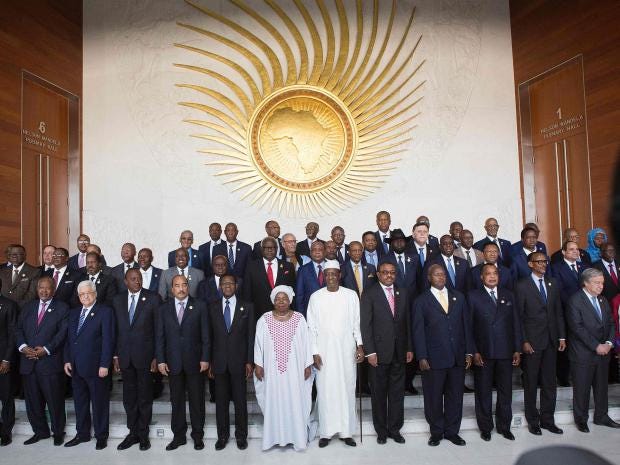 African Heads of State pose for a group photo ahead of the start of the 28th African Union summit in Addis Ababa on 30 January, 2017 AFP
The head of the African Union has criticised Donald Trump’s ban on immigration from some Muslim-majority countries, saying it presents “one of the greatest challenges” for the continent.
As representatives of the AU’s 53 member states met in Addis Ababa for a two-day summit, the chief of its commission said the bloc was entering “very turbulent times” after the US President’s election.
“The very country to which many of our people were taken as slaves during the transatlantic slave trade has now decided to ban refugees from some of our countries,” said Nkosazana Dlamini-Zuma.
_______________________________

 ADDIS ABABA – A top African Union official denounced on Monday the United States’ recent travel ban affecting seven Muslim-majority countries, saying that the same country that once took African slaves by the million was now denying entry to refugees from the continent.
Chairperson of the AU Commission Nkosazana Dlamini-Zuma said that the ban decreed by US President Donald Trump was one of the greatest challenges to Africa’s unity and solidarity.
“The very country to which many of our people were taken as slaves during the transatlantic slave trade has now decided to ban refugees from some of our countries,” said Dlamini-Zuma at the AU’s annual summit held in the Ethiopian capital, Addis Ababa.
“What do we do about this?” she added.
The travel ban, which was issued on Friday, affects three African countries (Libya, Somalia and Sudan) as well as four nations in the Middle East (Syria, Iraq, Yemen and Iran).
Dlamini-Zuma declared that Trump’s executive order heralded “very turbulent times” for the continent.
United Nations Secretary-General Antonio Guterres, who was also present at the summit, said that African countries host the largest refugee populations in the world.
“African borders remain open for those in need of protection when so many borders are being closed, even in the most developed countries in the world,” said Guterres, to the applause of the plenary assembly.
The executive order, titled “Protecting the nation from foreign terrorist entry into the United States,” has caused domestic waves of outrage manifested in multitudinous protests across dozens of US airports.
It also drew sharp rebukes from various members of the international community, including several key US allies such as Canada and Germany.
30 January 2017
Independent Guam can succeed with United States
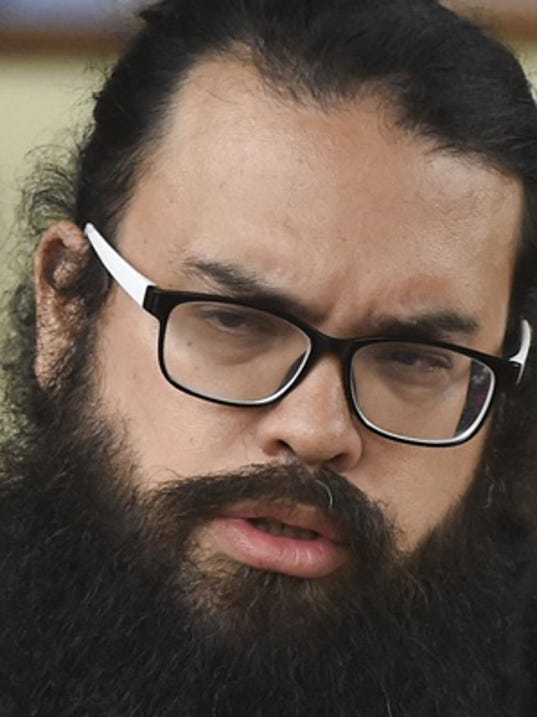
Michael Lujan Bevacqua
Michael Lujan Bevacqua is an author, artist, activist
and assistant professor of Chamorro Studies at the University of Guam.
 |
| Photo: PDN file |
In my own education on political status, this quote from the late Guam Sen. Frank Lujan in his article, “Sleeping Beauty: Times Passes By,” played a pivotal role in helping me see new and firmer truths, just beyond the colonial common sense:
“Those who defend Guam's colonial status argue that economic independence for Guam is impractical. We happen to agree. Guam by herself can never be economically independent. But nor can our great mother country the United States. There no longer is any such animal as an independent nation in the world today. ... All nations in the latter part of the 20th century are economically interdependent.”
There is so much to unpack in this simple quote, so much to discuss in terms of the way people misunderstand decolonization and independence.
Due to a resistance or a fear of change, they place onto the possibility of Guam all manner of fearful and unrealistic expectations. The ideas that independence for the island would mean isolation are particularly strange, given the fact that if you look at any of the almost 200 examples in the world today, all have relationships with other countries, through which they help each other.
Independence isn’t the end of existence, despite what some may feel — it is instead the beginning of international relations. It is the foundation for international interdependence.
On Guam today, we do not exist in interdependence with others, but rather a state of dependence. It is our colonial status that makes the difference.
Guam clearly has connections to other countries, but we are not the master of those connections and what we can negotiate is limited due to our status. Our connections depend primarily on our colonizer, the U.S. and their relationships to those around us, opening doors for us to some countries, closing doors to others. The U.S. exists in interdependence with those countries, making decisions based on its own vast interests. Sometimes Guam can benefit from those decisions, but that isn’t interdependence, that is coincidence.
The title of my column last week was “Guam can succeed without the United States,” which argued that Guam can become independent and so much of the fear or hesitancy that people may feel has colonial roots and shouldn’t be taken as fact. The insight from Lujan’s quote, however, is that no one is successful as an independent country alone. Even if political independence is meant to guarantee a minimum level of self-government and sovereignty, success is all about forging a system of interdependence with your neighbors and allies.
Independence does not mean leaving the world behind, it means joining it. It does not mean breaking all ties with the United States, but could actually improve or enhance our relationship to the U.S. At present we are a regularly disrespected and largely forgotten colonial footnote to the U.S. We are their possession. Why not be an ally of the U.S. instead? Why not work with them as equals or as partners?
Given our closely connected history with the U.S., and our strategic importance to them, it is very likely that an independent Guam and the U.S. would be key allies in this region. In my opinion, this arrangement would be far better than our current status. At present, we are a colony that fantasizes about being a real part of the U.S. and refuses to deal with our true relationship. As an independent country we could create a partnership that was mutually beneficial and based on respect and shared interests.
29 January 2017
U.N. DECOLONISATION COMMITTEE PLEASED WITH RELEASE OF PUERTO RICO HUMAN RIGHTS DEFENDER OSCAR LÓPEZ RIVERA
| OCCUPYOAKLAND.ORG |
Special Committee on Decolonization: Communiqué on the
commutation of the sentence of Oscar López Rivera
2017-01-20
The Special Committee on Decolonization welcomes and shares Puerto Rico’s joy
over the release of independence leader Oscar López Rivera thanks to the united
struggle and solidarity of the Puerto Rican people joined by various
international personalities including Pope Francis.
After serving 35 years of a 70-year sentence, his sentence was commuted by decision of the President Barack Obama.
The Special Committee on Decolonization requested of the Government of the United States of America the release of Oscar López Rivera by its decisions on the question of Puerto Rico adopted by consensus on 16 June 2015 and 16 June 2016. The Committee transmitted the latter decision to the United States Mission to the United Nations in New York by communication No. 000627 of 3 November 2016.
As part of the annual consideration of the question of Puerto Rico, for almost 40 years the Committee has been continuously requesting the release of Puerto Rican independence activists serving sentences in United States prisons, while at the same time reaffirming the inalienable right of the Puerto Rican people to self-determination and independence, in accordance with General Assembly resolution 1514 (XV), and the applicability of the fundamental principles of that resolution to the question of Puerto Rico.
The Special Committee on Decolonization, in response to the general outcry of the Puerto Rican population, coupled with the requests of prominent personalities, was unceasing in its demand that justice be done in the case of Oscar López Rivera, who became the longest-serving political prisoner in the world. In that connection, the Committee trusts that the release of Oscar López Rivera will take place within the established timeframe.
In the light of this important decision of the Government of the United States of America, and in line with the need to guarantee the legitimate right of the Puerto Rican people to self-determination and the protection of their human rights, the Special Committee on Decolonization reiterates its unequivocal commitment to the fulfilment of its mandate with regard to the implementation of the Declaration on the Granting of Independence to ColonialCountries and Peoples.
After serving 35 years of a 70-year sentence, his sentence was commuted by decision of the President Barack Obama.
The Special Committee on Decolonization requested of the Government of the United States of America the release of Oscar López Rivera by its decisions on the question of Puerto Rico adopted by consensus on 16 June 2015 and 16 June 2016. The Committee transmitted the latter decision to the United States Mission to the United Nations in New York by communication No. 000627 of 3 November 2016.
As part of the annual consideration of the question of Puerto Rico, for almost 40 years the Committee has been continuously requesting the release of Puerto Rican independence activists serving sentences in United States prisons, while at the same time reaffirming the inalienable right of the Puerto Rican people to self-determination and independence, in accordance with General Assembly resolution 1514 (XV), and the applicability of the fundamental principles of that resolution to the question of Puerto Rico.
The Special Committee on Decolonization, in response to the general outcry of the Puerto Rican population, coupled with the requests of prominent personalities, was unceasing in its demand that justice be done in the case of Oscar López Rivera, who became the longest-serving political prisoner in the world. In that connection, the Committee trusts that the release of Oscar López Rivera will take place within the established timeframe.
In the light of this important decision of the Government of the United States of America, and in line with the need to guarantee the legitimate right of the Puerto Rican people to self-determination and the protection of their human rights, the Special Committee on Decolonization reiterates its unequivocal commitment to the fulfilment of its mandate with regard to the implementation of the Declaration on the Granting of Independence to ColonialCountries and Peoples.
28 January 2017
Puerto Rico Independence Party (PIP) denounces federal (U.S.) lobbying for coal ash disposal in Puerto Rico
 Congressmen David B. McKinley and Alex X. Mooney from West Virginia sent a letter on January 17 asking the island’s chief executive to oppose legislations aimed to curb the disposal of coal combustion residuals (CCRs) in local landfills, after controversy ensued last year over its health and environmental impacts on neighboring communities.
Rep. Denis Márquez and Sen. Juan Dalmau, of the Puerto Rican Independence Party, affirmed that the local government must not succumb to federal pleas and prohibit coal ash deposits.
Márquez and Dalmau, of the local House and Senate, respectively, accused the federal officials of “intimidating” the governor and “responding to the interests of Applied Energy Services (AES),” a plant in Guayama that generates about 1,000 tons of ash daily that was in the middle of the Peñuelas Valley Landfill dispute that crossed party lines.
The pro-independence legislators affirmed that Puerto Rico can and should impose stricter CCR disposal laws, denouncing that the island’s “colonial subordination” is threatening to impose itself in this environmental issue. They insisted the local government must rebuke the congressmen’s “despotic” attitude, and place the people’s interests above federal pressure.
27 January 2017
VIRGIN ISLANDS PREMIER DELIVERS 2017 BUDGET ADDRESS
DR. THE HONOURABLE D. ORLANDO SMITH, OBE
DURING THE FOURTH SITTING OF THE SECOND SESSION OF THE THIRD HOUSE OF ASSEMBLY OF THE VIRGIN ISLANDS
MONDAY, 16th JANUARY, 2017
Charting Our Course: Positioning the Virgin Islands for the Future

Madame Speaker, I thank God for his mercies in allowing me to present my Government’s 2017 budget for the people of this Territory under the theme: Charting Our Course: Positioning the Virgin Islands for the Future.
I do so with great pride in the presence of Elected Representatives, Senior Government Officials, Residents of this Territory and everyone who is listening to me via the various forms of media.
Budget day is perhaps the most important date on the Government’s annual calendar of activities because it allows the Minister of Finance to outline the manner in which the Territory’s Finances are being managed for the benefit of the people who have sent us to this Honourable House to conduct their business.
Madame Speaker, this budget is important for many reasons, among others, because it is being presented against the background of remarkable global changes. For example, we have seen major international developments including Brexit, new and different leadership within the United States, significant regulatory changes and pressures to our financial services industry, all of which present varying degrees of challenges for BVI. But equally, all have presented us with opportunities to improve our business, our infrastructure and our people.
Take the Brexit vote for the UK to leave the European Union, for example. This surprised the global community and brought into question whether the future solitary posture of the UK will augur well for itself and its Overseas Territories. Despite the questions, I see it as an opportunity for the BVI to seek a deeper and more meaningful dialogue with the United Kingdom, and I have endeavoured to do just that, Madame Speaker.
You will recall that my Government requested of the British Government that the BVI be included in the exit negotiations with the EU on those points that directly affect our industries and our future. This, we feel, could set the stage for the deeper levels of dialogue which we seek. In fact, early in February, together with other Overseas Territories leaders, we will continue this important dialogue at a Brexit OT's Conference in the United Kingdom.
Madame Speaker, the BVI, with the remainder of the world, anxiously await the Trump presidency. Why? Because the North American market supplies the overwhelming majority of the tourists who visit our shores, and most of our trade is done within that market. A challenge? Surely, but also an opportunity!
READ THE FULL BUDGET ADDRESS HERE.
26 January 2017
Experts For College Lecture Series in British Virgin Islands

Dr. Carlyle Corbin
Photo Credit: United Nations
Former Minister of State for the External Affairs of the U.S. Virgin Islands, Dr. Carlyle Corbin is scheduled to kick off the 2017 Lecture Series, hosted by the H. Lavity Stoutt Community College on January 26.
Dr. Corbin, who is an international advisor on global governance, will join with legal expert Mr. Gerard Farara QC, where together, they will speak on the topic of “The Constitutional and Political Model for the Strategic Development of the BVI”.
The series will continue on February 16, on the topic of “Brexit and the Overseas Territories: Impact and Options for the BVI”, which will be led by Dr. Peter Clegg, Acting Head of Department and Senior Lecturer in Politics and International Relations, University of the West of England, Bristol.
On March 16th, Dr. Rhoda Reddock, former Head of the Centre for Gender and Development Studies and Principal of the St. Augustine Campus of UWI will speak in celebration of International Women’s Day.
On April 20th, Dr. Max Hiliare, Professor & Chair of the Department of Political Science at Morgan State University, USA will headline the topic “Trump Presidency: Impact on the Caribbean and BVI”.
Other topics for the series will be on Family Structure and Values, Sustainable Environment, and Cultural Expression and Youth.
The Lecture Series is focused on getting the community engaged in purposeful discussions on topics affecting the Territory. Each guest speaker has established a reputation that informs audiences in unique and powerful ways. HLSCC aims to leverage the influence of the series guest speakers to ignite more informed dialogue in the community.
23 January 2017
Effects of Jones Act on Guam consumer prices to be examined by Territory's Independence Task Force in January General Assembly

Independent Guåhan to discuss Jones Act,
To honor late Anthony L.G.
Independent Guåhan invites the public to its monthly General Assembly on Thursday, Jan. 26, from 6 to 7:30 p.m. at the main pavilion of the Chamorro Village in Hagåtña. For this first General Assembly of the year, the focus will be on the Jones Act and how Guam’s economy has been inhibited by this colonial imposition.
Jones Act
The Merchant Marine Act, also known as the Jones Act, passed in 1920. The act is designed to protect U.S. shipbuilding and maintain a vibrant American maritime industry. It requires that trade of goods between U.S. ports, including those in the territories, be conducted on ships built, owned and crewed in the U.S., and by U.S. citizens and permanent residents.
This act has led to an artificial inflation of prices on goods sold in places such as Guam. Such places are unable to take advantage of being in closer proximity to foreign countries that may have comparable and more affordable services. The educational presentation for this month’s meeting will discuss how this act negatively affects our economy and explores the opportunities for economic growth that Guam could achieve as an independent country.
Leader and advocate
Independent Guåhan will also honor the late Anthony Leon Guerrero, former president of the Bank of Guam, as part of the monthly Maga’taotao Series. Leon Guerrero is best known for his role in helping the Bank of Guam, the bank his father Jesus Leon Guerrero helped found, to become the first Guam-based business to be traded on the New York Stock Exchange. In addition, Leon Guerrero was a strong Chamorro cultural advocate, helping to found both the Guam Humanities Council and Guampedia.
He was also highly critical of Guam’s unincorporated political status, and strongly favored increased independence for the island. As he wrote in an essay, "If we are to develop our economy, we will have to do it ourselves. The colonizers not only do not help in economic development, they discourage it, either through direct actions or by setting up systems that makes us dependent on their continuing activities.”
For more information, contact Dr. Michael Lujan Bevacqua at (671) 988-7106, email independentguahan@gmail.com or visit www.independentguahan.com.
22 January 2017
U.S. and Commonwealth of the Northern Mariana Islands Special Representatives Transmit 902 Consultations Report to Congress
U.S. DEPARTMENT OF INTERIOR
PRESS RELEASE
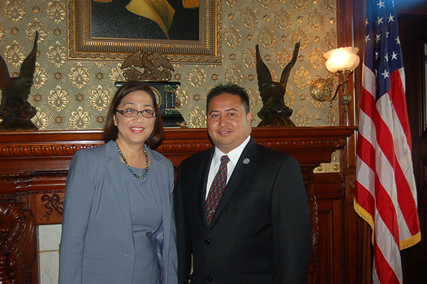
WASHINGTON, D.C. (January 17, 2017) – U.S. Special Representative Esther Kia’aina and the Commonwealth of the Northern Mariana Islands (CNMI) Special Representative, Governor Ralph Torres, transmitted the 902 Consultations Report to Congressional leaders today. The report is the culmination of eight months of official consultations, informal discussions, and site visits to locations in the CNMI, a U.S. territory in the Western Pacific region.
The 902 Consultations process began on May 19, 2016, when President Obama designated Esther Kia’aina, the Assistant Secretary for Insular Areas, as the U.S. Special Representative for 902 Consultations. These discussions are authorized by Section 902 of the Covenant to Establish the CNMI in Political Union with the United States of America. The U.S. and CNMI Special Representatives agreed to focus on two critical issues raised by the CNMI: (1) the expiration in 2019 of the CNMI-Only Transitional Worker (CW) program; and (2) proposed military activities in the CNMI.
The first meeting occurred at the White House on June 6, 2016, and was followed by mid-June site visits to the CNMI islands of Saipan and Tinian to see businesses and construction sites impacted by the limited number of foreign workers, facilities working to train and grow the U.S. worker population, and areas impacted by the expansion of military training. Meetings with elected officials and affected members of the community as well as the site visits, provided first-hand knowledge to the Special Representatives and their teams of the economic challenges facing the CNMI people, government, and private industry. This was followed by official 902 Consultations in August, September, October, and December, and an historic trip to the remote northern island of Pagan on September 30.
The consultations and site visits were the basis for this report which reflects the views of both the U.S. and the CNMI and concludes with recommendations that both sides agreed would help the CNMI transition to a U.S. workforce and help advance the national security concerns of the U.S. in the dynamic Asia-Pacific region.
On the issues of immigration and labor, the Special Representatives agreed to several recommendations for action to address the need for workers and a stable economy in the CNMI.
This included:
- Extending the CNMI-Only Transitional Worker (CW) Program Beyond 2019,
- Restoring the Executive Branch’s Authority to Extend the CW program with the U.S. Department of Homeland Security (DHS) as the lead department,
- Raising the CW Cap to 18,000 Increasing Foreign Workers allowed in the CNMI,
- Providing a Permanent Immigration Status for Long-Term Guest Workers,
- Considering Immigration Policies to Address Regional Labor Shortages in the CNMI and Guam,
- Extending Eligibility to the CNMI for federal Workforce Development Programs,
- Urging DHS to solicit information from stakeholders and interested parties in the CNMI on what regulatory changes should be made to the CW program in order to improve and better address the workforce needs of the CNMI, and
- Endorsing a Cooperative Working Relationship between DHS and the CNMI.
On the issue of proposed military activities in the CNMI, the Special Representatives and their teams reviewed the history of military activities in the CNMI, the original military plans for Tinian, and significant DoD projects in recent years (the Guam and CNMI Military Relocation Project, the Mariana Islands Training and Testing Project, the Air Force’s Divert Activities and Exercise Project, and the CNMI Joint Military Training Project (CJMT).
CNMI concerns focused on the:
(1) Potential Inconsistences between the CJMT and the CNMI Covenant, the Technical Agreement, and the 1983 Lease Agreement;
(2) Potential Impacts of the CJMT on the CNMI’s Economic Self-Sufficiency;
(3) The Need to Ensure Meaningful Opportunities for the CNMI to Participate in the Decision-Making Affecting the Commonwealth; and
(4) Appropriate Compensation for Military Activity on Farallon de Medinilla.
The Special Representatives, who credited the 902 Consultations process for strengthening relations between the U.S. Department of Defense (DoD) and the CNMI Government, recommended the creation of a CNMI/DoD Coordinating Council, which will institutionalize a process and improve communications and relations between DoD and the Commonwealth. This Coordinating Council addresses concerns by the CNMI that conversations with DoD should take place outside and beyond the required environmental analysis processes and gives territorial leaders a forum to engage in open communication to bridge disagreements and resolve issues.
The Special Representatives also agreed:
- To Identify Instances where Military Infrastructure Planning can be Coordinated with and Support Civilian Infrastructure Needs;
- That DoD will share the Framework for the Revised Economic Analysis as part of the CJMT Revised Draft Environmental Impact Statement (DEIS), and confer with the CNMI on the Draft Economic Analysis before the Revised DEIS is released;
- To make Economic Impacts an Agenda Item for future CNMI/DoD Coordinating Council discussions.
“It has been an honor to represent the United States for this process,” said U.S. Special Representative Esther Kia’aina. “This joint report reflects the strength of the U.S.-CNMI relationship and will provide federal policymakers in the Executive Branch and the Congress with a roadmap on how to best address important issues that have a tremendous impact on the economy and overall well-being of the CNMI people.”
“It was truly an honor to work alongside my federal government counterpart, Assistant Secretary Esther Kia'aina, in this significant endeavor for the people of the CNMI,” said CNMI Special Representative Ralph Torres. “I thank President Barack Obama for allowing the CNMI an opportunity to voice our concerns and have those concerns be incorporated into the Report's final recommendations. This is an important and historic event in our relationship with the Federal Government and is one that will continue to provide for greater understanding of the critical issues facing the CNMI going forward.”
Since the Covenant was fully implemented in 1986, several 902 Consultations have been initiated. This is the first known 902 Consultations to result in a report to the President that has been transmitted to Congress.
20 January 2017
Marianas Senate President wants reversal of support for U.S. marine sanctuary

Palacios wants Torres to rescind support of marine sanctuary
By Mark Rabago
Senate President Arnold I. Palacios (R-Saipan), who is currently the acting governor of the CNMI, opposes a proposal to overlay the Marianas Trench Marine National Monument with another protected designation—this time as a marine sanctuary—and wants Gov. Ralph DLG Torres to rescind his letter supporting the move.
“I’ve avoided talking publicly about it because after talking with the governor I found out late that he’s supporting this. But I have a totally different perspective…I want the governor to rescind his letter supporting the designation of the Marianas Trench Marine Monument into a marine sanctuary,” he said yesterday on Capital Hill.
“So what is that going to improve? Why is the marine monument, with supposedly all its restriction for conservation, can transpose to a better situation by making it and calling it now a marine sanctuary? What’s the difference?” he asked.
Palacios, who used to be a Lands and Natural Resources secretary and worked for years at the Division of Fish and Wildlife, said the Marianas Trench’s marine sanctuary designation would only build on what the marine monument designation successfully did to the people of the Marianas, which further restricted their rights to fish in the area, among others.
“What’s going to happen is the new proposal expands the boundary of the original monument. The island units will supposedly go all the way up to the 200-mile zone boundary instead of 50 miles. Right now, with the monument in the open oceanic areas you can still fish for pelagic fishes—migratory species like tuna in the water column. If the sanctuary kicks in, it proposes that we will no longer be able fish within the water column. So what is it are we trying to do here other than put restrictions and boundaries and expand these boundaries and call it now a marine sanctuary.”
Torres and Delegate Gregorio Kilili C. Sablan (Ind-MP) wrote to President Barrack Obama in September 2016 requesting that the government start the sanctuaries process for the Marianas Trench Marine National Monument through the Sanctuaries Program of the National Oceanic and Atmospheric Administration.
According to the Pew Bertarelli Ocean Legacy project, becoming a national marine sanctuary would provide the monument with a more robust conservation and management profile as well as bring more resources for education and community engagement in the Northern Mariana Islands.
It said the CNMI Legislature has written to the President in support of the governor and the delegate’s request, as has nearly every other elected official in the Commonwealth.
Last month, Marianas Conservation member John Gourley wrote to Obama to dissuade the outgoing president from designating the Mariana Trench as a marine sanctuary on top of being a national monument.
In his letter Gourley said once the Mariana Trench is declared a marine sanctuary on top of being a marine national monument, it will require those who wish to fish or mine in the area to obtain permission from the federal government twice—one for the trench being a national monument and another for the trench being a marine sanctuary.
Subscribe to:
Posts (Atom)