02 October 2015

Declaration of the 3rd World Social Science Forum


Council for the Development of Social Science Research in Africa 
Conseil pour le développement de la recherche en sciences sociales en Afrique 
Conselho para o Desenvolvimento da Pesquisa em Ciências Sociais em África 
مجلس تنمية البحوث الإجتماعية في أفريقيا 


Hosted in Durban, South Africa, the World Social Science Forum 2015 took place against the backdrop of multiple transitions that affect global governance, resource utilisation, social relations and quality of life leading to increased global inequalities. The Forum is the most significant gathering of scholars and policy-oriented intellectuals drawn from all the regions of the world and across different disciplinary interests in the social sciences and humanities.

It serves as a platform for presenting new knowledge and insights, re-thinking received wisdom, charting new directions, promoting innovation in the research-policy-action nexus, and nurturing new international partnerships.

Issues of justice and growing inequalities at global, regional, national and local levels and their impact on the quality of life of populations as well as on the sustainability of resources justifies the theme for the 2015 World Social Science Forum “Transforming Global Relations for a Just World”. The theme built upon critical issues that permeated debates during both the 2009 and 2013 editions of the Forum which focused respectively on the themes “One Planet – Worlds Apart” (2009) and “Social Transformations and the Digital Age” (2013) and addressed issues of power asymmetries, injustices, disparities, disjunctions and the divide that pervaded contemporary global realities.

Organized by the International Social Science Council together with the co-hosts – the Council for the Development of Social Science Research in Africa and the Human Sciences Research Council under the patronage of UNESCO – the Forum shone a spotlight on the nature and dimensions of injustice and inequality, including:

1. Macroeconomic policy choices and their impact;

2. The extent and consequences of income and asset inequalities;

3. Inequity in global governance, where the views of the majority of states are excluded in making major decisions regarding global affairs in various institutions and fora;

4. Agreed international legal instruments that uphold human rights are not fully implemented;

5. The impact of inequality in terms of patterns of production and consumption influencing the sustainability of resources;

6. The impact of gender, race and class inequalities, as manifested in unequal access to education, health, resources, employment and other social benefits;

7. Generational inequalities that exclude a majority of the youth and the elderly;

8. Wage inequalities and labour unrest;

9. Poverty and experiments in combating inequality; and

10. Lessons learned from the action of social movements, civil society, and governments, as well as policies, programs, and best practices. Over 1000 people from 84 countries came together in Durban, South Africa to share their experiences on research undertaken in the areas of injustice and inequality and to analyse the impact of these scourges. The Forum brought together leading thinkers and policy makers from around the globe with the objective of furthering collective understandings of inequalities for the purpose of addressing injustice. Participants addressed the trends, magnitude, nature, causes, manifestations and drivers of inequalities and injustices. This encompassed not just issues such as access to basic services including water, sanitation, health, education, and housing, relations among peoples, and overall quality of life, but also the national and international processes that generate inequality. The Forum provided a platform for seeking solutions to and effective strategies for these injustices and sharing experiences among people from the different countries.

The Forum also enabled participants to witness local manifestations of inequality in Durban, South Africa as well as the efforts of non-governmental and community based organizations to address injustice and inequality. Participants learned and shared lessons that can be adapted to different settings.

Inspired by this experience, we, the participants of the 2015 World Social Science Forum held on the 13-16 of September, 2015 in Durban, South Africa under the theme of “Transforming Global Relations for a Just World,” are concerned with the consequences of injustice and inequality for the quality of life for global populations as well as with the sustainability of global resources. 

As a result, we declare that we shall:

(a) Pursue theoretical and empirical research including development of reliable and multi-dimensional indicators on inequalities and injustices;

(b) Produce evidence to highlight issues requiring urgent attention and action, support advocacy and inform policies to respond to them;

(c) Support efforts to address asymmetries, disparities, divides, and lack of autonomy in knowledge production through the creation of transformative knowledge programs;

(d) Participate in programs and efforts that aim to end injustice and inequality;

(e) Make every effort to reduce income inequalities and promote equity, starting with scientific institutions where we have influence;
(f) Support measurable progress to overcome inequalities, including through the implementation of the Sustainable Development Goals;

(g) Promote policies, programs, and values that act to end gender inequality;

(h) Promote the integration of youth in work places through providing them with the
necessary skills to enter the labour force;

(i) Support efforts to achieve legally binding and universal agreement on avoiding
dangerous anthropogenic interference with the climate system; and

(j) Promote inclusive societies based on universal values and human rights.

The World Social Science Forum and the World Social Science Report advances social science research and awareness of these issues.

We believe that together, bolstered by our social science knowledge, skill and power, we will contribute to end injustice and inequality globally, regionally and locally as well as in our own work and home spaces.


01 October 2015

Statia meets with UN, starts process for more autonomy

The Daily Herald
page3a109
NEW YORK/ORANJESTAD--The St. Eustatius Government delegation that met with the United Nations (UN) Decolonisation Committee in New York this week has decided to proceed with the process to gather international support for the island to be placed back on the list of Non-Self-Governing Territories (NSGTs). Drafting a St. Eustatius Constitution is part of that process.

Also, a white paper on St. Eustatius’ present status as a Small Island Developing State (SIDS), including examples of the Dutch Government’s neglect of its responsibilities, will be prepared, as well as a draft UN resolution for re-inscription on the list of NSGTs.

The Statia delegation that met with the UN this week consisted of Commissioner of Constitutional Affairs Reginald Zaandam, Progressive Labour Party (PLP) party leader and Island Council Member Clyde van Putten, and United People’s Coalition (UPC) leader in the Island Council Reuben Merkman and advisor Xavier Blackman. 

During the constructive exploratory consultations at the UN in the past days, the delegation discussed the process of having St. Eustatius placed back on the list of NSGTs with a number of Member States, stated a press release on Wednesday.

“St. Eustatius will continue to garner regional and hemispheric support for re-inscription. During the process, the Netherlands will also be included in the consultations. Now that the delegation has been able to personally present and extensively explain Statia’s case to UN Member States, the process of developing regional and hemispheric support can be expedited and formalised,” the delegation stated.

Furthermore, a framework for a St. Eustatius Constitution as a more autonomous entity in relation to the Netherlands will be drafted, it was announced. This Constitution will be prepared with the assistance of experts on decolonisation and will be submitted to the Statia people for consultation purposes.

The delegation took its case regarding the constitutional change and decolonisation process to the UN based on four positions, with the backing of an Island Council motion that was adopted on May 28, 2015.

The first position is that the Netherlands has not complied with resolutions 1514, 1541, and 2526 of the UN Charter since 1954 and during the dismantling process of the Country the Netherlands Antilles.

According to the delegation, this non-compliance also has been argued by legal scholars like Steven Hillebrink, Charlotte Duijf and Afred Soons in their publications, and is supported by a motion of Parlatino as well.

“Non-compliance with these resolutions means that the process of decolonisation of the former colonies of the Netherlands has not been completed as yet, and that the colonies were unjustly removed from the list of NSGTs by the UN when the Charter of the Dutch Kingdom was ratified.”

The second position is that the Netherlands has not given proper content to the constitutional wishes of the Statia people, seeing that they have never voted for integration into the Netherlands. Hillebrink, Duijff and Soons have confirmed this position as well.

“The third position is that the Netherlands continues to abuse its position as (former) colonising power, violating basic human rights and unlawfully interfering with the local political process in St. Eustatius in a biased manner,” it was stated.

“A number of examples have already been clearly outlined by Commissioner Zaandam and include the boycott of St. Eustatius by the Dutch Government and the cutting of formal communication lines between appointed governing officials, imposing supervision without a proper motivation, and a subliminal public relations campaign emphasising presumably positive results of the Dutch policies and actions on the other two Caribbean Netherlands islands.

“Basically, the Dutch Government and their local allies are telling the Statia people that as long as its lawfully elected government dares to question the Dutch Government, look out for the best interest of its people and does not roll over and play dead, the island and its population will be punished by The Hague for not giving in to all its demands,” the delegation stated.

Fourth, St. Eustatius wishes to negotiate and achieve a change of its constitutional relationship with the Netherlands based on the different referenda that were held.

“This change can be accomplished by completely revising the outdated and impractical Kingdom Charter to accommodate the right to self-determination of all the Caribbean territories, and address issues like the democratic deficit and dispute resolution within the Kingdom. Solving these issues will benefit all that are involved, including the Netherlands.”

Based on these positions, St. Eustatius wishes to be (re)inscribed as a NSGT until such time that the decolonisation process has been completed and/or all issues pointed out have been resolved in a satisfactory manner, the delegation made clear.

A recent example of successful re-inscription is the case of French Polynesia. This precedent has created the opportunity for St. Eustatius to seek support for its cause, starting with a meeting between Councilman van Putten and Prime Minister of St. Vincent and the Grenadines Ralph Gonsalves earlier this year.

“Statia’s coalition government will continue to protect the best interests of the island and its population in the broadest sense of the word. To achieve sustainable social-economic development and a prosperous future for the entire population and not just a happy few, the constitutional challenges need to be addressed first and foremost.

“During its visit to New York, the delegation has laid the groundwork for doing so and as such the objective of the visit has been achieved.” The delegation thanked its advisers and everyone at home and abroad who support Statia’s “quest for justice and fairness, and the improvement of the well-being of its citizens.”


30 September 2015

Two non-independent territories to take governance concerns to the UN


News and commentary on Caribbean culture, literature, and the arts 


A post by Peter Jordens


Two non-independent territories in the Caribbean were recently in the news for announcing their intentions to petition the United Nations as part of their efforts to seek increased constitutional autonomy.

St Eustatius, a Dutch overseas municipality of the Netherlands, has visited the United Nations Decolonization Committee in New York, seeking to be included on the list of Non-Self-Governing Territories that are monitored by the Committee.

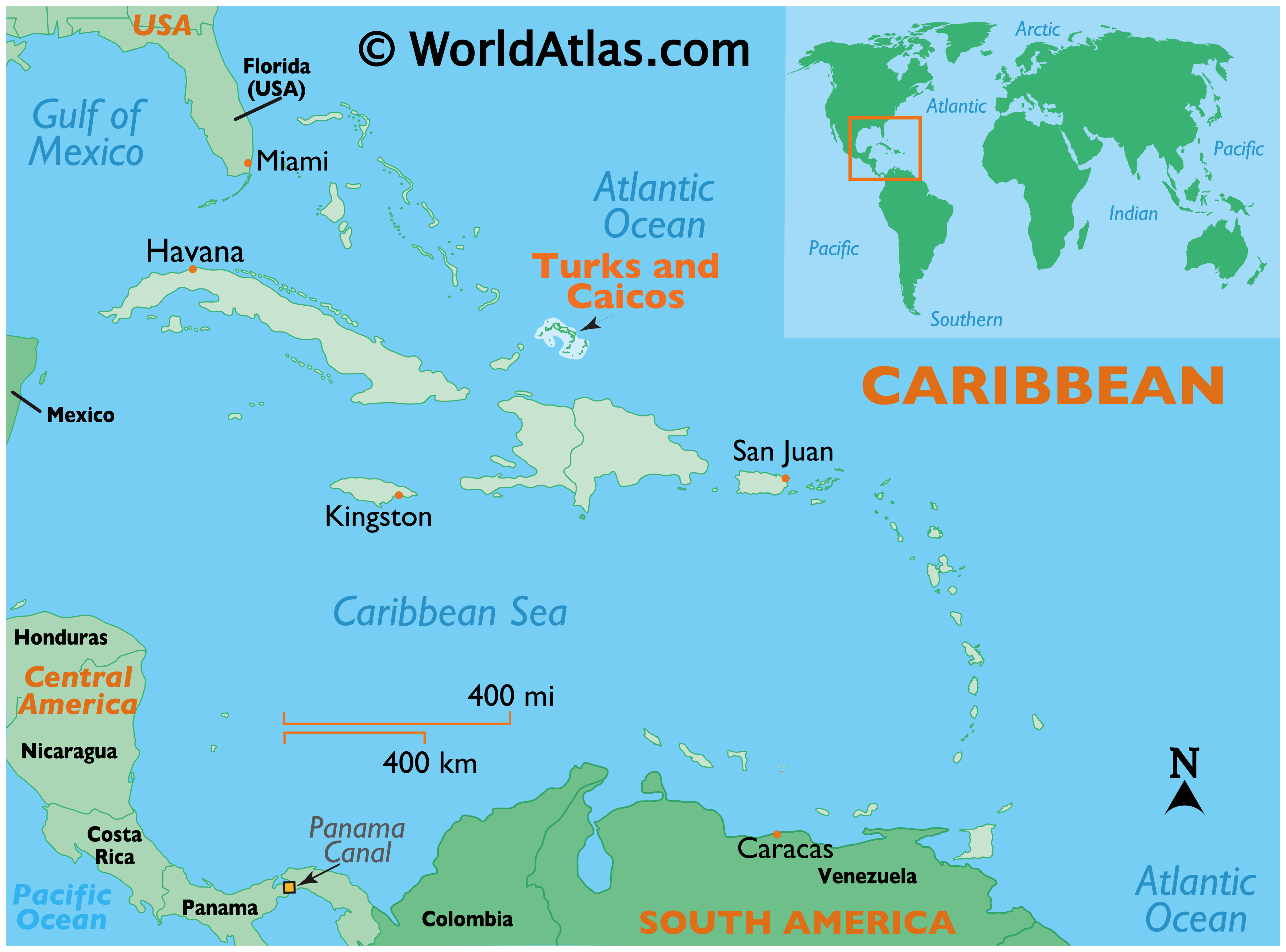
Meanwhile, the Turks and Caicos Islands, a British overseas territory, have announced their intent to approach the UN Decolonization Committee to air their concerns about the United Kingdom’s refusal to return constitutional democracy to the territory.


29 September 2015

Okinawa Governor, in UN Human Rights Council address, opposes U.S. base construction

Gov. Onaga gives speech at UN calling for stop to US Henoko base construction

Gov. Onaga gives speech at UN calling for stop to US Henoko base construction
Governor Takeshi Onaga describes how human rights are being neglected in Okinawa (September 21, UN Human Rights Council, Switzerland)

Ryukyu Shimpo Ryota Shimabukuro reports from Geneva
On September 21, shortly after 5:00 p.m., Governor Takeshi Onaga gave a speech at the United Nations Human Rights Council in Geneva, Switzerland, speaking about the fact that Okinawans do not agree to the new base construction being carried out by the governments of Japan and the U.S. in Henoko, Nago, and arguing to the international community that the forceful implementation of the base construction plans constitutes a violation of human rights and must be stopped by any possible and legitimate means. Governor Onaga called upon the international community, stating, “I would like the world to pay attention to Henoko, where Okinawans’ right to self-determination is being neglected.”
It was the first time a prefectural governor from Japan gave a speech at the UN Human Rights Council. Governor Onaga emphasized that the overwhelming burden of military bases being shouldered by the Okinawan people is a human rights issue, hoping that rising criticism at home and abroad will prevent the new base from being constructed.
Governor Onaga emphasized the unjust nature of the demand by the U.S. and Japanese governments that a replacement facility be built within Okinawa in order for Futenma to be closed, stating, “After World War II, the US military took our land by force…we have never provided our land willingly.”
He also stated, “Okinawa only covers 0.6% of Japan. However, 73.8% of US exclusive bases in Japan exist in Okinawa. Over the past seventy years, US bases have caused many incidents, accidents, and environmental problems in Okinawa.” Based on this, he concluded, “Our right to self-determination and human rights have been neglected.”
Governor Onaga also mentioned the fact that candidates opposing the construction of a new base in Henoko won a series of important elections last year, including the gubernatorial election, the Nago mayoral election, and the lower house election. He announced his determination to prevent the base construction, stating, “I am determined to stop the base construction using every possible and legitimate means.”
(Translation by T&CT and Sandi Aritza)


******


Historical Highlights of Okinawa’s Hardships, Debating Base Issues at UN Symposium

Historical Highlights of Okinawa's Hardships, Debating Base Issues at UN Symposium

September 22, 2015 Ryukyu Shimpo Ryota Shimabukuro reports from Geneva
On the morning of September 21, the symposium Militarization and Human Rights Violations in Okinawa opened at the United Nations European Headquarters in Geneva, Switzerland. Governor Onaga spoke first at the symposium for about 20 minutes, mentioning that Okinawa was once an independent nation before its annexation by Japan. Now, after the Battle of Okinawa that claimed 200,000 victims, looking back on the 70-year span of an overwhelming base burden on Okinawa, he claims that Okinawan people’s freedom, equality, human rights, democracy, and right of self-determination are being disregarded.
The symposium was jointly hosted by Shimin Gaiko Centre (Citizens’ Diplomatic Centre for the Rights of Indigenous Peoples), the International Movement Against All Forms of Discrimination and Racism (IMADR), and the Shima Gurumi Association, among others. The issues of carrying out construction of the new base in Henoko were discussed through the lens of human rights, the environment, and other such aspects.
Co-representative of Citizens’ Network for Biodiversity in Okinawa, Hideki Yoshikawa, said that the process of conducting environmental impact assessments of the new base construction has been harshly criticized by experts as “the worst in Japan’s history,” among other such critiques. He said he wishes for scientists and experts around the world to investigate the impact that new base construction will have on the people and environment of Okinawa.
Hideaki Uemura, president of Shimin Gaiko Centre, introduced particulars about the United States’ tie to the Ryukyu Kingdom by the Treaty of Amity, its silence over Japan’s annexation of the Ryukyu Islands, and Okinawa’s militarization under direct U.S. control after the Battle of Okinawa. He presented that after Okinawa’s return to Japan, the U.S. expanded and strengthened its bases in Okinawa, meanwhile allowing its actions to fall under the shadow of the Government of Japan. Liability for Okinawa’s situation also falls heavily on the U.S., Uemura attested.
Yoshikazu Shiohira, Chief Editor of Ryukyu Shimpo, reported that cases have been occurring in which city residents protesting construction of the new base come to be in scuffles with and are arrested by police. Reflecting on another case in which a coast guard officer overreached his duty and restrained a citizen by straddling her, he said these behaviors undermine freedom of expression, freedom of assembly, and freedom of the press. He asserted that as Okinawan people do not condone new base construction, the construction should certainly be ceased.
(English translation by T&CT and Erin Jones)

28 September 2015

Rapanui decolonisation discussed at U.N. Human Rights Council

Santi Hitorangi at UNHRC


(Friday, Sept 18, 2015) the United Nations Human Rights Council continued general debate on the promotion and protection of all human rights.


Santi Hitorangi and the Indian Law Resource Centre questioned the legitimacy of Chile’s control over the Rapa Nui people, including their natural resources, and voiced concerns over human rights violations against Rapa Nui people. It called on the international community to ensure the Rapa Nui right to self-determination.


*****

RAPA NUI LEADERS SEEK PROTECTION FROM CHILE ARMED FORCES

The Indian Law Resource Center

WASHINGTON, D.C. -- Renewed tension between the Rapa Nui people and the Chilean government has prompted the Indian Law Resource Center to file a request for protection orders on behalf of the Rapa Nui clans with an international human rights body.

“In the last two weeks, four prominent Rapa Nui leaders were unjustly arrested and jailed for trying to exercise their right of self-determination and their right to protect their sacred sites,” said Leonardo Crippa, senior attorney in the Center’s Washington, D.C. office. “The repressive measures aimed at disabling the Rapa Nui Parliament must stop.”

The Center has asked the Inter-American Commission on Human Rights (IACHR) to reissue precautionary measures to protect the Rapa Nui peoples’ right to life, their right to liberty and to protect their basic human rights. In 2010, the Commission granted precautionary measures under similar circumstances to protect Rapa Nui leaders from violent evictions by the Chilean government and opened an investigation regarding human rights violations. Those measures were allowed to lapse after negotiations began between the Rapa Nui Parliament and the Chilean government. In March 2015, negotiations broke down and the Rapa Nui Parliament assumed management of their own resources to protect and preserve their sacred sites.

“Chile treats the Rapa Nui as sub-human and without rights,” said Santi Hitorangi, a member of the Hito Clan, as he described the tension on Easter Island. “The fact that the state has named our ancestral sites as a national park for their entertainment shows the degree of disrespect that exists between Chile and the Rapa Nui people.”

The Rapa Nui island, commonly known as Easter Island, is in the southeastern Pacific Ocean and is called a special territory of Chile, annexed in 1933 without the consent of the Rapa Nui people. Most of the 36 Rapa Nui clans have been engaged in a collective effort to recover their ancestral lands, protect sacred sites, and exercise their right of self-determination.

The IACHR’s mission is to promote and protect human rights. As an organ of the Organization of American States, the Commission has the authority to hold countries such as Chile accountable for human rights abuses. A decision by IACHR on reissuing precautionary measures could come within a few months.

###
Contact: Ginny Underwood gunderwood@indianlaw.org +1-405-229-7210

The Indian Law Resource Center is a non-profit law and advocacy organization established and directed by American Indians. The Center is based in Helena, Montana, and also has an office in Washington, D.C. The Center provides legal assistance without charge to Indian nations and other indigenous peoples throughout the Americas that are working to protect their lands, resources, human rights, environment and cultural heritage. The Center’s principal goal is the preservation and well-being of Indian and other Native peoples. For more information, please visit us online at www.indianlaw.org orwww.facebook.com/indianlawresourcecenter.


24 September 2015

Okinawans appeal to United Nations Environment Programme

Futami residents demand government stop new US base construction and respect letter from UN Environment Programme

Futami residents demand government stop new US base construction and respect letter from UN Environment Programme
On July 30, Fujiko Matsuda and members of the Association of Residents of the Districts North of Futami delivered a petition to staff of the Ministry of Environment at the Lower House Diet Members' Office.

On July 30, residents of Teima, Nago and the Association of Residents of the Districts North of Futami demanded the Ministries of Environment, Foreign Affairs and Defense stop construction of a new U.S. base in Henoko, Nago. They sent a letter highlighting that the UN Environment Programme (UNEP) has stressed that the ecosystem in Oura Bay should be protected.
After meeting with officials of the three ministries, the association president Fujiko Matsuda and other members held a press conference in the Diet building. Matsuda pointed out that the Ministry of Environment did not include Oura bay in its dugong habitat investigation, and that the Ministry of Defense reported noise predictions lower than the value observed by the Nago municipal government.
She said, “The Ministry of Environment has no sense of responsibility, despite its critical mission to protect the environment.” A ministry official said they have not yet received a letter from UNEP, which has also written to the government to stress the importance of protecting Oura Bay.
The residents of Teima and the Association of Residents of the Districts North of Futami urged UNEP to put pressure on the Japanese government to block the construction of the new U.S. base in order to protect the environment in March. The UNEP Regional Office for Asia Pacific replied in a letter: “We understand the importance of habitat protection for endangered species such as the dugong. We share your concerns and would like to convey that to the Ministry of Environment in Japan.”
(English translation by T&CT, Hitomi Shinzato)  

22 September 2015

Sint Eustatius seeks U.N. support against Dutch colonial practices

Statia takes its cause to the UN


A four-member Statia delegation will be meeting with the United Nations’ Decolonisation Committee this week in an effort to seek the support of international organisations such as the UN to intervene on the island’s behalf in the struggle with the Dutch Government for more autonomy and the right of self-determination.
page3a106

Commissioner of Constitutional Affairs Reginald Zaandam was very clear as he was about to leave for New York on Saturday: The Netherlands, as Statia’s mother country has a responsibility and duty to work with St. Eustatius, and not to put up stumbling blocks and even boycott the public entity.

“The UN must be made aware of the fact that while the Netherlands made billions of euros available to Greece through the European Union, of which it is certain that 90 per cent or more will be written off, The Hague uses all sorts of petty reasons and excuses to substantiate as to why they cannot provide our people with the same living standard as those living in the Netherlands and why they cannot spend a couple of 100 million euros to eradicate the deprivation in the Caribbean part of the Kingdom,” Zaandam told The Daily Herald.

“We had sincerely hoped that the Netherlands would have assisted in finding ways to help the islands to foment economic growth. But I have come to believe that they rather keep us as beggars because that way they can freely execute their neo-colonial policies,” he said.

The Commissioner accused The Hague of treating the refugees better than the Statia residents. “Imagine refugees obtain the rights to the many (social) provisions available in the Netherlands, under the denominator humanitarian support, in comparison to our people that are kept to a bare minimum.”

He said it was “unacceptable” that refugees were being treated better than people with a Dutch passport living in the Caribbean part of the Kingdom. “One wonders if we should not opt for the refugee status.”

Referring to the history of St. Eustatius and its prosperous times in the 18th century, Zaandam said, “It is a bloody shame that The Hague neglects the obligation to credit St. Eustatius for a substantial part of the wealth they are enjoying now. After all, St. Eustatius was sacrificed in too many ways to mention in the Dutch interest.”

Zaandam said that he hoped to make the UN aware of the unbecoming practices of the Netherlands. “Hopefully this international organisation will see the unsupported and strong manipulated side of the Dutch in its behaviour where it comes to dealing with the decolonisation process.”

The Statia delegation, which besides Zaandam consists of Members of the Island Council Clyde van Putten (PLP) and Reuben Merkman (UPC), and advisor Xavier Blackman, will also table arguments to convince the UN Decolonisation Committee to place St. Eustatius back on the UN’s list of Non-Self-Governing Territories in accordance with Chapter XI of the UN Charter.

Zaandam explained that being on this list guaranteed that the island’s interests as occupant of the dependent territory St. Eustatius was paramount and required the Netherlands as a member state in control of the island, as a non-self-governing territory, to submit annual information reports concerning Statia’s development.

In so doing, an appeal upon the UN will be made to call the Netherlands to task regarding human rights, the fostering of social and economic development in St. Eustatius and to facilitate the decolonisation process without duress, the Commissioner added.

Noting that coming of age was generally a complex, hard process, Zaandam said that this phase, as part of the decolonisation process, besides being time consuming and challenging, required planning, understanding and especially commitment.

“There are enough examples in the world that portrays these struggles. Most of them are accompanied and accomplished by war and are laced with blood. People paying with their lives and blood for a better life in an accepted constitutional status. Often enough, it is the colonial mother country that does not want to let go and places hindrances just to be able to maintain their neo-colonial agenda.”

According to Zaandam, history was testament to the fact that the first and most difficult step in the decolonisation process took commitment. “After this step, the point of no return is passed and there is no going back. The Hague knows that. The first martyr in this process was Mr. Ricardo Tjie-A-Loi.”

Subsequently St. Eustatius was confronted with an instruction to get its finances in order and to improve the quality of the public administration. “On top of that The Hague secretly put a boycott in place. In first instance, this boycott only related to visits of dignitaries. But the reality proved to be different. All channels to the Dutch ministries have been bogged down and we are compelled to do everything through the office of the Rijksvertegenwoordiger (Kingdom representative).”

But, Zaandam warned, “The Hague must know that the words giving up were not in the vocabulary of the current government coalition. Furthermore, we are giving them notice that we are shedding our cocoon of “wie betaalt, bepaalt” (whoever pays, determines the outcome). It is our island, so anything regarding us will be done with our integral input.”

Breaking the Media Blackout in Western Sahara


Moroccan security forces charge against a group of Sahrawi women in Laayoune, occupied Western Sahara. Credit: Courtesy of Equipe Media

LAAYOUNE, Occupied Western Sahara,  (IPS) - Ahmed Ettanji is looking for a flat in downtown Laayoune, a city 1,100 km south of Rabat. He only wants it for one day but it must have a rooftop terrace overlooking the square that will host the next pro-Sahrawi demonstration.

“Rooftop terraces are essential for us as they are the only places from which we can get a graphic testimony of the brutality we suffer from the Moroccan police,” Ettanji told IPS. This 26-year-old is one the leaders of the Equipe Media, a group of Sahrawi volunteers struggling to break the media blackout enforced by Rabat over the territory.

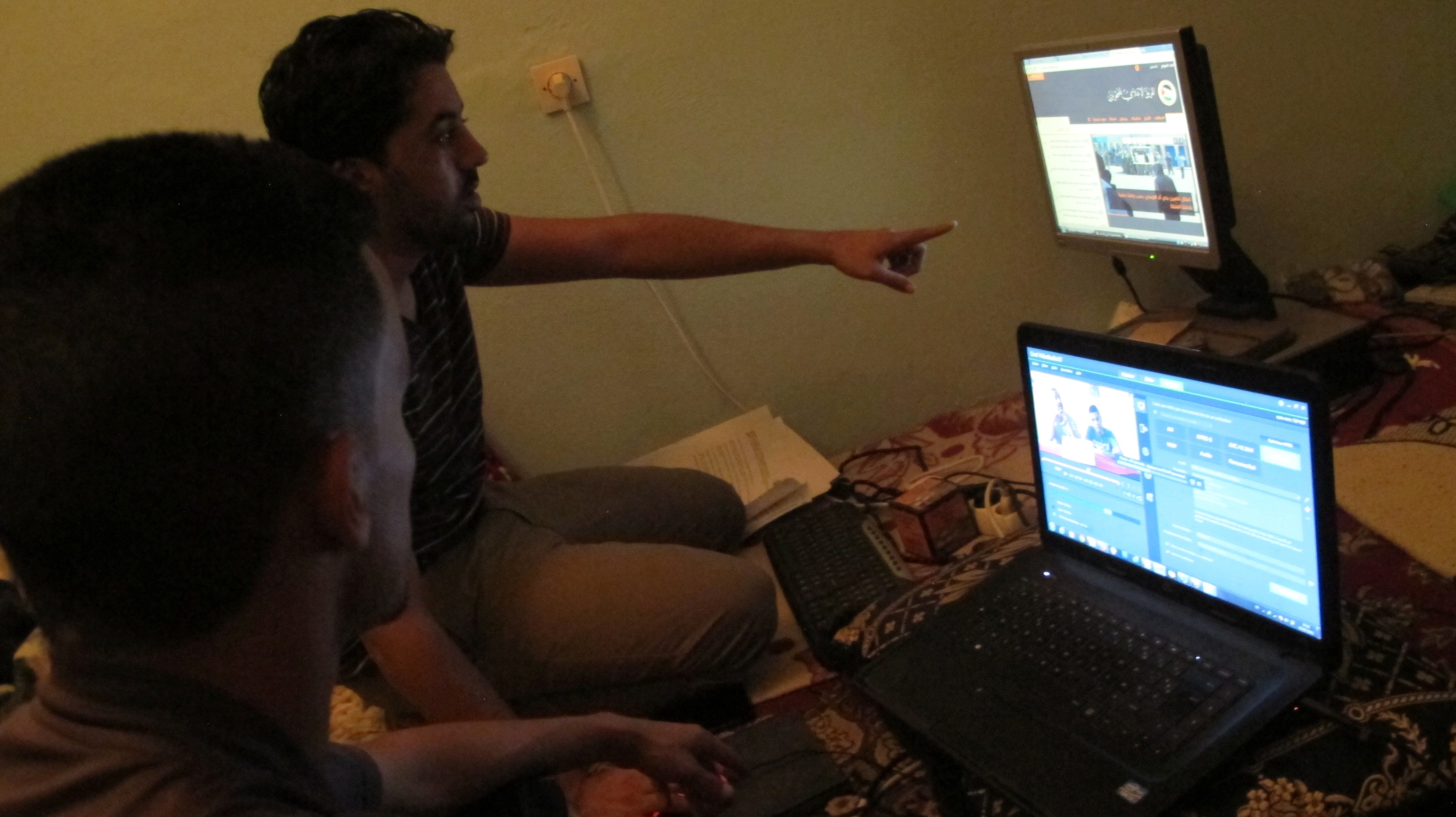
Ahmed Ettanji and a fellow Equipe Media activist edit video taken at a pro-independence demonstration in Laayoune, occupied Western Sahara.

Credit: Karlos Zurutuza/IPS
“There are no news agencies based here and foreign journalists are denied access, and even deported if caught inside,” stressed Ettanji.

Spanish journalist Luís de Vega is one of several foreign journalists who can confirm the activist´s claim – he was expelled in 2010 after spending eight years based in Rabat and declared persona non grata by the Moroccan authorities.

“The Western Sahara issue is among the most sensitive issues for journalists in Morocco. Those of us who dare to tackle it inevitably face the consequences,” de Vega told IPS over the phone, adding that he was “fully convinced” that his was an exemplary punishment because he was the foreign correspondent who had spent more time in Morocco.

“The Western Sahara issue is among the most sensitive issues for journalists in Morocco. Those of us who dare to tackle it inevitably face the consequences” – Spanish journalist Luís de Vega.

This year will mark four decades since this territory the size of Britain was annexed by Morocco after Spain pulled out from its last colony of Western Sahara.

Since the ceasefire signed in 1991 between Morocco and the Polisario Front – the authority that the United Nations recognises as a legitimate representative of the Sahrawi people – Rabat has controlled almost the whole territory, including the entire Atlantic coast. The United Nations still labels Western Sahara as a “territory under an unfinished process of decolonisation”.

Mohamed Mayara, also a member of Equipe Media, is helping Ettanji to find the rooftop terrace. Like most his colleagues, he acknowledges having been arrested and tortured several times. The constant harassment, however, has not prevented him from working enthusiastically, although he admits that there are other limitations than those dealing with any underground activity:

“We set up the first group in 2009 but a majority of us are working on pure instinct. We have no training in media so we are learning journalism on the spot,” said Mayara, a Sahrawi born in the year of the invasion who writes reports and press releases in English and French. His father disappeared in the hands of the Moroccan army two months after he was born, and he says he has known nothing about him ever since.

Sustained crackdown

Today the majority of the Sahrawis live in the refugee camps in Tindouf, in Western Algeria. The members of Equipe Media say they have a “fluid communication” with the Polisario authorities based there. Other than sharing all the material they gather, they also work side by side with Hayat Khatari, the only reporter currently working openly for SADR TV. SADR stands for ‘Sahrawi Arab Democratic Republic’.

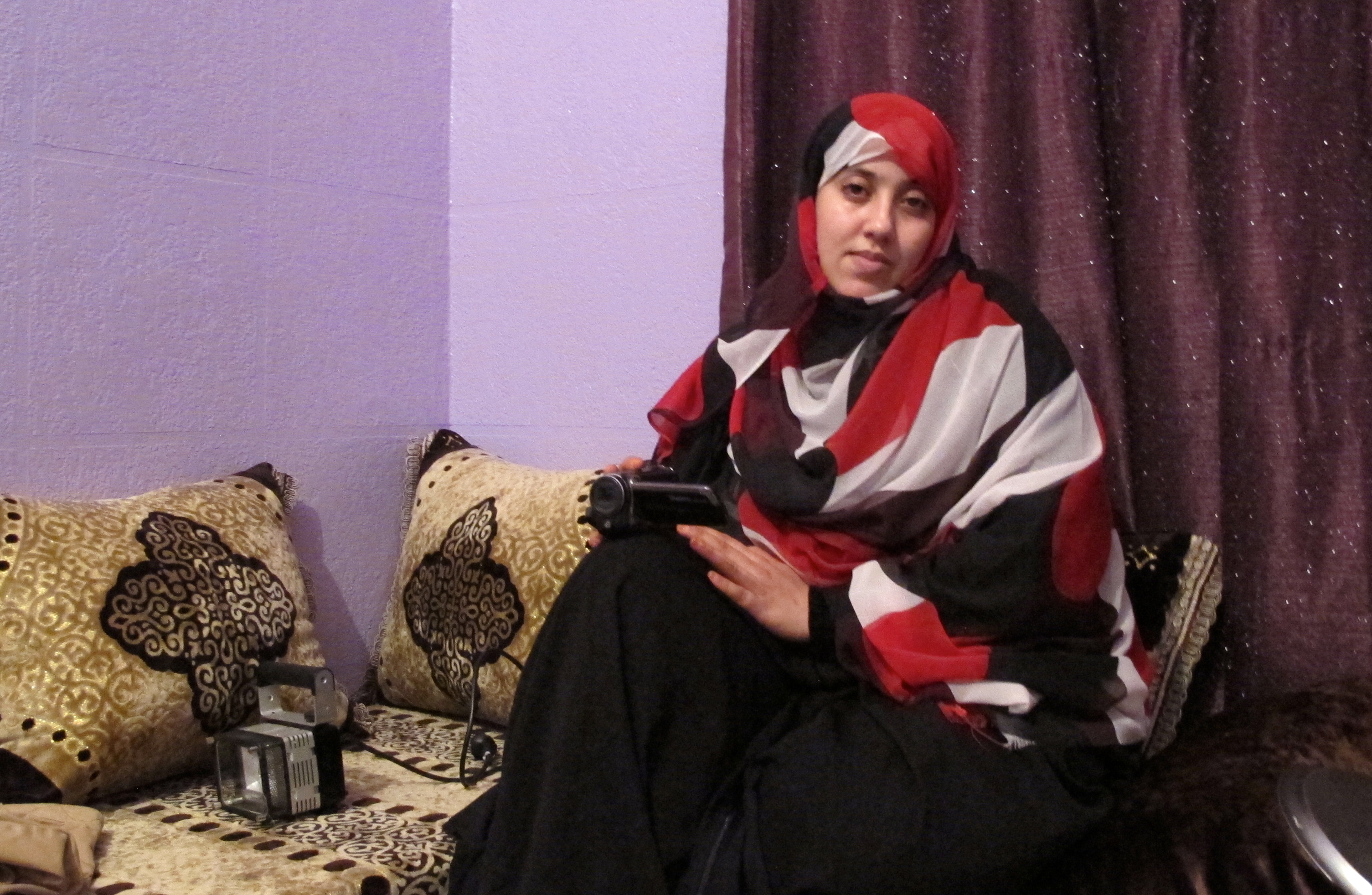
Hayat Khatari, the only reporter currently working openly
 for SADR TV in Laayoune. Credit: Karlos Zurutuza/IPS

Khatari, a 24-year-old journalist, recalls that she started working in 2010, after the Gdeim Izzik protest camp incidents in Laayoune. Originally a peaceful protest camp, Gdeim Izzik resulted in riots that spread to other Sahrawi cities when it was forcefully dismantled after 28 days on Nov. 8.

Western analysts such as Noam Chomsky have argued that the so-called “Arab Spring” did not start in Tunisia as is commonly argued, but rather in Laayoune.

“We have to work really hard and risk a lot to be able to counterbalance the propaganda spread by Rabat about everything happening here,” Khatari told IPS. The young activist added that she was last arrested in December 2014 for covering a pro-independence demonstration in June 2014. Unlike Mahmood al Lhaissan, her predecessor in SADR TV, Khatari was released after a few days in prison.

In a report released in March, Reporters Without Borders records al Lhaissan´s case. The activist was released provisionally on Feb. 25, eight months after his arrest in Laayoune, but he is still facing trial on charges of participating in an “armed gathering,” obstructing a public thoroughfare, attacking officials while they were on duty, and damaging public property.

Related IPS Articles


In the same report, Reporters Without Borders also denounces the deportation in February of French journalists Jean-Louis Perez and Pierre Chautard, who were reporting for France 3 on the economic and social situation in Morocco.

Before seizing their video recordings and putting them on a flight to Paris, the authorities arrested them at the headquarters of Moroccan Association of Human Rights (AMDH), one of the country’s leading human rights NGOs, which the interior ministry has accused of “undermining the actions of the security forces”.

Likewise, other major organisations such as Amnesty International and Human Rights Watch have repeatedly denounced human rights abuses suffered by the Sahrawi people at the hands of Morocco over the last decades.

Despite several phone calls and e-mails, the Moroccan authorities did not respond to IPS’s requests for comments on these and other human rights violations allegedly committed in Western Sahara.

Back in downtown Laayoune, Equipe Media activists seemed to have found what they were looking for. The owner of the central apartment is a Sahrawi family. It could have not been otherwise.

“We would never ask a Moroccan such a thing,” said Ettanji from the rooftop terrace overlooking the spot where the upcoming protest would take place.

Edited by Phil Harris


21 September 2015

Turks and Caicos Islands requests U.N. assistance to end British colonialism


TCI to petition United Nations on UK’s refusal of constitutional changes

THE TURKS and Caicos Islands Government has signalled its intention to head to the United Nations Committee to air their concerns about the United Kingdom’s refusal to accept proposed constitutional changes.

Speaking at a town hall meeting on Monday, September 7, Premier Rufus Ewing called on members of the public and the Opposition to join the Government in its petition to the international body.

He told the gathering that the issue has to be taken to the international arena, as the world needs to understand that the United Nations Convention is being violated by the United Kingdom government.

"We have another opportunity to state our case to the United Nations Committee because we have had invitations and I will extend that invitation to the Opposition and members of the public who would like to petition the UN.

"We were invited to submit our petition about our concerns such as the refusal to give constitutional advancement and we as a Government will take up that opportunity and I am inviting the Opposition members and any other member who would like to attend that meeting to rally and petition the UN because that is the only way we are going to get true representation in this country,” Ewing urged.

He added that the TCI cannot look to the British for representation, as they are conflicted.

"We have to represent ourselves with the help of others other than the UK government.”

The Premier stated that there needs to be a constitution so that the Government can do what the people elected them to do and one which will ensure that they can govern properly.

He said it does not matter which party is in power, the same problems will exist.

"For the United Kingdom to have an election, let a Government come into power and still does not trust that Government to make decisions for themselves and on behalf of the people, is not democracy.

"So for the UK government to deny and have no interest whatsoever – outrightly, blanketly and categorically state that no I am not interested in changing anything in that constitution is indeed a slap in the face of democracy and all Turks and Caicos Islanders.”

He noted that everyone knows what the UK’s trepidation is, but that the country needs to rally together to demand the changes they made an effort and a sacrifice to put together.

"It is important that we stand together on the issue of constitutional advancement and constitutional reform, it is important that we do so.”

He added that he and the Leader of the Opposition have agreed to sit and plot a way forward,
as well as put together a bipartisan team to go the UK to sit with the Foreign and Commonwealth Office and Members of Parliament to show them why it is necessary for the TCI to get what the people asked for.

"Every time I go to the Governor his usual question is - this is what they say, this is the constitution that you have if you don’t like it you can call a referendum.

"So I am telling you that we have to push and push at this door until that time comes and if you think that you have had enough and we think we have had enough then that is an option that we have to strongly consider and make a decision as Turks and Caicos Islanders,” the Premier advised.

He noted that it is not his decision alone, but the decision of all Turks and Caicos Islanders.

*****


(Left) Minister of Finance Hon. Washington Misick (Right) Premier Hon. Dr. Rufus Ewing

Mon, Sep 14, 2015
Premier Hon. Dr. Rufus Ewing and Minster of Finance Hon. Washington Misick have rebuked Governor Peter Beckingham for suggesting that terrorism threats were among the reasons why the Turks and Caicos Islands Government was ordered by the United Kingdom to pay US$2.2million for extra security for Special Prosecutor Helen Garlick and her team of investigators and lawyers.


In a strongly-worded press release, Premier Ewing noted that the Governor in his press release last week communicated that he was instructed by the Foreign and Commonwealth Office to instruct the Chief Financial Officer to use his powers under the Constitution and Chief Financial Officer’s Ordinance to authorize an additional $2.2M to fund security cost for SIPT. 

"My Government is on record condemning this action, which, while being within the legal authority of the Governor and CFO, is considered by my Government to be an abuse of power and without proper justification. Even though I have demanded I am yet to receive any information about any threat to national security or the security of any members of the SIPT that warrants such exorbitant additional expenditure," the Premier said. 

He added: "The only threat to national security that I am aware of is the constant threat of illegal immigrants and poachers traversing our maritime borders engaging in illegal fishing, and trafficking of human, guns and drugs. Such funding is better spent on the procurement of marine defense vessels and manpower to defend our boarders from these illegal activities, a responsibility that the UK Government has constantly shunned."

"The Turks and Caicos Islands is a peaceful nation of friendly people that enjoys some of the lowest crime rates globally, and we should not be compared to other countries where acts of terrorism abound. I condemn this characterization by the Governor and demand his retraction and clarification of this outlandish and unwarranted statement. The SIPT has been operating in these islands for the last five years without incident, at the expense of the tax payers of this country, and they seem to be no further ahead than when they started but they certainly are richer."

The Premier noted that the Turks and Caicos Islands’ House of Assembly, in previous sittings has "appropriated funding for the SIPT and now, so too has the CFO and without the approval of Cabinet or House of Assembly, and in all of these instances, my Government’s calls for accountability and transparency for the expenditure of the people’s money have been blatantly ignored by the Governor, the CFO and the Commissioner of Police".

Premier Ewing continued: "This is surely not an example of good governance. We have a right to know how much of the tax payers money is being spent and what specifically it is being spent on. We do not seek to compromise the investigations but making that information available after the trials have ended is totally unacceptable and we will therefore not approve another “red cent” for SIPT."

He added: "Since coming to office in 2012 I have made representation to the UK Secretary of State, the FCO and DFID, both in writing and in person requesting them to assume the responsibility for the funding of the SIPT, as previously recommended by the UK Foreign Affairs Committee and Chief Prosecutor Helen Garlick, and the UK Government has consistently refused to accept its responsibility as a sovereign nation and provide support to these islands, but instead insists on providing employment and financial opportunities for the British on the backs of tax payers in the Turks and Caicos Islands.

The economic prosperity of these islands came with the hard work of this Government and the hard work and sacrifice of the people of these islands, and such economic gains should be spent as a priority for the improvement of the lives of the people of these islands and not for the enrichment of SIPT and other UK tax payers. The UK’s insistence on the brow beating of the people both by their insistence on taxing the people to pay for SIPT as well as their recent denial of the people’s call for constitutional review are acts to be abhorred."

The Premier said his Government will continue to make representation to the Secretary of State, FCO and FAC and agitate for the UK Government to live up to its responsibility as a sovereign nation and fund the SIPT or find alternate methods of exacting justice as recommended by the Report of the CARICOM Mission to the Turks and Caicos Islands and for them to uphold good governance instead of demonstrating the might of the Great British Empire in abusing its authority. 

"My Government is prepared to take this fight to Whitehall as we will not accept this or the UK’s response to the House of Assembly’s recommendations for constitutional amendments. It is past time for a frank discussion on the future of the relationship between the UK Government and the people of these “beautiful by nature” islands," Premier Ewing added.

In a separate press statement, Minister of Finance Hon. Washington Misick said: "We are amazed at the speed, and ease at which UK Ministers make decisions negatively impacting the public purse of the TCI when it is expedient to their agenda. These actions fly in the face of transparency and the generally accepted principals of public sector budgeting practise by TCIG, and insisted on by the UK.

The explanation for the unilateral appropriation of funds claim that the money is to cover expenses to the end of March 2016. The truth is that given the snail’s pace at which matters are progressing, this process will not be completed by March 2016 and may go on indefinitely thereby attracting additional recurrent cost of $4-5 million dollars annually." 

He added: "It is our view that the decision to increase funding to SIPT demonstrates bias and scant regard for the welfare of the people of these islands. Key infrastructure expenditure including that for a new/recondition RO plant for Grand Turk are routinely denied. One off expenditure such as ex-gratia payments to recently retiring low wage earners in the public service who have no prospects of alternative employment or any other means to support themselves, and who had a legitimate expectation to receive such payments based on policy have also been denied. These decisions beg the question does TCI lives matter? It is morally wrong for the UK Government to be open fisted with TCIG tax payers’ money. If additional funding is to be provided to the Police it should first be provided to fight youth on youth violence, community policing and border protection as is their international obligation which they continuously neglect."

Misick said the people of these islands have sacrificed much to return to fiscal stability, adding that it is "a slap in the face that their sacrifice is being rewarded by diverting resources away from infrastructure development and social programs".

He stated: "My Government decries the continued draconian stance by Britain towards the people of these islands and will not be silent in the face of its imperious posture."
- See more at: http://suntci.com/governor-under-attack-from-tci-government-p1890-108.htm#sthash.0TvSMQ3G.dpuf