22 September 2015

Breaking the Media Blackout in Western Sahara


Moroccan security forces charge against a group of Sahrawi women in Laayoune, occupied Western Sahara. Credit: Courtesy of Equipe Media

LAAYOUNE, Occupied Western Sahara,  (IPS) - Ahmed Ettanji is looking for a flat in downtown Laayoune, a city 1,100 km south of Rabat. He only wants it for one day but it must have a rooftop terrace overlooking the square that will host the next pro-Sahrawi demonstration.

“Rooftop terraces are essential for us as they are the only places from which we can get a graphic testimony of the brutality we suffer from the Moroccan police,” Ettanji told IPS. This 26-year-old is one the leaders of the Equipe Media, a group of Sahrawi volunteers struggling to break the media blackout enforced by Rabat over the territory.

Ahmed Ettanji and a fellow Equipe Media activist edit video taken at a pro-independence demonstration in Laayoune, occupied Western Sahara.
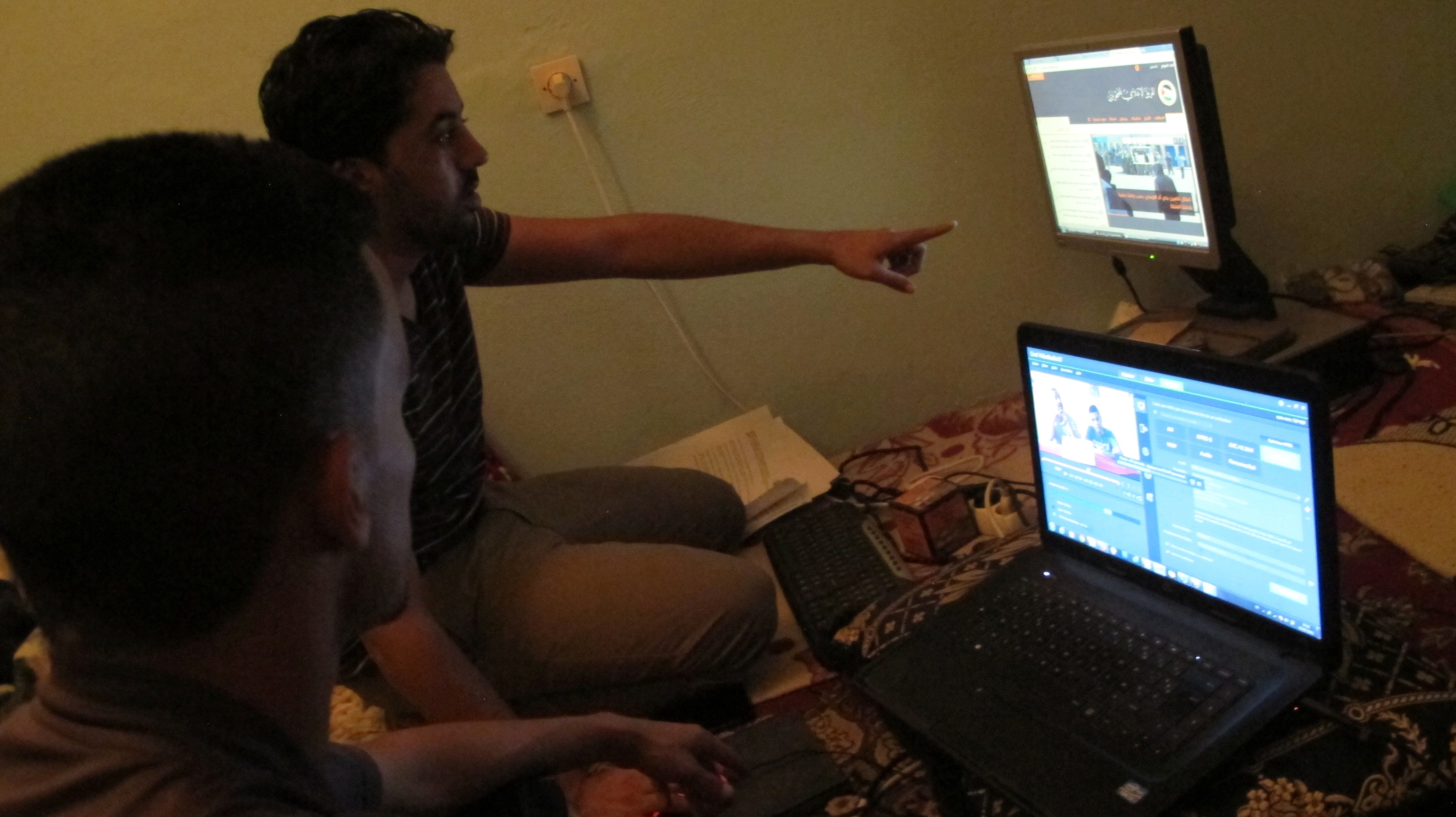
Credit: Karlos Zurutuza/IPS
“There are no news agencies based here and foreign journalists are denied access, and even deported if caught inside,” stressed Ettanji.

Spanish journalist Luís de Vega is one of several foreign journalists who can confirm the activist´s claim – he was expelled in 2010 after spending eight years based in Rabat and declared persona non grata by the Moroccan authorities.

“The Western Sahara issue is among the most sensitive issues for journalists in Morocco. Those of us who dare to tackle it inevitably face the consequences,” de Vega told IPS over the phone, adding that he was “fully convinced” that his was an exemplary punishment because he was the foreign correspondent who had spent more time in Morocco.

“The Western Sahara issue is among the most sensitive issues for journalists in Morocco. Those of us who dare to tackle it inevitably face the consequences” – Spanish journalist Luís de Vega.

This year will mark four decades since this territory the size of Britain was annexed by Morocco after Spain pulled out from its last colony of Western Sahara.

Since the ceasefire signed in 1991 between Morocco and the Polisario Front – the authority that the United Nations recognises as a legitimate representative of the Sahrawi people – Rabat has controlled almost the whole territory, including the entire Atlantic coast. The United Nations still labels Western Sahara as a “territory under an unfinished process of decolonisation”.

Mohamed Mayara, also a member of Equipe Media, is helping Ettanji to find the rooftop terrace. Like most his colleagues, he acknowledges having been arrested and tortured several times. The constant harassment, however, has not prevented him from working enthusiastically, although he admits that there are other limitations than those dealing with any underground activity:

“We set up the first group in 2009 but a majority of us are working on pure instinct. We have no training in media so we are learning journalism on the spot,” said Mayara, a Sahrawi born in the year of the invasion who writes reports and press releases in English and French. His father disappeared in the hands of the Moroccan army two months after he was born, and he says he has known nothing about him ever since.

Sustained crackdown

Today the majority of the Sahrawis live in the refugee camps in Tindouf, in Western Algeria. The members of Equipe Media say they have a “fluid communication” with the Polisario authorities based there. Other than sharing all the material they gather, they also work side by side with Hayat Khatari, the only reporter currently working openly for SADR TV. SADR stands for ‘Sahrawi Arab Democratic Republic’.
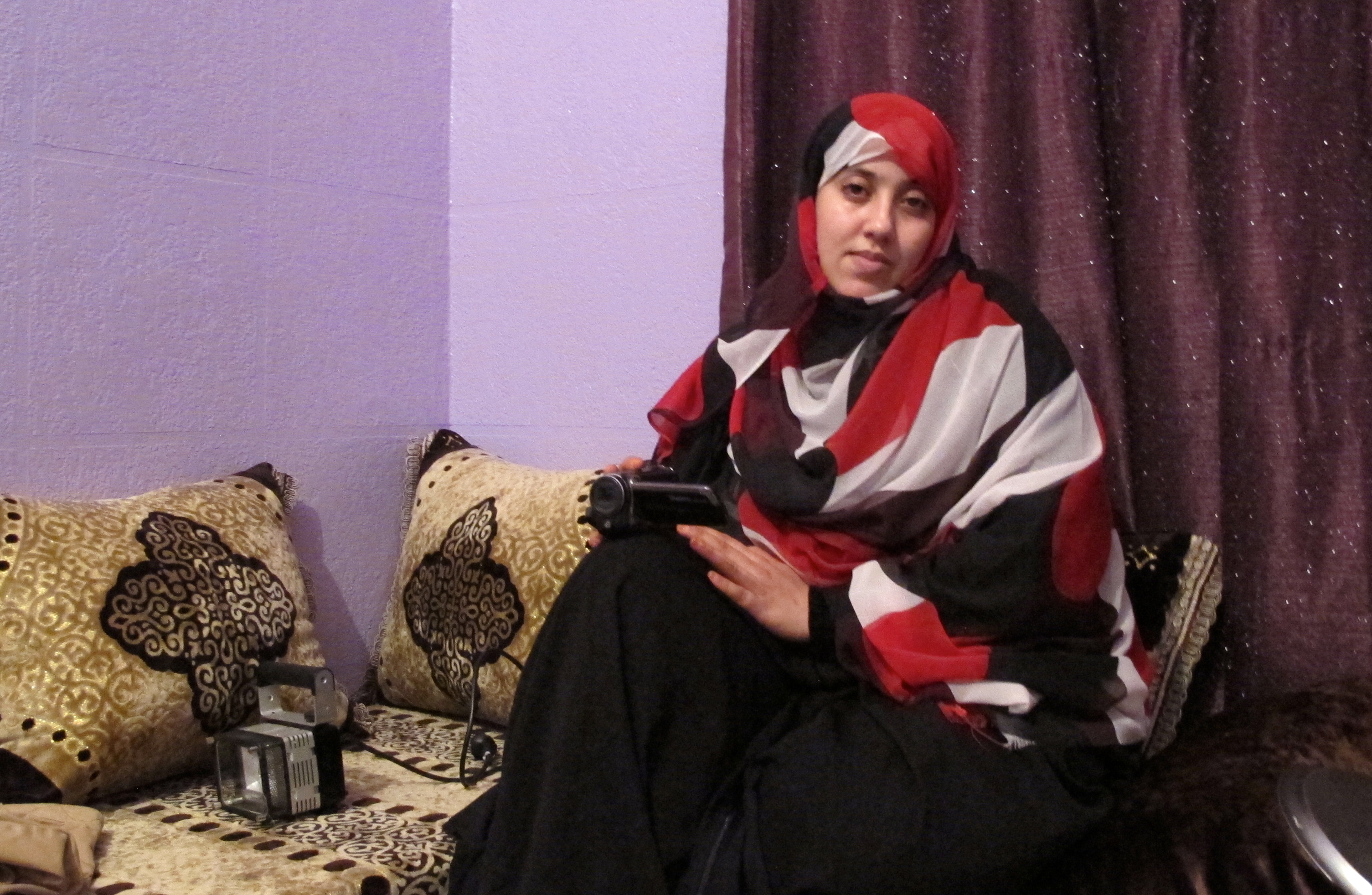
Hayat Khatari, the only reporter currently working openly
 for SADR TV in Laayoune. Credit: Karlos Zurutuza/IPS

Khatari, a 24-year-old journalist, recalls that she started working in 2010, after the Gdeim Izzik protest camp incidents in Laayoune. Originally a peaceful protest camp, Gdeim Izzik resulted in riots that spread to other Sahrawi cities when it was forcefully dismantled after 28 days on Nov. 8.

Western analysts such as Noam Chomsky have argued that the so-called “Arab Spring” did not start in Tunisia as is commonly argued, but rather in Laayoune.

“We have to work really hard and risk a lot to be able to counterbalance the propaganda spread by Rabat about everything happening here,” Khatari told IPS. The young activist added that she was last arrested in December 2014 for covering a pro-independence demonstration in June 2014. Unlike Mahmood al Lhaissan, her predecessor in SADR TV, Khatari was released after a few days in prison.

In a report released in March, Reporters Without Borders records al Lhaissan´s case. The activist was released provisionally on Feb. 25, eight months after his arrest in Laayoune, but he is still facing trial on charges of participating in an “armed gathering,” obstructing a public thoroughfare, attacking officials while they were on duty, and damaging public property.

Related IPS Articles


In the same report, Reporters Without Borders also denounces the deportation in February of French journalists Jean-Louis Perez and Pierre Chautard, who were reporting for France 3 on the economic and social situation in Morocco.

Before seizing their video recordings and putting them on a flight to Paris, the authorities arrested them at the headquarters of Moroccan Association of Human Rights (AMDH), one of the country’s leading human rights NGOs, which the interior ministry has accused of “undermining the actions of the security forces”.

Likewise, other major organisations such as Amnesty International and Human Rights Watch have repeatedly denounced human rights abuses suffered by the Sahrawi people at the hands of Morocco over the last decades.

Despite several phone calls and e-mails, the Moroccan authorities did not respond to IPS’s requests for comments on these and other human rights violations allegedly committed in Western Sahara.

Back in downtown Laayoune, Equipe Media activists seemed to have found what they were looking for. The owner of the central apartment is a Sahrawi family. It could have not been otherwise.

“We would never ask a Moroccan such a thing,” said Ettanji from the rooftop terrace overlooking the spot where the upcoming protest would take place.

Edited by Phil Harris


21 September 2015

Turks and Caicos Islands requests U.N. assistance to end British colonialism


TCI to petition United Nations on UK’s refusal of constitutional changes

THE TURKS and Caicos Islands Government has signalled its intention to head to the United Nations Committee to air their concerns about the United Kingdom’s refusal to accept proposed constitutional changes.

Speaking at a town hall meeting on Monday, September 7, Premier Rufus Ewing called on members of the public and the Opposition to join the Government in its petition to the international body.

He told the gathering that the issue has to be taken to the international arena, as the world needs to understand that the United Nations Convention is being violated by the United Kingdom government.

"We have another opportunity to state our case to the United Nations Committee because we have had invitations and I will extend that invitation to the Opposition and members of the public who would like to petition the UN.

"We were invited to submit our petition about our concerns such as the refusal to give constitutional advancement and we as a Government will take up that opportunity and I am inviting the Opposition members and any other member who would like to attend that meeting to rally and petition the UN because that is the only way we are going to get true representation in this country,” Ewing urged.

He added that the TCI cannot look to the British for representation, as they are conflicted.

"We have to represent ourselves with the help of others other than the UK government.”

The Premier stated that there needs to be a constitution so that the Government can do what the people elected them to do and one which will ensure that they can govern properly.

He said it does not matter which party is in power, the same problems will exist.

"For the United Kingdom to have an election, let a Government come into power and still does not trust that Government to make decisions for themselves and on behalf of the people, is not democracy.

"So for the UK government to deny and have no interest whatsoever – outrightly, blanketly and categorically state that no I am not interested in changing anything in that constitution is indeed a slap in the face of democracy and all Turks and Caicos Islanders.”

He noted that everyone knows what the UK’s trepidation is, but that the country needs to rally together to demand the changes they made an effort and a sacrifice to put together.

"It is important that we stand together on the issue of constitutional advancement and constitutional reform, it is important that we do so.”

He added that he and the Leader of the Opposition have agreed to sit and plot a way forward,
as well as put together a bipartisan team to go the UK to sit with the Foreign and Commonwealth Office and Members of Parliament to show them why it is necessary for the TCI to get what the people asked for.

"Every time I go to the Governor his usual question is - this is what they say, this is the constitution that you have if you don’t like it you can call a referendum.

"So I am telling you that we have to push and push at this door until that time comes and if you think that you have had enough and we think we have had enough then that is an option that we have to strongly consider and make a decision as Turks and Caicos Islanders,” the Premier advised.

He noted that it is not his decision alone, but the decision of all Turks and Caicos Islanders.

*****


(Left) Minister of Finance Hon. Washington Misick (Right) Premier Hon. Dr. Rufus Ewing

Mon, Sep 14, 2015
Premier Hon. Dr. Rufus Ewing and Minster of Finance Hon. Washington Misick have rebuked Governor Peter Beckingham for suggesting that terrorism threats were among the reasons why the Turks and Caicos Islands Government was ordered by the United Kingdom to pay US$2.2million for extra security for Special Prosecutor Helen Garlick and her team of investigators and lawyers.


In a strongly-worded press release, Premier Ewing noted that the Governor in his press release last week communicated that he was instructed by the Foreign and Commonwealth Office to instruct the Chief Financial Officer to use his powers under the Constitution and Chief Financial Officer’s Ordinance to authorize an additional $2.2M to fund security cost for SIPT. 

"My Government is on record condemning this action, which, while being within the legal authority of the Governor and CFO, is considered by my Government to be an abuse of power and without proper justification. Even though I have demanded I am yet to receive any information about any threat to national security or the security of any members of the SIPT that warrants such exorbitant additional expenditure," the Premier said. 

He added: "The only threat to national security that I am aware of is the constant threat of illegal immigrants and poachers traversing our maritime borders engaging in illegal fishing, and trafficking of human, guns and drugs. Such funding is better spent on the procurement of marine defense vessels and manpower to defend our boarders from these illegal activities, a responsibility that the UK Government has constantly shunned."

"The Turks and Caicos Islands is a peaceful nation of friendly people that enjoys some of the lowest crime rates globally, and we should not be compared to other countries where acts of terrorism abound. I condemn this characterization by the Governor and demand his retraction and clarification of this outlandish and unwarranted statement. The SIPT has been operating in these islands for the last five years without incident, at the expense of the tax payers of this country, and they seem to be no further ahead than when they started but they certainly are richer."

The Premier noted that the Turks and Caicos Islands’ House of Assembly, in previous sittings has "appropriated funding for the SIPT and now, so too has the CFO and without the approval of Cabinet or House of Assembly, and in all of these instances, my Government’s calls for accountability and transparency for the expenditure of the people’s money have been blatantly ignored by the Governor, the CFO and the Commissioner of Police".

Premier Ewing continued: "This is surely not an example of good governance. We have a right to know how much of the tax payers money is being spent and what specifically it is being spent on. We do not seek to compromise the investigations but making that information available after the trials have ended is totally unacceptable and we will therefore not approve another “red cent” for SIPT."

He added: "Since coming to office in 2012 I have made representation to the UK Secretary of State, the FCO and DFID, both in writing and in person requesting them to assume the responsibility for the funding of the SIPT, as previously recommended by the UK Foreign Affairs Committee and Chief Prosecutor Helen Garlick, and the UK Government has consistently refused to accept its responsibility as a sovereign nation and provide support to these islands, but instead insists on providing employment and financial opportunities for the British on the backs of tax payers in the Turks and Caicos Islands.

The economic prosperity of these islands came with the hard work of this Government and the hard work and sacrifice of the people of these islands, and such economic gains should be spent as a priority for the improvement of the lives of the people of these islands and not for the enrichment of SIPT and other UK tax payers. The UK’s insistence on the brow beating of the people both by their insistence on taxing the people to pay for SIPT as well as their recent denial of the people’s call for constitutional review are acts to be abhorred."

The Premier said his Government will continue to make representation to the Secretary of State, FCO and FAC and agitate for the UK Government to live up to its responsibility as a sovereign nation and fund the SIPT or find alternate methods of exacting justice as recommended by the Report of the CARICOM Mission to the Turks and Caicos Islands and for them to uphold good governance instead of demonstrating the might of the Great British Empire in abusing its authority. 

"My Government is prepared to take this fight to Whitehall as we will not accept this or the UK’s response to the House of Assembly’s recommendations for constitutional amendments. It is past time for a frank discussion on the future of the relationship between the UK Government and the people of these “beautiful by nature” islands," Premier Ewing added.

In a separate press statement, Minister of Finance Hon. Washington Misick said: "We are amazed at the speed, and ease at which UK Ministers make decisions negatively impacting the public purse of the TCI when it is expedient to their agenda. These actions fly in the face of transparency and the generally accepted principals of public sector budgeting practise by TCIG, and insisted on by the UK.

The explanation for the unilateral appropriation of funds claim that the money is to cover expenses to the end of March 2016. The truth is that given the snail’s pace at which matters are progressing, this process will not be completed by March 2016 and may go on indefinitely thereby attracting additional recurrent cost of $4-5 million dollars annually." 

He added: "It is our view that the decision to increase funding to SIPT demonstrates bias and scant regard for the welfare of the people of these islands. Key infrastructure expenditure including that for a new/recondition RO plant for Grand Turk are routinely denied. One off expenditure such as ex-gratia payments to recently retiring low wage earners in the public service who have no prospects of alternative employment or any other means to support themselves, and who had a legitimate expectation to receive such payments based on policy have also been denied. These decisions beg the question does TCI lives matter? It is morally wrong for the UK Government to be open fisted with TCIG tax payers’ money. If additional funding is to be provided to the Police it should first be provided to fight youth on youth violence, community policing and border protection as is their international obligation which they continuously neglect."

Misick said the people of these islands have sacrificed much to return to fiscal stability, adding that it is "a slap in the face that their sacrifice is being rewarded by diverting resources away from infrastructure development and social programs".

He stated: "My Government decries the continued draconian stance by Britain towards the people of these islands and will not be silent in the face of its imperious posture."
- See more at: http://suntci.com/governor-under-attack-from-tci-government-p1890-108.htm#sthash.0TvSMQ3G.dpuf

20 September 2015

Papua New Guinea PM against Bougainville independence

PM Peter O’Neill vows Papua New Guinea 

won’t be broken up

Rowan Callick | The Australian

Papua New Guinea Mine Watch


Bougainville Freedom Movement Responds

Prime Minister Peter O’Neill has stressed that Papua New Guinea will not be broken up under his watch, as the nation celebrates the 40th anniversary of independence today.

papua new guinea

Under the terms of the peace agreement that ended the civil war on Bougainville after a dozen years, a referendum about its future governance is to be held within five years.
The referendum will include the option of independence — which was also raised by Bougainvillean leaders in the lead-up to PNG’s independence, and led to the establishment of provincial governments in 1977.
Mr O’Neill told The Australian: “It’s important to understand that a vote of yes for independence on Bougainville by Bougainvilleans doesn’t necessarily mean it will lead to independence. That remains the responsibility of the national parliament.”
The parliament, he said, would consider the question with great seriousness, “with the backdrop of our understanding about our country”.
“We have a diverse and tribal country, so we can ask ourselves, where does it stop?” he said.
The government’s own views, he said, “are very clear, which I stated when I visited Arawa and Panguna” on the island in January last year. “We have no interest in thinking about independence, but about ser­vices, and the wellbeing of the people on Bougainville.

“While we appreciate working with the autonomous Bougainville government on many of these issues, I have the responsibility to make sure government services get rolled out and infrastructure built, and continue to talk to the ABG and landowners and other partners for economic opportunities there, including mining,” he said.
Politician and former Catholic priest John Momis was re-elected president of the ABG in June, with about half the votes cast. He is a figure associated strongly with PNG and Bougainville nationalism, and is prepared to negotiate eventually the reopening of the Bougainville copper mine as a crucial source of revenue if the population is to seek independence.
“Mining is not the answer to all our issues. For us, if the mine remains closed, that is a decision that landowners and the people of Bougainville need to make,” Mr O’Neill said.
“But it’s equally important the PNG government, the ABG and landowners resolve issues we have with Bougainville Copper Ltd in a manner that’s going to be commercially accepted, that will enhance our reputation as an investment destination by prospective investors in the ­future.
“This is the only way for meaningful engagement, and this is our government position.
“We need to find a solution through these discussions taking place in a constructive manner.”
Discussions towards finalising Bel Kol, a traditional reconciliation ceremony involving all parties to the civil war and ­associated disputes, especially concerning the mine, remain elusive, with opposition among former combatants recently forcing postponement of ­negotiations.

*****

A response to the Prime Minister
 Bougainville Freedom Movement

It is time that Mr O’Neill, the Prime Minister of Papua New Guinea (PNG) was educated in that:
Bougainville is geographically a part of the Solomon Islands Archipelago. It is the biggest island lying in the north of the Solomons chain and is a mere eight kilometres from the arbitrary sea border of the independent state of the Solomon Islands. In contrast Bougainville is over 900 kilometres from the Papua New Guinea capital, Port Moresby. It is not part of the land mass of PNG and is separated by the Solomon Sea.
The people of Bougainville
 
and the Solomons are related to each other culturally and ethnically. They have visited and traded with each other since time immemorial. Even after the formal separation of Bougainville from the rest of the Solomon Islands archipelago traditional border crossings and clan visitations for family reasons took place and this exchange goes on today. The people of Bougainville also have much darker skins than the people of Papua New Guinea.
Lineage is through the matrilineal clan system, where the clan is traced through the “queen” of the clan who is also the titleholder and custodian of the tribal land. There are few resemblances with the people of Papua New Guinea who are made up of very culturally diverse groupings with up to 800 different tribes and languages.
“Alienation from agricultural land was a problem but this did not approach the grievances of the landowners affected first by mine construction and then the destruction and devastation of the environment by Bougainville Copper Limited (BCL)”.
“It is worth remembering that Australia was the country that granted independence to Papua New Guinea. For almost 70 years, Australia maintained colonial rule over the eastern half of New Guinea. Unfortunately, this fact is largely absent in contemporary discussions of relations between the countries…
“The imposition of Australian ideas created problems in the years immediately following independence. Leaders sought to find a balance between continuing the Australian policies and finding a new course that reflected the tenuous sense of Papua New Guinean identity.

“The results were not always successful. Economic problems combined with unrest in places like Bougainville challenged the government in Port Moresby. The ethnic diversity of Papua New Guinea sat uneasily with the Australian insistence on granting independence to a single, united country”.


19 September 2015

Raizal people of Colombian Caribbean archipelago defend cultural traditions


By Carlos Meneses Sanchez

The Raizals, a Creole-speaking, Afro-Caribbean people who inhabit the Colombian archipelago of San Andres, Providencia and Santa Catalina, are fighting to achieve greater respect for their centuries-old culture and achieve a place for their language in all local institutions.
This Protestant ethnic group makes up more than half of the population of San Andres, the largest island in the archipelago, which is located 220 kilometers (135 miles) off the coast of Nicaragua and 700 kilometers (435 miles) from mainland Colombia.
San Andres-Providencia Creole has its origins in different African dialects spoken by slaves brought to these islands by the English, guide Rodrigo Sarmiento, a native of San Andres and member of the Raizal community, told EFE, adding that slaves mixed English with words from their native tongues so their owners would not understand them.
He gave one example of a phrase in the local language, noting that the question "How are you?" sounds like "Jo yo de."
San Andres-Providencia Creole is the language most commonly heard in the primarily Raizal neighborhoods of San Luis and La Loma, two of the three sectors into which San Andres is divided.
Meeting the demand from that community is a small local television station, TeleIslas, that offers programming in Creole with Spanish subtitles.
"We're fighting so that Creole is in all the institutions. Previously it was considered a dialect because it didn't have a written form or grammatical rules, but now it can be both written and spoken. There are even books," said Mario Bailey, a young Raizal who sings in the local Baptist church's youth choir.
Constructed entirely with wood brought from the U.S. state of Alabama, the church, the first of that denomination to be built on San Andres, was founded on the island's highest point by Rev. Phillip Beckman in the mid-19th century, shortly after Britain's Parliament abolished slavery throughout the British Empire.
The Raizal's Baptist tradition, also adopted from British slave owners and settlers on the archipelago, makes their belief system distinct from the majority Catholic population of Colombia, since they believe in the Holy Trinity but not in the intercession of "saints or virgins."
They do, however, have respect "for the Virgin Mary as Jesus' mother," Bailey said.
The Raizals' architecture also hearkens back to the past with its cone-shaped roofs and wooden stilt houses to prevent flooding in the rainy season.
Another cultural novelty is the existence of some private cemeteries hidden away between houses, even though they are prohibited because of their potential for contaminating groundwater.
But because of the Raizal population's cultural differences with the rest of the country, locals say Colombian governments for a time completely neglected the island.
There was a period in which the national government paid no attention to the Raizal population concentrated in the neighborhoods of San Luis and La Loma, the guide Sarmiento said, adding that things improved somewhat when a military dictator, Gen. Gustavo Rojas Pinilla, became the first Colombian president to visit San Andres and declared it a free port in 1953.
In Rojas Pinilla's remembrance, the island's small airport bears his name.
Despite the government's neglect, the Raizals have managed to implement an educational system in their schools that ensures a place for their culture in Colombian history books.
"In my high school, they're very strict with our traditions. We had to learn what slavery was like, the history of the church, everything ... They also teach us all the dances, and we have to be able to dance them to graduate," Bailey said.
In terms of local permits, if a private company wants to carry out a construction project it must first obtain the approval of the Raizal population and then only hire native workers.
This ethnic group also has its own cuisine that includes empanadas (a stuffed bread or pastry) and crab soup as well as rondon, a fish and seafood stew simmered in coconut milk and accompanied with rice, breadfruit, cassava or fried banana.
Inside the Baptist church, which is sober in appearance but features a drum set on the side of the altar to liven up the services, several people are fixing part of the roof and putting up the portraits of some of the seven pastors who have spiritually guided the community over the past 171 years.

Up high in the scaffolding, one young Raizal woman says something to one of her work companions in Creole. She is wearing a T-shirt that reads: "Dis dah fiwi: teritory, stuory, langwij ahn koltyo!" which means "This is Ours: Land, History, Language and Culture!" 

18 September 2015

Transition to solar power for Cook Islands

3 News - News from New Zealand

Auckland, New Zealand


Just beside the Cook Islands' only international airport, there's a paddock full of solar panels.

It's something of a jarring sight - rows and rows of shiny black solar panels, 3000 in all, hemmed in by a wire fence, set against a backdrop of lush rainforest and towering, rocky outcrops.

The solar power plant - Te Mana o te Ra, meaning power from the sun - was built last year on one of the rare large flat areas of Rarotonga, with the help of $3.3 million of funding from New Zealand.

The plant churns out about a megawatt of energy in the middle of the day and it meets around five percent of Rarotonga's electricity demand.

It's designed for the unique conditions of Rarotonga, meaning it can withstand the odd tropical cyclone and the constant blast of jet engines.

It's another step towards the Cook Islands' goal of being powered entirely by renewable energy sources by 2020, having already hit the target of being 50 percent renewable by 2015.

New Zealand aid programme manager Joseph Mayhew says the switch to renewable energy sources has a host of benefits for the Cook Islands.

It reduces fuel bills - savings to the tune of about $500,000 a year - and reduces the Pacific nation's dependence on imported diesel and petroleum for electricity generation, he said.

That in turn reduces greenhouse gas emissions by over 1000 tonnes a year.

Mr Mayhew says New Zealand has also been instrumental in getting solar power to six of the more remote northern islands in the Cook group.

The $20m investment means the island of Pukapuka, which didn't have reticulated electricity previously, now has access to a modern amenity most take for granted.

Over the last three years, New Zealand has provided $78 million in aid to the Cook Islands.

Just over 40 per cent of that has been spent on infrastructure projects, including renewable energy, water supply and sanitation.

The New Zealand government is committing another $64m or so to a variety of projects over the next three years.

Turks & Caicos Freedom Fighter Joins the Ancestors


Prominent pastor found dead in Turks and Caicos Islands


Rev. Conrad Howell
Reverend Dr. Conrad Howell

Reverend Dr. Conrad Howell, a prominent pastor, talk-show host and author of the Turks and Caicos Islands' national song, was found dead early on Saturday September 12th, after his wife reported him missing on Thursday.


Howell's body was found in bushes near his home in Blue Mountain, Providenciales, following a massive search that was carried out by scores of residents and police. Foul play is suspected, police said.

Howell was last seen by his wife at their home sometime around midnight on Thursday September 10th, 2015. 

His wife told police she awoke around 2 a.m. and discovered that he was not at home.

In a Facebook post after he went missing, his wife Brikell Howell wrote: "It is out of character for reverend Conrad Howell not to be in contact with his family. Therefore the family is concerned that we have not seen him since last night. He was wearing a black pants, white singlet and socks. Should anyone see him or know of his whereabouts please contact the police or one of the family members."

Commenting on the tragic death, Premier, Hon. Dr. Rufus W. Ewing said, "Our nation has suffered a tremendous loss. Rev. Howell, as he was known to many, was a true patriot to our country and a soldier for our people. During his lifetime, he has made an invaluable contribution to the development of our society we are truly blessed to have known the late Rev. Dr. Conrad Howell and he will be greatly missed. As the host of the popular Radio Talk Show, Expressions, Rev. Howell also stirred dialogue and national debate on some of the most controversial topics of our time but one of Rev. Howell's most notable national accomplishments is the penning of the National Song This Land Of Ours."
- See more at: http://suntci.com/#sthash.nAnKfJnr.dpuf

Reverend Howell was a consistent presentor in proceedings of the United Nations Decolonisation Committee at its regional seminars in the Spring of each year, and its regular sessions each June. He had also was a consistent speaker to the United Nations Special Political and Decolonisation Committee, and  was an avid supporter of a robust role of the United Nations in the decolonisation of the Turks and Caicos Islands. He was expected to continue his advocacy work at the 2015 proceedings in October. His last U.N. statement can be read here

The struggle continues! May he rest well. 

OTR
   

17 September 2015

Standing While Black: Apartheid Justice in America


Dave Lindorff is a founding member of ThisCantBeHappening!, an online newspaper collective, and is a contributor to Hopeless: Barack Obama and the Politics of Illusion (AK Press).


If tennis great James Blake had done the obvious thing and resisted being tackled by an apparent thug on a New York sidewalk who didn’t identify himself as a cop before attacking him, he would probably be dead today like Eric Garner, or at least seriously injured or tased.

Blake, a well-known black athlete who not too long ago was the fourth-ranked tennis player in the world, was just leaning against the front of his hotel in midtown Manhattan when four undercover cops, who claim they “mistook” him for the suspect in an identity-theft scam, walked towards him, whereupon one of them suddenly jumped him, threw him to the ground face first, climbed on top of him, yanked his arms behind his back and cuffed him, in the process causing minor injuries to an elbow and eye (injuries that are no small matter for a tennis pro!).

There is so much wrong with what happened to Blake it’s hard to know where to begin. In a surveillance video, Blake can be seen just resting there on the sidewalk and actually smiling at the men approaching him, he says, because he assumed, as a celebrity, that they were fans who had recognized him and were coming to greet him. Blake, a Harvard grad, was calm and relaxed, not armed, and not at all acting like someone who planned to flee. There was, in other words, absolutely no reason for the officers not to simply identify themselves and ask politely to see his identification. Even then, if at that point they still suspected him, they could have taken him peacefully to the station for questioning, as they would ordinarily do had he been a well-dressed white guy, instead of a well-dressed black guy.

NYPD Chief Bill Bratton has apologized to Blake for the outrageous incident, as has Mayor Bill DeBlasio. At least one of the cops, who was particularly brutal on the video that captured the assault, has been pulled off the street and put on “administrative duties” by the chief, who said he was “disturbed” by the video. But Bratton insists that Blake is wrong to think that what happened to him had anything to do with his race, despite the fact that his assailants were all white.

Bratton certainly knows better. His statement that race wasn’t involved is laughable. He knows that the cop who tackled Blake instead of identifying himself a cop and asking politely for Blake’s identification has a history of complaints about abusive behavior — for which neither the cop nor Bratton has ever apologized. Want to guess the race of the victims of that abuse?

READ THE FULL REPORT HERE

16 September 2015

Tiny Guam, Huge US Marine Base Expansions

Truthout.org


On Saturday morning, August 29, 2015, the United States Navy signed the Record of Decision (ROD), the final document needed for the implementation of one of the largest "peacetime" military build-ups in US history. This will cost between $8 and 9 billion, with only $174 million for civilian infrastructure, which Congress has not released yet. As a central aspect of the United States' foreign policy "Pivot to the Pacific," the build-up will relocate thousands of Marines and their dependents from Okinawa, Japan, to Guam.

This does not auger well for the people of Guam. For decades, the Okinawans have protested the violence, pollution, military accidents and sexual assaults committed by US Marines on the local population. Moving those Marines to tiny Guam frightens many.

READ THE FULL REPORT IN TRUTHOUT.ORG


Forum du Pacifique : "Pour être « Full member » le préalable est que l’on soit un État souverain"

TAHITI INFOS, les informations de Tahiti


Original Article 

Oscar Temaru, vendredi 11 septembre lors de la conférence de presse donnée par l’UPLD.

Oscar Temaru, vendredi 11 septembre lors de la conférence de presse donnée par l’UPLD.


PAPEETE, 11 septembre 2015 - Le groupe UPLD dénonce un "effet d’annonce" dans la communication faite par la Présidence sur le thème d’une possible accession de la Polynésie française au statut de membre à part entière du Forum du Pacifique. En outre une telle évolution du statut de la collectivité au sein du FIP serait préjudiciable aux démarches engagées par les souverainistes à l’ONU. 

"Plutôt que d’espérer vainement que le Forum change les règles qui ont prévalu à sa création, Edouard Fritch devrait réaliser que la solution est simple pour devenir « full member ». Cela s’appelle l’indépendance, et c’est la solution pour développer ce Pays et gagner, à domicile comme à l’extérieur !", insiste un communiqué publié jeudi soir par le mouvement souverainiste UPLD. 

Le Forum des îles du Pacifique (FIP) est l'une des deux principales organisations régionales dans le pacifique, il regroupe 16 États indépendants. 

Vendredi matin, le leader indépendantiste Oscar Temaru et Antony Géros, président du groupe UPLD à l’assemblée, ont animé une conférence de presse pour dénoncer une campagne de désinformation organisée autour d’une interprétation du communiqué final du 46e Forum du Pacifique. Le document mentionne en effet que, sous réserve d'une modification des conditions d'admission en son sein, le Forum du Pacifique pourrait intégrer la Polynésie française en dépit de sa qualité de collectivité française d'outre-mer. 

"C’est tellement simple cette histoire", a réagi Oscar Temaru jeudi en évoquant une manipulation de l'information. "Depuis des années nous menons des démarches pour que notre pays soit membre à part entière du Forum. Mais ce n’est pas du tout la même démarche. Pour être « Full member » le préalable est que l’on soit un État souverain, comme les autres États membres. (…) La résolution adoptée le 17 mai 2013 par l’ONU (réinscription de la Polynésie française sur la liste des territoires non autonomes à décoloniser, NDLR) a été soutenue par tous les pays membres du Forum. Ils ne peuvent pas avoir changé de position en deux ans. Cela est très clair. C’est la France qui souhaite s’infiltrer dans les assises internationales dont le Forum", estime-t-il. 

Soutien de la France 

La présidence de Polynésie française a publié jeudi un communiqué de presse qui assure que les critères d'admission au Forum seront revus pour tenir compte de la demande du Pays d’accéder au statut de membre à part entière du Forum alors la Polynésie est actuellement "membre associé". En réalité, le communiqué final du 46e forum mentionne que "les leaders du Pacifique différent leur décision sur la demande de la Polynésie française d’être membre à part entière dans l’attente d’une révision des critères d’admission pour les nouveaux membres du Forum". 

Le Premier Ministre samoan, Tuilaepa Aiono Sailele Malielegaoi, a indiqué que le processus administratif n’était pas achevé, mais que les États insulaires s’étaient mis d’accord sur cette intégration. 

George Pau Langevin, ministre française des Outre-mer a participé ce vendredi au dialogue post-forum du Forum des Îles du Pacifique, à Port-Moresby (PNG). A travers elle, l'État français soutient la demande d'accession de la Polynésie française au statut de membre à part entière du Forum. George Pau Langevin a "rappelé aux États, collectivités et organisations représentées que la France, avec une communauté de 550 000 personnes, est une puissance du Pacifique et apporte un soutien marqué à la demande des gouvernements de la Polynésie française et de la Nouvelle-Calédonie pour adhérer comme membres de plein exercice au FIP", indique un communiqué du ministère des Outre-mer, vendredi. 

En autorisant la Polynésie française à accéder au statut de membre à part entière du Forum – au prix d’un aménagement de ses conditions d’admissibilité – le FIP pourrait se trouver à l’origine d’un parasitage des démarches engagées par les souverainistes polynésiens à l’ONU, auprès du comité des 24. Pour soutenir leur demande de réinscription de la Polynésie française sur la liste des collectivités non autonomes à décoloniser, les souverainistes polynésiens avaient en effet dû faire la démonstration de l’assujettissement de la collectivité à sa "puissance administrante", la France : malgré son large statut d’autonomie la collectivité ne pouvait pas être considérée comme autonome au sens de la déclaration de l’ONU. Or, de la part de ceux-la même qui ont soutenu la procédure de réinscription, l’admission de la collectivité, en l’état, au nombre des pays membres du FIP donnerait un signal contradictoire et de nature à retarder les travaux du comité des 24.


15 September 2015

Okinawa governor eyes referendum on U.S. base relocation


By GO KATONO 
Staff Writer


NAHA--Okinawa Governor Takeshi Onaga is considering a referendum on the relocation of a key U.S. air base to impress upon Tokyo the extent of local opposition to the project.

“I think the public will in Okinawa was already shown in a series of elections last year but (the central government) does not want to acknowledge that,” Onaga told reporters in reference to the Dec. 14 Lower House election in which candidates opposed to the relocation won in all of Okinawa’s four single-seat constituencies as well as sweeping other elections.

“We will consider holding the referendum after taking into various views into consideration," he added Sept. 8 at Naha Airport, a day after month-long talks over the relocation and other issues between Tokyo and Naha ended without progress.

The planned referendum would ask Okinawa residents about the central government’s decision to relocate the U.S. Marine Corps Air Station Futenma in Ginowan to the Henoko district of Nago, both in Okinawa Prefecture.

Onaga will make a final decision after carefully monitoring public opinion in the prefecture and also seeing if the government resumes relocation-related work despite the overwhelming opposition from islanders.

Onaga also said he wanted to attend the United Nations Human Rights Council sessions in Switzerland in late September to deliver a speech about the overwhelming U.S. military presence in Okinawa Prefecture.