14 April 2015

Northern Marianas Mayor: "No Military Activity On Pagan"

Government should focus on homestead program: Aldan

By Cherrie Anne E. Villahermosa 
Marianas Variety

Northern Islands Mayor Jerome Aldan’s message to the military is to "pack up and leave Pagan alone." Aldan was among the public officials who were in the House chamber yesterday to hear what the representatives of the Marine Corps Forces Pacific had to say during a meeting that lasted for more than three hours.

Aldan in an interview said he has not changed his position and is still opposed to the proposed use of Pagan for any military activities in the Northern Islands.

"Pagan is an island that people of Northern Marians descent should use to the full extent. There are a lot of resources there that we can tap. When you’re talking about bombs and live ammunition, that’s destruction to me. No matter how you call it…I still find it hard to believe because when you’re dropping bombs of course they will have a a significant impact once they hit the ground."

Instead of considering the military proposal, the CNMI government should help implement the homestead program for the Northern Islands.

He did not say how the financially strapped CNMI government can finance the resettlement of Pagan, which has an active volcano.

"We need the government to help us expedite the homestead program so we can go back to the Northern Islands. It’s not true that the place is uninhabited. There are still families living there and the numbers have tripled. So instead of prolonging the issue, let’s implement the homestead program. We can start it in Pagan. There’s a lot of flat land in Pagan and it’s a lot easier to maneuver there — there’s a road and there’s an existing landing area there already and all we have to do is renovate and upgrade them."

The mayor said the airport master plan was done by Efrain Camacho & Associates and it cost $500,000.

"All we need is to get the money," he added.

"We are losing a lot of lands already. There are over 4,000 pending applications for homestead lots so my take is let’s do it. Let’s start improving Pagan. We don’t need the military’s money. In fact I even asked the Marianas Visitors Authority to include Pagan to the list of the CNMI’s tourist attractions. It’s beautiful and there are a lot of attractions there."

[PIR editor’s note: Marianas Variety also reported that ‘There is a gradual loss of access to the islands. ... This was a perspective that Sen. Arnold I. Palacios, chairman of the Senate Committee on Federal Relations and Independent Agencies conveyed to the visiting Marine Corps Forces Pacific representatives yesterday in a meeting on Capital Hill. ... "We are starting to lose our islands," said Senator Palacios noting that it was not just to the U.S. military, but to other federal agencies as well. ... The islands are being federalized. ... "I am just looking at it from a different perspective. Out of the 14 islands, we have lost eight of our islands — eight to the federal government; one to nature—Anatahan."’]

Aldan said he is not against the military.

"Our CNMI leaders are also leaning toward no to bombs, no to live fire exercises at all. Even on Tinian, there are a lot of concerns…. I’m just surprised that nobody has asked yet about the possible contamination."

He is urging members of the public to get involved in the upcoming meetings.

"It’s important to participate. We want the people to come out and voice their concerns and be active and be involved because these are their islands.

"Again, I am not against the military. It’s their proposal that I’m against with. It’s not the plan that we see for our kids and the future. I just hope the Legislature and the governor will do the right thing and decide what is best for the people."

For his part, Lt. Gov. Ralph Torres is also requesting community members to participate in the hearings and public meetings regarding the draft of the Environmental Impact Statement.

Torres in a statement yesterday said: "We are in a crucial stage of the long-discussed military activities on Tinian and Pagan. In the hearings and public meetings of the coming weeks, we are provided an opportunity to participate in this important process.

"I strongly encourage the members of the public and community organizations to take the time to contribute your thoughts and comments both in writing and during the scheduled public meetings."

*****

CNMI Mayor: Strong Opposition To Pagan Militarization


Militarization and resettlement incompatible


A Northern Marianas mayor says most of the people in his region opposes the United States military's plans for a live fire range on Pagan island.

The military wants to lease the uninhabited island in its entirety so the Navy, Air Force, Army and Marines can practice live fire training as part of plans for a greater presence in the Asia-Pacific region.

But the mayor of the CNMI's northern Islands, which include Pagan, Jerome Aldan, says the island's original inhabitants were hoping to re-settle, but those plans will be scuttled if it is turned into a firing range.

"What do you think about live-fire and live-bombing? For me, it's destruction, contamination and basically after they're done the island is going to turn into a wasteland. I can say about 100 percent are against this, more particularly the folks from the northern islands who are waiting to make good use of the island, go back home."

Jerome Aldan says there are also plans to site a fishing community on Pagan in coming months, but this could now be halted.


09 April 2015

Hawaiians seek to protect mountain from construction of telescope

Mauna Kea, Kaʻohe, Hāmākua, Hawaiʻi
For Immediate Release
April 7, 2015

TMT SHUTDOWN

Protectors of Mauna Kea update the status of their encampment on the mountain

The protectors of Maunakea continue to camp out across the Maunakea Visitors Center at approximately 9,200 feet elevation night in and night out and will soon reach the two week mark of their encampment. Although over 30 arrests were made on Thursday, April 2 by the Hawaii County Police Department and the DOCARE officers of the DLNR, the protectors atop the mountain of Wākea, continue their stance against the construction of the Thirty Meter Telescope and continue to build momentum and gain support. 
One reason for the building of momentum and support, they say, is what they are calling the Kapu Aloha. “Abiding by this is what has fueled and protected us in this movement,” says Lanakila Mangauil. Mangauil says the Kapu Aloha is about conducting oneself with respect towards others, under any and all circumstances. Over the weekend, hundreds of supporters ascended the mountain to join in the protection efforts, with many flying in from Maui, Molokaʻi, Oʻahu and Kauaʻi. Although no construction has taken place since the day arrests were made, the protectors have kept a constant presence and plan to continue to do so while attempting to garner more support.
Protectors of the mountain have many reasons why they oppose the proposed construction of the TMT, one being that the mountain is considered sacred and perhaps the most sacred lands in all of Hawaiʻi. The mountain is named after Wākea who mated with Papahānaumoku to birth Hawaiʻi Island. The peak of the mountain is considered to be wao akua, or the realm of the gods, as it is the dwelling place of gods and goddesses such as Poliahu, Waiau, Lilinoe, Lihau, Kukahauula, Kahoupokane and Mooinanea. 


Another reason for the opposition to the TMT is the fact that protectors feel that the TMT does not adhere to the developmental laws of conservation lands as determined by the State of Hawaiʻi and the mountain also contains many religious shrines as well as burial sites and sits on top of the largest aquifer on the island of Hawaiʻi and therefore they consider it to be desecration. 
Lastly, the protectors realize and understand that even if the TMT was in compliance with the laws of developing on conservation lands, the State of Hawaiʻi is illegal and the Hawaiian Kingdom was never lawfully annexed by the United States of America and therefore continues to exits today according to International Law. This stems from the fact that Americaʻs only claim to annexing Hawaiʻi is by Joint Resolution on July 7, 1898, which is really just a domestic law having no authority outside the boundaries of its territory, and Hawaiʻi clearly was not a part of the U.S in 1898 since it required annexation. 
Because the State of Hawaiʻi is illegal, the protectors argue that every extension and branch of the State is therefore also illegal and due to this, all contracts between the contractors and the State of Hawaiʻi are void and illegal. Protectors of the mountain call upon all countries involved to honor the continued independence of Hawaiʻi that America has refused to acknowledge for the last 122 years while illegally occupying Hawaiʻi in violation of the laws of occupation.
The protectors of the mountain know that there are many out there who have and continue to offer their support through donations of food, water, money and other necessities, and while appreciated, those atop the mountain humbly and respectfully ask that any attempts of raising funds and collecting and delivering donations be communicated first with the protectors so as not to mismanage resources and cause confusion amongst the people in regards to what certain funds and donations could be used for. 
Kahoʻokahi Kanuha, one of the protectors and one who was arrested in the first group last Thursday, says “We canʻt thank everyone enough. The amount of support we have received over the past week is absolutely unbelievable and simply amazing. I am not quite sure our people have seen a movement like this in their lifetime and I think itʻs a testament to the fact that our people have been ignited and are ready to move forward and solidify ourselves once again throughout the world as a people and a country.”


###

For more information, contact:
1-808-494-0626 or 1-808-936-4249
tmtshutdown@gmail.com
Twitter: @tmtshutdown
#TMTshudown on Facebook, Instagram & Twitter
http://www.gofundme.com/maunakeaohana
See also:  
Hawaii Governor Calls ‘Timeout’ on Mauna Kea Telescope Construction


08 April 2015

University of Hawai'i Summit to address Militarisation of the Pacific


Civil Beat


The symposium will feature panels focused on the Marshall Islands, Mariana Islands, French Polynesia and Hawaii.


The University of Hawaii Asian-Pacific Law & Policy Journal is hosting a symposium this month exploring the impact of militarization on Micronesian and Polynesian islands.
The event, entitled “Bombs in Paradise: A Legal, Social, and Political Discussion of Militarization in the Pacific”, will take place on April 17 at the University of Hawaii law school campus.
Sailor's Hat on Kahoolawe where the Navy dropped a 500lb TNT bomb to simulate the effects of an atomic blast.9.30.14
Sailor’s Hat on Kahoolawe where the Navy dropped a 500lb TNT bomb to simulate the effects of an atomic blast.
The symposium will feature panels focused on the Marshall Islands, Mariana Islands, French Polynesia and Hawaii. Julian Aguon, a Guam native who is an attorney, author and activist, will give the keynote speech.
In Hawaii, state lawmakers are figuring out how much money to set aside this year to support the restoration of the former bombing range Kahoolawe, once known as “Target Island.”
For more background on Kahoolawe, read Civil Beat’s series Promised Land.


Chagos islanders ‘betrayed’ by UK failure to decide on their return


The Guardian

Supporters of Chagossians’ return to the Indian Ocean atolls condemn the government’s postponement and ‘lack of political courage’


Supporters of the inhabitants of a British overseas territory deported from their homeland are furious that the government has reneged on a promise that it would decide before the election on whether they could return.


Shortly before parliament disbanded, the government said it would delay confirming whether the Chagossian people could go back to the Chagos Islands, a series of atolls in the Indian Ocean. The main island, Diego Garcia, has been leased to the US military since 1966. That agreement expires next year. 

Novelist Philippa Gregory, secretary of the UK Chagos Support Association, branded the delay “another serious betrayal of the Chagossian community”. She added: “Chagossians have suffered in exile for years, and it is disgraceful the government has failed to deliver a small measure of justice by supporting return.” Television presenter and author Ben Fogle will hand a petition to Downing Street after the election urging the next government to let the Chagossians go back.

READ THE FULL ARTICLE IN THE GUARDIAN .


United Nations publishes 2015 reports on British dependencies


Image result for decolonization

The United Nations has begun to release its informational Working Papers for 2015 on the 17 non self-governing territories. Below are links to the six dependencies administered by the United Kingdom in the Caribbean. The reports are prepared annually by the Decolonisation Unit of the Department of Political Affairs, and are used by the member States of the U.N. Decolonisation Committee as they review the political, constitutional, and socio-economic developments in each territory and make recommendations to the General Assembly on measures to advance the decolonisation process.   

Image result for decolonization
www.buddhistpeacefellowship.org
According to the latest Report of the U.N. Office of Internal Oversight Services (OIOS) on the U.N. system support to the decolonisation process (2007), the production of the annual Working Papers on the 17 non self-governing territories are the "primary way" the Decolonisation Unit supports the Special Committee (on Decolonisation). The OIOS Report indicated that the research, analysis and drafting of the Working Papers constitute the Unit’s main output" utilising "some 73 per cent of the total Unit work months." 

These Papers also constitute the main substantive documents for the annual regional seminars originally designed in 1990 to alternate between the Caribbean and Pacific, and to focus on the small island territories which constitute most of the remaining dependencies.
________________________


United Nations Working Papers 2015
British-administered dependencies


_________________________________

International Reparations Summit to Convene in New York

ibw-logo-header
31-35 95th  Street, East Elmhurst, NY 11369 ♦ 718.429.1415 ♦ info@ibw21.org  ♦ www.ibw21.org
FOR IMMEDIATE RELEASE
Contact:Don Rojas
Tel: 410-844-1031
Email: donjbrojas@gmail.comWeb: www.ibw21.org

International Black Reparations Summit to Meet in New York


Organized by The Institute of the Black World (IBW)


New York, March 26—The Institute of the Black World 21st Century IBW), a leading research, policy and advocacy group with offices in New York and Baltimore, announced today that it is holding an International Reparations Summit at various sites across New York City, from April 9 to 12, 2015.
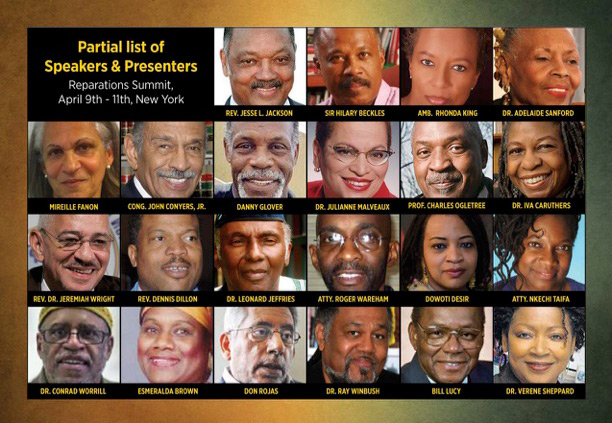
Speakers at the conference include Prof. Sir Hilary Beckles, Vice-Chancellor of the University of the West Indies and chair of the Caribbean Community’s (CARICOM) Reparations Commission; civil rights leader Rev. Jesse Jackson, Prof. Charles Ogeltree of Harvard University and Mireille Fanon Mendes France, President of the Frantz Fanon Foundation and Chair of the UN Working Group of Experts on People of African descent and daughter of Frantz Fanon, the Black liberation theoretician and psychiatrist from Martinique.
During the Summit, U.S. Rep. John Conyers Jr. (D-Mich.), the most senior member of Congress and the dean of the Congressional Black Caucus, will be honored for authoring HR 40, the “Commission to Study Reparation Proposals for African Americans Act” and for his 50 years of service on Capitol Hill.
“We are delighted that the Institute of the Black World can be a clearinghouse for ideas and strategies on how to pursue reparations for historical crimes and injustices against people of African descent in the US and across the Americas,” said Dr. Ron Daniels, the Institute’s President. “The courageous decision by nations in the Caribbean to demand reparations from the former European colonialists for Native Genocide and African enslavement and the formation of a CARICOM Reparations Commission is re-energizing the Reparations Movement in the U.S. and throughout the Pan African world.”
Scores of reparations advocates, Pan-Africanists and social justice activists from across the USA, Canada, Europe, Latin America and the Caribbean will take part in the New York summit. Leaders of national reparations commissions, committees and task forces from 11 CARICOM nations will interface with leaders of the recently formed European Reparations Commission and with members of the National African-American Reparations Commission (NAARC) which will be formally launched during the conference.
The NAARC will comprise of some of the leading scholars, activists, attorneys, economists and historians in Black America. In the months ahead, the NAARC will hold a series of town hall meetings across the country designed to solicit ideas from African-American communities on what should constitute a comprehensive program that advocates for reparations for the historical crimes of slavery and segregation.
“The main purpose of the International Summit is to advance the public discussion and debate around reparations issues and to provide a platform for advocates from around the world to dialogue, learn from each other, strategize collectively, support and reinforce each other’s campaigns, build bridges across geographical and linguistic barriers and co-ordinate action plans,” said Don Rojas, IBW’s director of communications. “The international nature of this summit is unprecedented in the long (and all too often ignored and marginalized) history of the reparations movement in the Americas.”
The conference, whose opening and closing public sessions are to be Webcast and audiocast live by WBAI-Pacifica Radio and Sirius XM Satellite Radio, will be held in three of New York City’s five boroughs—Manhattan, Brooklyn and Queens.
The conference begins at the historic Mother AME Zion Church in Harlem, the oldest black church in New York State and a center for the Underground Railroad back in the 19th Century. The business sessions will be held at York College in Queens and the summit will conclude with a public rally at the First AME Zion Church in Central Brooklyn, home to the largest Caribbean community in the United States.
One of the highlights at the closing rally will be inspirational music sung by a newly formed ‘Reparations Choir’, composed of members from several black churches in Brooklyn.
The three-day meeting will honor pioneers in the fight for reparations for Black Americans, including Callie House (1861-1928), a former slave who demanded that $68 million in taxes on Confederate cotton seized by the North be given to Blacks as reparations, and Queen Mother Moore (1898-1997), a longtime Harlem activist who popularized the reparations idea in the middle 20th century. It will also pay tribute to the tireless work over many years of The National Coalition of Blacks for Reparations in America (N’COBRA).
“Reparations is not an issue of the distant past,” said Dr. Daniels. “The Japanese-American community demanded—and got—reparations in the late 1980s for how they were treated by the American government—their own government—during World War II,” he said, referring to the internment of those Japanese by the United States.
“And in 2015, the parliaments of Russia and Greece are voting to demand Germany pay them for the damage inflicted on them by the Nazis,” he added. “So this issue is not, and should not, go away, particularly when African-descended people are concerned.”
Reparations is an issue that has occasionally flared up in Black political circles since the end of slavery in the mid-19th Century. It has been publicly opposed by several U.S. Presidents and dismissed by most white Americans but it has always found a place on the Black political agenda.
At the UN’s Conference on Racism in Durban, South Africa in 2001, the Atlantic slave trade and chattel slavery was declared a “crime against humanity” and was described as the greatest holocaust in human history. Hundreds of reparations activists from the USA and the Caribbean participated actively in the Durban conference, which helped to infuse the reparations movements with new energy at the beginning of the 21st Century. But that energy petered out in the first decade of the new century.
IBW, however, believes that today this pattern is changing. A June 2014 cover story in The Atlantic magazine, “The Case for Reparations,” by prominent journalist Ta-Nehisi Coates, generated much discussion in African-American communities as well as within elite white American intellectual and political circles.
IBW maintains that the work of the National African-American Reparations Commission will have to be resourced by black communities across the country. “Black people and those sympathetic to the cause will have to finance this initiative,” Dr. Daniels explained. “We can’t expect corporations or foundations to underwrite a campaign for Reparations for Black people. In the spirit of the Honorable Marcus Mosiah Garvey, IBW is counting on contributions from the people to finance the work of the commission.”
The IBW International Reparations Summit comes two years after the 15-nation CARICOM group decided unanimously to form a reparations commission and to demand that the former European colonial and slave-trading powers pay the debt owed to African people in the Caribbean region for the enormous wealth made off of their forced and uncompensated labor during the centuries of African enslavement.
And in January 2014 CARICOM issued a 10-point program for “Reparitory Justice” that frames their reparations demands as a “development strategy”. The program’s stated goal is “to use reparations payments to deal collectively with pressing economic and educational problems facing the citizens of the Caribbean that trace their origins to the underdevelopment imposed by slavery, slave trading, native genocide, and economic exploitation by the European nations”.
CARICOM’s 10-Point Program enjoys the unanimous support of all the member countries in the Community of Caribbean and Latin American States  (CELAC) and the Bolivarian alliance for the Peoples of the Americas  (ALBA).
For more information on IBW’s International Reparations Summit, please visit www.ibw21.org.
About The Institute of the Black World
The Institute of the Black World 21st Century (IBW) is committed to enhancing the capacity of Black communities in the U.S. and globally to achieve cultural, social, economic and political equality and an enhanced quality of life for all marginalized people. The Institute was conceived as a resource center and engine for capacity-building and empowerment of Black organizations and communities, utilizing cooperative and collaborative methods and strategies.
The group emerged as an outgrowth of the State of the Black World Conference which attracted some 2,500 African American scholars, activists, organizers and concerned individuals to Atlanta in 2001. Convened by a core group of veteran social and political activists led by Dr. Ron Daniels (former Executive Director, National Rainbow Coalition; Deputy Campaign Manager, Jesse Jackson for President, 1988 and Executive Director, Center for Constitutional Rights), the birth of IBW was more than a decade in the making.
Research ♦ Policy ♦ Advocacy
ibw-summit-speakers


06 April 2015

U.S. Virgin Islands to commemorate territory's 2nd elected Governor; Addressed U.N. in 1975 on territory's decolonisation


St. Thomas Source

The Virgin Islands Legislature invites the public to attend the 11th annual commemorative ceremony in honor of former Gov. Cyril Emmanuel King, which will be held at 9 a.m. on Tuesday, April 7 (Cyril E. King's birthday) at the Cyril E. King Mausoleum in the Kingshill Cemetery, according to a press release issued by Sen. Terrence Nelson’s office.


King was the second elected governor of the United States Virgin Islands, serving from 1975 until his untimely death at age of 56, in 1978. He also briefly served as acting governor in 1969, following the resignation of Gov. Ralph M. Paiewonsky. In 1984, the Harry S. Truman Airport on St. Thomas was renamed Cyril E. King Airport, by the V.I. Legislature. His political party was the Independent Citizens Movement (ICM), where his legacy of caring, responsive and efficient government lives on through the party’s platform, philosophy and agenda.


He was married to Agnes Agatha Schuster and is survived by one daughter, Lillia.


Two wreaths will be placed in the mausoleum, one for the governor and the other for his wife, who rests right beside him.

All are encouraged to attend. 


For more information: (340)712-2287.

_____________________


See also: 

United Nations Address of U.S. Virgin Islands Governor Cyril E. King - 1975


Britain Used Spy Team to Shape Latin American Public Opinion on Falklands (Malvinas)

The Intercept


BY ANDREW FISHMAN AND GLENN GREENWALD


Faced with mounting international pressure over the Falkland Islands territorial dispute, the British government enlisted its spy service, including a highly secretive unit known for using “dirty tricks,” to covertly launch offensive cyberoperations to prevent Argentina from taking the islands. 

A shadowy unit of the British spy agency Government Communications Headquarters (GCHQ) had been preparing a bold, covert plan called “Operation QUITO” since at least 2009. Documents provided to The Intercept by National Security Agency whistleblower Edward Snowden, published in partnership with Argentine news site Todo Notícias, refer to the mission as a “long-running, large scale, pioneering effects operation.” 

At the heart of this operation was the Joint Threat Research and Intelligence Group, known by the acronym JTRIG, a secretive unit that has been involved in spreading misinformation.

READ THE FULL REPORT HERE.


03 April 2015

“Voices of Decolonization: A University of Guam Political Status Debate”

Announcement

Ep. 218 “Voices of Decolonization: A UOG Political Status Debate” (hosted by Dr. Michael Lujan Bevacqua with producer Alan Grossman) was recorded 1/16/15 at the University of Guam and airs 4/3/15. 

Image result for Guam
ns.gov.gu
Guam is one of 17 non-self-governing territories recognized by the United Nations as needing decolonization. Chamorros have been pushing for this for several decades but momentum on the issue has built and waned over time. There has been a resurgence of interest since the start of 2015 as both Governor Eddie Baza Calvo and Congresswoman Madeleine Bordallo highlighted the importance of political status change in their state of the island addresses. 

For the first time in several years the Commission on Decolonization, the government body tasked with helping guide the island towards decolonization has received a modest budget for public education on the issue. 

This episode features a debate over political status courtesy of a Guam History class at the University of Guam, taught by Dr. Michael Lujan Bevacqua. As part of this course, a debate on decolonization is conducted whereby the students are divided into three groups, each representing a different possible political future for Guam (statehood, free association or independence). 

The students research each status, conduct interviews and develop their arguments as to why their particular status would be the best choice. Although the process of formally voting on this political issue is limited to only those who are considered “native inhabitants” of Guam, this exercise shows the importance of non-Chamorros to participate in the discussion as well. 

Vivian Loyola Dames, Ph.D. 
Anchor Host & Coordinator
 Beyond the Fence 
KPRG -89.3FM
303 University Drive
 UOG Station 
Mangilao, GU 96913

02 April 2015

Western Sahara: UN and ANC legitimise colonisation


Officials from the United Nations, the African National Congress and an array of mostly former but also present world leaders have participated in the Crans Montana Forum in Dakhla, occupied Western Sahara, to the delight of the colonizer Morocco.
18. marts 2015


The Special Advisor to the UN Secretary General, and former French Minister, Philippe Douste-Blazy, chaired the opening ceremony and a workshop, and the President of UN Women Canada, Almas Jiwani, gave a presentation. But neither was apparently there representing the United Nations, since the UN has stated that it did not send a delegation to the forum and that Douste-Blazy attended “in his private capacity”.

The African National Congress was also allegedly represented at the forum, although they stated in a press release that they have not sent a delegation and would “never send an anonymous delegation anywhere, let alone to Western Sahara”. The Crans Montana Forum claims on their website that President Zuma’s daughter Ntombenhle Msiza and the Chairman of International Relations of the ANC, Lindi Rufus Radebe, attended nonetheless as part of a “large delegation”.

Embarrassing for UN and ANC

The attendance at the forum of their high-ranking officials is nevertheless profoundly embarrassing for both the UN and the ANC.

The UN have repeatedly criticized the colonization of Western Sahara and demanded a referendum on the status of the colony for decades through an array of resolutions. And the ANC and South Africa have long claimed to support the Saharawis, President Zuma himself stating last year that South Africa “supports the peoples that are still struggling for freedom and democracy, in particular Saharawi and Palestinian peoples”.

The African Union, of which the Saharawi government in exile is a member, for their part condemned the forum as “a grave violation of the international law” and “in contradiction with the efforts made by the international community to resolve the conflict in Western Sahara”. Nevertheless, several African countries sent presidents and ministers to the forum, apparently unaware of the stance and statement of their own union.

A colonized tourist destination

But perhaps the real reason behind the forum in Dakhla, at least for Morocco, is to legitimize its colonization of Western Sahara in the eyes of the world, sell Western Sahara as a Moroccan tourist destination, and continue to illegally plunder the colony together with its foreign friends without too many questions asked.

Morocco’s Minister of Tourism certainly seemed to think so. The forum gave Morocco “high exposure around the world”, he told Morocco World News, singling out Dakhla as an “emergent tourist destination” where “we want to open new air routes” to Europe “in order to make it easier for European tourists to come to Dakhla”.

A club of exploiters

The list of people present, including Tourism Ministers from Africa, former French and Spanish Presidents and PM’s, high level government officials from New Zealand and Australia, and representatives from the WTO, OPEC and several banks certainly read like a bit like a club of present and future exploiters of Western Sahara. And there was certainly no criticism of the choice of Dakhla as the host city during the conference, where the Western Sahara conflict was not mentioned at all.

The Crans Montana Forum claims that the forum in Dakhla was “an opportunity to promote peace and dialogue”, but as its founder Jean-Paul Carteron also described Dakhla as “a model for the future of Morocco and Africa”, any peace is bound to be Moroccan-dictated and the dialogue more akin to a Moroccan monologue.

According to the head of Secretariat Morten Nielsen from the Danish solidarity organisation Afrika Kontakt, who have campaigned for a free Western Sahara for many years, the forum was something of a fiasco, however.

“Morocco hasn’t got the positive news publicity that they had hoped for. And the meeting hasn’t really yielded any concrete results, even though it has been very costly for Morocco”, said Morten Nielsen.

Stuck in a human rights nightmare

But regardless of the results or lack hereof of the Crans Montana Forum, Morocco refuses to discuss any solutions to the conflict that might lead to independence for Western Sahara, even though The International Court of Justice rejected Morocco’s claims to Western Sahara before Morocco invaded in 1975, including the referendum on the future of Western Sahara that Morocco initially had accepted.

So the Saharawis in Western Sahara are stuck in a budding Moroccan tourist paradise that is more akin to a nightmare for them. And have been for nearly 40 years.

Amnesty International and other human rights organisations frequently report grave human rights violations in Western Sahara, especially against Saharawis who advocate or promote independence. Amnesty’s new “Stop torture” campaign classes Morocco (including Western Sahara) as one of the world’s five worst torturing nations. And Freedom House rates Morocco as one of the absolutely worst countries in the world regarding civil liberties and political rights.

01 April 2015

Hawai'i Judge confirms continued existence of Hawaiian Kingdom

PRESS RELEASE


Weblog of the acting government of the Hawaiian Kingdom presently operating within the occupied State of the Hawaiian Islands.

Maui Circuit Court Judge takes Judicial Notice that the Hawaiian Kingdom still Exists and State of Hawai‘i Courts lack Subject Matter Jurisdiction

Judge_CardozaHONOLULU, HAWAI‘I—Today, Dexter K. Kaiama, attorney for Kaiula Kalawe English and Robin Wainuhea Dudoit, filed a petition for a writ of mandamus with the Hawai’i Supreme Court in Honolulu seeking an order to compel Judge Joseph E. Cardoza to dismiss the 

criminal cases against his clients because Judge Cardoza took judicial notice that the Hawaiian Kingdom continues to exist, which admits that the State of Hawai‘i did not have subject matter jurisdiction over the arrests and criminal proceedings. Judge Cardoza refused to dismiss the criminal complaints despite taking judicial notice that the court does not have subject matter jurisdiction.

READ FULL RELEASE HERE.

Chagos Islands All-Party Parliamentary Group Meeting

Big BenThe Chagos Islands All-Party Parliamentary Group have  agreed a statement on the prospects of Chagossian resettlement of their homeland. Please find the statement below a brief summary of this evening’s meeting. Thanks as ever to voluntary co-ordinator of the APPG David Snoxell for providing both the summary and the statement.

Coordinator’s Summary of the 48th Meeting of the Chagos Islands All-Party Parliamentary Group


The Chagos Islands APPG held its 48th and final meeting of this Parliament on 23 March. The Group discussed the PQs tabled (not yet answered) and exchanges in the Commons with the Leader of the House and the Prime Minster since the last meeting on 23 February. 
Members noted that  their letter of 24 February to the Prime Minister had not yet been answered and nor had the Government’s anticipated statement to Parliament on the KPMG report been made.
The Group noted the progress that had been achieved since 2008 and agreed a statement on prospects for Chagossian resettlement and the future of the Chagos Islands (below) for release to the media and interested parties. It was decided that the Group would be re-established in the next Parliament and meet in early June.

Statement on 23 March 2015 issued by the Chagos Islands (BIOT) APPG on prospects for Chagossian resettlement and the future of the Chagos Islands.
port
The Chagos Islands (BIOT) All-Party Parliamentary Group was established in December 2008 to help bring about a resolution of the issues concerning the future of the Chagos Islands and of the Chagossian people. Considerable progress has been made towards this aim.

The KPMG report on the feasibility of resettlement, published last month, concluded that there were no legal obstacles to resettlement.
The Group held its 48th and final meeting of this Parliament on Monday 23 March 2015. In the absence so far of a statement by the Government on the KPMG report members concluded that:
  1. 1: Notwithstanding the period of purdah, between the dissolution of Parliament and the general election, the Government should consult and agree with the main political parties a statement on the future of the exiled Chagossian people to be made before the election, setting out the intentions of parties likely to form the next government.
  1. 2: The APPG believes that, following the KPMG study, there should be agreement to a pilot resettlement on Diego Garcia, work on which should begin immediately when the next government comes to office, with a view to the first settlers arriving in early 2016.
  1. 3: The APPG urges the political parties to seize this opportunity, during the year of the 800th anniversary of Magna Carta and the 50th anniversary of the creation of the British Indian Ocean Territory, to bring about a fair and just settlement to which Conservatives and Liberal Democrats were committed before the 2010 election, and rectify one of the worst violations of fundamental human rights perpetrated by the United Kingdom in the twentieth century.
  1. 4: The APPG considers that any renewal next year of the 1966 UK/US Agreement on the use of BIOT for defence purposes should be conditional on a commitment by both parties to facilitate and support resettlement.
  1. 5: The Group welcomes the Arbitral Tribunal’s conclusion of the international arbitration between the UK and Mauritius and its finding that the undertakings given by the UK in 1965 are legally binding in international law. It calls upon the Government to open discussions with Mauritius concerning fishing rights which until the declaration of the MPA were operated by Chagossian owned and operated vessels.
  1. 6: In consequence of the above finding which gives Mauritius an “interest in significant decisions that bear upon the possible use of the Archipelago” the APPG urges the Government to consult Mauritius over future arrangements both for the MPA and for the US base on Diego Garcia, and also on plans for the resettlement of Chagossians, in view of the facilities available on Diego Garcia. The Government should also draw on expertise and experience available in Mauritius.
  1. 7: The APPG will be re-established after the election and continue to promote its aim of an overall settlement of the issues.