30 March 2015

Pan African Congress adopts resolutions on colonialism, occupation and other issues affecting the African World


"We collectively called for the total liberation of all Africans and persons of African descent still living under the yoke of occupation, colonization and oppression, including as one of the last colonies in Africa, Western Sahara, Martinique, Mayotte Comoros, Chagos Island, Puerto Rico, Cayenne, Guadalupe, and West Papua." 
(et al-OTR) 

-  Resolution of the 8th Pan African Congress

Pambazuka News


RESOLUTIONS OF THE 8TH PAN AFRICAN CONGRESS

2015-03-19, Issue 718

http://pambazuka.org/en/category/features/94258


The Pan African Congress was held 21 years after the previous one. Its resolutions capture the Congress’s desire to re-ignite the Pan African spirit, enthuse commitment to our African identity and inject energy into the Pan-African Movement.

ACCRA, GHANA, 5 - 7 MARCH 2015

We, the representatives of the global Pan African family, gathered in Accra, Ghana from 5th to the 7th of March 2015, to review progress made thus far since the Pan African Congress in 1994 and to take stock of the continual challenges confronting African persons of African descent globally. This represented the first session of the 8th Pan African Congress, with the second session to be convened by May 2016.

The President of the Republic of Ghana, H.E John Dramani Mahama, officially opened the 8th Pan African Congress and delivered a keynote address calling upon all African governments and people to take practical steps collectively - and in solidarity- for the unification and development of Africa.

We recognized that we belong to a historical tradition of congress and regional meetings that have convened over irregular periods since 1900, incorporating ardent Pan Africanists of various persuasions from the Global Pan African Family, who brought ideologies and political practice from a diverse set of circumstances in a search for a more positive future for all. 

We affirmed the contributions of the 1994 pre-Congress of women that established the Pan African Women’s Liberation Organization to address the specific needs and aspirations of women activists in the Pan African Movement.

We acknowledged that the world has significantly changed since the 1600 delegates, men, women and youth from twenty countries and six continents, gathered in Kampala and it is in that context that we understand the challenges and contradictions faced by the standard bearers of Pan-Africanism. It is also in that context that the Resolutions of the 7th Pan-African Congress were adopted, partially implemented or completely ignored. 

We recognized the need for African leadership to immediately implement processes and structures that incorporate the 6th region of the African Union, the Diaspora, in implementing Agenda 2020 and Agenda 2063

Specifically, the head of the Secretariat, Tajudeen Abdul Raheem, was acknowledged for playing a significant role in laying the groundwork for the continental transition of the Organization of African Unity to the African Union in 2000.

Similarly, he was a pivotal factor in ensuring that the social contradictions that resulted in open warfare in the Great Lakes Region were mediated by the involvement of all stakeholders - governments and civil society – under the rubric “Africans to Solve African Problems.”

This capacity to grasp complex situations with multiple interest and players was also deployed by the head of the Secretariat in expediting dialogue between the African Union, Civil Society and the Regional Economic Communities. 

As a direct result of the persuasive powers of the PAC Secretariat head based on the resolution of the 1994 delegates, Ethiopia amended its policy to allow the majority of Africans to apply for a visa on arrival. Uganda and Tanzania subsequently followed suit. We unreservedly applaud Mauritius, Seychelles, Mozambique, Rwanda and Comoros that facilitate visa-free or visas on arrival for all African citizens. This is a significant step in the often expressed desire for a continental passport.

Communication on these and other initiatives were shared on a regular basis via “Tajudeen Postcards,” a short form of expression that cogently captured existing challenges and successes while sharing a brief historical narrative that provided an appropriate context. These briefs have been captured in book form under the title “Speaking Truth to Power” effectively serving as a potential guidepost for the future. 

Structurally the Secretariat established a Youth Desk and Women’s Desk, both of which were functional for approximately six years after the 1994 Congress. Due to existing external conditions which undermined earlier optimism regarding fundraising, the Secretariat was unable to fund these two operations after that time. However, both sectors have continued to contribute through the work of volunteers, with the Youth able to do so more regularly. Youth Regional Meetings, workshops and mobilization drives have kept the mission of the Pan African Congress viable, especially within the East African Community States. 

We acknowledged that all these achievements were only possible through the generous support of the Uganda government who provided not only concrete resources but a sense of legitimacy both within and external to the host country. 

Focusing on current conditions, we recognized the obligation of the 8th Pan African Congress to address in the most forceful terms the recent examples of the violation of territorial sovereignty and personal dignity, and specifically the abductions (and subsequent murder of one) of Presidents Laurent Gbagbo and Muammar Gaddafi. 

We called for an African member of the Security Council to ensure an African Voice for both policy discussion and votes that are supportive of Global African Unity.

We also recognized that the establishment of an African Union brigade could effectively serve as a stabilizing force in areas previously destabilized by Western interests, such as in Libya.

We welcomed the decision by the governments of the Republic of Cuba and the United States of America to re-establish diplomatic relations between both countries and call on all African governments to continue to support the lifting of the US blockade against Cuba in all international forums.

We acknowledged the need for strong collaboration, especially through citizen input, with existing Pan African entities and initiatives, such as Agenda 2063 of the AU, and especially those identified to promote the Sixth Region of the African Union and the United Nations Decade for the Peoples of African Descent. Efforts such as these can serve to educate and stimulate individuals within the Global African Family who have not been previously reached to be mobilized in their own interests.

We stood in solidarity with all those who believe that Black Lives do matter and called for raising greater consciousness in this area by expanding the concept to “Global African Lives Matter.”

We viewed with alarm the root causes that drive so many African youth to migrate from the continent, only to end up in desperate straits of indentured servitude, especially young African women.

We received solidarity messages of support from the highest levels of government from Algeria, Benin, Brazil, Equatorial Guinea, Iran, Togo, Venezuela and Zimbabwe in addition to the Instituto Cubano de Amistad con los Pueblos.

We reiterated our opposition to the imposition of a neo-liberal Agenda that has and continues to impoverish Africans farmers, peasants, workers, women and youth. 

We unequivocally acknowledged the centrality of equal and equitable representation and voice in all development and governance processes. In particular we recommit ourselves to these principles of non-discrimination, equality and equal representation of women and youth in PAM structures and processes.

We collectively called for the total liberation of all Africans and persons of African descent still living under the yoke of occupation, colonization and oppression, including as one of the last colonies in Africa, Western Sahara, Martinique, Mayotte Comoros, Chagos Island, Puerto Rico, Cayenne, Guadalupe, and West Papua.

We strongly condemn all forms of religious extremism and other forms of fundamentalism and uphold building an environment for religious freedom of consciousness and expression. We condemned the recent murders of 21 Egyptian citizens in Libya. 

We unequivocally condemn the unchecked violence being perpetrated by extremist groups such as the Jama'atu Ahlis Sunna Lidda'Awati Wal-Jihad (Boko Haram), Al Shabaab, Islamic State of Iraq and Syria (ISIS), Al Qaida, Democratic Forces for the Liberation of Rwanda (FDLR), Allied Democratic Forces (ADF), Lord’s Resistance Army (LRA) and Janjaweed against African people while recognizing that neoliberal policies and imperialist interventions are the real cause.

We re-committed ourselves to Global Solidarity Action in mutual Support of Struggle of the Global Pan-African family. 

Then after meeting in six Commissions with full, lengthy, interactive discourse, we adopted the following Resolutions as identified by each specific area:

RESOLUTIONS OF THE 8th PAN AFRICAN CONGRESS, 5 – 7 MARCH, ACCRA, GHANA 

We, the people of Africa, convened here in Accra under the auspices of the 8th Pan African Congress,

AWARE of the efforts made by our fore bearers towards the total liberation and unity of the African people,

WARY of the obstacles and challenges faced by the African people in this pursuit from both within and without,

CONSCIOUS of the multiple systems of oppression faced by black people across the world, 

APPRECIATING the need to strengthen unity and foster solidarity across borders, within and outside of Africa amongst the global African community,

COMPELLED by the need to organize the efforts and energies of those living on the continent and those in the diaspora toward achieving these goals,

SENSITIVE to the demands of our local communities and of the need to integrate them into a coherent continental whole,

FAVOURING the values of community, co-operation and altruism versus individualism, self-interest and competition,

EMPHASISING the need to establish the Pan African Congress as a social, economic and political platform for the common people to engage in at all levels of society,

APPRECIATING the need to integrate within the framework of the Pan African Congress a human-based value system that promotes collectivism, altruism and co-operation as principal components of the organization,

ACKNOWLEDGING the need for Africa to unite through a common framework that unites all regions that have significant African populations, and

COGNIZANT of the fact that all black lives matter: 

The 8th Pan-African Congress resolves through its respective commissions as follows:

COMMISSION NO. 1: CONCERNING PAN AFRICAN ALTERNATIVES TO NEO-LIBERALISM AND FOR SUSTAINABLE DEVELOPMENT


ALIVE to the effects of neo-liberalism and convinced of the need to develop an alternative system that will afford economic justice to the African people, 

AWARE of the need to create an organ through which the common African can directly voice their needs and mobilize themselves towards common action, and

AWARE of the historical impetus of the series of the Pan African Congresses and of its need to mature into a permanent representative body of the African people

Do hereby resolve to:

1. Ensure that African governments not pursue neo-liberal development pathways and instead seek to build local industrial base founded on value addition.

2. Promote the development of common African currency for the African continent, with concurrent supportive monetary policies, as a basis for the development of a real alternative to neo-liberalism.

3. Reiterate our opposition to the privatization of public assets to the detriment of the rights, livelihoods and legitimate interests of populations.

4. Call upon African governments not to ratify the Economic Partnership Agreements (EPAs) with the European Union (EU) as these would be ruinous to the masses of the African population, primary producers, workers and self-employed small-holder farmers.

5. Ensure that natural and national resources should be utilized in a manner that benefits present and future generations of Africans. This should include policies that reject use of GMO stock, support plant variety protection and address the development of a central seed bank with subsidiaries in various parts of the Pan African world.

6. Encourage local economic and social development anchored on collective ownership, control, management and benefit by communities. Current concerns include, but are not limited to, land reclamation after legal and illegal mining activities, restitution of barren farm lands, slash and burn methods that destabilize forest areas and community control of timber cutting.

7. Recognize the long-term threat posed by genetically modified organisms and reject the commercialization of seed stock that jeopardizes Africa’s own food sovereignty.

8. Recognize that sustainability is a hollow concept without a healthy population and therefore call on PAM at all levels to address traditional and Western forms of medical treatment and care and to share this knowledge appropriately.

9. Call upon the African Union (AU) to establish clear norms and a body of professionals to regulate medical research by multinational corporations and external institutions in Africa in order to stop the exploitation of the poor and uninformed.

COMMISSION NO. 2: CONCERNING STRENGTHENING GLOBAL SOLIDARITY AND VOICE OF THE PAN AFRICAN WOMEN’S MOVEMENT

In light of the theme of the 8th Pan African Congress and building on the resolutions of the 7th Pan African Congress in 1994, the commission on strengthening global solidarity and voice of pan African women’s Movement states as follows:

Recognizing and appreciating the inherent linkages, inseparability and complementarity between the struggle for women’s emancipation and gender justice and the struggle for Africa’s liberation and development

We resolve to:

1. Commit to addressing structural barriers that keep half of the pan-African constituency subjugated and unable to access freedom, justice and dignity.

2. Commit to the documentation and preservation of women who have made immense contributions to the Pan-African movement and commit to ensuring they form part and parcel of the collective memory and public imagery of dominant/mainstream narratives of pan Africanism. 

3. Call to memory and demand the immediate release and rescue of the over 200 girls who were abducted in Chibok, Nigeria close to a year ago and still remain abductees, and to ensure provision of socio-psycho and material support upon their return.

4. Stand in solidarity with and call for the immediate freedom for women and girls and the peoples of Sahrawi Democratic Republic (Western Sahara) from colonization and patriarchy. 

5. Call for universal and immediate ratification and implementation of existing gender responsive instruments (Maputo Protocol, Solemn Declaration on Gender Equality Agenda, CEDAW, Beijing+20, 1325, 1820) as well as ensuring accountability for non-compliance as a way to further ideals of pan-Africanism.

6. Commit to strengthen healthcare systems and volunteerism to prevent and effectively respond to crises such as Ebola. 

7. Recognizing that we cannot afford to sustain practices that are harmful to the dignity, respect and freedom of women and girls, including FGM, child/early/forced marriage, widow inheritance, breast ironing, indentured servitude, especially in the Middle East, and thus contrary to ideals of pan-Africanism, we call for their immediate abolishment.

8. Push for equal access to, control over and ownership of Africa’s resources (between men and women) – ensure progressive land policies and secure access to land rights for African women. 

9. Address all forms of violence against women and girls, the radicalization of violence and sexism in both private and public spheres, religious fundamentalism and extremism that threatens progress and freedom.

10. Address illicit financial flows, ensure tax justice – progressive taxation, remove VAT on essential products and direct these as well as other funds to finance the African women’s movement as a means to further the cause of pan-Africanism. 

11. Effect a policy on IDPs and their treatment and their human right to dignity. 

12. Ensure inter-generational mentoring, exchange and learning takes place; that young women will have a place in discussions, deliberations and decision-making spaces. 

13. Reach out to and create linkages with existing structures, networks and platforms including the African Feminist Forum, for greater synergy and impact.

14. Must put to an immediate stop the plunder, not only of mineral resources, but most importantly of human resources, the women and their bodies (DRC). 

15. Address the burden of unpaid care work that falls largely on women and girls and has resulted in the large number of women affected by Ebola. 

16. Establish as a principle of 50% representation of women in decision-making within 8th Pan African Congress structure (Interim processes, International Planning Committee and Governing Council). 

17. Ensure the convening of a women’s congress prior to the second phase of the 8th Pan African Congress, and the resuscitate the women’s desk and congress. 

18. Define and celebrate the African woman. Her image as defined by the African women, her color, Her Strength, Her Creativity. Alleviate the burden on the African woman. Change the depiction of African women and celebrate the African woman in all her diversity. 

19. Support the creation of a reparation fund that is tax free and 60% directed to the status of the African women. 

20. Recognize the political rights of women and must be promoted and protected, in terms of attending meetings, voting rights etc.

COMMISSION NO. 3: CONCERNING ENHANCING PAN AFRICANISM THROUGH DEMOCRACY, ACCOUNTABLE GOVERNANCE & PEACE AND SECURITY

We resolve that:

1. African Nations should explore alternatives sources of financing the key regional bodies on Peace and security, good governance and democracy for higher effectiveness and coherence, including AU and Regional Economic Commissions. The commission recognizes that states are already undertaking additional measures away from donor funding and encourages them to continue in that search of alternatives.

2. There are a lot of external actors and foreign states embedded in our governance and economic systems which we regard as a dangerous situation. African States should be governed following their own interests and priorities and they should be able to make decisions that work for them in the long term and that do not weaken the already fragile economic structures. We specifically call for the removal of the USA facilitated African Command and all other foreign military bases in Africa.

3. The importance of fighting against illicit financial flows in Africa is a paramount concern. African States need to enforce structures for reducing and monitoring illicit financial flows 

4. The reduction of poverty is key to the promotion of sustainable peace and security and the need for implementing mechanisms that address and control corruption.

5. African States need to address poverty as the key cause of conflict and insecurity, as well as to address new challenges to peace and security such as radicalization, terrorism, etc. 

6. African States need to reinforce their commitment to national and regional instruments that seek to strengthen the spirit of Pan Africanism, especially in a South-to-South context, highlighting the commitments towards the UN resolution 1325 on women, peace and security; and the AU Agenda 2020 to end all armed conflict in Africa by 2020.

7. Africans should benefit directly from their own natural resources.

8. African states need to keep showing strong solidarity with the people of Western Sahara and the Saharawi people, in one of the last colonies in Africa. In particular, African states should boycott any activities that are geared towards destabilizing the region. Likewise, it urges International Organizations and all other organizers to accomplish the decolonization process through political, economic, and sports sanctions against Morocco, Spain and France, as well as to cancel any meeting or activity planned in the occupied city of Dakhla. 

9. African States should consolidate resources towards strengthening employment structures by creating jobs and opportunities for the youth to assure decent work, empower them and avoid concerning issues as the recruitment of young people into terrorist groups.

10. There should be the establishment of an African security policy with respect to resource mobilization management and the development of appropriate security personnel.

11. Pan Africanism respects diverse political ideologies and approaches for development of their members, celebrating the diversity in unity. 

COMMISSION NO. 4: YOUTH AND STUDENTS COMMISSION

The Youth Commission resolves:

1. To actively promote the grass root development of the Pan African Movement (PAM) through clubs, educational institutions, youth led and youth focused organizations.

2. To collaborate with the Secretariat to fast track the formulation of the Pan Africa Youth Movement as resolved in the 7th Pan African Congress.


3. To organize a youth exchange program for the youth within the Pan African Movement, in all countries both on and off the continent.

4. To propagate the Pan African Agenda by harnessing the gains made by Information Communication Technology within the continent and Diaspora with an aim of mobilizing for the movement.

5. To establish Pan African Youth Solidarity Platform across the globe for the Independence of Western Sahara.

The Youth Commission calls upon the Secretariat to:

1. Put in place a Monitoring and Evaluation Mechanism that ensures the implementation of the resolutions of the PAC by strengthening the local, regional and secretariat capacities to implement resolutions. 


2. Actively advocate for the transformation of the education systems to raise the Pan African Consciousness.

3. Ensure that the PAC Constitution is implemented to the letter.

4. Enhance linkages between Pan African investors and Pan African entrepreneurs to promote a thriving PAM.

5. Deliberately co-opt youth into all structures of the Pan African Movement including but not limited to the Governing Council and the International Preparatory Committee, and resuscitating the youth desk and congress.

6. Establish and elect a Pan African Youth Coordinator and designate such coordinator as part of the permanent structures of the Pan African Movement.

7. Ensure that the Pan African Youth Parliament is established via a deliberate electoral process.

8. Create a Centre for Pan-African Leadership and Excellence by which a new generation of Pan Africanists will be groomed in leadership, service and integrity.

COMMISSION NO. 5: CONCERNING PAN-AFRICAN MEDIA & THE GLOBAL PAN-AFRICAN FAMILY: (COMMUNICATION & TRADITIONAL MEDIA; ROLE OF THE NEW SOCIAL MEDIA) 

Recognizing the crucial role of the media (traditional as well as the new social media) in advancing the cause of Pan-Africanism, the commission resolves that 8th PAC should support the PAM to:

1. Work towards assisting Africa to find its voice in the global space.

2. Provide African content in the curricular of institutions of media and mass communications.

3. Set up a Communications Unit in the PAM Secretariat as well as a Communications committee in preparation for the second Phase of the 8th PAC.

4. Establish and implement a strategy to popularize the values of pan-Africanism as well as activities of the global Movement.

5. Establish a code of principles for pan-African journalists as well as a network of politically-conscious Pan-African journalists and content producers (including bloggers, writers and social media activists).

6. Create, populate and popularize a Pan-African Calendar to highlight events and ideas of the Pan African movement. 

7. Promote 25 May using all media to focus on Pan-Africanism.

8. Establish a pan-African publication on Pan-Africanism.

9. Establish a network for broadcasting pan-African news and ideas and create synergies with existing platforms.

10. Promote the use of African languages in African media.

11. Support existing pan-African publishing ventures to promote works that further the ideals of pan-Africanism.

12. Ensure pan-African publications that are available, accessible and affordable. 

13. Establish Pan-Africa Media Awards.

14. Promote access to HTML code for all ages through regional trainings to ensure competencies to create PAM websites.

COMMISSION 6: CONCERNING THE ROLE OF CULTURE AND CREATIVE ARTS IN PROMOTING PAN AFRICANISM

COGNIZANT of the immense role of culture and the creative arts in documenting our history and shaping our collective narratives and consciousness, we resolve to:

1. Promote arts education in schools and encouragement of education departments to ensure school curriculum that is afro-centric, recognizes the validity of Indigenous Knowledge Systems and promotes the values and principles of Pan-Africanism.

2. Facilitate cultural exchanges and ensure freedom of movement that by addressing the prohibitive nature of visas to facilitate this.

3. Translate knowledge from local languages into colonial languages and vice-versa so that information can be better shared. Institutes of higher learning with language departments and with funding from governments could be tasked with doing this at masters or doctoral level as a conditionality to receiving funding.

4. Establish and support existing pan African literary prizes/residencies funded by monies from the Pan African world.

5. Support the African arts industry by encouraging all African institutions and pan-African focused and led institutions and institutions working on the continent to commission and display visual art, play African music, African books, utilize African furniture and serve African food (airlines). 

6. Strengthen existing institutions for example Pan Africa Writers Association (PAWA) and Academy of African Languages (ACALAN) to ensure that their efforts are being duplicated. 

7. Make use of emerging technologies and ICTs, new media platforms including social media to ensure a wider reach to all constituencies. 

8. Strengthen copyright law and promotion of purchase rather than piracy of works of art so that artists can make a living from their work.

9. Strengthen national associations of visual, performance and literary artists. 

10. Establish a quota system in libraries and resource centers for African books, radio and TV for African music and films from the pan-African world. Eliminate VAT on books, film and music. 

11. Ensure resolutions of the pan-African congress are fed through arts and culture education at regional culture and arts centers and the African Union.

RESOLUTION 7: CONCERNING HISTORICAL AND CONTEMPORARY INJUSTICES AGAINST PEOPLE OF AFRICAN ORIGIN

Agreeing that the two critical issues for discussion were addressing Racism and Violence against Black People and Reparations for historical and Contemporary Injustices. We resolve to:

1. Condemn worldwide the violence and racial discrimination perpetrated against black people wherever they find themselves. In that regard, the Congress should strongly express solidarity to the ‘Black Lives Matter’ campaign in the North America but more importantly consider the proposal that ‘African Lives Matter’ be adopted as a global campaign as a way of consolidating our common identity. Moreover, it is time that African leaders use global political platforms to condemn brutalities committed against African descendants globally and to speak of the holocaust committed against the African people, including the targeting of African populations who are incarcerated in disproportionate numbers in Western prisons.

2. Raise the contradiction of African leaders not responding to injustices meted against African citizens. For instance, there was a recent solidarity march in France joined by some African leaders to condemn the violence against French citizens in France whiles no African leader has responded to the atrocities committed against over 2000 people in Nigeria.

3. Encourage Africans to approach their issues from the bottom-up, as way of knowing themselves rather than being committed to top-down approaches. For instance, the manner in which African leaders recently succumbed to the US Africa summit sponsored by the Obama Administration.

4. Acknowledge that the debt burdens carried by most African countries is unconscionable and should be reviewed as part of the reparations discussion.

5. Acknowledge that the struggle of African people against Racism should also be looked at from a biological warfare perspective. For instance, the recent epidemic of Ebola in the West Africa region, in terms of its introduction, professional approach to contain and reduce infections and follow-up for both infected and non-infected populations should be seen as a critical issue of Western Imperialist aggression to reduce black populations and control their resources.

6. Address the origins of racism, particularly from the point of economic oppression and its manifestation as a state of mind, with appropriate mechanisms for all Africans irrespective of social status.

7. Call on the Congress to appeal to African leaders to show respect and love to themselves as a reflection of the people that they govern. The Congress should therefore appeal to all Africans to value themselves.

8. Appeal to African governments to train their diplomats in their foreign missions to make connections with the African people living in foreign countries to promote Pan African objectives.

9. Fully support the CARICOM initiative on Reparations as a model for addressing a particular form of reparations.

10. Recommend that PAM be more inclusive of all the Reparation initiatives in the Diaspora and in Africa as a united effort. This is to include all efforts, whether or not for formerly enslaved Caribbean people, such as N'COBRA in North America and the United Kingdom initiative.

11. Acknowledge our fallen or ascended ancestors who were not mentioned during the plenary session, such as: Bob Marley, Amb. Dudley Thompson, Harriet Tubman, Sojourner Truth, Queen Nzinga, Kwame Ture', Cong. Donald Payne, Sylvester Williams, Marcus Garvey, Rev. Leon Sullivan, Rosa Parks, Dorothy Height, Ben Ami Israel, Julius Nyerere, Nelson Mandela, Oliver Tambo, Walter Sisulu, Walter Rodney, Tajudeen Abdul Raheem, Imamu Baraka, Elombe Brath, Maya Angelou and Malcolm X.

12. Draw the attention of the Congress to the absence of our Traditional Leaders in the Congress as custodians of the land and the symbolic embodiment of tradition and culture. This includes our religious leaders who have so much influence over the minds and souls of our people and the need to coop them into the Pan African movement/initiative.

13. Recommend that the identification of appropriate organizations to be a conduit for Africans of the Diaspora to partner the PAM initiatives at all levels and facilitate the involvement or inclusion of Africans from the Diaspora who have repatriated back home to Mother Africa.

14. Strongly support the actualization of the concept of the 6th Regional of Africa, being the Diaspora, by the 8th Pan African Congress.

15. Propose that the institutions that have emerged in the past 2 decades such as the PANAFEST, Emancipation Day, Mwalimu Nyerere Intellectual Festivals and others which have promoted Pan Africanism and contributed significantly to the Pan African movement be supported through incorporation at all levels of the Congress.

16. Strenuously call on all African governments to recognize the role of previous African societies in the human enslavement process and commit to dual citizenship for those Africans descendants who are unable to identify their countries of origin. 

After the resolutions from the Commissions were presented to plenary the session chair requested full additions and or amendments to the existing resolutions. Comments that could be were integrated into the existing resolutions proposed by the Commissions. Listed below are the outstanding resolutions that were not applicable to the existing Commissions.


Resolution A: Concerning a Permanent Post-Congress Organizational Structure 

Recognizing the need for permanent and enduring organizational structures and operational principles for sustained activism in order to achieve the goals and objectives of the resolutions arising from preceding Congresses to the 8th PAC; 

Aware of the constraints which have hindered optimum functioning of the Pan African Movement and recognizing the need to eliminate these in the post Congress period in the build up to Phase II of the 8th Pan African Congress; 

The 8th Pan-African Congress resolves to:

1. Draft for the Pan African Congress a constitution that facilitates dialogue, resolution and action within the local communities and centers power at the African grass root.

2. Institute a committee to develop a general meeting of delegates from all recognized regions for approval and adoption of the constitution.

3. Provide an historical account of the development and activities of the Pan African Congresses since 1994.

4. Provide a concept on the way forward that will be accessible to all delegates at least two weeks prior to the next global plenary session.

5. Compile a database within 5 months of all opposition political parties across Africa and leftists organizations to ensure inclusivity in terms of representation at all levels of PAM.

Resolution B: Concerning Financial Matters of the Congress

1. That the Local Organizing Committee should publish a report of the first session of the 8th Pan African Congress within 3 months of the closing plenary.

2. That the above report should include a financial statement which includes identification of the friendly countries which supported the Congress through financial donations and the amounts.

3. Draft for the Pan African Congress a constitution that facilitates dialogue, resolution and action within the local communities and centers power at the African grass root.

4. Institute a committee to develop a general meeting of delegates from all recognized regions for approval and adoption of the constitution.


RESOLUTION C: CONCERNING VENUE AND DATE OF THE NEXT CONGRESS


GIVEN that the 8th Pan African Congress has convened 21 years after the 7th Pan African Congress and that the current Congress has agreed that this is a two stage process,

COGNIZANT of the concerns expressed by a significant number of delegates regarding the negative impact on the PAM of not convening subsequent Congresses in a timely manner, and

ACKNOWLEDGING the strengths that are gained through collaborative partnerships based on transparency, integrity and political synergies,

We resolve that: 

1. The Governing Council should evaluate in a timely manner, with due consultation at the appropriate levels, all proposals for the second phase of the 8th Pan African Congress, and

2. The membership be informed of the Governing Council’s decision in an equally timely manner so as to ensure the presence of all identified delegates by sectors.

3. CONCERNING MOTION OF THANKS 

The Pan-African Congress wishes to pass a special motion of thanks to the initiators of this meeting, namely His Excellency John Dramani Mahama, President of the Republic of Ghana, and His Excellency Yoweri Museveni, President of Uganda and Patron of the 8th Pan-African Congress; Rtd. Major General Kahinda Otafiire, Convener and Chairman of the International Preparatory Committee (IPC); Members of the IPC; the Local Organizing Committee (LOC), Various National Preparatory Committees; the Staff and Volunteers of the Secretariat, and all those who morally and materially contributed to the success of this Congress. Finally, the delegates, participants and observers of this Congress hereby express their sincere gratitude to the people and the government of Ghana for their generous hospitality.


27 March 2015

UK Chagos Support Association

Permanent Court of Arbitration rules on Chagos Islands

The Permanent Court of Arbitration has ruled that the UK breached its international obligations in creating a Marine Protected Area around the Chagos Islands in 2010.Guardian correspondent Owen Bowcott  reports that the UK “acted illegally” and suggests the ruling offers “hope of return” to exiled
pca
Chagossians. In the verdict, the court notes that the MPA was created in “haste…dictated by the electoral timetable.” Read our reaction in the below statement.

The court ruled, by a vote of three to two, that it did not have jurisdiction to rule on what amounted a challenge to the UK’s sovereignty over the Chagos Islands. Two judges did though issue a dissenting comment, saying that the UK “showed complete disregard for the territorial integrity of Mauritius”and had used the “language of intimidation.” The full details of the case and the final judgement can be read here.
Chagossians in the UK, Mauritius and The Seychelles were not properly consulted about the creation of the Marine Protected Area. As we stated at the time, the failure to work with all relevant stakeholders, Chagossians included, meant that the decision ultimately lacked moral and legal legitimacy. Diplomatic documents released by Wikileaks later revealed that the creation of the Marine Protected Area was, at least in part, an attempt to prevent Chagossians from returning to their homeland.
Environmentalists, including our Patron Ben Fogle and Greenpeace, who had initially supported the measure condemned the manner of the creation of the Chagos Marine Protected Area when the full facts came to light.

Our Statement

This must draw a line under the failures of the past, and the UK Government must now focus on supporting Chagossians’ right to return to their homeland.
The Marine Protected Area, whatever its intention, does not prevent Chagossian return home. It does not apply to Diego Garcia at all and only starts three miles from land. An artisan fishing industry could then be sustained without significant alteration to the MPA.
More importantly, a Government-commissioned feasibility study has already found that return is entirely feasible in environmental, defence, social and economic terms. Notably it emphaised that Chagossians are deeply passionate about protecting the environment of their homeland and wished to be actively involved in conservation efforts upon their return.
The Government committed to making a decision on Chagossians’ right to return before the 2015 election and time is running out. We urge Parliamentarians to engage fully with all stakeholders to end decades of human rights abuse and remove a terrible stain on the UK’s character. This administration has a unique opportunity to deliver justice for Chagossians by ending over forty years of enforced exile and supporting return.

25 March 2015

Regional Conference on "Last Colonies in the Caribbean" adopts resolutions on decolonisation, other international issues

The International Conference on The Last Colonies in the Caribbean organized by the Independence for St. Martin Foundation convened at the University of St. Martin from March 6 – 8, 2015.

Dr. Rhoda Arindell, organizer (photo by OTR)
The official opening ceremony of the conference was held on the evening of March 6, and was attended by senior political leaders, members of civil society representatives, students and members of the Sint Maarten/St. Martin community. The conference resumed on March 7 at the University of St. Martin with a series of substantive discussions. The sessions began with a panel on Youth, Education and Independence, followed by a Case Study on the U.S. Virgin Islands presented by Attorney Genevieve Whitaker of St. Croix.

Other panels focused on the Economic Viability of an Independent St. Martin; Labour and Independence; Education and Independence, and Political System and Checks/Balances.

The conference adopted four resolutions which are shown below (OTR edited)The resolutions will be sent to the United Nations (U.N.) Secretary General; the U.N. Decolonisation Committee; the Chairman of the Organisation of Eastern Caribbean States (OECS); the Chairman of the Caribbean Community (CARICOM); the Organisation of American States (OAS); the European Union (EU); the governments of France, the Kingdom of the Netherlands, Indonesia, Australia, New Zealand, and Papua New Guinea; the governments and parliaments of the territories represented at the conference; other relevant authorities and non governmental organisations.


Conference panelists  (photo by OTR)


CONFERENCE RESOLUTIONS    

Decolonization


Acknowledging the importance of this conference as an effective forum to renew focused discussion on matters concerning Non-Self-Governing Territories in the Caribbean, 


Considering that discussion about the actual situation of Non-Self-Governing Territories in the Caribbean have been sparse and in-between, thus creating the impression that peoples in said territories have embraced the status quo as “permanent” and therefore not deserving of change;

Declaring that there is an urgent need for the unfinished task of decolonization in the Caribbean to be placed again on the agenda of CARICOM and other international fora and be made a priority until the process is satisfactorily completed;

Realizing that unity, cooperation and mutual assistance are crucial for each remaining territory to achieve full decolonization in this world of globalization;

Reaffirming that until the last colonies in the Caribbean have been fully decolonized, the goals of regional cooperation, integration, democracy and development will remain a pipe-dream;

Resolve to:

1. Communicate with one another regarding the progress each one is making in the decolonization process;

2. Cooperate with one another in an attempt to hasten the decolonization process on each non-self-governing territory;

3. Pledge mutual support, solidarity and exchange of ideas, information, tactics, as well as strategies pertinent to the decolonization process in the Caribbean and elsewhere;

4. Applaud the initiative taken by the Independence for St. Martin Foundation in organizing this conference and recommends that similar conferences be held on a rotation basis in the Caribbean at least once a year.


Attorney Genevieve Whitaker of St. Croix (photo by OTR)

United Nations Reinscription

Considering that the United Nations states that only 17 Non-Self-Governing Territories remain today and in view of its declaration of the period 2011 -2020, a period that is only five years away, as the Third Decade for the Eradication of Colonies; 

Taking into account that several of the non-self-governing territories in the Caribbean represented at this conference consider their territories to be colonies, no matter what definition of colony is propounded; 

Cognisant of the fact that to be able to garner international support for their struggle for political freedom, their respective territories have to be re-listed by the UN as still non-self-governing; 

Considering that, in particular, the Kingdom of the Netherlands, since the Charter of 1954, has consistently and repeatedly stated that it recognizes the right to self-determination of all its six possessions in the Caribbean, to wit, Aruba, Bonaire, Curacao, Saba, St. Eustatius and St. Martin (South), 

Noting that this right to self-determination of the island territories has been reiterated at several constitutional conferences within the Kingdom ever since; 

Realizing that the vast majority of the remaining colonies in the world are found in the Caribbean region; 

Declaring that colonization in any shape or form, regardless of the level of autonomy or so-called integration of the non-self-governing territory granted by the Administering Power, is in crucial contradiction to all known principles of democracy; 

Acknowledging that there are significant voices being raised on several of the remaining colonies in the Caribbean for sovereignty of their respective territories; 

Recognizing and reconfirming the ongoing and legitimate role of the United Nations in the decolonization process, especially through the UN Special Committee on Decolonization; 

Resolve as follows: 

1. To call on the UN to reinstate those remaining colonies who request such on its list of Non-Self-Governing Territories; 

2. To request the active support of CARICOM, OECS and the OAS in particular, and other international bodies and organizations in furthering the valid cause of decolonization in the Caribbean, through their individual respective representations at the UN and other such organizations; 

3. To request the UN, through its Special Committee on Decolonization, to speed up action in and to continue providing support until all outstanding decolonization issues were resolved in a satisfactory manner, so that there would be no need to establish a Fourth Decade for the Eradication of Colonies in the world; 

4. To request all those states with administering powers over the remaining colonies to cooperate in the UN decolonization process; 

5. To demand that the results of free and fair constitutional referenda – whenever these are in favor of political independence – be recognized and respected as the popular expression of the people of that territory to attain independence; To urge ALL member states of the UN to continue to stand resolutely behind the legitimate desires for political independence of the peoples in the remaining colonies in the Caribbean.


From left, panelists  Joseph H. Lake, Jr., Shujah Reiph and Claire Eischot (photo by OTR)


RESOLUTION
Reparatory Justice


Considering that the present situation in the Caribbean, and in particular, the colonial situation in the non-independent territories in this region are a direct result of centuries of exploitation, dehumanization, genocide and oppression which the Atlantic Slave Trade, colonialism and neo-colonialism represent;

Agreeing that Slavery is a crime against humanity that has no statutes of limitation until reparatory justice has been achieved; 

Taking into account that the CARICOM Heads of Government, has established the CARICOM Reparations Commission (CRC) and subsequently endorsed the latter’s Ten Point Plan of Action; 

Reiterating our belief that reparatory justice is not only a moral obligation, but also one of integrity and a legal right of the Caribbean people and others who have endured a similar historical trauma; 

Concurring that Reparations is not just about writing a check to finally pay for the forced and unpaid labor for centuries of our ancestors; 

Hereby resolves as follows: 

1. To endorse and fully support the leadership of CARICOM in the quest for reparatory justice for our people; 

2. To endorse and fully support the Ten Point Plan of Action of the CARICOM Reparatory Commission; 

3. To encourage all the remaining colonies in the Caribbean, particularly those attending this conference, to establish National Reparations Commissions along the lines established by CARICOM; 

4. To call on all other nations and regional and international organizations to support the efforts and initiatives of CARICOM, including the legal suit it has filed against the UK, France, Spain and The Netherlands, in particular, for reparations 

5. To undertake public awareness campaigns to raise consciousness in the region and beyond about the need for reparations and the efforts that are being undertaken to achieve this. 

6. To alert the various educational authorities in the Caribbean to include the study of Slavery and Reparations in their school curricula.
Dr. Maria van Enckevort (photo by OTR) 

Support for the people of West Papua


Considering that the ongoing struggle and resistance of the People of West Papua against the illegal occupation of their land, the systematic oppression, incarceration and murder of those fighting for their political freedom by the government of Indonesia


Declaring their faith and confidence in Mr. Benny Wanda, Nobel Peace Prize nominee, and acknowledged leader of the international campaign for a free West Papua;

Reiterating that the United Nations General Assembly in its Resolution 69/119 declared the period 2011 – 2020 the Third International Decade for the Eradication of Colonialism, which is now only five years away from expiration;

Agreeing that the right to self-determination is an inalienable right of the people of West Papua, which should be freely and democratically expressed;


Resolve to 

1. Support the legitimate struggle of the People of West Papua for the independence of their country;

2. Support the calls for a free and fair referendum in West Papua for West Papuans to determine their own political future;

3. Calls on the international community to extend similar support to the People of West Papua and raise global awareness about their ongoing struggle;

4. Calls on regional bodies, in particular, the OECS, CARICOM and OAS, to use their good offices to seek a peaceful and democratic process which would lead to the independence of West Papua.


Members of the Conference Organising Committee at close of the Conference 
(photo by OTR)


24 March 2015

United Nations to Commemorate International Day of Remembrance of the Victims of Slavery and the Transatlantic Slave Trade


A close-up from the memorial on the legacy of slavery. UN Photo/Devra Berkowitz


UNITED NATIONS PRESS RELEASE
24 March 2015 – A permanent memorial to honour the victims of one of the most horrific tragedies of modern history will be revealed at United Nations Headquarters in New York on Wednesday, when the world marks the International Day of Remembrance of the Victims of Slavery and the Transatlantic Slave Trade.

The Permanent Memorial to Honour the Victims of Slavery and the Transatlantic Slave Trade at the United Nations, entitled ‘The Ark of Return,’ is designed by Rodney Leon, an American architect of Haitian descent. It pays tribute to the courage of slaves, abolitionists and unsung heroes while promoting greater recognition of the contributions made by slaves and their descendants to societies worldwide.

“It is absolutely vital that the dangers inherent in racism are made crystal clear to all,” said UN Secretary-General Ban Ki-moon. “The Ark of Return will bring home to people around the world the terrible legacy of the slave trade. It will help us to heal as we remember the past and honour the victims.”

The memorial aims to remind visitors of the complete history of slavery, urging them to acknowledge the tragedy and its legacy, and to heighten awareness of the current dangers of racism, prejudice and slavery’s lingering consequences that continue to impact the descendants of slavery’s victims today.

An international committee was established in 2009 to oversee the project of placing the memorial on the UN’s grounds. In 2013, the committee chose Rodney Leon’s design following an international competition featuring 310 entries from 83 countries.

The International Day of Remembrance of the Victims of Slavery and the Transatlantic Slave Trade has been marked on 25 March in each of the last seven years to honour the memories of the estimated 15 million men, women and children who were victims of the largest forced migration in history.

This year’s theme, ‘Women and Slavery,’ pays tribute to the women victims and to those who fought for freedom from slavery and for its abolition. It also celebrates the strength of enslaved women, who succeeded in transmitting their African culture to their descendants.

“Women slaves played a key role in maintaining the dignity of their communities. Too often their leadership and brave resistance have been underestimated or forgotten,” said Mr. Ban.

Other events taking place at UN Headquarters on the International Day include a special commemorative meeting of the General Assembly where the historian and slave-trade expert Sylviane Diouf will deliver the keynote address; a culinary event at which chef Pierre Thiam will present a range of food illustrating the impact of the Middle Passage on culinary traditions in the countries that participated in the transatlantic slave trade; and performances by drummers and dancers of the Djoniba Dance and Drum Centre.


23 March 2015

Desmond Tutu again calls for U.N. review of West Papua status

West Papua Daily


Archbishop Emeritus Desmond Tutu Renews Call for UN Review of West Papuan Self-Determination

Archbishop Emeritus Desmond Tutu with Benny Wenda in St George's Cathedral, Cape Town, South Africa. 27th Feb 2015 - Free West Papua CampaignArchbishop Emeritus Desmond Tutu with Benny Wenda in St George’s Cathedral, Cape Town, South Africa. 27th Feb 2015 – Free West Papua Campaign


Jayapura, Jubi/Press Release – On 27th February 2015 Archbishop Emeritus Desmond Tutu met with West Papuan independence leader and founder of the Free West Papua Campaign, Benny Wenda, in Cape Town, South Africa. He has released the following statement renewing his call for the UN to instigate an investigation into the so called Act of ‘Free’ Choice in which Indonesia unlawfully annexed West Papua in 1969.

“I’m shocked to learn that West Papua is still not free. I didn’t think that things like this still happened. I call on the United Nations and all the relevant bodies, please, do what is right, as they know, for West Papua.” Archbishop said.

“We can’t have some people in the world free and others not free. As long as there is one person not free, we are all not free.” Archbishop added.

Archbishop said, he is very, very distressed and pray that Indonesia and other countries will do what is right.

“Because it is not their (West Papua’s) gift, it is their right as the children of god. Next time I see you (Benny), you will have a West Papuan passport,” Archbishop promised to Benny Wenda.

In 2004 Archbishop Emeritus Desmond Tutu stated to the UN, “It is with deep concern I have learned about the United Nations’ role in the takeover of West Papua by Indonesia, and in the now-discredited “Act of ‘Free’ Choice” of 1969. Instead of a proper referendum, where every adult, male and female had the opportunity to vote by secret ballot on whether or not they wished to be part of Indonesia, just over 1,000 people were hand-picked and coerced into declaring for Indonesia in public in a climate of fear and repression,”

One of the senior UN officials at the time, Chakravarthy Narasimhan, has since called the process a “whitewash”.

A strong United Nations will be capable of, among other things, acknowledging and correcting its mistakes.

“I would like to add my voice to growing international calls for the UN Secretary General to instigate a review of the UN’s conduct in relation to the now-discredited “Act of ‘Free’ Choice”,” Archbishop promised again. (*)

22 March 2015

Results of Bonaire elections - Coalition to be formed

Illustration by Bonaire Reporter


Bonaireans have chosen the political parties who will represent them in the Island Council but exactly who will lead the people via the Executive Council has yet to be decided.


The Island Councils are the elected people's representatives of each of the public bodies of Bonaire, St Eustatius and Saba - and previously of each of the island territories of the Netherlands Antilles. The Island Council supervises the island's Executive Council, which is composed of a Lieutenant Governor, Island Secretary and several members appointed by the Council. The Island Council may be compared to a town council. Like the town council, the Island Council is elected for a period of four years.

The number of members of the Island Council differs per island: Bonaire: 9 seats; St Eustatius: 5 seats; Saba: 5 seats

In last Wednesday’s Island Council elections in Bonaire Elvis Tjin Asjoe’ s “Movementu di Pueblo Boneriano” (MPB) beat Clark Abraham’s “Partido Demokratiko Boneriano” (PDB) by just 33 votes and the former top vote getter James Kroon/s “Union Partriotiko Boneriano” (UPB) by 462 in Wednesday’s Island Council election, but each party ended up with three of the nine seats.

None of the four other parties PHU led by Heinrich Prinsen/Michel Bijkerk (645), Lista 7 of Eric Soleana (406), Tim Magno (364) and AKB Christians (215) received enough votes for a seat, even though they needed only 75 per cent of the number required to earn a seat outright to vie for a possible residual seat.

The MPB’s “Aruba Style” campaign was the most visible campaign while the UPB and PDB got going later. Before the elections MPB leader Elvis Tjin Asjoe promised he would not work with his UPB former party. A coalition between traditional rivals PDB and UPB would be historic if it happens.

The turnout (78%) was close to the 80% considered respectable compared to the 74% in 2011. However, in Saba The voter’s turnout percentage was a staggering 91.3 per cent With the WIPM party the biggest winner..

St. Eustatius voters opted for a coalition government in Wednesday’s Island Council elections, as none of the six parties in the polls emerged with the needed three or more seats in the Island Council. Statia had a 65.5% voter turnout.

Since October 2010, when the islands of Bonaire, St Eustatius and Saba became part of the Dutch Electoral Act applied to all elections on these islands, as well as in the European Netherlands. While the results from those Provincial Elections for the Senate and Water Boards will not be available until March 23 it appears that The Dutch center-right government will lose a third of its seats in the Senate (upper house of parliament).


_____________________________________________________

Analysis by James Finies, Nos Ke Boneiru Bek   


Resultado elekshon abase di enganjo i manipulashon no ta refleho demokratiko di posishon Boneiru riba struktura estatal.

E resultado di elekshon kaminda ku tres partido, UPB , MPB i Demokrat a reparti e asientonan igual den nan tres a wordu interpreta dor di analistanan ku e e mayoría di pueblo Boneriano ta di akuerdo ku e posishon aktual estatal den Hulanda. Nos semper a boga pa referéndum tuma lugar prome ku elekshon pa e simpel motibu ku Hulanda lo juda dividi, guía, kumpra i hinka e pueblo Boneriano den e trampa aki ku judansa di kolaboradornan di Boneiru. Motibunan simpel pa komprende ta pasobra e pueblo Boneriano ta bini di un kultura i tradishon folkloristiko emoshonal di vota basa riba patronahe politiko, pues favor, trabao, tereno, favor, famia, amistad, kumpramentu di voto, enganjo i manipulashon di informashon i asta leynan. I awor den e elekshon aki ta binia aserka involvimentu di e pueblo Hulandes ku su votadonan imigrando di Hulanda Oropeo repopulando nos isla Boneiru, Hulanda Karibense a influensia nos proseso demokratiko. Tambe mester tene kuenta ku e administrashon i registrashon ta den nan mes man nos i ku eksperensianan di e tantisismo kasonan direkshon di sabotahe elektoral i dimes direkshon i na favor di Hulanda i su partidonan ku e ta sostene. E partidonan UPB i MPB ku tabatin e posishon di keda den Hulanda, sigui den e direkshon aki den Hulanda subordina i sin derecho demokratiko, kontra nos derecho, i ambos ku a opone na referendum na ultimo ora un siman prome ku elekshon publikamente a deklara ku nan tambe ta pro organisa un referendum pa e pueblo porfin por duna su opinión riba e struktura ku a dune asina tantu sufrimentu i hasie infelis. Pues e votadornan ku según enkuestanan ku a wordu tene prome ku elekshon ku mas ku 60% ta kontra e struktura aki i tambe eksperiensa di kampanjadornan di e partidonan aki a eksperensia ku e pueblo en general su prioridat tabata referéndum i asta no tabata tuma sen pa kumpra nan dignidat, nan isla i nan voto pasobra ta referéndum nan ke. Dor di e deklarashonnan manipulativo i enganjoso di e lidernan politikonan di e partidonan ku semper tabata kontra referéndum, e votadornan a bolbe kere i konfia nan i no mester a kambia di partido i tradishon i vota kontra nan pa hanja referéndum pasobra nan mes partido a priminti nan ku lo organisa referéndum pa nan. Pues e konklushon ku 60% di e pueblo Boneriano a vota pa keda den Hulanda, e estado ilegal aki, ta basa riba enganjo i manipulashon di organisa un referéndum pa nan i tambe manipulashon di líder di MPB ku autonomía flexibel integra den Hulanda. Tristu ku nos lidernan ta ninga di komprende ku referéndum o e derecho di e pueblo den su totalidat pa skohe su mes struktura i destino ta su desishon so i no di ningún líder o partido ni esun ka gana elekshon ku su poder i durashon ta di kuater(4) anja, pero eskoho i desishon estatal ta solamente di e pueblo so i den su totalidat. Finalisando uniko manera ku por legalisa e struktura aki i trese pas i unión bek na Boneiru ta pa duna pueblo bek su derecho di por ekspresa su mes den referéndum i no den ningún elekshon di konseho insular. 


20 March 2015

American Samoan Delegate to Congress says political status issues should be decided by the people, not by the U.S. courts


Link: Pacific Islands Report
Pacific Islands Development Program, East-West Center
With Support From Center for Pacific Islands Studies, University of Hawai‘i


Am. Congresswoman: Citizenship Issue Should Be Decided By Territory; Federal Courts should not be involved in ‘political status question’


By Fili Sagapolutele
Samoanews


PAGO PAGO, American Samoa (The Samoa News, March 16, 2015) – Congresswoman Aumua Amata says the citizenship lawsuit appeal pending in the federal appeals court in Washington D.C. is a "political status question" for the people of American Samoa to decide on, and not for a federal court thousands of miles away in the nation’s capital.

She also says that she is looking at federal legislation to amend federal law, which would simplify the process for U.S. Nationals seeking to obtain U.S. Citizenship.

Aumua’s comments were made during her first town hall meeting last Thursday with local residents. She was responding to questions raised by military veteran Morgan Suapilimai, who claimed that there are a lot of veterans who are supportive of automatic U.S. citizenship for persons born in American Samoa.

Oral arguments were made last month before a panel of three judges at the federal appeals court, on the citizenship lawsuit filed by eight U.S. nationals led by local resident Leneuoti Tuaua. The plaintiffs also include the Los Angeles-based Samoan Federation of America, a non-profit organization.

In her response to Suapilimai’s question, Amata explained that the citizenship lawsuit is a question on whether U.S. Nationals— who are persons born in American Samoa—have a Constitutional birthright to be automatic U.S. citizens— or is this a Congressional process.

She said that last year, she travelled to 13 different military installations across the county, and the citizenship question came up many times.

"What I feel, is that U.S. Nationals here on island have a different priority than the U.S. Nationals in the States" when it comes to the U.S. citizenship issue, she said, adding that U.S. nationals in the States are involved in the communities where they live and settle, and want to become U.S. citizens.

On the other hand, U.S. nationals in the territory "deal with faasamoa and everything else and they’re a little afraid of the U.S. citizen status, because they feel that it might jeopardize our faaaganu’u [our faasamoa]," she said.

"What I would propose to do— and all of these proposals will have to be cleared by our people and leaders—is amend the [federal] Immigration and Nationality Act, to allow the simplification of the procedure to become a U.S. citizen," she said, adding that only Congress can make this necessary change in the procedure.

She went on to explain that a U.S. national is a non U.S. citizen who owes permanent allegiance to the United States, and a U.S. citizen is also an individual who owes permanent allegiance to the United States.

"To me they are the same, except one has a different label from the other… it was put there in 1900 and it was a way for the United States... to somehow help us hang on to our culture, our language and our customs," she said.

As far as the lawsuit in federal court, Aumua said, "that is a political status question and we must not allow that political status question to be solved in court" thousands of miles away in Washington D.C.

"This is a question for our people to decide," she said, adding that she doesn’t agree to having a federal court decide the citizenship issue.

Pulu Ae Ae Jr., the Congresswoman’s local District Office director, reminded the audience that American Samoa remains an unorganized and unincorporated territory of the U.S. and that he disagrees with automatic citizenship for U.S. nationals.

He also shared his own views on this matter, saying that American Samoa will be faced with many problems if automatic citizenship is granted to persons born in the territory, and among those problems, will be the federal government "taking our land and imposing federal taxes on us just like what’s been done to other states."

Pulu went on to say that he believes that some U.S. nationals want automatic citizenship to avoid having to pay the high cost of obtaining U.S. citizenship.

NEW FILING

Last week, U.S. Assistant Attorney Wynne P. Kelly filed a one-paragraph letter with the clerk of the Court of Appeals to address any misimpression that may have been left after oral arguments on Feb. 9 that the federal government would concede that it could not prevail in a hypothetical case where the American Samoan government supported the plaintiffs’ position.

Kelly said the federal government’s "position, as their brief reflects, has been, and continues to be, that its position is fully consistent with federal law, and thus the American Samoan government’s support of the Federal [government’s]position is not dispositive for the Government to prevail on the issue before the Court."

The federal government’s letter was published by an off-island online group, and some local and off island American Samoans had interpreted the letter as indicating that ASG was changing its stand and heading toward supporting the plaintiffs.

Responding to Samoa News request for comments and reaction on the federal government’s letter, Michael F. Williams— attorney for ASG and for Congresswoman Aumua in the appeal—said the letter is to clarify that the federal government’s position in the case would not change if ASG or the Congresswoman changed their views on the case.

Additionally, the letter was intended to clear up confusion that might have resulted from the United States’ response to a question raised at the oral argument.

"To be sure, the letter is addressing a hypothetical situation because the American Samoa Government and Congresswoman Amata continue to believe that the status of American Samoans is a question for the American Samoan people to decide, not a question for courts in Washington, D.C.," he stressed.

The citizenship lawsuit, with a decision due out later this year, picked up national attention last week on John Oliver’s HBO program "Last Week Tonight", in which the issue of U.S. territories being unable to vote for the U.S. President— and the fact that American Samoans are not U.S. citizens— was discussed on national television.

Oliver said people from Guam still get a better deal than those from American Samoa—the only U.S. territory where citizenship is not inherited at birth.

"The American part of American Samoa is really a title that doesn't mean anything," said Oliver, "like 'People's Choice Award nominee' or 'social media expert.'"


19 March 2015

“HawaiÊ»i A Voice For Sovereignty” to be Aired in U.S.on March 22

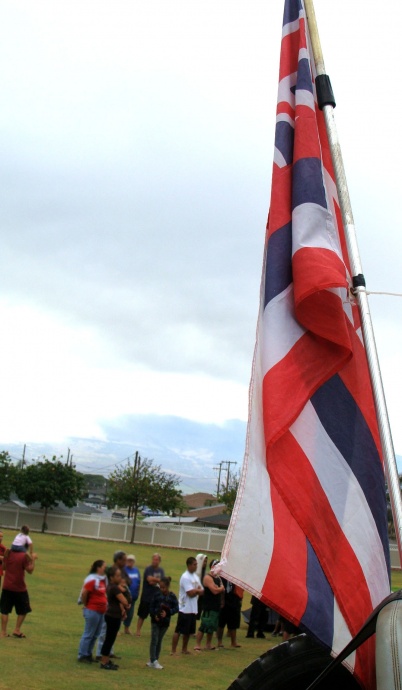
Hawaiian flag. File photo by Wendy Osher.
By Maui Now Staff
A documentary film entitled Hawaiʻi A Voice for Sovereignty will be broadcast nationally on PBS stations affiliated with the First Nations Experience Network.
The film will air in eight states on... March 22, 2015.  The latest broadcast schedule does not include HawaiÊ»i.  (A complete listing is available below.)
The award winning documentary focuses on the Native Hawaiian struggle to reconnect to the land and to obtain sovereign rights after the illegal takeover of by US businessmen and military on Jan. 17, 1893.
On November 23, 1993, President William Jefferson Clinton signed United States Public Law 103-150, also known as the “Apology Resolution,” acknowledging the 100th anniversary of the overthrow of the Kingdom of HawaiÊ»i and offering an apology to Native Hawaiians on behalf of the United States.
In the film, photojournalist and producer Catherine Bauknight explores the Native Hawaiian culture and the social, economic and ecological issues that have developed since the overthrow.
“I have witnessed firsthand what happens when a small, sustainable society is separated from their land, fresh water and ocean resources and then converted for profit by western powers,” said Bauknight in a press release statement.
“Today, with over 8 million tourists a year crowding their small and ecologically-fragile islands, the Hawaiians are disconnected from their own land and suffer some of the highest rates per capita of poverty, homelessness, health issues related to diet and incarceration in the state. My goal is to continue to share the story to assist the Hawaiian’s ongoing struggle for sovereign rights and their efforts as stewards of the land to protect what’s left from further destruction.”
The documentary was initially released in 2012, and has since been shown internationally at various festivals, screenings, and events.
It was recently honored with the “Best Global Documentary Film Creating Change” during the Pacific Talent Film Festival in Los Angeles, California.  Here in the islands, it earned the Audience Award for Best HawaiÊ»i Film at the Maui Film Festival.  Other accolades include the Mana Wairoa Award from the Maori Film Festival, and the Best Global Documentary Film Creating Change from the Pacific Talent Film Festival.
The soundtrack for the film features some of Maui’s talented musical artists including:Richard HoÊ»opiÊ»i, George Kahumoku, Willie K, KeÊ»eaumoku Kapu, Charles KaÊ»upu, KealiÊ»i Blaisdell, and Wilmont KahaialiÊ»i.
BROADCAST SCHEDULES:
 6:30 p.m. PT, 9:30 p.m. EST on Feb. 22 and March 22, 2015.
  • Alaska: KUAC Channel-9.4
  • California: Greater Los Angeles Area – FNX available on Verizon Fios-KVCR (channel 471); Direct TV KVCR 24-2 (channel 24.2 Over the Air), and locally (channel 24.2) in the greater Los Angeles; KEET TV Channel-13.4 (California Public Television for the Northcoast; Eureka, Hoopa & Fortuna); KJHP-LP Channel-18 (Morongo Valley)
  • Illinois: Chicago WYCC PBS Channel-20.2
  • Indiana: Comcast Channel-373
  • Minnesota: Paul Bunyan Channel-173; Lakeland Public Television (LPTV) in Bemidji Channel-9.2; Lakeland Public Television (LPTV) in Brainerd Lakes Channel-22.2; Mid Continent Communications Channel-595
  • Oklahoma: Cat Channel-47
  • Utah: UEN Channel-9.3
  • Wyoming: K32EL-D Channel-32.1

18 March 2015

Bonaire Activist comments on "illegal" political status on eve of territory's election (Dutch)


Aan: De gezaghebber van het eilandgebied van Bonaire, dhr E Rijna en Minister van Binnenlandse zaken en Koninkrijksrelaties, Dhr. Plasterk Plaza Wilhelmina 1 

Bonaire, 17 maart 2018 

Betreft: verkiezing van de leden van de eilandsraad 18 maart 2015


Uit

James Finies
Postbus 341 
Kralendijk, Bonaire


Geachte Gezaghebber en Minister, 

In verband met de te houden ER-leden verkiezing van 18 maart a.s. breng ik U het volgende onder Uw aandacht:

-in 2004 is er een referendum gehouden die een fraudulente process heeft doorlopen en geen internationaal rechtsbasis bezit om de huidige staatsstructuur te hebben opgelegd op onze volk en niet het legitieme volkenrechterlijk stem geniet.

-op 10 Oktober 2010 is het autonome land Nederlandse Antillen ontbonden zonder de legitieme toestemming van het Antilliaanse volk (non-dissolution-principle) en tegen het stem van het volk van St Eustatius in.

-in december 2010 is er een referendum gehouden die de ilegale status van integratie in Nederlands staatsbestel als “openbaar lichaam” onder artikel 134 had moeten legitimeren. Dit nadat de afgesproken referendum in maart 2010 door de on-democratische vertegenwoordigers van het Nederlands belang gezaghebber Thode en gouverneur Goedgedrag op international-rechterlijke betwistbare redenen, waarbij volkenrechterlijk referenda verzwaardere eisen kan worden opgevoerd om de binding met het gebied te waarborgen hebben vernietigd. De vraag stelling: “ Ik ben er het ermee eens, dat Bonaire een openbaar lichaam is geworden in de zin van van artikel 134 van de Nederlandse grondwet: “Ja” of “Nee”. Dus de legitimatie van deze illegal status dat de bedoeling was van deze referenum is ook tot vandaag nog steeds uitgebleven , door de duidelijke afwijzing en sabotage van het referendum en tot op dit moment nog niet en nooit uitgebrachte rapport van de Verenigde Naties supervision.

-de eilandsraadsverkiezing van 8 maart 2011 had geen rechtsbasis door het niet legitimeren van de illegale OLB status door de referendum van december 2010. En bovendien heeft het volk ook de partij UPB die de status van OLB steunde en trok afgewezen en stemden op de andere partijen , PDB, PHU en MLB die een referendum wilden om het volk zich uit te laten spreken over hun toekomst.

-in september 2011 heeft dmv de gezaghebber Thode en de rijksvertegenwoordiger Stolte beiden a-politiek en on-democratisch vertegenwoordigers van Nederlands belang, door politieke interventie in de lokale politiek, de rechtmatige regerende koalitie gedestabiliseerd met het gevolg met het val van de koalitie en vormen van de huidige koalitie die ondemocratisch(met ca 1000 minderheids-stemmen) tot nu toe heeft geregeerd. 

-in september 2012 heeft het Boneriaans(en BES) bevolking weer uitdrukkelijk deze status, door de opgelegde 2de kamer-verkiezingen die ook een “verkapte legitimatie van deze status zou kunnen worden” afgewezen als hun volks-vertegenwoordigers (ca 80%).

-in mei 2014 heeft het Boneiraans(en BES) bevolking weer uitdrukkelijk deze status en Europese parlament verkiezing afgewezen(ca 80%).

-in december 2014 heeft St Eustatius een referendum georganiseerd waar u op de hoogte ben dat er hevig is gesaboteerd door de verantwoordelijke authoriteiten maar wel weer een duidelijk beeld en signaal gaf van de onvrede en opgelegde status van openbaar lichaam overduidelijk afwees en koos voor hun rechtmatige onschendbaar recht op zelf-bestuur of autonomie. 

Al deze feitelijke officiele legale intenties om subtiel via een verkapte democratie deze illegale status te legaliseren is zoals u ook weet door onze volk afgewezen, en niet eens mee te voegen de talloze protestacties, handtekening-acties, enz, tenzij U blijft doorzetten met het forceren van deze illegale status die het Boneriaans volk totzover heeft verdeeld en ongelukkig houdt. Nu is weer een oproep voor de Boneriaanse bevolking te gaan stemmen voor de eilandsraadsleden op 18 maart 2015. U gaf diverse malen aan dat deze eilandsraadsleden verantwoordelijk zijn voor het referendumwet en organiseren hiervan. En u zal ook weten dat er na 2004 oplopend tot un een bevolkings-imigratie-groei explosie was, 400% stijging waarvan de overgrote meerderheid Europese Nederlanders die naar hun (ei)land Nederland in de cariben, Caribisch Nederland, openbaar lichaam Bonaire zijn geimmigreerd en allemaal direkt stemrecht hebben verworven. Dus dat deze ER verkiezing van 18 maart 2015 nooit en nimmer een eerlijke democratische weergave zal zijn door deze invasieve stemgerechtigden, en u beweerd een verduidelijke beeld en zelfs als legitimatie of legalisatie van de tot nu toe illegale status van integratie(nooit heeft iemand of het volk van Bonaire voor integratie gestemd en op geen enkele stembiljet of referendum) in het Nederlands staatsbestel als Openbaar Lichaam. Verschijdene verzoeken aan U en de Minister om in een a-politieke positie in te grijpen en een a-politieke referéndum te helpen organiseren voor het volk, gebaseerd op het feit er een grove mensen en volkenrechterlijke schending van rechten plaats heeft gevonden en bovendien ons “onschendbare recht op zelf-bestuur” heeft geschonden en onteigend en u telkens weer verwijst en naar deze “ilegale en korupte en met invasief/besmette Europees-Nederlands stemmen democratie” overlaat. Dus al het corruptie en omkooppartijen dat niet meer een publieke geheim is maar een alledaagse aktiviteit(Booi heeft zelf op de Nlse TV bekend dat het normaal is?) omtrent de verkiezingen, dus uw ingevoerde volmacht-stemmen dat afgeschaft was op de Antillen daardoor, en u geen gehoor of geen serieuze intentie doet of neemt voor onderzoek of een of andere commissie in het leven heeft geroepen om de bevolking gerust te stellen dat u ook een oor heeft voor hun zorgen, dus het afkopen van hun enige zeggenschap, dus de verkiezing. Dat u dan laat blijken dat u de andere kant opkijkt, dus niet naar het waarborgen van hun veiligheid en rechtstaat basis, dus een eerlijke democratisch process. En verder het stempas distribuitie was direkt op hetzelfde pad als de gesaboteerde St Eustatius referendum van december 2014, onduidelijkheid en chaotisch, en verder stembiljetten uitgegeven aan mensen die zelfs meer dan 10 jaar niet meer op Bonaire wonen. Vandaar of is wel te begrijpen dat U aangeeft dat u alleen een geldige identificatie van voor 19 maart 2010 ook geldig is, dit zeker voor het uitoefenen van een corrupte-volmacht van een uitlandig wonende stemgerechtigde. 


Ook is te melden dat er de ca 25% funktioneel-analfabeet bevolkings-groep zeker grove problemen zal hebben met uw uitgebreide Nederlandstallige stempas instructies en zeker met uw Europees Nederlands stembiljetten zonder partij-kleuren tenzij u wel toestaat dat de partijen met hun folkloristische kleuren volop kampagne voeren, dus nog meer verwarring en chaos ondersteund en geen eerlijke democratisch process hier gaande is. Een en al en niet te vergeten hoe het mogelijk is of wij als volk moeten kunnen begrijpen dat u in de autonome landen Curacao, Aruba en St Maarten in hun interne politiek en autonomie ingrijpen en in uw eigen politiek-verantwoordelijk gebied en Nederland in de Cariben, Bonaire dat niet doet. Dus politieke leider die corruptiezaak bekent en veroordeeld wordt en door uw eigen ministerie ontslagen wordt toch blijft funktioneren als gedeputeerde, (plaatvervangende)gezaghebber en zonder enig argwaan van uw kant. Dus dan is ook duidelijk voor het volk dat de stapels corruptie zaken die uw openbaar ministerie jarenlang hebben uitgepluist en door uw zgn niet mee willen bemoeien met lokaal-politiek nooit zullen begrijpen en accepteren dat u presteer net voor alle laatste voorgaande verkiezingen onredelijk en wantrouwig te handelen in de zaken van de bekende politicus Booi die de trekker van deze illegale status is en verklaard heeft een referendum “over zijn dead body” dus nooit zal plaatsvinden. Nooit zal u kunnen verklaren dat voor de referendum van desember 2010, op 30 november 2010 de nasporing, onderzoek te stoppen door uw rechter, dan 26 januari 2011 seponeren van de zaken en in maart de verkiezing 2011, en in oktober 2014 een week voor de laatste stap in een unaniem geakoorde besluit tot starten van de referendumprocess, Booi weer vrij, weer in de Eilandsraad als lid toe-treed en direkt het referéndum stopt en nu alweer, echt het record , vrijspraak een paar dagen voor de verkiezingen. U zal wel begrijpen dat ons geloofwaardigheid in uw te noemen onafhankelijk rechtstaat organen en systemen echt geschaad is of niet meer te vertrouwen zijn en u als lokaal politiek instrumenten tegen de mensen en volkenrechterlijke zelfbeschikkingsrecht van het volk wordt beschouwd en wordt gebruikt.

Tenslotte teken ik hiermede oficieel bezwaar tegen deze eilandsraads-leden-verkiezing die geen legitieme rechtsbasis bezit, en geen eerlijke democratisch basis bezit door uw invasieve opgelegde Europese Nederlanders stemgerechtigden en deze illegale status niet legitimeer omdat het alleen te legitimeren of te leagliseren is door een legitieme zelfbeschikkings volksraadpleging en mijn stem (en alle willige petitie tekenaars voor een zelfbeschikkings referendum en anderen) onder protest uit zal brengen.


cc. Kabinet van de Koning Leden van de 2de kamer van de Staten-Generaal Leden van de 1ste kamer der Staten –Generaal Leden van de vaste commissie voor Koninkrijksrelaties Office of the High Commisioner for Human Rights