08 May 2014

Marshall Islands primed for climate fight for survival


From nowhere does the problem of climate change look more desperate than standing on the shores of the Marshall Islands. The tiny coral islands, seemingly idyllic, are slowly sinking into the ocean as sea levels rise. A 1.5C increase in global temperatures could make the islands virtually uninhabitable. So far, the planet has warmed by around 0.8C, and scientists warn that the CO2 already emitted means we’re already locked in for more.
Unsurprisingly, this means the Marshall Islands and other small island states have become some of the most progressive voices within the international negotiations around a treaty intended to limit the reach of climate change.This leaves Marshall Islands foreign minister Tony de Brum, who leads their climate change efforts, with a tough job, pushing for a climate change deal that is far beyond what less vulnerable countries would happily settle for.

“Carbon free should be the ultimate goal of everyone and if we concentrated in developing on that pathway it’s a win-win for all concerned,” he tells RTCC, during a visit to London. He has just come over from Brussels, where he met with EU climate commissioner Connie Hedegaard, and is about to fly over Abu Dhabi, where he will discuss with other politicians the potential for further pledges at a high-level meeting to be hosted by the UN Secretary General Ban Ki-moon in September.

The international climate negotiations may be notoriously tough, but with their target of limiting warming to only 2C, they are not stringent enough for some of the small island states, for whom even a successful treaty poses an existential threat. At present, even this modest 2C level of success is by no means a foregone conclusion; while the Marshall Islands are sinking, big emitters such as the US, India and China remain embroiled in largely ideological battles over who should bear the brunt of reducing their greenhouse gas emissions most and first.

Even if the Marshall Islands went carbon neutral today, it would barely make a dent on combatting climate change, where the impacts bear no relation to where the greenhouse gases are being emitted. In fact, it is usually those who have least contributed to the issue that suffer the most. While the Marshall Islands have a per capita emissions rate of 2 tons of CO2 for their 53,000 population in 2010, compared 17.6 in the US for each of its 317,000,000 inhabitants, they face a perilous future. But although the Marshall Islands are a speck on the map compared to these countries both in terms of size and emissions, their vulnerability means that they punch above their weight when it comes to the negotiations.

“I think that we have enjoyed relatively good rapport with development partners, the big states, the big emitters,” says de Brum. “We try and bring to the table what we consider to be the immediate and longer term concerns of the small islands states and to point out that our ambitions and goals are not that much different from those of the developed countries, that the idea of climate change leadership and working towards sensible climate change policies does not necessarily cancel out development.”

Rather than waiting for the annual UN climate conference to build these bridges, the Marshall Islands have been proactive in getting key players together in order to start forging the common ground that everyone needs to stand on if there is to be any chance of a successful outcome in Paris 2015, when the UN hopes a climate treaty will be struck.

Last year, they hosted the Pacific Islands Forum, where a focus on climate change saw participants sign a ‘Majuro Declaration’, designed to spark “a new wave of climate leadership”, which Marshallese president Christopher Loeak then presented to Ban Ki-moon as a “Pacific gift” at the UN General Assembly. More recently, they hosted the Cartagena Dialogue, bringing together an unusual selection of the global north and south countries with a progressive attitude to tackling climate change.

And Tony de Brum is about to make his way to a meeting of the Major Economies Forum—the second time the Marshall Islands have been invited to participate—which he says is a sign that other major players are starting to realise they play key role in facilitating progressive action. “We view that as America and the other big countries’ recognition of our ability to contribute to that debate and to come up with solutions that can be accepted and promoted by the big states as well,” he says.

He adds: “We also have been able to dialogue directly with the United States and also with Chinese officials throughout the Pacific and have been able to share with them what our concerns are. It seems to us in fact that is taking hold.” The conversations that he has had during his current diplomatic mission have left him feeling hopeful he says, as there seems to be a growing recognition among international leaders of the Marshall Islands’ predicament.

But there is one thing that this trip cannot do, which is allow foreign politicians to witness the destruction facing the Marshall Islands for themselves. “There’s nothing like seeing it,” says de Brum. “Landing on the airstrip in the capital city of Majuro and seeing sandbags on either side of the runway is a message that’s rather too powerful to forget.”

He explains how those who have attended events hosted by the Marshall Islands in recent years have been “awed” by the sight of the disappearing islands—a feeling which has contributed to the success of his meetings with the likes of Connie Hedegaard and UK foreign minister Hugo Swire. “It’s ridiculous the kind of climate displays that are occurring in small island states, but it was a powerful message that we wanted to share with the world, and I think it worked,” he says. “Our job as a bridge between the developed states and the small island vulnerable states is difficult, but it’s something that someone must do.”.


SOURCE: RTCC/PACNEWS

07 May 2014

Claims British territory of Diego Garcia was 'used by US as a secret jail

MailOnline - news, sport, celebrity, science and health stories


Leaked Senate Committee report says UK knew about CIA 'black jail'

Sources claim 'high-value' terror suspects were held on island

Operation was carried out with 'cull co-operation' of UK government


The British government is under pressure to answer claims it allowed the Indian Ocean island of Diego Garcia to be used to hold Al Qaeda suspects in a secret jail. A leaked report in the US suggests the CIA held ‘high value’ detainees on the British territory with the ‘full co-operation’ of the UK government. The claims contradict repeated denials that Britain had ever let the US use Diego Garcia for the ‘extraordinary rendition’ of terror suspects.


The British territory of Diego Garcia in the Indian Ocean was used to hold 'high value' terror suspects in a secret black jail, according to reports in the US. A report by a Senate Intelligence Committee into the CIA’s kidnap and torture is due to be published in weeks.
But sources told Al Jazeera America it includes claims that Britain was aware of the use of Diego Garcia as a secret ‘black jail’.

US President George W Bush confirmed in 2006 that the CIA had operated a network of secret prisons around the world to interrogate terror suspects.

The Senate report claims that ‘the CIA detained some high-value suspects on Diego Garcia, an Indian Ocean island controlled by the United Kingdom and leased to the United States’, Al Jazeera America reported.

‘The classified CIA documents say the black site arrangement at Diego Garcia was made with the “full cooperation” of the British government.’

Foreign Secretary William Hague is under pressure to answer questions raised by the reports
In 2011 ministers denied Diesgo Garcia had been used in this way.

Foreign Office minister David Lidington said: Aside from the two cases of rendition through Diego Garcia in 2002, the US Government has confirmed that there have been no other instances in which US intelligence flights landed in the UK, our Overseas Territories, or the Crown Dependencies, with a detainee, on board since 11 September 2001.’

However, Mr Hague now faces pressure to address the claims which have emerged from the Senate Committee report. Reprieve, a legal charity which represents victims of rendition, has written to Mr Hague demanding an explanation.

Reprieve strategic director, Cori Crider said: ‘We need to know immediately whether ministers misled Parliament over CIA torture on British soil.

‘If the CIA operated a black site on Diego Garcia, then a string of official statements, from both this and the last government, were totally false.

‘Were ministers asleep at the wheel? Or, as the report suggests, have we been lied to for years?

‘The Foreign Secretary must urgently clarify whether the CIA ran a secret prison on Diego Garcia, and whether our clients Abdel-Hakim Belhaj and his wife Fatima Boudchar were among its victims.’

A Foreign Office spokesman said: ‘I refer you to statements we’ve made in the past on this issue.’

06 May 2014

Women Call For Removal Of Military From Asia-Pacific Region

                                                                       Pacific Scoop

Peace campaigners release WILPF Auckland Declaration


AUCKLAND, New Zealand (Pacific Scoop, April 27, 2014) – Women peace campaigners from Aotearoa, Australia, Hawai’i, Japan, Philippines and Polynesia/Te Ao Maohi have called for the removal of military occupation and bases in the Asia-Pacific region.

Meeting at AUT University in New Zealand, the three-day conference organised by the Aotearoa section of the Women’s International League for Peace and Freedom also called for the removal of military training and promotions that "normalise violence" in schools.

The women campaigners urged that military spending be reallocated to eliminate all forms of violence – domestic, social and military. The WILPF Auckland Declaration said:


* Military occupation and military bases must be removed from the Asia Pacific region.

* A call for the decolonisation and demilitarisation of the Pacific came from women at a regional gathering of Women’s International League for Peace and Freedom (WILPF) in Auckland April 25-27.

* Women attended from Rapa, Polynesia/Te Ao Maohi, Japan, the Philippines, Aotearoa, Australia and Hawai’i.

* They also call for the removal of military training and promotion from schools since this normalises violence. Military spending should be reallocated to eliminate all forms of violence: domestic, social and military, to meet human needs.

* People have been dispossessed of their land through military colonial forces and all forms of human rights violations.

* The meeting called for recognition of independent countries [which] are still under colonial military domination.

* "Militarisation in the past has caused the colonisation of countries which are still under domination," said Roti Make from WILPF Polynesia section. She specified Hawai’i under the USA, Rapanui under Chile, French Polynesia/Te Ao Maohi, Kanaky (New Caledonia), Wallis and Futuna annexed under France, and West Papua under Indonesia.

* "We call on the United Nations to accept our identity and recognise us as independent nations," she added.

* The women also called for an end to joint military exercises.


WILPF has its hundredth anniversary in April 2015 and they invite all women in the region to join their call.
The conference was held in partnership with Peace Movement Aotearoa and AUT’s Pacific Media Centre.


05 May 2014

Independence supporters in New Caledonia unite for sovereignty

Independence movement launches unity ticket 


       Islands Business


Exclusive story
By Nic Maclellan 
From Paita, New Caledonia


The meeting is supposed to start at 6pm, but the audience drifts in slowly and by 7 o’clock, the customary welcome is underway. The Kanak independence movement is gathering in Paita, a town on the outskirts of the capital Noumea, to rally support for this week’s crucial elections in New Caledonia.
A restricted roll of long-term residents will vote this Sunday 11 May, to choose representatives for three provincial assemblies (in the North, South and Loyalty Islands) and for the national Congress in this French Pacific dependency.

For the first time since 1989, the independence movement is presenting a united ticket in the Southern province, in a bid to gain a majority in New Caledonia’s Congress. The four political parties that make up the Front de Libération Nationale Kanak et Socialiste (FLNKS) have developed a joint list of candidates with other parties that are not formal members of the independence coalition: Parti Travailliste (PT), Dynamique Unitaire Sud (DUS), Libération Kanak Socialiste (LKS) and the local branch of the French Socialist Party.

After 15 years transition under the 1998 Noumea Accord, this week’s vote is important for the future political status of New Caledonia. By 3/5 majority, the incoming Congress can decide to proceed to a referendum on self-determination. If a date is not set, the French State must organise a vote before 2018, although opponents of independence are actively campaigning for alternative scenarios to avoid a popular vote.

Voting is not compulsory under New Caledonia’s electoral system, so it’s important for supporters and opponents of independence to mobilise their base and woo new converts. Around the country, candidates are campaigning: handing out leaflets to potential supporters, using blogs, Youtube and Facebook to reach younger voters, kissing babies in the markets and organising old-style public meetings.

Building a rainbow nation

Last week, around 300 people gathered in Paita’s community hall to meet candidates of the independence movement’s united electoral list. Former political rivals stand together on the stage beneath a giant Kanak flag and a banner with the unity ticket’s slogan: Construisons notre nation arc-en-ciel (Let us build our rainbow nation together).
As the evening progresses, speaker after speaker highlights the imbalance between indigenous Kanaks and the European community which makes up the bulk of the Southern province’s population.

For Marie-Pierre Goyetche of the Parti Travailliste (Labour Party), the issue is employment. Goyetche, President of the USTKE trade union confederation, highlights the need for training for young Kanaks, so they can compete in the jobs market with migrants arriving from France or Wallis and Futuna. For Jean-Pierre Deteix of the Socialist Party, the challenge is housing, with 8000 people living in squatter settlements around Noumea and thousands more seeking adequate public housing. Yvon Faua of the Rassemblement Démocratique Océanien (RDO) talks of education, the challenges for Kanaks and islanders to succeed in the French education system and the importance of the school as a place to develop civic values. Sylvain Pabouty (DUS) and Louis Mapou (Palika) highlight the need for economic development to build an independent nation.
But then Roch Wamytan takes to the stage. Wamytan heads the rainbow electoral ticket, as a high chief from Saint Louis, a former President of the FLNKS, a past chair of the Melanesian Spearhead Group (MSG) and currently Speaker of New Caledonia’s outgoing Congress.

The veteran Kanak leader calls on the audience to rally their friends, family and neighbours to vote next Sunday, 11 May.
“Our opponents always forget their history,” he says. “But these elections are part of the long struggle of the Kanak people to determine the future of our nation, our rainbow nation, and to develop as a sovereign country.”

Unity in the South

On 11 May, a restricted electorate of long-term residents will vote for 76 members in three provincial assemblies, with 40 seats in the South, 22 in the North and 14 in the outlying Loyalty Islands. A proportion of these assembly representatives (32 from the South, 15 from the North and 7 from the islands) make up the 54-member Congress. 

At their first meeting a week after the election, members of Congress choose the 11-member Government of New Caledonia, who then select the President and Vice President of the country. Only groups with six or more members (11 per cent of the Congress) can gain seats in the multi-party government.

After generations of settlement and ongoing immigration, the Southern province is a bastion of anti-independence sentiment, long dominated by conservative parties loyal to France. European and immigrant Wallisian voters hold sway in the province, while the indigenous Kanak population (who largely support independence) dominate in the rural provinces.

This year, however, the Right is divided between competing parties, uncertain about the future, and the FLNKS hopes to seize the moment.

In the North and Loyalty Islands, the major independence parties Union Calédonienne (UC), Parti de Libération Kanak (Palika) and Parti Travailliste (PT) are running their own tickets, competing to gain a majority in the provincial assemblies. 

However, the independence movement has learnt from bitter experience that disunity in the European-dominated South can lead to defeat. To gain a seat, an electoral list must win enough votes to reach the threshold of five per cent of registered voters in the province. In 2004, there were so many pro-independence electoral lists that none of them reached the five per cent barrier. For five years, the Southern assembly had no dissenting voices from the independence movement. At the last elections in 2009, there were three different tickets and only four pro-independence representatives were elected to the 40-member Southern assembly.

In December 2013, the FLNKS Congress in Poya reaffirmed that there should be a united independence ticket in the Southern province. There was common agreement that the head of the list should be Roch Wamytan of Union Calédonienne (the largest party in the FLNKS). 

Beyond agreement on the head of the list however, there were months of hard bargaining to determine the order for the remaining candidates. With eight parties in the unity process, there was competition for the top spots that would ensure election to the Congress as well as debate over the manifesto to present to voters. 

The negotiations were also complicated by the requirement under France’s parity law that electoral lists include equal representation of men and women (the alternate listing of male and female candidates ensures that more than 40 per cent of New Caledonia’s Congress and assemblies are made up of women, a sharp contrast to most Melanesian parliaments where women are rarely represented in the legislature).

Mobilising the vote

Last March, supporters of independence launched a joint ticket for New Caledonia’s municipal elections under the banner of the Mouvement Nationaliste Unitaire (MNU). Although they could not defeat the anti-independence parties that dominate town hall politics in Noumea and surrounding towns like Paita, Mont Dore and Dumbea, the increased vote for the MNU gave heart to the independence movement for this month’s provincial elections.

In the 2009 Congress, supporters of independence held 23 seats in the 54-member legislature. To win just four more seats would bring the tally to 27-27. With five extra seats in the Congress, the FLNKS and its allies would hold the narrowest of majorities and could nominate the first pro-independence President of the country.

Yvon Faua of the RDO told Islands Business: “At the last elections, we held four seats in the South. In this month’s vote, we are hoping to double that representation and maybe even gain a majority in the Congress for the first time. But we must persuade young voters to look to their future.”

After mobilising their forces for the traditional May Day rally in Noumea last Thursday, the FLNKS will hold further public meetings in Mont Dore and Rivière Salée this week to bring out the vote. 

But with less than a week till the elections, there’s still a long way to go. It’s a difficult challenge to win a congressional majority: the independence movement must win a clean sweep in the Loyalty Islands, hold their ground in the Northern Province against a divided loyalist movement and successfully mobilise voters to take on the five anti-independence lists in the South. The RDO is reaching out to the large Wallisian and Tahitian communities in the South, but these Islander voters have long supported parties loyal to France, fearful of their status in an independent Kanaky.

This week is the 25th anniversary of the death of Kanak independence leader Jean-Marie Tjibaou on 4 May 1989. Tjibaou’s vision of an independent Kanaky still inspires the movement, even as the challenges of building a new nation remain.

(Part two of Nic Maclellan’s report will look at the loyalist parties in New Caledonia).

United Nations sends mission to New Caledonia

en.wikipedia.org


By Nic Maclellan
The United Nations has sent a delegation to New Caledonia in the lead up to crucial municipal and provincial elections as supporters and opponents of independence joust over who should have the right to vote.
The UN delegation arrived in New Caledonia in March in the midst of the electoral campaign for local town councils. The visit also coincided with the arrival of French judges charged with updating the electoral rolls for national elections to be held on 11 May.

According to a UN statement, the objective of the visit is to monitor “New Caledonia’s provincial electoral process, especially the technical issues related to the electoral lists for the provincial elections in May, as well as to uphold the spirit and letter of the 1998 Noumea Accord in this process.”

New Caledonia was relisted with the UN Special Committee on Decolonisation in 1986, and since that time the UN has maintained a watching brief over progress towards a referendum on self-determination in the French Pacific dependency.

As Islands Business magazine goes to press, voters in New Caledonia are awaiting the results of two rounds of voting in municipal elections held on 23 and 30 March.

The final results will give an indication of the balance of forces within and between political camps. A good result in the municipal elections will also provide momentum for political parties as they campaign for elections in May for New Caledonia’s three provincial assemblies and national Congress.
This year’s election is the culmination of a long transition under the Noumea Accord - if the incoming Congress agrees by 3/5 majority, the country can proceed to a vote on New Caledonia’s final political status. After 15 years of collegial government, relations between leading political figures have begun to fray in the lead up to the crucial vote.

United Nations scrutiny

The United Nations delegation was led by Amadu Koroma of Sierra Leone, vice president of the UN Special Committee on Decolonisation, joined by representatives from Ecuador, Papua New Guinea and Fiji, together with UN decolonisation experts and officials.

The two Pacific nations are both members of the UN decolonisation committee. Papua New Guinea’s UN ambassador Robert Aisi, chair of the Pacific Small Island Developing States (PSIDS) group, was joined in New Caledonia by Esala Nayasi, political director at the Fijian Ministry of Foreign Affairs.

While the visit was approved by the French Government, local anti-independence parties soon made it clear that they did not support the UN involvement in New Caledonian affairs. The Union pour une Calédonie dans la France, which unites some parties loyal to France, stated: “We state that the Union for New Caledonia within France does not support this visit… This visit brings with it tension and confusion, at a time we have need of clarity and serenity.” 

Philippe Gomes, leader of the anti-independence Calédonie Ensemble (CE), attacked the presence of a Fijian representative in the UN delegation. In a similar gesture to the one he made before the 2013 Melanesian Spearhead Group summit in New Caledonia, Gomes wrote to French Foreign Minister Laurent Fabius criticising Fiji as a “military dictatorship” that should not “interfere in the affairs of a democratic country.”

The UN mission met with political and community leaders, the Kanak Customary Senate and provincial authorities. It will present its report to a regional seminar of the UN Special Committee, to be held in Fiji in May, and the next formal meeting of the committee in New York.

Municipal elections

The municipal elections have brought new faces to local politics. Long-serving Mayor of Noumea Jean Leques announced last year that he would not re-contest his position on the capital city’s town council. Leques, an 82-year-old veteran of anti-independence politics, was first elected mayor in 1986 at the height of armed conflict between supporters and opponents of independence. From 1999, he also served as the President of New Caledonia for two years, following the first elections held after the signing of the Noumea Accord.

In a city where the majority of voters are of European heritage and oppose independence from France, there is a fierce competition for the top job between three anti-independence parties: Calédonie Ensemble (CE) led by Philippe Gomes; Rassemblement UMP (RUMP) led by Pierre Frogier, and the breakaway party Mouvement Populaire Calédonien (MPC) led by Gael Yanno.

Yanno, a former deputy mayor in Noumea, left the largest conservative party RUMP last year and established his own group after falling out with RUMP leader Pierre Frogier. Yanno is seeking to rally conservative French voters, criticising RUMP’s policies and Frogier’s attempts to build links with Union Calédonienne (UC), the largest pro-independence party in the country. RUMP has lost some support from European voters after it backed independence leader Roch Wamytan to be Speaker of New Caledonia’s Congress and endorsed the policy of flying two flags - the French tricolour and the flag of Kanaky - outside public buildings. 

In a pre-election coup, Yanno persuaded the conservative UMP party in France to formally endorse his breakaway group rather than the larger RUMP, to the annoyance of RUMP mayoral candidate Jean-Claude Briault. Another leading RUMP politician, Pierre Bretegnier, also defected to the MPC in the middle of the municipal election campaign.

The other leading candidate for Mayor of Noumea is Sonia Lagarde of the Calédonie Ensemble party. As well as serving in New Caledonia’s Congress, Lagarde is also deputy in France’s National Assembly in Paris, after defeating the long-standing RUMP representative in 2012 elections. 

For the municipal vote in the southern province, much of the independence movement has launched the Mouvement Nationaliste Unitaire (MNU) led by Jean-Raymond Postic. This is a united list that includes activists from a range of pro-independence forces: FLNKS members (UC, UPM and RDO) together with parties that support independence but are not formal members of the independence coalition: Libération Kanak Socialiste (LKS); Dynamik Unitaire Sud (DUS) and Parti Travailliste (PT).

This effort at unity has been undercut by a separate initiative led by Marie Claude Tjibaou, the widow of assassinated Kanak leader Jean-Marie Tjibaou. Her Ouverture Citoyenne (OC) has been widely criticised in the independence movement, with PT President Louis Kotra Uregei suggesting it is a deliberate attempt by the French state to disrupt efforts to build a common pro-independence platform: “Instead of having united pro-independence lists in the South, as it is necessary to prepare for the provincial elections in May, we see once again an Ouverture Citoyenne ticket, as happened in 2009. This list includes the League for Human Rights and the French Socialist Party, which does not support independence for this country - so we ask what are they doing there?” 

This effort by the MNU to unite independence supporters in Noumea has been replicated in nine other municipalities across the country such as the northern town of Hienghene where UC President Daniel Goa is leading a united FLNKS ticket. 

But in other areas in the Northern Province and the outlying Loyalty Islands where Kanaks are the overwhelming majority of the population, each different independence party is running its own list. On the island of Mare there are seven different tickets, while in other municipal battles, the Union Caledonienne (UC), the Party of Kanak Liberation (Palika) and the Parti Travailliste (PT) are all running their own tickets, seeking a majority on municipal councils. An FLNKS Congress in January called for competing parties to unite if there is a second round run-off against anti-independence forces.

While the municipal elections were focussed on urban issues, the social gulf between Kanaks and Europeans in Noumea raised broader tensions. CE’s Sonia Lagarde is mobilising support amongst French voters in the city by highlighting issues of security and youth delinquency, focussing attention on the many young, unemployed Kanaks who have moved to the capital looking for education, employment or enjoyment.

In contrast, the MNU electoral statement said: “There are great disparities between the northern and southern suburbs in Noumea. It is vital that we overcome the gap in public infrastructure in the northern suburbs, as well as improving the quality of life of all inhabitants so they can be proud of belonging to the same city.”

For the pro-independence MNU, town councils must work directly with the young: “This population is too often neglected. We must put together the equivalent of a Marshall Plan to help them avoid idleness and living on the edge. This plan would involve a policy of popular education, developing places to support them to provide activities for their spare time, artistic and cultural expression and professional training.”

Different voting rolls

Beyond the basics of housing, public transport, social services and jobs, the campaign for the municipal elections was intensely political, with competing parties seeing the town halls as a springboard for the vote next May to elect provincial assemblies and the national Congress. 

Because voting is not compulsory in New Caledonia, it is vital to mobilise uncommitted voters. But the electorate for the municipal vote in March is not exactly the same as the national poll on 11 May. 
New Caledonia’s voting system is different for local, provincial, national and European elections. All French nationals of voting age who register at the local town hall are eligible to vote in the March municipal elections, as well as elections for the National Assembly and Senate in France and European parliament. 

However under the 1998 Noumea Accord, voting for May’s crucial elections for the three provincial assemblies and the Congress is restricted to a limited electoral roll of New Caledonian citizens, rather than all French nationals. This special electoral roll for the local institutions is restricted to those who meet residency criteria set out in the Noumea Accord, a policy confirmed by a joint sitting of the French parliament in 2007. 

At the last Congressional elections in 2009, some 18,230 people resident in New Caledonia —11.8 per cent of the normal electoral roll — could not vote in that year’s elections for the local institutions. These were mainly French public servants, soldiers and short term contract workers who have travelled from Europe to the Pacific, but do not see New Caledonia as their home. In contrast, the independence movement has recognised since 1983 that the so-called “victims of history” - the descendants of the convicts, soldiers and farmers who arrived in New Caledonia in colonial days - were welcome in the country “to build a common destiny.”

02 May 2014

THE US – CARIBBEAN’S FRIEND OR UNINTENTIONAL FOE?


Sir Ronald Sanders
barack_obama_400_690436025In what has to rate as one of the most insensitive and outrageous demands on a Caribbean country, US government representatives have told the Bahamas government that it must drop “all duties” on US products entering the country as a condition of being admitted to membership of the World Trade Organisation (WTO).
Should the Bahamas agree to do so, the country would lose the larger part of US$700 million that it earns from duties on imports, the vast majority of which comes from the US for obvious reasons of proximity. In effect, agreement to what amounts to a preposterous request from the US would create such a large hole in the government’s revenues that it would be impossible for it to provide the goods and services that the Bahamian people have a right to expect of their government. Incidentally, that includes fighting drug trafficking and curbing the inflow of refugees on which the US places great emphasis.
What is more, surrender to the US demands would have a wholly decimating effect on such manufacturing that occurs in the Bahamas or that may be introduced in the future as part of a chain of operations that adds value in the course of multi-country production.  If there is a phased approach to the reduction or elimination of duties on US products that compete with theirs, the present manufacturers would have the time to make adjustments to their production and marketing, and thus may survive.
Not unreasonably, the Bahamas Minister for Financial Services, Ryan Pinder, told his country’s Chamber of Commerce and Employers’ Confederation that his government rejected the US request on the basis that it would virtually wipe out the domestic economy.
Who are the advisers to the US government on its relations with the Caribbean?  Whoever these persons are, they could not possibly be the US diplomatic staff in the region who would understand, at the very least, the difficult international trade and financial environment in which Caribbean countries are operating.  In that connection, it would be a fair expectation that they would advise the US Trade Representative’s Office that to demand immediate removal of duties on all US products would harm any Caribbean country in whose economic development and social progress they should have a vested interest. The US, as a good friend, should be helping its small neighbours to enter and function in the WTO, not making entry tough for them.
If the US government is surprised when Caribbean governments do not vote with it on resolutions in United Nations bodies and in the Organisation of American States, its officials should understand that US government’s insensitivity to the development challenges of Caribbean nations plays a large part in determining how they vote.
READ FULL ARTICLE AT 1804CARIBVOICES

01 May 2014

U.S.-Dependent Pacific Island Defies Nuke Powers


U.S.-Dependent Pacific Island Defies Nuke Powers

A Patriot interceptor missile is launched from Omelek Island Oct. 25, 2012 during a U.S. Missile Defense Agency integrated flight test. Credit: U.S. Navy
A Patriot interceptor missile is launched from Omelek Island Oct. 25, 2012
during a U.S. Missile Defense Agency integrated flight test. Credit: U.S. Navy

UNITED NATIONS, Apr 25 2014 (IPS) - The tiny Pacific nation state of Marshall Islands – which depends heavily on the United States for its economic survival, uses the U.S. dollar as its currency and predictably votes with Washington on all controversial political issues at the United Nations – is challenging the world’s nuclear powers before the International Court of Justice (ICJ) in The Hague.
The lawsuit, filed Thursday, is being described as a potential battle between a puny David and a mighty Goliath: a country with a population of a little over 68,000 people defying the world’s nine nuclear powers with over 3.5 billion people.
"The United States should defend the case and widen the opportunity for the Court to resolve the wide divide of opinion regarding the state of compliance with the disarmament obligations." -- John Burroughs
John Burroughs, executive director of the Lawyers Committee on Nuclear Policy and the U.N. Office of the International Association of Lawyers Against Nuclear Arms (IALANA), told IPS the Marshall Islands and its legal team strongly encourage other states to support the case, by making statements, and by filing their own parallel cases if they qualify, or by intervening in the case.
Burroughs, who is a member of that team, said the ICJ, in its 1996 advisory opinion, held unanimously that there exists an obligation to pursue in good faith and bring to a conclusion negotiations on nuclear disarmament in all its aspects under strict and effective international control.
And these cases brought by the Marshall Islands nearly 18 years after the ICJ advisory opinion “will put to the test the claims of the nine states possessing nuclear arsenals that they are in compliance with international law regarding nuclear disarmament and cessation of the nuclear arms race at an early date.”
The nine nuclear states include the five permanent members (P5) of the U.N. Security Council, namely the United States, the UK, France, China and Russia, plus India, Pakistan, Israel and North Korea.
Burroughs said three of the respondent states – the UK, India, and Pakistan – have accepted the compulsory jurisdiction of the Court, as has the Marshall Islands.
For the other six states, he said, the Marshall Islands is calling on them to accept the Court’s jurisdiction in these particular cases.
“This is a normal procedure but the six states could choose not to do so,” said Burroughs.

READ FULL ARTICLE AT INTER PRESS SERVICE

29 April 2014

The search for transparency in a global gold rush for rare earths

the guardian


Rare earth elements are an essential ingredient of modern technologies, but poor regulation has led to environmental ruin.
Bright Yellow Sunset French Polynesia
Japanese researchers say they have found evidence of rare earth elements under the seas in French Polynesia. Photograph: Douglas Peebles/Corbis
A new global gold rush is under way. But today's prospectors aren't the fortune hunters of old, panning for precious nuggets on the American frontier. They're mining companies hoping to find lucrative deposits of rare earths, the 17 elements vital for the production of smartphones, laptops, electric cars, wind turbines and other technologies.
Although rare earths are abundant in the earth's crust, they are difficult to find in commercially viable concentrations. Extracting individual elements from the host mineral's chemistry is a complex and energy-intensive process, involving strong acids and other hazardous chemicals. Radioactive materials such as uranium and thorium are often found alongside rare earth elements, and these can end up in the "tailings" – a toxic stew of waste products from the refinement process.
In recent years the business of mining and processing rare earths has fallen almost exclusively to China, with catastrophic results. Communities living around the Bayan-Obo mining area in Inner Mongolia have had their crops, health and water supply ruined by a large, poorly maintained tailings lake. In Southern China, ion-absorption clay deposits rich with the most valuable "heavy" rare earths have given rise to illegal mining and smuggling operations.
For more than two decades Beijing effectively turned a blind eye; lax regulation of the industry allowed it to sell rare earths at low prices and dominate the global market. That changed in 2010 when China cut export quotas on rare earth supplies by almost 40%, citing a desire to clean up the mess the industry had created, consolidate it into several large districts and crack down on illegal smuggling – believed to account for almost a third of all rare earth elements that left the country in 2008.
China not only produces rare earth intermediate products, such as metals, alloys and carbonates, but manufactures the LEDs, catalysts, batteries and magnets that make use of them. According to Professor Saleem Ali, director of the Centre for Social Responsibility in Mining, that makes it "very difficult to track and trace [rare earth elements] from the mine to the product, because a lot of electronics manufacturers are outsourcing their product manufacturing and operations to Chinese companies, which get that material from somewhere within China".
Buyers in the US, EU and Japan were frustrated, convinced that China was using its effective monopoly of the market (estimated at the time as 95% of supply) to force up prices and encourage high-tech manufacturers further up the supply chain to shift their operations to the country. An appeal to the World Trade Organisation resulted in a ruling that Chinese restrictions on exports are incompatible with its rules, although Beijing is expected to appeal.
The Oeko-Institut (Institute for Applied Ecology) fears the "global pressure for a steady rare earth supply might lead to further new mines outside of China with unacceptable environmental standards".
Rich deposits of rare earths have already been identified in Malawi, Namibia, South Africa, Vietnam, Kazakhstan, Afghanistan and Laos, as well as Canada, Greenland, Australia and the US. Japanese researchers claim to have discovered vast deposits of rare earth minerals in the seabed in international waters, east and west of Hawaii and east of Tahiti in French Polynesia. The high upfront costs of establishing a mine, and potentially long and complex approval processes, could prevent many of these deposits from being exploited in the near-term.
Yet existing mines in Australia a0nd the US, which were forced out of business by cheap Chinese exports, have recently reopened. Mountain Pass Mine in California now features state-of-the-art waste processing facilities (it faced heavy fines before its closure for failing to report radiation-laced wastewater spills).
Lynas Corporation, which owns the Mount Weld mine site in Western Australian (reportedly one of the richest deposits in the world), has built a processing plant in Kuantan, Malaysia, the first to be finished outside China in three decades. The plant faced opposition from groups such asSave Malaysia Stop Lynas, after fears of a repeat of the radioactive contamination caused by the Asian Rare Earth plant in Bukit Merah two decades ago, blamed for birth defects and an increase in local cancer cases.
In Greenland, the government has overturned the country's 25-year ban on uranium and rare earth mining in the hope of boosting the country's cash-strapped economy. But there are concerns that the proposed mines will harm fragile ecosystems, and damage the traditional Inuit fishing and hunting trades. And several years on from China's rare earth export restrictions, which kick-started the hunt for alternative supply chains, smuggling and environmental damage is still an issue.
Siemens, Samsung, Toyota and other major technology manufacturers are already designing new products that use fewer rare earths or substitute materials. Recycle rates of rare earths from existing products, very low because of the expense and complexity involved, may also increase in future (Honda has already begun extracting more than 80% of its rare earth materials from nickel-metal hydride batteries).
Julian Kirby, lead campaigner for Friends of the Earth's Make It Better initiative, which aims to make companies come clean about their supply chains, is adamant that "environmental costs must be factored into the prices of rare earths", creating an incentive to recycle existing materials.
Kirby also believes there should be "a step change in reporting" to ensure it includes non-financial information. Only then will electronics manufacturers take greater responsibility for the way rare earth elements are mined and refined.

23 April 2014

Pueblo indígena Raizal de San Andrés busca estrechar lazos con pueblos caribeños nicaragüenses

El 19 Digital

Raúl Lenin Rivas

(see original article here

Pueblo indígena Raizal de San Andrés busca estrechar lazos con pueblos caribeños nicaragüenses


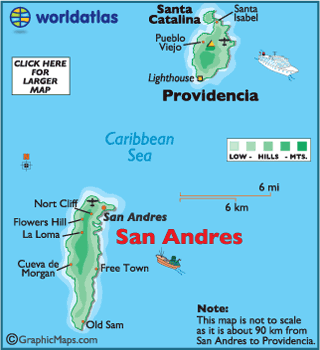
Establecer relaciones culturales, comerciales y tener un acercamiento con los pueblos originarios de la Costa Caribe nicaragüense es el propósito de la visita de una delegación de la Autoridad Nacional del pueblo Raizal del Archipiélago de San Andrés, Providencia y Santa Catalina que arribó a suelo nicaragüense la noche de este lunes 10 de marzo.

Dicha delegación, integrada por el Vicepresidente de la organización, su Coordinador, el Secretario General y la Vocera, fue recibida en el Aeropuerto Internacional Augusto C. Sandino por el Vicecanciller de Cooperación Externa Valdrack Jaentschke y a partir de este martes realizará una gira de trabajo por territorio de la Región Autónoma del Atlántico Sur de Nicaragua, donde sostendrá encuentros con las autoridades locales y regionales de los pueblos indígenas de Bluefields, Corn Island y Laguna de Perlas en búsqueda de lograr un intercambio y relaciones comerciales, culturales y deportivas para unir a los hermanos caribeños sin importar fronteras o límites territoriales.

“Nosotros tenemos una relación desde hace muchos años que se ha roto y nosotros estamos buscando volver a lo que es nuestra herencia ancestral, tenemos hermanos aquí en este país y queremos volver a encontrarnos y mantener esa unión que nunca debió habernos separado”, manifestó Corine Beberly Duffis Steele, Vocera de la Autoridad.

Jairo Rodríguez Davis, Coordinador de la Autoridad Nacional Raizal detalló que con su visita pretenden reconstruir esa relación ancestral de forma armoniosa entre los pueblos indígenas aprovechando las afinidades y vínculos muy fuertes con las poblaciones de Corn Island y Bluefields, relación que se debe mantener independientemente de los países que tengan dominio sobre los territorios marítimos.

“Nosotros tenemos claras las relaciones ancestrales que siempre ha habido entre el pueblo raizal y los pueblos indígenas y tribales de la Costa Caribeña de Nicaragua. Ha sido un vínculo familiar, cultura, de lengua y de vecinos. Supimos convivir armoniosamente por mucho tiempo y desafortunadamente esas relaciones se fueron deteriorando ante una disputa territorial ante ese mar y lo que buscamos como pueblos es reconstruir las relaciones, las buenas relaciones con esos hermanos nuestros, el pueblo creole en Bluefields, en las Regiones Autónomas Atlántico Norte, Atlántico Sur y pueblos indígenas también como el miskito”, expresó Rodríguez.

Solo Nicaragua reconoce autonomía de pueblos originarios

El Coordinador de la Autoridad Nacional Raizal valoró de muy importante la Ley de Autonomía que el Gobierno del Frente Sandinista ha promovido sobre los territorios y pueblos originarios de la Costa Caribe, algo que no ha vivido el pueblo Raizal en San Andrés producto de las políticas de Estado que ejecuta el gobierno colombiano.

“Se ha sido muy maduro acá en concederle una autonomía muy merecida que tienen los pueblos indígenas en la Costa Atlántica nicaragüense. Esas dos regiones autónomas bien merecido lo tienen. Allá en San Andrés y Providencia el pueblo raizal todavía no disfruta de tales beneficios de una autonomía, no tenemos, es una lucha con Colombia […] estamos en esa lucha de tener derecho a la autodeterminación”, dijo Rodríguez Davis.

El Vicecanciller aseveró que el régimen de autonomía y los derechos reconocidos a los pueblos originarios por parte del Gobierno de Nicaragua, es un buen ejemplo para construir con los hermanos del Caribe las relaciones que históricamente se han venido desarrollando y se vieron interrumpida por diferentes factores.

Colombia agrede a pueblo Raizal

Enrique Pusey Bent, Vice-Presidente de la Autoridad, señaló que el pueblo Raizal sufre agresiones producto de las políticas y leyes aprobadas por el Gobierno de Colombia, que ha permitido la inmigración de continentales a las islas del archipiélago ocasionándoles la pérdida del 53% de su espacio vital sin una ley que los proteja como pueblos originarios, incluso excluyéndoles de los negocios de turismo que se han establecido en las islas.

“Hoy en día San Andrés se está convirtiendo, por la superpoblación, en un gran desierto, sacan el agua del subsuelo, bombean el agua para el sector continental y se olvidan de los raizales. Solamente una vez al mes llega el agua a San Luis y las Lomas por unas horas, mientras en los sectores donde viven los continentales el agua va diario, pero algo paradójico, las reservas de agua están debajo de nuestras casas y nuestras finquitas”, comentó

Según Pusey otra de las agresiones que sufren constantemente de parte del gobierno colombiano es el irrespeto a su cultura y a su lengua dado que los avisos públicos, la educación, los medios de comunicación escritos y documentos oficiales se emiten únicamente en español y son obligados por los agentes policiales, soldados y la fiscalía a hablar español.

“Hay discriminación en todos los niveles y el gobierno Colombiano no nos está tratando bien, no hay respeto para nosotros y lo único que piensan es en la soberanía y la nacionalidad, mientras mi pueblo Raizal está siendo extinguido, o sea aquí configura genocidio conforme al convenio internacional para prevenir y sancionar el delito de genocidio”, declaró Pusey.

Pusey sostuvo que mediante la Ley 52 de 1912 en su Artículo 14 y la Ley 127 de 1959 en el Artículo 13, el gobierno de Colombia promueve masivamente la inmigración de continentales de Suramérica y Colombia hacia las islas de San Andrés, Providencia y Santa Catalina, lo que les ha ocasionado la pérdida del 53% de su suelo vital al pueblo los Raizales, donde realizar sus cultivos y construir, “porque ya hemos perdido el 100% de las playas, de los cayos, de las lagunas y de los manglares, porque ya la defensa colombiana se han apoderado de estas zonas y nosotros apenas tenemos menos del 5 por ciento de permisos para pescar en nuestras propias aguas”.

Gobierno de Nicaragua reconoce derecho ancestral sobre Mar Caribe

Rodríguez Davis calificó como un acto de respeto y de reconocimiento del derecho ancestral del pueblo Raizal sobre las aguas del Mar Caribe, al permitir el Gobierno del Comandante Daniel Ortega que sus miembros realicen labores de pesca en el territorio que le fue devuelto a Nicaragua tras el fallo del 19 de noviembre del 2012 por la Corte Internacional de Justicia.

Destacó las facilidades que existen en Nicaragua para que las poblaciones de los Raizales visiten territorio nicaragüense, lo que debería ser reciproco y brindar el gobierno de Colombia también facilidades para que los pueblos originarios nicaragüenses mantengan contacto los que son sus hermanos en San Andrés y Providencia.

“Creo que efectivamente tanto la posición del Comandante Daniel (Ortega), presidente de la República, alrededor de los derechos de los pueblos raizales ha sido clara, ellos reconocieron y creo que hay que ver con una diáfana claridad, una claridad como los compañeros raizales se refieren a la necesidad de fortalecer las relaciones y de seguir comunicándonos como en el pasado”, agregó Jaentschke.

22 April 2014

Sint Eustatius' Nu Star diversifies its oil storage market

Reuters


statiatourism.com

(Reuters) - Petroleos de Venezuela (PDVSA), which urgently needs space in the Caribbean to store its oil, has emerged as the renter of tanks owned by NuStar Energy (NS.N) on the island of Saint Eustatius, where the Venezuelan state-run company will blend crudes, sources close to the transaction told Reuters.

NuStar, a San Antonio, Texas-based pipeline and terminals company, said last month it signed a long-term agreement to lease parts of its facility on the Caribbean island to a national oil company, but did not disclose the name of its client.

"The company renting the tanks in Saint Eustatius is PDVSA. They will use the facility as a mixing hub to produce blends that can then be exported," one of the sources said.

After selling terminals to raise cash, PDVSA now must rent space in the Caribbean to store its oil, produce a wider portfolio of blends, and handle trading as it imports more fuels. It also needs the facilities to load large tankers to be sent to Asia, which has become its main market.

In a global market oversupplied with oil, the NuStar facility is one of several PDVSA has leased in recent years, particularly since fires damaged its domestic storage network in 2012. In at least one case, it pays rent with oil because of its well-known cash flow problems.

READ FULL ARTICLE HERE

20 April 2014

Petition to Free the Raizal People from Columbian Colonization


csmonitor.com

"We are tired of being a Colony of Colombia and of her bad treatment, we are taking back our Land and our Freedom".

The ancestors of the Raizal People voluntarily adhered to Colombia in 1822 ("according to Colombian historians"), thinking it would be a safe relationship; but tod
ay, the Raizal People are on their way to extinction under the ethnocidal and genocidal Colombian regime by:
(1) Losing more than 50% of their ancestral land titles. (2) 
The capital island being intentionallyoverpopulated, today with a density of more than 3.000 inhabitants per km2 causing multiple problems, making it unsustainable environmental, social, economically, giving deaf ears to the pleas by Raizals   (3) Being outnumbered by immigrants and becoming a minority on their ancestral Territory.  (4) Being discriminated in their own land.  (5) Having their Territory ceded to other countries through unconsulted treaties.  (6) Having their traditional peace and welfare affected by Colombia's tolerating and encouraging drug trafficking, money laundering and violence through its corrupted forces and its corrupted political system.