17 March 2014

Pacific Network calls for United Nations inscription of Rapanui (Easter Island) as non self-governing territory

Santi Hitorangi
Moana Nui/Rapa Nui


We seek admission to the U.N. list of Non-Self-Governing Territories (NSGT), and join the ranks of our Pacific brothers and sisters from American Samoa, French Polynesia, Guam, New Caledonia, Pitcairn and Tokelau, working to create conditions for self-determination in accordance with UN GA Resolution 1514, “The Declaration on the granting of independence to colonial countries and peoples. “

Unlike Hawaii, and West Papua who seek re-enlistment to the NSGT list, Rapanui was never registered as a territory to the United Nations.

In 1946, when the signers of the United Nations were required to list their territories, the Administering Powers of 74 territories were placed on the NSGT list. The Administering Powers who listed their territories were Australia, Belgium, Denmark, France, the Netherlands, New Zealand, the United Kingdom, and the United States of America.
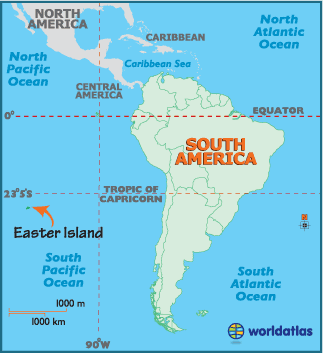
Worldatlas.com
As an Administering Power, we ask why Chile never reported or listed Rapanui.

In 1946, despite formally replying to the Secretary-General’s questions on the administration of territories as covered by Chapter XI, we ask why Chile did not fulfill their obligation alongside the other Administering Powers, and list Rapanui as a Non-Self-Governing Territory.

We find the knowing omission of this obligation as being akin to fraud, and demand that this knowing omission of facts be corrected.

Chile has violated the trust mandate of the UN Charter, Chapter XI, by not assuming responsibilities for the administration of Rapanui, whose peoples have not yet attained a full measure of self-government.

Chile has failed to recognize the interests of the inhabitants of Rapanui as being paramount, and they have failed to accept as a sacred trust the obligation to promote to the utmost, within the system of international peace and security established by the present Charter, the well-being of the inhabitants of Rapanui, and, to this end:

Chile has failed to ensure, with due respect for the culture of the Rapanui, our political, economic, social, and educational advancement, our just treatment, and protection against abuses;

Chile has failed to develop Rapanui self-government, and failed to take due account of the political aspirations of Rapanui, and to assist us in the progressive development of our free political institutions, according to our distinct culture as Pacific Islanders belonging to Polynesia.

What Chile has done in the past, however, is to promote confusion as to our history and to whether we Rapanui even exist. While even now, they continue to sponsor programs that fabricate our history, as well as claim our ecological and environmental resources and cultural artifacts.

Chilean armed forces continue to be deployed on our island.

Chile is encouraging unchecked immigration to the island.

Chile is promoting unsustainable development on our island, which is a UN world heritage site, while privatizing our customary lands and resources.

Bearing in mind the principles embodied in the Declaration regarding Non-Self-Governing Territories and objectives set forth in Chapter XI of the Charter, we are ready to submit all the factors and criteria to be taken into account in deciding whether Rapa Nui is a territory, whose people have not attained a full measure of self-government.

Moana Nui, a network of Pacific-wide rights-holders focusing on justice issues concerning resources, trade, militarization and indigenous rights.

16 March 2014

Scientists call for tougher treaty to protect the deep ocean

 Papua New Guinea Mine Watch

Oleg Klimov / Panos | Sci Dev Net
  • A new treaty could be used to police the expected rise in deep-sea mining
  • It could also ensure that gains from marine genetic resources are fairly shared
  • Capacity building is needed to help developing nations exploit their resources
A new international agreement is needed to police the exploitation of the deep ocean because of the rising threats of deep-sea mining and bottom trawling for fish, say scientists.
Speakers at a symposium this month (16 February) urged the UN to negotiate a new treaty for the deep ocean to supplement the UN Convention on the Law of the Sea.The symposium took place at the annual meeting of the AAAS (American Association for the Advancement of Science) in Chicago, United States.
“This is an opportunity for scientists to voice their concerns about mounting human impacts on the once-remote deep ocean to those who have the power in their hands to make the changes,” says Kristina Gjerde, high seas policy advisor for the International Union for Conservation of Nature.
The deep sea makes up about two-thirds of the world’s oceans. It begins at a depth of around 200 metres, both within and beyond zones of national jurisdiction.
But deep-sea environments are threatened by “imminent” mining and bottom trawling for fish, said the scientists at the meeting.
“We’re calling for a new treaty to sew the gaps in international law that don’t currently include biodiversity, conservation, marine genetic resources, capacity development and technology transfer for areas beyond national jurisdiction,” says Gjerde.
The UN-sanctioned International Seabed Authority (ISA) was established in 1994 to regulate mineral extraction from the deep seabed outside national zones of jurisdiction. The ISA, based in Jamaica, has so far approved 19 mineral prospecting licences in the deep ocean around the world for companies and government bodies, including China and India, as well as those sponsored by the Pacific island nations of Kiribati, Nauruand Tonga [See map]. The Cook Islands have also applied to explore deep-sea mining opportunities.
The map shows prospecting licences approved so far by the International Seabed Authority. The colour-coded arrows show the approximate location of licences held by larger countries. Several smaller nations, circled in orange, have permission to prospect in the Pacific ocean. Credit: SciDev.Net
But the ISA does not regulate marine genetic resources, which could be valuable to the medical and pharmaceutical sectors, or biodiversity conservation, says Lisa Levin, director of the Center for Marine Biodiversity & Conservation at the Scripps Institution of Oceanography, United States.
“The problem is that the ISA’s mandate is to facilitate the extraction of minerals. They don’t have a mandate to identify which parts of the sea floor are most critical to ecosystem health in the ocean,” says Linwood Pendleton, senior scholar in the Ocean and Coastal Policy Program at Duke University, United States.
The new treaty would ensure that financial gains made from marine genetic resources are shared between all nations, and that new mechanisms are developed to transfer marine technology and developcapacity in this field, says Gjerde.
Significant deep sea resources are often found within the deep seas of the developing world, often within the nations’ exclusive economic zones [that stretch up to 200 nautical miles from their shore] of those countries, says Levin.
“Yet those countries often don’t have the necessary expertise or technology to explore the deep seabed. So they often rely on countries that do have the technology and expertise,” she says.
“It’s very important that we do a lot of capacity building, information sharing and transfer of expertise so that those countries are able to manage their own deep ocean resources.”
The scientists at the meeting also warned that extracting minerals and precious metals from the deep sea could cause catastrophic long-termdamage to marine ecology unless managed carefully.
New technology, dwindling land-based resources and high commodity prices mean that deep-sea mining is not only feasible, but imminent, says Pendleton.
“Precaution is essential,” says Gjerde. “This means rules should be in place before mining begins, including measures such as environmental impact assessments, comprehensive systems of marine protected areas and the mechanisms for monitoring and controlling impacts.”
She adds: “It is important to set and maintain common standards so that a few unscrupulous operators can’t take advantage of countries with weak legal systems, causing irreparable harm in return for very short-term gain.”
New mining ventures are underway off various Pacific islands and off the African coast, as well as on the international seabed area that lies outsidenations’ jurisdiction, says Gjerde.
Canadian company Nautilus Minerals had planned to mine hydrothermal vents in Papua New Guinea, but this has been delayed, says Levin.
And the Namibian government is considering leasing the deep sea bottom in its national waters for phosphate mining, although last September it placed an 18-month moratorium on all mining decisions, while it gathers new information, she adds.
“Because no mining has happened yet [anywhere in the deep sea], there’s time to put some major environmental management in place,” she tellsSciDev.Net.
The key is to identify places where mineral wealth is high and ecological impacts are low and target mining there, says Pendleton.
Deep-sea trawling for fish has already had terrible long-lasting impacts on the deep sea, says Gjerde.
The deep sea fish populations are quickly depleted because the fish aggregate, which makes them easy to catch, and they are slow growing, living over one hundred years, says Levin.
One-fifth of the world’s continental margins, an area the size of the United States and Canada combined, have already been trawled, she adds.

14 March 2014

Pacific Organisations: "Climate change represents the greatest development and human rights challenge"


Preparatory Committee Meeting for SIDS 2014 Conference 

24-26 February 2014


SECRETARY GENERAL TUILOMA NERONI SLADE

PACIFIC ISLANDS FORUM SECRETARIAT

STATEMENT ON BEHALF OF 
THE COUNCIL OF REGIONAL ORGANISATIONS OF THE PACIFIC (CROP)
FIRST PREPARATORY COMMITTEE MEETING FOR SIDS 2014 CONFERENCE
24 - 26 February 2014
samoaobserver.ws

Distinguished Co-Chairs,

I have the honour to make this statement on behalf of nine inter-governmental and development agencies of our region all serving Pacific Forum countries and other island communities and coordinated as the Council of RegionalOrganisations of the Pacific (CROP).

We congratulate AOSIS and the Small Island Developing States (SIDS) for the inter-regional outcomes document which we believe is an informed and sound basis to guide the engagement of other stakeholders as we seek an agreement which is forward looking, and one which allows for true ownership. We note that, by design, implementation is by the global community in supportive collaboration with SIDS, and thus a broad engagement by local, national, regional and international stakeholders.

Our region has had long engagement with the negotiations and outcomes of both the Barbados Programme of Action (BPoA) and the Mauritius Implementation (MSI) agreements. Having built on those solid foundations, we need now to move with even greater perspective, to be even bolder in what we strive for in Samoa and beyond. 

The Samoa outcomes must reflect the urgency of global challenges which now threaten world-wide livelihoods and sustainability. Climate change represents the greatest development and human rights challenge, for it is exposing people and their security to serious and multiple risks, in particular amongst the most vulnerable and disproportionately affected communities like SIDS. There is need to generate a global response of immediacy and of justice. 

The Oceans is home, and the natural setting for all island communities. It is the major driving force in the global environment and the sustainable development of SIDS, indeed, of the rest of the world. We are concerned about the state and management, rather mismanagement, of the world’s Oceans and Seas. By their nature and inert-linkages, we think the Oceans, Seas and Islands demand a place of stand-alone prominence in the post 2015 framework.

The special case for SIDS requires much more than repeated affirmation. There is need to address modern challenges in real and practical terms and to work out effective solutions, innovative and inclusive of private sector and civil society and maximising opportunities through harnessed strengths and comparative advantages. For this, we would seek leadership and defined commitment in the outcomes of the Samoa conference, together withinstitutionalised frameworks of accountability and structured assessment against commitments agreed to. We note, Mr Chairman, that several paragraphs of the inter-regional document, on capacity building (134) and institutional support and linkages (158 and 163), for example, call for precisely such a result.
For a proper understanding of the implementation of international agreements, we believe that all development partners must complement the national assessments of SIDS with their own frank partner assessments of performance. Such collective stakeholder assessments will, assuredly, point the way to best practice performance and the effective evaluation of results, whether positive or not. 

We think there is merit in adopting and refining the approach taken with the original BPoA of 1994 by which, in respect of each issue, opportunity and emerging challenge identified, there is a clear statement of the necessary actions and responsibilities to be addressed at country, regional and international levels. This makes it easier to develop reporting and monitoring frameworks, for all stakeholders, and not leave just the SIDS to bear the major responsibility.

We thank and congratulate the Government of Samoa for the theme of the conference. There cannot be a more effective pathway to sustainability than by the assurance of genuine commitment and enduring partnerships. Clear criteria need to be developed very quickly and we are committed to assisting, applying our own regional experiences of partnerships and their accountability frameworks, including those launched as Type II partnerships at the Johannesburg Summit. 

As I close, Mr Chairman, let me say that we in the vastness of the Pacific Ocean have lived by a code of Pacific regionalism developed over the past six decades and more, including the Pacific Plan for closer regional cooperation and integration, now currently undergoing significant review and recalibration in keeping with the changing times. It is in the name of regionalism that I appear to speak for the Regional Organisations of the Pacific, and to commend the well tested place of regional cooperation and coordinated approaches in the sustainable development of small island developing States. 

On the SIDS conference and its processes, all CROP organisations will continue and remain ready to provide needed support and assistance to all Forum and Pacific States.

THANK YOU.

13 March 2014

Prime Minister: Vanuatu only hope for West Papua

Home

By
 Godwin Ligo

SEE VIDEO OF THE ADDRESS OF VANUATU PRIME MINISTER MOANA CARCASSES KALOSIL HERE .
“Vanuatu is the only country in the world that is not afraid to stand up and speak out for the right of freedom for the West Papuan people whether in the United Nations (UN), or other meetings anywhere in the world,” Vanuatu Prime Minister Moana Carcasses Kalosil, told Acting Prime Minister Willie Jimmy Tangapararua, State Ministers, Senior Government Officials and representatives of West Papua on his arrival in Vanuatu yesterday afternoon.
He said not every country around the world is supportive as Vanuatu to voice the concern of the suffering and brutality faced by the West Papuan People.
“I fully agree and uphold the quote by the late Father Walter Lini, first Prime Minister of Vanuatu that Vanuatu is not totally free until other colonized people in the region are politically freed ,” said PM Carcasses.

“The West Papuan people are a suffering community. It is therefore the duty of Vanuatu which is the only country in the world that is not afraid to face up to such a powerful nation as Indonesia to bring the issue of West Papua to the UN Committee on Human Right.

“It is a God-given right that Vanuatu must gain independence in 1980 and so the same with the people who are still being colonized and the duty of an independent state of Vanuatu to stand up and speak out for the freedom of these colonized people because it is God’s will for this people to be freed, “ said PM Carcasses.

Prime Minister Carcasses said the Chairman of the UN Committee on Human Rights who is from South Africa told him that he admired the prime minister’s courage in the manner in which he stood up and spoke out for the freedom of the West Papuan people. He also said other world leaders that he met after his speech also expressed the same.
“We have already discussed with the Deputy Prime Minister and Minister of Foreign Affairs (Edward Natapei) in New York to prepare a document on West Papua case to go before the Council of Ministers to approve for Vanuatu to host a Special Forum which will bring together leaders of West Papua from around the world to come together to Port Vila to deliberate on the new roadmap towards the freedom of West Papuan people.

“This was confirmed by the Deputy Prime Minister and Minister for Foreign Affairs Edward Natapei who said the Forum will take place around July or thereafter pending funding from international supports and arrangements to be in place.

“I am confident we have full support from the government, and the people Vanuatu on the stand we have taken in speaking out for the West Papuan people in the UN Committee on Human Rights,” said Prime Minister Carcasses.
On the question of how Indonesia reacted to his speech and the call for the freedom of the West Papuan people, Prime Minister Carcasses replied that, Indonesia used a diplomatic way in rejecting the call by Vanuatu’s Prime Minister.

“This is normal for Indonesia to find a diplomatic tact to reject to the call, but Vanuatu will continue to apply pressure with a new roadmap for the freedom of the West Papuan people,” said PM Carcasses.

Prime Minister Carcasses was accompanied by the Deputy Prime Minister and Minister of Foreign Affairs Edward Natapei, MP Joe Natuman and the Ministry of Foreign Affairs Director General, Johnny Koanapo.

Virgin Islands Minister for Education and Culture calls for more awareness of territory's African history

Statement by Honourable Myron V. Walwyn
Minister for Education and Culture
Government of the Virgin Islands

IN OBSERVANCE OF BLACK HISTORY MONTH 2014


Officially started in the United States in 1976 and now recognised by governments around the world, Black History Month is a time where citizens around the world, of all races, take the time to understand the journey of Africans on the continent and in the diaspora. It is also a time for us to appreciate our struggles and contributions to this new world.

BVI.GOV.VG
It is a time that I hope we here in the Virgin Islands will use to learn even more about our history as Virgin Islanders and our connection to people of African decent throughout the world and indeed in our region. While we celebrate our local heroes such as the Honourable H. Lavity Stoutt, Dame Janice Pereira, Honourable Ralph T. O’Neal and Mr. Noel Lloyd, we must also equally celebrate the contributions of names such as Errol Barrow, Franz Fannon, Nelson Mandela, Martin Luther King Jr., and yes, Barack Obama.

As Virgin Islanders, it is important for us to remember that our journey is very much connected to those of persons of African ancestry throughout the region and throughout the world and the freedoms and opportunities that we enjoy today, have been inspired by King, Mandela, Barrow and many others.

We must also recognise that black history does not start with the Atlantic Slave Trade. While our ancestors came to the Americas as slaves, we should be fiercely proud to learn about their history as independent and free men and women throughout Africa prior to the 16th century.

Reflection on one of my favourite quotes, our Jamaican brother, Marcus Mosiah Garvey, where he said, “A people without the knowledge of their past history, origin and culture is like a tree without roots.”

Upon becoming the Minister for Education and Culture, one of the first things I had the opportunity to do was to utilise members of our community through the African Studies Club to work along with the Department of Education in putting together a curriculum for Virgin Islands History to be taught in our secondary schools. We were able to get this completed and have instruction started for the 2012-2013 school year.

Going back to that quote by Marcus Garvey, I do not believe that we can build young people to further these Virgin Islands without first giving them an understanding of their heritage and inspiring an appreciation for that heritage. This firmly plants them in our community and gives them an understanding of their purpose and their responsibility as citizens of these great Virgin Islands.

I want to commend Mr. Gill Trott and members of the Virgin Islands African Studies Club for their continuous efforts to refine our self image. On Sunday, February 2, I had the opportunity to attend the wreath laying ceremony to commemorate the lives of our ancestors that were lost during the travel to the Americas as well as those that died since.

At the ceremony we were given a broad history of the journey of slaves that ended up in the Virgin Islands by our very own Dr Catherine Smith. We also heard from local authors, Dr. Quincy Lettome, Dr. Pat Turnbull, Mrs. Verna Penn Moll and Ms Eugenia O’Neal, who have all woven in the history of our ancestors in their work.

Annually this event pays tribute to our ancestors and it reminds us of our connection to a significant event in world history. We have indeed come a very long way and now it is time for us to make our contribution to the rich history provided by our ancestors.

Throughout the month I will be highlighting significant individuals of African ancestry on my Facebook page. I encourage other members of our community to do the same. During this month of February, I would ask our teachers throughout our schools to have our students select a person of African decent that has made a significant contribution to the development of our race, their community or the world. I ask that these presentations be made by the students during class and general school assembly.

This presents an opportunity to expose our students to the lives and works of men and women who have changed the world for the better and to whom they are connected. This will give our youth knowledge of their past history, origin and culture and firmly root them in our community with confidence to become productive citizens.

Let this month be a great opportunity for all of us in the Virgin Islands to learn more about the history of both Virgin Islanders and other persons of African heritage.

Happy Black History Month 2014 Virgin Islands!

12 March 2014

Día de las Relaciones entre Haití, República Dominicana y Puerto Rico

Conferencias Caribeñas 14
Día de las Relaciones entre
Haití, República Dominicana y Puerto Rico
jueves, 13 de marzo de 2014
 

Conversatorio sobre el libro HISTORIA DOMINICANA
Orlando Inoa (autor), Editorial Letra Gráfica, República Dominicana
10:00 a.m. – 12:00 p.m.
 
Dr. Pedro San Miguel
Facultad de Humanidades, UPR-RP
Dra. Lidia Marte
Facultad de Ciencias Sociales, UPR-RP
Dra. Elissa L. Lister (moderadora)
Universidad de Nacional Colombia, Sede Medellín
 
                                                                  
Economía, Comercio y Sociedad entre Haití y la República Dominicana
1:00 p.m. – 3:30 p.m.
 
Crecimiento y comercio desbalanceado en La Española, 1960-2013
Dr. Paul Latortue
Facultad de Administración de Empresas, UPR-RP
 
La sentencia 168-13 en el contexto de las relaciones Dominico-Haitiano
Dr. Miguel Ceara Hatton
Centro José Luis Alemán & Pontificia Universidad Católica Madre y Maestra
 
                                                                  
Documentales
4:00 p.m. – 6:15 p.m.
 
Prof. Sonia Fritz
Universidad del Sagrado Corazón
“Visa para un sueño, la migración de las mujeres dominicanas a Puerto Rico” (1990) (28min.)
Dra. Ruth Nina
Facultad de Ciencias Sociales, UPR-RP
“Ojos que no ven...” (2013) (24min.)
                                                                  
Conversatorio
6:30 p.m. – 9:00 p.m.
 
“La guagua va en reversa”: Realidades de la comunidad dominicana en Puerto Rico)
 
Dra. Ruth Nina (moderadora)
Facultad de Ciencias Sociales, UPR-RP
Romelinda Grullón
Centro de la Mujer Dominicana, Río Piedras
José Rodríguez
Comité Dominicano de Derechos Humanos
Carlos Roberto Gómez Beras
Isla Negra Editorial
 
Anfiteatro Manuel Maldonado Denis (CRA 108)
Edificio Carmen Rivera de Alvarado (CRA),
Facultad de Ciencias Sociales, UPR – Río Piedras
 
Transmisión en vivo por Internet