Vous trouverez ci dessous l'intervention du Sénateur.
A forum for critical analysis of international issues and developments of particular relevance to the sustainable political and socio-economic development of Overseas Countries and Territories (OCTs).
05 March 2014
le 1er Colloque international en France sur "les impacts humanitaires des essais nucléaires"
Labels:
Colonialism,
France,
French overseas territories,
human rights violations,
non self-governing territories,
nuclear testing,
radiation
04 March 2014
Millennium Development Goals - Rapa Nui (Easter Island)
Millennium Development Goals
Statement
Eighth session of the Open Working Group on Sustainable Development Goals
Agenda Item
Rule of Law and Governance
Feb 7, 2014, 9:45 a.m.
Moana Nui/Rapa Nui
I am advocating for Moana Nui, a network of Pacific-wide rights-holders focusing on justice issues concerning resources, trade, militarization and indigenous rights.
In my capacity as a member of the Hitorangi clan from Rapa Nui, I am here to put forward ourmana’u over the eight Millennium Development Goals addressing poverty and hunger, universal education, gender equality, child mortality reduction, maternal health, access to medicines, environmental sustainability and the global partnership. These are all sectors of development that Rapa Nui has been denied, or has not adequately been provided for by Chile.
Otherwise known as Easter Island, Rapa Nui is 3,700 kilometers from the coast of Chile, and claimed as a territory in 1888 under fraudulent circumstances.[i] We are a nation struggling for self-determination, and seek to be recognized by the UN to be placed on the list of non-self-governing territories for decolonization.[ii] We represent an indigenous struggle, a human rights struggle, and a struggle to protect our traditional resources and ecological biodiversity throughout our Pacific island communities.
Chile is one of the original signatories of the Trans Pacific Strategic Economic Partnership, or the TPP, and they are negotiating in the largest free-trade agreement in the world with 12 other countries.[iii] Together these 12 countries represent nearly 28 trillion dollars, about 40% of global GDP.[iv]
Read full report here.
03 March 2014
United Nations Dep. Secretary-General confirms legitimacy of the re-listing of French Polynesia as a non self-governing territory
| ||||
| Department of Public Information • News and Media Division • New York |
Decolonization Message Must Reach Wide Audience, Says Deputy Secretary-General
Applauding Special Committee’s Latest Efforts at Opening of 2014 Session
Following are UN Deputy Secretary-General Jan Eliasson’s remarks at the opening of the 2014 session of the Special Committee on Decolonization:
I thank you for this opportunity to address the Special Committee, the “C‑24”, at the start of its work this year.
We are now in the middle of the Third International Decade for the Eradication of Colonialism, and we have already seen encouraging signs of rejuvenation of the work of the Special Committee. For example, the General Assembly last year recognized that French Polynesia remains a Non-Self-Governing Territory. This effectively mandated the Special Committee to consider an additional item on the agenda.
For the first time in many years, the Bureau held several meetings with each of the four administering Powers — France, New Zealand, the United Kingdom and the United States, as well as various other stakeholders, in order to identify next steps in the decolonization process. I welcome the intensification of the face-to-face talks among interested parties. I also appreciate that all administering Powers have given the green light in principle for visiting missions where appropriate. The voice of the C-24 is again becoming loud and clear.
To the international community, colonialism is a historic aberration. Thus, all of us must take up the challenge of eradicating remaining forms of colonialism, in keeping with the principles of the Charter and relevant United Nations resolutions.
The decolonization message needs to reach a wide audience. I call for inclusive, proactive and forward-looking efforts by the Special Committee, the administering Powers and the Non-Self-Governing Territories, on a case-by-case basis. This could help trigger a break in a deadlock on some cases, or encourage the Committee to become involved in situations between a Territory and its administering Power.
The 17 Non-Self-Governing Territories look to the United Nations for comprehensive and sustained initiatives for the future. The Special Committee has begun to open a wider window of opportunities. Still, the pace of decolonization remains slow. I am confident that the year ahead will be a period of intensified diplomatic efforts on decolonization as the Committee continues to build on its recent steps forward in dialogue and consensus-building. These include the planned expansion of the Special Committee’s Bureau, with the addition of Indonesia, and the first visiting mission of the decade, to New Caledonia.
The Special Committee is a unique platform to advance the historic decolonization mandate of the United Nations. The Secretariat will continue to support the Special Committee in its important work.
I count on your leadership and I wish you success.
Labels:
Caribbean,
Colonialism,
Decolonization,
French Polynesia,
human rights conventions,
international law,
Pacific,
Self-Determination,
United Nations
02 March 2014
Bougainville President thinks a lot like our Australian colonial ‘masters’
Brothers by other mothers?
The now departed Minister for Territories, Charles Barnes, had a tad paler complexion, and hailed from rural Australia – but he certainly thought so much like the ABG’s current President, John Momis, you cant tell them apart.
Here is what Charles Barnes said about mining on Bougainville in 1969, immediately after he had sent in the riot squads to beat up Bougainville’s protesting mothers:
And what does his long lost brother, Honest John Momis say now he is facing a revolt among the landowners of Panguna, who wont go along with his hand-picked ‘chiefs’ … well:
The colonial playbook is alive and well – tell the ‘natives’ the project is all about them, for their benefit, and only extreme and primitive outsiders would dare oppose ‘development’. Then take the ore, make the cash, and leave behind a smouldering wreck.
Honest John and Barnes the Impaler you two are a match made in heaven.
|
Labels:
Asia,
Bougainville,
Colonialism,
natural resources,
Pacific
28 February 2014
LE CENTRE POLITIQUE EN CRISE
Special to OTR
LA NATION
LA NATION
QUOTIDIEN D'INFORMATION EN LIGNE FONDÉ LE 21 FEVRIER 2005
NEUVIÈME ANNÉE N°962 DU 20 JANVIER 2014
1801/2014 : 213e ANNÉE DE LA NATION GUADELOUPE
Le centre du système colonial français brûle à nouveau. Le président de la république qui s'était fait élire pour une présidence normale censée mettre un terme aux frasques de la présidence précédente est selon les plus récents sondages rejetté par une large partie de l'opinion française. C'est la première sous la 5e république que l'on assiste à un tel phénomène. Rien n'arrête cette lame de fond .Les initiatives prises par le président se retournent contre lui et son gouvernement . Sa conversion subite au libéralisme et sa proposition de pacte de responsabilité semblent au contraire accentuer son divorce avec l'opinion française.Le désarroi de l’électorat de gauche, que traduit la marée basse des sondages de popularité de l’exécutif, est devenu une réalité durable. En Guadeloupe par contre où il n 'y a pas d'observations régulières de l'état de l'opinion, il semble que l'on assiste au même phénomène de rejet ou de méfiance probablement pour des raisons différentes . Quand au sein d'un système colonial le centre est en difficulté les marges de manœuvre pour la contestation de ce système s'élargissent considérablement. Cependant pour que la situation bascule ou se mette en position de bascule, il faut que les forces politiques qui contestent l'ordre établi soient aptes à saisir les opportunités. Malheureusement,aujourd'hui ces forces politiques nationales ne donnent pas l'impression de pouvoir changer le cours des choses tant elles sont désorganisées .
Labels:
France,
French overseas departments,
Guadeloupe
27 February 2014
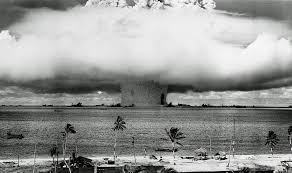
Sixtieth anniversary of the Bravo nuclear test on Bikini Atoll
| theatlantic.com |
This Saturday (1st March) is the sixtieth anniversary of the Bravo nuclear test, when the US government detonated a thermonuclear device on Bikini Atoll.
The test, on 1 March 1954, sent a cloud of radioactive fallout across the northern atolls of the Marshall Islands, which were part of the United Nations Trust Territory of the Pacific Islands, a strategic UN trusteeship administered by the United States.
Part of Operation Castle, Bravo weighed in at fifteen megatons, the largest nuclear device the US military had tested.
The people of the Marshall Islands live to this day with the health and environmental consequences of 67 atomic and hydrogen bomb tests conducted by the United States on Bikini and Enewetak atolls.
Around the Pacific region, March 1 is commemorated as Nuclear Free and Independent Pacific day, remembering the survivors of 315 US, British and French nuclear tests around Oceania.
Let us remember, and let us act.
One hundred and forty six nations - but none of the nuclear powers - have just met in Mexico for the Second Conference on the Humanitarian Impact of Nuclear Weapons. There is international momentum to develop a treaty banning the development and deployment of nuclear weapons.
As Rev. François Pihaatae of the Pacific Conference of Churches has stated: “In international forums, including conferences on the humanitarian impact of nuclear weapons, the Pacific must speak with a united voice to bring about attitudinal change in the larger nations. We must speak out, for if we remain silent the larger countries will be under the misconception that their testing, development and construction of nuclear weapons are acceptable.
“That is why we will continue to call for a global ban on nuclear weapons. These weapons are no good for the Pacific, and no good for the world.”
*********
“History Project”, written and performed by Marshallese poet Kathy Jetnil-Kijiner
The long shadow of Bravo, Inside Story, 25 February 2014
Banning nuclear weapons: a Pacific Islands perspective, International Campaign to Abolish Nuclear Weapons (ICAN) report presented to the Second Conference on the Humanitarian Impact of Nuclear Weapons in Nayarit, Mexico, February 12-14
America’s Nuclear Test Legacy: Still an Issue for the Marshall Islands, video seminar by Giff Johnson, PIDP, University of Hawaii.
“Mission to the Marshall Islands (27-30 March 2012) and the United States of America (24-27 April 2012)” - Report of the Special Rapporteur on the implications for human rights of the environmentally sound management and disposal of hazardous substances and wastes, Calin Georgescu, 3 September 2012, A/HRC/21/48/Add.1
Nuclear Remembrance Day – from Majuro to Arkansas
Labels:
Colonialism,
environment,
human rights violations,
indigenous peoples,
Marshall Islands,
nuclear testing,
Pacific,
radiation,
small island developing states
Scientists warn over coming era of deep sea mining
Steve Connor | The Independent (UK)
The last great unexplored wilderness on Earth is about to experience industrial-scale mining that could change the face of the pristine seabed of the deep ocean for generations to come, scientists have warned.
Access to the mineral deposits and rare-earth metals that are known to exist on the sea bed has never been easier with the help of robotic submarines and there are already 19 leases for prospecting in international waters and another five leases that are pending, they said.
Strip mining involving giant underwater cutters, where vast areas of the seabed are removed and brought to the surface as a slurry, and vacuum mining where the seabed is literally sucked up by machines, are the kind of mining operations that could be commonplace in a few years time, they told the American Association for the Advancement of Science.
“The deep ocean is a vast repository of natural resources and we’re going to be going in there if not now, then within the next 50 years,” said Lindwood Pendleton of the Duke Nicholas Institute for Environmental Policy Solutions in Beaufort, North Carolina.“We’re really in the dark when it comes to the ecology of the deep sea. We know a lot about a few places, but nobody is dealing with the deep sea as a whole, and the lack of knowledge is a problem for decision-making and policy,” Dr Pendleton said.
Without careful controls the physical habitat of the sea bed hundreds of feet below the surface could be irrevocably destroyed along with the unique wildlife it supports, said Cindy Lee Van Dover of Duke University in North Carolina.
“The deep sea is out of sight, out of mind, and because there isn’t a specific human society that will be directly impacted by the negative consequences of extraction, there’s a whole level of concern that isn’t being expressed when it comes to deep sea industrialisation,” Dr Van Dover said.“There’s just so much that we don’t know about the deep sea, and we need that basic research before we form policy, but we urgently need policy before this window of opportunity closes,” she said.“One hundred years from now, we want people to say they got this right based on the science they had, and they weren’t asleep at the wheel,” she told the meeting.
One mining company prospecting off the coast of Namibia intends to remove between 1 and 5 metres of seabed silt and ship it to the land for extracting phosphate deposits before the waste slurry to siphoned off and dumped back into the sea.
Bronwen Currie of Namibia’s National Marine Information and Research Centre in Swakopmund, said that concerns about the environmental impact of the phosphate mining has led to the government imposing a moratorium until further assessments can be made about its long-term effects.
“The biggest concern is the accumulation of effects. We need research on the impact on fish stocks. There is no real knowledge of the real impacts of this kind of mining,” Dr Currie said.
26 February 2014
Chagos Islanders ‘Will Not Give Up’ Fight to Return Home
The Chagossians pictured here when they visited the archipelago in 2006. Many are still fighting to return to the islands they were evicted from almost 40 years ago. Courtesy: Chagos Refugees Group (CRG).
PORT LOUIS (IPS) - “The Marine Protected Area (MPA) created around the Chagos archipelago is a new obstacle that the British government has placed in our path to prevent us from going back to our homeland,” claims Olivier Bancoult, leader of the Chagos Refugees Group (CRG).
For the past 40 years, the Chagossians have been fighting to return to their home in Chagos archipelago, a set of 55 islets situated 1,200 km north of the Indian Ocean Island of Mauritius.
They lived there for five generations until the early 1970s when the archipelago was excised from Mauritius by the United Kingdom. The Chagossians were evicted and the archipelago now forms part of the British Indian Ocean Territory (BIOT).
“We’ll not give up,” Bancoult tells IPS as he prepares for a new legal battle against the British government, which will be heard by the High Court of Justice in London on Mar. 30. However, the Chagossians feel that the 2010 creation of the MPA, which does not allow for human settlement on the Chagos archipelago or travel there unless one is in possession of a permit from the U.K. government, prevents their resettlement.
Bancoult was four when he and his mother, Rita, came to Mauritius. In 1983 he created the CRG to defend the rights of his community and over the years the organisation has staged numerous public demonstrations and hunger strikes.
The MPA covers almost 545,000 square kilometres and aims to protect the natural resources of the Chagos archipelago by implementing strict controls over fishing, habitation, damage to the environment and the killing, harming and collecting of animals.
The U.K. Foreign and Commonwealth Office (FCO) designated the archipelago as an area that needs to be preserved “on the basis that the archipelago is one of the most precious, unpolluted, tropical ocean environments left on earth.”
READ FULL ARTICLE HERE.
Labels:
Chagos,
European Union,
human rights violations,
indigenous peoples,
occupation,
United Kingdom
25 February 2014
Curacao Leading Caribbean In Cruise Tourism Growth
WILLEMSTAD – Curacao posted the largest year-over-year increase in cruise passenger visits of any country in the Caribbean last year, according to data from the Caribbean Tourism Organization.
The Dutch Caribbean island welcomed 610,186 cruise passengers in 2013, a 41.4 percent increase over the previous year.
That was significantly higher than the next-fastest-growing destination, Aruba, which posted a 25.4 percent increase compared to 2012.
Not all Caribbean destinations had complete data for 2013, although it’s likely that none of the countries without complete 2013 reporting would have come close to Curacao.
The island’s growth came in a mixed year for cruise tourism in the region, one which saw 10 destinations report negative growth in cruise arrivals.
Overall, the Caribbean saw a 2.7 percent increase in cruise arrivals last year, with around 21.9 million in total, according to the Caribbean Tourism Organization.
The region remained the world’s leading cruise destination, however, according to Cruise Lines International Association (CLIA).
Source: Caribbean Journal
Subscribe to:
Posts (Atom)