04 April 2013

Does France supports self-determination - in Western Sahara?


Human Rights Watch asks French President Francois Hollande to pressurize Morocco to respect human rights in Western Sahara

New York, April 3, 2013 (Sahara Press Service) - Human Rights Watch called Monday on the French President Mr. François Hollande exert pressure on Morocco to respect human rights in Western Sahara and in Morocco, in a statement published on its website.

Human Rights Watch indicated that Mr. Hollande should raise ongoing human rights concerns in his meetings with Moroccan officials, including torture in detention, unfair military trials, restrictions on free expression rights, and the vulnerability of child domestic workers.

On February 17, a Rabat military court sentenced 25 Sahrawi civilians, including several human rights defenders, to prison terms, nine of them to life in prison, in an unfair trial that should not have gone before a military court, added the statement.

It therefore urged French President to voice concerns about the fairness of the trial of Gdeim Izik prisoners.

The Organization published on Monday a report condemning the Moroccan martial trial against Gdeim Izik group. (SPS)

090/089/TRA

*****

Council of Ministers urges Hollande to convince Morocco to stop violating Saharawi human rights

 
Chahid Al Hafed (refugee camps), April 3, 2013 (Sahara Press Service) - The Council of Ministers urged Tuesday the French President François Hollande, on the occasion of his upcoming visit Morocco, to convince Moroccan party to stop its gross violations of Saharawi human rights, in a statement concluded a meeting on Tuesday chaired by the President of the Republic Mr. Mohamed Abdelaziz.

The Council called on Moroccan party to comply with international legitimacy for the decolonization of Western Sahara, through the just and democratic solution which is to enable the Saharawi people of his inalienable right to self-determination and independence, through free, just and impartial referendum supervised by the UN.

It hailed the struggle of Saharawi masses in occupied territories, in south Morocco and university sites, condemning the unjust trial against Gdeim Izik heroes, and calling for their immediate release along with all the Saharawi political prisoners.

The Council strongly condemned and deplored the continued campaigns of repressions carried out by Moroccan occupation forces against the defenseless Saharawi civilians, especially women, stressing the need for the UN to assume responsibility in accelerating the establishment of a UN mechanism to protect, monitor and report about human rights in Western Sahara.

It therefore expressed satisfaction for the outstanding presence of Saharawi cause and for the solidarity and sympathy with Saharawi people that have been expressed at the World Social Forum, hosted by Tunisia late March.

On other hand, the Council decided to refer a number of conventions and treaties of the African Union, in addition to a bill to regulate and protect public property and environment protection law, to the next session of the National Council (Parliament). (SPS)

Comrade Chávez won't go


Farooque ChowdhurY

 Issue 619

http://pambazuka.org/en/category/features/86487


cc Patos

The death of President Chavez is a big loss not only to Venezuelans but also to everyone who believes in the essential struggle to create a just society for all. But his revolution, 21st century socialism as he called it, will live on.


Hugo Chávez won’t go. Class conflict-ridden history shall not allow Chávez to go. He is part of history, part of people struggling against dispossession, exploitation and poverty, part of people struggling for democracy and dignity. ‘Those who die for life, can’t be called dead,’ said Nicolas Maduro, the Venezuelan vice-president. This makes Chávez live forever among the people.

Venezuela's President Hugo Chávez has passed away ‘after battling a tough illness for nearly two years’. A number of persons celebrated the news by honking their car horns. Reaction of his class enemies tell the cause Chávez stood for. Identity of his class enemies tells the class position Chávez chose. The cause and the class position make Chávez part of people, part of people’s history, part of class struggle toilers carry forward. 

It was not his personal cause. It was a cause an old republic created with its failures, a cause determined by the society’s history. It was a cause the multitude demanded. It was a cause to which exploitation and inequality, injustice and lies, all practiced by the elites, provided the rationale. The cause was not driven by a personal vendetta. 

So, Chávez stood for the excluded, for the poor, for the prisoners of poverty, for the captives of starvation. So, Chávez stood for the shackled, for those compelled to live with indignity and dishonor. So, Chávez stood for labour tied to the yoke of capital, to the yoke of capital’s dictatorship and tyranny. So, began the historic political journey by Comandante Chávez.

Thus, a ‘sin’ was committed in the court of the rich, the propertied classes, the appropriators, the land speculators, the oil wealth thieves, the world capitalist system. Hence Chávez turned on a sworn-in class enemy of the powerful, of the key keepers of property, of the custodians of undue privileges.

Chávez united workers, peasants, small and medium business people, women, indigenous communities, youths and students, professionals, members of the military, and activists and almost the entire leadership in the camp striving to make a forward journey, a new political practice for exercising national sovereignty and independence free from all external influences and interferences. He forged the largest progressive social-political force in Venezuela. Over the years, he led a struggle so that power belongs to the people, not to the rich.

He engaged the armed forces en masse into activities aimed at social protection and national development. An archaic state machine was pressed to gear a transformation process, frustrating at times, yet a challenging task. 

Chávez made unique effort by cementing a Bolivarian civic-military political force relying on the people’s yearning for freedom and dignity. The aim was to reconstruct state institutions, a transformation process, and claim people’s sovereignty with the goal of transforming the social, political and state structures. 

He mobilized the poor and the most excluded parts of the society. This was his constituency and strength. In response, the rich tried to flood mass psyche with lies-stuffed media, and employed Guarimba, violent mobilizations using firearms, to provoke the government to resort to repressive measures.

Despite conspiracies the people of Venezuela achieved victories over the years. The latest victories include the people’s patience and unity in the face of propaganda on the health condition of Chávez and electoral victory by the United Socialist Party of Venezuela in 20 of 23 states.

Chávez initiated unique experiments. With the existing reality these are difficult indeed. These provide people spaces for learning, getting mobilized, taking leadership roles, initiating plans, increasing awareness.

Venezuela can be called a land of cooperatives. Thousands of cooperatives are being organized in spheres of the society. There are thousands of farming cooperatives. It’s an initiative to change the way food is produced and to move towards sustainable and community-based food production. Lands expropriated from land speculators are being used to achieve food sovereignty. There are cooperatives of taxi drivers, janitors, small producers… 

Chávez initiated projects for the benefit of the people, especially the poor. At the centre, it’s the Bolivarian Revolution. There are missions, projects, for heath, education. The housing program constructs dignified homes for the poor. More than half-a-million houses for the poor have already been constructed. The public housing program plans to construct two million homes in the next six years. A project of Community Urban Agriculture with an aim to produce food free of agro-chemicals by not damaging soil and recycling organic waste has been initiated. The project contributes to attaining food sovereignty and breaks down alienation in community. People are initiating ‘socialist’ direct community production enterprises. Alternative, free and community media aims at promoting feminism, gender diversity and wages an anti-patriarchal fight. There is effort to initiate a new type of policing aimed at dealing with the problem of crime through prevention and community engagement.

Mass debate over Venezuela’s Socialist Plan of the Nation 2013-2019 was initiated. People participated in hundreds of assemblies to specify the draft plan proposed by Chávez. On this plan he was re-elected as president. It’s part of the struggle he began.

The struggle, a persistent fight to collectively transform the society, goes on. Thousands of revolutionary social movements join together to consolidate the Great Patriotic Pole, a platform of all the popular organizations and political parties supporting the Bolivarian Revolution. Peasant organizations with thousands of people are struggling for ‘Democratic Radicalization’ and Land Reform, and against bureaucracy as bureaucracy sabotages socialism. It’s people’s fight against bureaucracy. Their demands include acceleration of the land reform program and the elimination of corruption and obstacles to construct of a socialist economy. Workers are struggling to run industrial units properly. They are getting mobilized.

These are part of a fight for what Chávez called 21st Century Socialism. It’s a long struggle. A bitter and longer struggle is there in the coming days. Already there are news of destabilization plans by the right wing and their international masters. 

The people are rallying together to mourn the death of their president. They are expressing the defiant hope: ‘The struggle has already been ignited.’ People gathered in Plaza Bolivar, in front of Miraflores Palace, in central squares across the country voiced ‘Chávez lives, the struggle continues’, ‘people united will never be defeated’, the Venezuelan bourgeoisie ‘will never return to the Miraflores Palace’. These hopes keep Chávez alive. 

It is people, their steadfastness, awareness, organization, unity that will determine the future path. The voice of the people is saying to the Comandante, Alo Presidente (Hello President), ‘Nobody is Surrendering Here’.

This meaningless Falklands referendum will resolve nothing


The Guardian

Falkland Islanders are voting on remaining part of the UK, but it won't solve any of the sovereignty problems with Argentina 

Protesters in favour of UK sovereignty of the Falkland Islands in London
Protesters in favour of UK sovereignty of the Falkland Islands in London. Photograph: Dan Kitwood/Getty Images
Over the next few days, around 1,600 inhabitants of the Falkland Islands will be asked whether they wish to "retain their current political status as an overseas territory of the United Kingdom".
Never before in British history has the outcome of a referendum been so predictable, its purpose so provocative. The referendum, to be held on Sunday and Monday, will solve nothing. It will exacerbate tired and anachronistic arguments about sovereignty.
The question will be accompanied by an explanation: "Under the Falkland Islands constitution the people of the Falklands Islands have the right to self-determination, which they can exercise at any time".
Explain that to the inhabitants of the Chagos Islands, expelled so that Britain could establish its "Indian Ocean territory" and allow the US to build a base on the archipelago's biggest island, Diego Garcia, from where aircraft have bombed targets in Iraq and Afghanistan, and refuelled CIA aircraft rendering individuals to Guantánamo Bay.
The Falklands executive council, made up of three legislative assembly members, insists the islands are not a "colony" even though the governor is appointed by London and has the power to impose laws on the inhabitants. It describes the islands as "entirely self-governing, except for defence and foreign affairs". It also says that the council "can review its status at any time. This could include full independence."
The referendum, of course, is a device to strengthen the British and Falklands governments' hand as Argentina steps up its calls for negotiations over the sovereignty over the islands.
The dispute over sovereignty has been going on for centuries, and Britain has never been really confident over its claim to the islands. In 1929, the Duke of Wellington observed: "I have perused the papers respecting the Falkland Islands. It is not clear to me that we have ever possessed the sovereignty of all these islands."
Britain was prepared to do a deal even with Galtieri's military junta in the years before the 1982 invasion of the islands. Documents recently released at the National Archives under the "30-year rule" showed that the British policy, as Lord Carrington, Thatcher's foreign secretary put it, was one of neglect and hoping for the best, he told a private meeting of the committee set up to look into the circumstances leading up to the 1982 invasion:
"If I may be very frank and rather rude, you had to keep the ball in the air with the Argentines. That was the object. We did not have any cards in our hands."
Carrington added: "There were all sorts of reasons why a settlement was to the advantage of everybody. If you cannot afford to defend a place … the only conceivable thing that you can do is to keep negotiations going as long as possible whether or not you think they are going to be successful."
Referring to a lease-back plan suggested by the Foreign Office a year earlier, he said: "As I recollect, the Argentine conversations did not go too badly and to begin with the Falklands Islanders did not react too strongly, but the House of Commons reacted very strongly." The papers reveal that Thatcher herself was prepared to negotiate with Argentina even after the invasion as the British taskforce was heading for the islands.
Argentina questions the right to self-determination for the inhabitants of the islands as demanded by Britain. They should not have that right, Argentina says, but would continue to enjoy all their human, civil, political, and cultural rights, their way of living, as minorities do in other countries around the world.
UN resolutions on the dispute, of which there have been 40, do not refer to self-determination but to the "interests" of the islanders. Attempts by Britain at the UN to include the phrase have proved unsuccessful. The UN says the dispute over sovereignty must be settled through bilateral negotiations, between Argentina and Britain, not with the islanders.
According to recent figures, the majority of inhabitants were not born on the Falklands. For the first time last year, says Argentina, the census did not provide information about people born on the islands. However, the inhabitants were asked what they considered their national identity to be. A majority said "Falklanders". On his visit to London last month, Hector Timerman, the Argentinian foreign minister, said there was no such thing as a "Falklander".
The inhabitants of the islands are British, says Argentina, but the territory is not. It is a matter of territorial integrity. A visitor from Mars would be astonished if anyone argued otherwise. A settlement that enshrined fundamental rights – political, human, social, economic, cultural – protected by law, would bring much healthier and more practical benefits for the inhabitants of the Falklands than a sterile dispute over sovereignty. This is a concept that in any case has been eroded over the years as nations – including Britain – agreed to be bound by the rules and obligations, as well as the benefits, of international military, economic and trading alliances.
So, as the countries of the region, through their Union of South American Nations (Unasur), have already made clear, the coming Falklands referendum is all but meaningless .

03 April 2013

Japan ignores voices of Okinawa in Futenma move


The Asahi Shimbun

Editorial

The Defense Ministry on March 22 submitted a land reclamation application to Okinawa Prefecture to build a new airfield off Henoko, in the city of Nago, that would replace the U.S. Marine Corps Air Station Futenma.

The move is part of an agreement between Japan and the United States to relocate the Futenma base from its current location in the middle of the densely populated city of Ginowan.
But it can only be described as a long-shot attempt to break the impasse over the issue without laying the necessary groundwork.

Okinawa Governor Hirokazu Nakaima is to decide whether to accept the application in about eight months.

We have argued in our editorials that applying to Okinawa for the land reclamation despite strong opposition from an overwhelming majority of the people there would only complicate the situation.

Unfortunately, the administration of Prime Minister Shinzo Abe has turned that worrisome prospect into reality.

Nakaima on March 22 said: “How is it possible to do it when all 41 municipalities (in Okinawa Prefecture) are opposed? I just can’t understand it.”

Nago Mayor Susumu Inamine also expressed his resentment about the action, calling it “a surprise attack, totally without warning.”

It is hardly surprising that the move has further deepened Okinawans' distrust of the central government.

It would be grossly irresponsible for the Abe administration to put pressure on the governor to accept the application after creating such a situation.

The Abe administration has rushed to submit the application for land reclamation primarily because it wanted to achieve visible “progress” toward an early relocation of the Futenma base. Tokyo and Washington have agreed to solve the problem swiftly to demonstrate their commitment to enhancing the bilateral security alliance.

The Abe administration also fears that the victory of a candidate opposed to the relocation plan in the Nago mayoral election early next year would make it even more difficult to move forward with the plan, and apparently wants to pave the way for the governor’s approval of the plan before the election.

But there is no denying that the move has only hardened Okinawa’s attitude toward the issue.

Abe has expressed his intention to “pursue the implementation of the relocation plan while listening to the voices of people in Okinawa and building mutual trust.”

But his actions have completely contradicted his words.

The Futenma move is not the only example.
http://wwii-letters-to-wilma.blogspot.com
The Abe administration plans to hold a government-sponsored ceremony on April 28, the day on which the San Francisco Peace Treaty came into force in 1952, to commemorate Japan’s independence. The government has decided to call it the “Restoration of Sovereignty Day.”

It was the day when the occupation of Japan by the Allied powers ended. But it is called the “Day of Humiliation” in Okinawa, which remained under the administration of the U.S. military even after the treaty took effect.

Many of the U.S. bases in the mainland were relocated to Okinawa one after another, forcing the southern island prefecture to bear an unfairly heavy burden in Japan’s security alliance with the United Sates.

Naturally, people in Okinawa have long been voicing their indignation about the heavy U.S. military presence within their prefecture.

It seems clear that the Abe administration is making every effort to please the United States while paying little serious attention to the feelings of Okinawans.

The government intends to take measures to ease Okinawa's burden in order to soften the public opposition there to the Futenma relocation plan. However, it is hard to imagine that such half measures will change Okinawans' minds.

Is Abe ready to take political responsibility himself for the consequences if the governor says no to the application?


02 April 2013

U.S. Virgin Islands Legislator Addresses past, future of territory


Senator Myron Jackson’s Transfer Day Speech 

to the St. Croix Landmarks Society, St. Croix 

on March 23, 2013 

Theme: “Recalling Our Past, Forging Our Future to 2017”


Good morning fellow Virgin Islanders, visitors.

I would like to thank The Transfer Day Planning Committee comprised of the St. Croix Friends of Denmark and the St. Croix Landmarks Society with the support of the Office of the Governor and the Department of Tourism, for the invitation to address this gathering this morning.  This year March 31st coincides with the Christian observance of Easter Sunday.  Today, this event will most likely be recorded as the official observance in the Territory that marks the 96th anniversary of the sale, purchase and transfer of a former Danish colony and people to the United States of America. 

My family connection as well as many of yours are linked to ancestors who were born, lived, contributed, died and were buried in this sacred soil.  My grandmother Maude Clendenin Peterson was born in the Danish West Indies in 1905.  She provided us with the insights of her life and those of countless others who lived during this period of great turmoil and uncertainty.  She witnessed the official Transfer Day ceremony on March 31, 1917 at 4:00 pm, with a conscious mother, who understood the importance of that day and the transition that they, however marginalized, were going to face from the political, social, economic and cultural changes that America would bring.  

As they and other West Indian working class subjects throughout the colony took their vantage points behind the barriers around the Forts in the towns, Danish families and government officials took the best vistas and official positions. There was stillness in the air as if time had stopped.  As the anthems played, flags were exchanged, and cannons and gun salutes boomed, there was a great sense of sadness as elders shed tears and children buzzed with excitement over the day. Oral history tells us that on that day the elders throughout the land said, “We know what we had but we do not know what we going to get.”  “And this the Danish West Indies passed into history and the Virgin Islands of the United States were born.”

This chapter of our history, over the last nine decades, continues to be an interesting saga. Descendants of Danes and Afro-Danes, Virgin Islanders, sociologists, historians, politicians, Congress, the Department of Interior, the United Nations, and others locally, regionally and internationally have questioned and debated our past, our present political status, and our quality of life under American rule.   Have we been better off under the American flag? What is and should be the future political status of the Virgin Islands of the United States?  Will we be able to achieve a constitution for the advancement of self governance and exercise our fundamental democratic right for self determination?

One question that is pivotal to a collective consensus is should we make the needed investments required for the Centennial observance of a history spanning over 500 years?  I would suggest, yes we should.  We should use this period prior to the Centennial to have an open and meaningful discourse with our communities and celebrate our history through debates and forums on topics such as our common colonial past, reparations, our political status and our identity. Workshops, exhibitions, art programs, genealogy research and DNA exploration, cultural exchange, science, energy and technology innovations, business opportunities, sports, tourism, music festivals, dance, theater, literature and any other facet of our human and intellectual expressions should be essential components of engagements between Denmark, West Africa, the Virgin Islands, United States and the Caribbean.  These initiatives will afford opportunities that will allow us to heal from past wounds and build bridges of mutual respect and cooperation.

We have an opportunity to have an ongoing education initiative that will provide a framework from which we can collectively work from. Should we ignore our early native ancestors who dwelled and defended these islands from 15th and 16th century European colonization? Their remains and footsteps can still be found in the sands. However, we continue to desecrate their sacred sites and lack the creativity and foresight to celebrate this rich cultural legacy.  Their blood still runs in our veins and we should honor them.

1917 marked 250 years of Danish colonization.  This chapter brokered a capitalistic mercantile and plantation enterprise that enslaved and sold our ancestors from West African Slave Castles and depots to enterprising European companies and sea captains who forcibly transported our African ancestors to build the Americas. This saga as well as other accounts of our struggles and accomplishments are well documented in our shared history of irreplaceable historic archives and records, housed in Denmark, United States, the Virgin Islands and other depositories around the world that hold the key to many of our questions in our search and rediscovery for our identity. Our ancestors contributions can be seen on this landscape and in the inherited surviving architectural heritage of our three towns, villages, vernacular cottages, churches, plantation sites, Forts, sites of memory and graveyards, and landmarks. African and Creole expression and retentions are also found in our language, foodways, spiritual beliefs, dance music and decorative arts such as mahogany furniture, which has been auctioned, sold and transported to the four corners of the world.

Transfer Day is a significant observation in Virgin Islands History.  To many it may be merely a property transaction between two countries, a treaty signed and the contents unknown or understood by most Virgin Islanders.   Others mark it as the end of one way of life and the beginning of another.  Then there are those whose vision of Transfer Day are deep rooted, introspective and reflect a cohesive account of the past and how it ties into the future of these islands.  Linking the relevant factors of our past in a manner that charts a direction for the future is never an easy task.  However, if we are to embrace this day from a new perspective, we should explore what it signifies to us as a people.

The fact remains that culture and history are essential to our spiritual well being.  The age old saying remains, “if you don’t know your past, you won’t know your future.”  You do not have an identity.

As the world recovers from the global economic meltdown that began in 2007, tourist destinations must find ways to distinguish themselves from each other.  After the landscape, beaches and rum libations, what is left to be explored?  The culture of a place will be an overriding factor and history becomes a magnet and an enticement.  As we approach the centennial observance, we have a unique opportunity to showcase the Virgin Islands and its people to the world.  This celebration should be used to express where we have come from, who we are today, and our hopes and aspirations for the future. 

01 April 2013

Burden of Framework for Fiscal Responsibility Rests with Technocrats


Anguillian Newspaper Online


Chief Minister won’t sign unless they say yes.


Chief Minister Hubert Hughes


This evolved from a question posed by Reverend John A. Gumbs to Dr. Aidan Harrigan, Permanent Secretary, Finance, one of the Government’s leading technocrats. The Supernumerary Methodist Minister’s question was: After a two-and-a-half hour public consultation on the Framework for Fiscal Responsibility, or Fiscal Sustainability and Development, on Monday evening, there has been no other definitive conclusion about the signing of the policy document than that it is for the senior public servants to advise the Chief Minister to sign it.

“The Chief Minister has said that he can only sign the document if he is advised by his technocrats. My question: ‘Are you, the technocrats, prepared to advise our Chief Minister to sign the document?’”

Dr. Harrigan replied in part: “If we are to compromise on the main issue which seems to be sticking with debt to recurrent revenue, we would advise that you agree that – subject, however, to the framework being reviewed after a certain period of time – and we have recommended five years. There are some other subsidiary issues that we mentioned that need to be finalised as well… and the transition period to be in compliance,but they are not as major…”


The Chief Minister, alluding to the fact that the UK Government will not approve the 2013 budget, unless the FFR is signed, said that the Anguilla Government was losing money in taxes by not having an approved budget to collect revenue. “We need to give Britain an answer soon because the British financial year starts on the first of April. So we have to give an answer soonest and I would stand ready to comply with the advice of my technocrats,” he stated.

Earlier, in criticising the Framework for Fiscal Responsibility, the Chief Minister painted a gloomy picture of Anguilla’s economy. “Britain has offered us 12 million out of the 140 million dollars we asked for,” he said. “We have certain unexpected commitments. We have to pay 32 million dollars right now to civil servants in deferred payments…We have to be subsidising the Health Authority by up to 21 and 25 million dollars, and we had to reduce it to 16 million…and we still have to find money to send people away.

“We owe debt to one of the security agencies…of nearly 17 million dollars right now, and rising. We have to subsidise the Anguilla Air and Seaports Authority which has been recently established. We have to take care of unpaid bills in the Treasury; we have to pay off a St. Lucian loan/debt of 21 million dollars. We still have to service our CDB loans and our local expensive bank loans. We have a host of obligations that the international norms dictate. We have to feed our prisoners properly…

“We have hotels where we have given out large hunks of land and those hotel investments are not producing – such as the golf course project which stopped construction in June/July 2008 and construction has not yet started. We have Cap Juluca Hotel which was producing a lot in terms of jobs and strength to the economy, to the banks, families, to Social Security – and we have lost, to a great extent, that contribution which Cap Juluca should be making all now. Malliouhana stopped [operations] for almost two years, putting 180 people out of work. Those wages and salaries helped in the general economy. Mariners is still closed for years. Cinnamon Reef is still closed for years.

“So basically we are saying to the British: you have certain obligations to us. You have not lived up to those obligations but you have imposed restrictions on our development. If Britain had lived up to her obligations, we would not have gone into borrowing so early.As a territory which was neglected for three or four hundred years, and which had a revolution about that neglect, there was no reason for us to go into borrowing so early because the British did promise to develop the infrastructure but, instead, we had to spend money.

“Right now we have no water. The Aqua Design project at Crocus Bay – GE – is charging us some five million US dollars for unpaid bills, so that project is closed down. That’s why we are rationing water. So the infrastructure that we expected to be done has not been done and still remains a burden on the taxpayers of Anguilla. So we are justified in asking for a pittance and that pittance was 140 million EC dollars. That’s all we asked for because we know that we still have to settle all these debts.

“It is not an easy task. The whole question of a paper called Framework for Fiscal Responsibility is only paper but there are greater dimensions – there are repercussions for the general economy and the tax burden of the Anguilla people for the fact that we still do not have the amenities and facilities that we invested so much in, and we are still suffering. There is poverty in Anguilla. So we can’t have a document which has an anti-development bias. Anguilla needs to develop and we can’t have Britain, 4,000 miles away with no interest in us, trying to impose these things while restricting people from investing in Anguilla.”

Three of several technocrats working inside and outside the Ministry of Finance and Economic Development gave presentations at the public consultation on the FRR. In addition to Dr. Harrigan, the others who spoke were Foster Rogers, Permanent Secretary, Economic Development, and Anthea Ipinson, Chief Projects Officer. Their presentations were on the recommendations made by the Anguilla Government to the UK Government on the FFR and other related matters.

Following their deliveries, several questions and comments were put forward by members of the public including former Minister of Finance of the Anguilla United Front Government, Victor Banks. He was of the view that the time had come for some conclusion to the Framework for Fiscal Responsibility.

There was no discussion on the progress of talks between the Anguilla Government and the UK Government on the FFR which were said to be nearing agreement.

27 March 2013

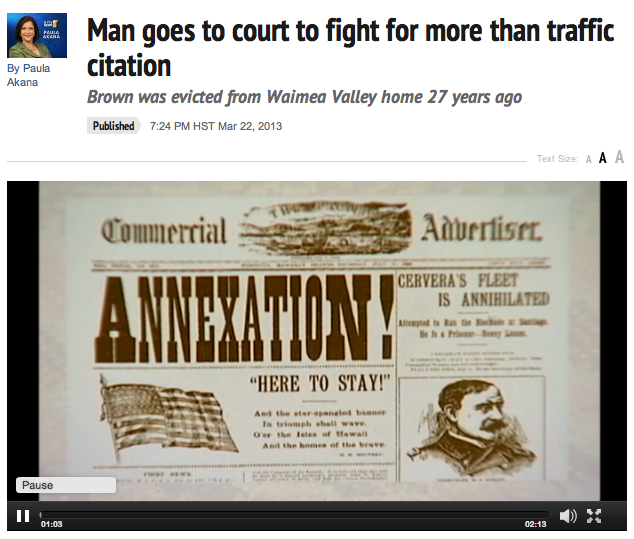
Man Goes to Court to Fight for More Than Traffic Citations


        Hawaiian Kingdom Blog

Weblog of the acting government of the Hawaiian Kingdom 
presently operating within the occupied State of the Hawaiian Islands

KITV News

KITV News_Brown


Yesterday, Lopaka Brown, through his attorney Dexter Kaiama, esq., provided evidence and argument in District Court that the court is not lawfully constituted according to United States constitutional law and international law because there exists no treaty of annexation that would have incorporated the Hawaiian Islands into the United States of America. 

Without a treaty, U.S. law enacted by the Congress have no force and effect beyond U.S. territory, which nullifies the 1898 Joint Resolution of Annexation and the 1959 Statehood Act. The District Court derives its authority from the 1959 Statehood Act. The proper Court is a military commission established by the U.S. Pacific Command that administers Hawaiian Kingdom law and the laws of occupation.

Additional evidence provided to the court were two executive agreements entered into between Queen Lili‘uokalani and President Grover Cleveland that settled the illegal overthrow of the Hawaiian government. The first agreement, called the Lili‘uokalani assignment, binds the U.S. President, through the Pacific Command, to administer Hawaiian law and the laws of occupation. 

The second agreement, called the Agreement of restoration, binds the U.S. President to restore the government and thereafter the Queen to grant amnesty. Both agreements are treaties and under U.S. constitutional law are called sole-executive agreements. Sole-executive agreements are also binding upon successor Presidents for their faithful execution. See also War Crimes: The Role of the International Criminal Court during the Occupation of the Hawaiian Kingdom.

If the Court disregards the evidence, it would be committing a felony by denying Brown a fair trial according to Title 18, U.S.C., §2441. In 1996, Congress enacted the War Crimes Act that criminalized war crimes identified in the 1949 Geneva Conventions as felonies. Article 147 of the Fourth Geneva Convention states that failure to provide a fair trial in an occupied territory is a war crime. 

See also War Crimes are Felonies under U.S. Federal Law. The War Crimes Act is enforceable “outside” of U.S. territory when the United States military is the occupant of an occupied State.

Former Netherlands Antilles PM joins the ancestors


Daily Herald

Miguel Pourier has passed away


page1a
WILLEMSTAD--Former Prime Minister of the Netherlands Antilles Miguel Pourier passed away on Sunday in Curaçao at the age of 74. He had been battling prostate cancer for some time.

Originally from Bonaire, the financial expert founded the political party "Partido Antia Restruktura" (PAR) that came out of a social movement backing the winning Option A to maintain the Antilles, in Curaçao's first constitutional referendum of 1993. All the existing parties had backed the losing Option B for the island to get an autonomous status.

Pourier, who had been interim prime minister for a short period once before in 1979, led PAR to victory in the 1994 elections. He served as Prime Minister from 1994 to 1998 and again from 1999 to 2002.

The efforts to meaningfully restructure the so-called "Antilles of Five" (Aruba had already left the constellation in 1986) and remove certain obstacles to keeping the islands together failed, however. A second round of referenda was held, starting in St. Maarten in 2000, in which majorities in Curaçao and St. Maarten opted after all to become autonomous countries within the Dutch Kingdom, prompting the dismantling of the Netherlands Antilles effective 10-10-10, with the three "small islands" Bonaire, St. Eustatius and Saba becoming special overseas public entities of The Netherlands.

Despite this disappointment, Pourier worked tirelessly on the enormous financial problems facing the Central and Curaçao governments during his terms in office. With support from the International Monetary Fund (IMF), he took severe austerity measures that were so strongly opposed that at one point he had to take a boat to work to circumvent a blockade.

He will be remembered as a man of integrity, a sober and courageous leader who was not afraid to take unpopular decisions. He felt left in the cold and abandoned active politics in 2002, when part of the budgetary support from The Hague agreed on with the execution of the IMF programme remained forthcoming because not all conditions had been met.
.

25 March 2013

Emancipation did not end with the abolition of chattel slavery


International Day of Remembrance of the Victims of Slavery and the Transatlantic Slave Trade Special Commemorative Session of the United Nations General Assembly


Statement on Behalf of 


The Group of Latin American and Caribbean States (GRULAC)

delivered by H.E. Ms. Dessima M. Williams

Grenada

Ambassador Extraordinary and Plenipotentiary


25 March 2013


"...we cannot lose sight of the fact that in a number of regions, including the sub-region of the Caribbean and elsewhere, emancipation ushered in the era of colonialism which, in many respects, merely perpetuated a refined form of what had formerly prevailed. Thus, the anti-colonial struggle was born, in earnest, as a logical outgrowth of the emancipation struggle, and serves as a constant reminder that full emancipation did not end with the abolition of chattel slavery."


Mr. President, Mr. Secretary-General, Excellencies, Ladies and Gentleman,

I have the honour to speak on behalf of the Group of Latin American and Caribbean Member States (GRULAC) on this 2013 observance of the International Day of Remembrance of Victims of Slavery and the Transatlantic Slave Trade under the theme: "Forever Free - Celebrating Emancipation."

On this day each year this august body pays its respects to those who were forcibly taken from their homes and families against their will, and transported across the Atlantic Ocean under the most inhumane conditions known to humankind. The Atlantic Ocean became the final resting place of thousands of souls who perished along the way.

Those who survived this infamous horror known as the Middle Passage were landed in ports throughout Latin America and the Caribbean into an existence of forced labour and systemic cruelty which lasted for generations. Entire economies in much of what is now known as the "developed world" were literally built on the backs of this involuntary African labour, in large measure. May such an acknowledged crime against humanity never be repeated, in any form or manifestation, in any part of our globe.
uptownflavor.com

Mr. President,

Emerging from this unparalleled tragedy in the history of our planet was the liberation of the many African men, women and children who had endured the torment, torture and attempted de-humanization, and who fought against considerable odds to gain their freedom. Those persons - and their descendants - are those who the great Jamaican thinker Bob Marley referred to as "the survivors."

Yet, the struggle for full and absolute emancipation remains a continuing endeavor, and reparation is necessary to fully heal humanity from the brutality of the period when chattel slavery was forced and perpetuated upon a particular segment of humankind.  


un.org

Mr. President,

Part of this emancipation, this freedom, was achieved first in Haiti in 1804. This set in motion the movement for freedom from bondage in other parts of the Caribbean and our wider Latin American region, as well as in North America, Europe, and beyond.  At this juncture, we cannot lose sight of the fact that in a number of regions, including the sub-region of the Caribbean and elsewhere, emancipation ushered in the era of colonialism which, in many respects, merely perpetuated a refined form of what had formerly prevailed. Thus, the anti-colonial struggle was born, in earnest, as a logical outgrowth of the emancipation struggle, and serves as a constant reminder that full emancipation did not end with the abolition of chattel slavery.  
              
Mr. President,

Latin America and the Caribbean takes note of  August 2012 Report of the Secretary-General of August 2012 outlining the implementation of the outreach programme and steps to enhance global awareness on the activities associated with this commemoration.  In this connection, we express our appreciation to the Department of Public Information for the organisation of the historical briefing held last year. We also recall the successful exhibit here at U.N. Headquarters in conjunction with the Schomburg Center for Research in Black Culture, Yale University Press, the National Portrait Gallery in Washington, D.C. and other institutions.

We further commend the organizers for the 2012 showing of the documentary film on post emancipation slavery, the broadcast of radio programmes on the slave trade, and the student video conference which made connections among young people whose societies were linked to the transatlantic slave trade, and some that were not.  We wish to also acknowledge with admiration the important work of UNESCO within its successful "Slave Route Project: resistance, freedom, heritage," and most recently, with the production of the educational film: "A Story Not to Be Forgotten." We thank you.

We are especially appreciative of the events organised last week around this year's commemoration including the panel discussion with eminent scholars, the global student video conference, the film screening of the movie "Lincoln," the presentation and book signing, the cultural and culinary evening, and the dynamic concert last Friday night.

At the national level, a number of initiatives have been undertaken by GRULAC member states in furtherance of dissemination of information on the slave trade and its gruesome historical legacy. In this connection, the work of El Salvador in the integration of the issue of slavery into the social studies curriculum of the education system is to be highly commended. 

The work of Jamaica is to be especially highlighted, in promoting awareness of the rich historical and cultural expressions, and through the various artistic, literary, scholarly and other programmes carried out by an array of governmental and civil society bodies.

The Group endorses the leadership role played by Jamaica and other GRULAC Member States, including my own country Grenada, and of CARICOM in close collaboration with the Member States of the African Group in relation to the development of the Permanent Memorial to and remembrance of the victims of slavery and the transatlantic slave trade. In this connection, the Members States of Latin American and Caribbean encourage other Member States, international institutions, and other relevant parties within the international community to continue and further enhance their voluntary contributions to the Trust Fund established to facilitate the completion of this universal permanent memorial project.


Mr. President,

In conclusion, GRULAC Member States join with the wider international community in commemorating this important day which observes the struggle and subsequent achievements of the people who were emancipated from the scourge of physical slavery. It is, indeed, a day of celebration. But it is also a day for us to take stock, and to deepen our resolve to tackle the contemporary challenges of inequality, poverty, colonialism and more - all of which have their antecedents in the mindset which held "one race superior, and another inferior". This concept must be thoroughly "discredited and abandoned" even in its most contemporary forms. 

Freedom won must be constantly protected.  

Please count on Latin America and the Caribbean in this noble pursuit.

Thank you.

Virgin Islands Joins United Nations Global Island Partnership

Government of the British Virgin Islands

Last month the Virgin Islands (VI) officially joined the Global Islands Partnership (GLISPA) in a move that is expected to strengthen Government’s efforts to preserve the natural environment and accelerate the sustainable development of the Territory.


Deputy Premier and Minister for Natural Resources and Labour, Dr. the Honourable Kedrick Pickering, made the announcement  at the GLISPA 2013 Steering Committee Meeting in Washington, DC.

Lonelyplanet.com 
In an interview with the Department of Information and Public Relations, Honourable Pickering said, “GLISPA is a United Nations (UN) recognised partnership and a platform for islands to cooperate on conserving their biodiversity and to promote sustainable development.”

He added, “There is a great deal that we can learn from our GLISPA partners and much that we can offer in terms of the work we have done here in the Territory in the area of environmental management.”

Speaking on the benefits of GLISPA, the Deputy Premier said, “Around the world islands are doing innovative things to grow sustainably. We can benefit from the UN’s experience with Small Island Developing States and the experience of our island partners in GLISPA who are successfully meeting the challenges faced by islands as they grow.”

“In the Pacific for example, Hawaii is doing a number of interesting things as it pertains to green growth, while Seychelles in the Indian Ocean has made substantial progress in managing its marine protected areas and building local awareness on biodiversity and promoting sustainable fisheries. We will be engaging them in the future on best practices in these areas,” he expounded.

The meeting brought together officials from a number of United Nations agencies, non-governmental organisations (NGOs) and governments to discuss GLISPA’s strategic plan for 2013. The 2013 strategic plan will focus on strengthening the link between sustainable development and conservation under the theme blue/green growth; and preparing for the United Nations Third International Conference on Small Island Developing States (SIDS) in Samoa in 2014.

In the margins of the meeting Honourable Pickering, held individual meetings with representatives of the United Nations Development Programme (UNDP), United Nations Environment Programme (UNEP) and the UN Office of the High Representative for the Least Developed Countries, Landlocked Developing Countries and Small Island Developing States (UN-OHRLLS). He also met with Hawaii and Seychelles officials.

Honourable Pickering capped off his visit with a presentation on the Caribbean Challenge Initiative (CCI) at a High Level Briefing organised by GLISPA.

The Deputy Premier was joined by Senior Political and Public Affairs Officer at the BVI London Office, Mr. Benito Wheatley.

GLISPA was formed in 2006 to help islands address the conservation and sustainability of their natural resources in support of their people, cultures and livelihoods. It is recognised by the Convention on Biological Diversity (CBD) as a partnership to advance the implementation of the CBD 2010 biodiversity target, to reduce the rate of biodiversity loss, and the programmes of work on island biodiversity and protected areas.

The Ministry of Natural Resources and Labour envisions sound stewardship of our human and natural resources by implementing a legal framework that fosters environmentally-friendly best management practices.

24 March 2013

Virgin Islands strengthens ties with Middle East


Government of the British Virgin Islands


The British Virgin Islands (BVI) has renewed links with investors and businesses from the Middle East, and has reaffirmed the positive advantages of doing business with the BVI, following two conferences and a series of meetings in Dubai last week.


A small BVI delegation attended the Hedge Funds World Conference at the Jumeirah Beach Hotel, and the Society of Trust and Estate Practitioners’ (STEP) ‘Opportunities for the Flow of New Wealth Conference’.

Delegation member, Executive Director of the BVI International Finance Centre (IFC) Ms. Elise Donovan, told the Department of Information and Public Relations, “The BVI has become an attractive option to investors from the Gulf States looking to acquire BVI company structures for a multiplicity of investing and other cross-border transactions.”

She continued, “BVI trusts and fiduciary services and funds and investment business are popular in the Middle East for wealth management, investing, structuring ownership and control, and for planning for the succession of assets.”

In explaining why, Ms. Donovan said, “BVI’s structures are easy-to-use, flexible, widely-accepted and cost-competitive compared to other products being offered in the region.”

The IFC head referenced Conyers Dill & Pearman as an example, stating the company was recognised for its BVI office’s involvement in the Mostorod Oil Refinery Project, named ‘Project Finance Deal of the Year’ by the International Financial Law Review’s (IFLR) Middle East Awards.

Conyers Dill & Pearman acted for Citadel Capital, a listed Egyptian private equity firm, on the US$3.7 billion financing for the redevelopment of an oil refinery near Cairo. The deal was the largest-ever financing project in Africa and among the largest inward-investments into Egypt; resulting in the firm’s IFLR award.

Commenting on the present BVI-Middle East relationship, Ms. Donovan said, “We were given a very warm welcome on our return to the United Arab Emirates and it is clear that many investors from across the region recognise the advantages of using BVI structures and services for conducting international business.”

She added, “Our aim is to strengthen and deepen the relationship the BVI has with the Middle East so that we can work more closely together in the future.”

The BVI delegation also included Deputy Secretary in the Premier’s Office Mr. Brodrick Penn, Chair of the Financial Services Business Development Committee Mrs. Lorna Smith, OBE, and Chief Operating Officer of the BVI IFC Ms. Maritza Mercer.

The BVI International Finance Centre’s mission is to further enhance and promote the Territory’s reputation so that the BVI is recognised as a globally integrated and responsible financial services jurisdiction.