07 July 2012

Emancipation Day: A celebration, commemoration of freedom won

page1a039PHILIPSBURG--"Surrender not one day of Freedom won" were the words repeated by dignitaries and the public alike at the Monday, July 2, celebration of Emancipation Day.

For the first time as a new nation, St. Maarten celebrated 149 years of emancipation on a day filled with cultural music, dance, food, commemoration and education.

The hot July day began with an Emancipation Day ecumenical service at St. Martin of Tours Roman Catholic Church at 9:00am. Dignitaries of both sides of the island and the public were greeted by steel pan music played by Tropical Brothers Steel Band, led by their captain Neville York. The band played a medley of "This is the Day," "Send the Light" and "Whosoever will."

Prime Minister Sarah Wescot-Williams expressed her joy in celebrating the day and recognising the fight for recognition and the efforts of many in society who had kept the flame burning, those who had done their research and those who had documented history to make this day a reality. The past history has shaped what St. Maarten is today, she said.

The struggle and fight of the forefathers of St. Maarten "represent a part of our collective history. It has made us a resourceful, resilient and productive people. The more we celebrate who we are, the more proud we become to be called

St. Maarteners," she said.

"I stand still as I recognise the efforts of those members of our society who have kept the flame burning for Emancipation Day, those who, holiday or not, celebrated the commemoration of July 1st every year. The most important observance in my opinion, however, comes from those who have gone to great lengths to research, document and transmit our history, a history that is as colourful as a patch quilt.

"There is no denying that the importation of men and women to our island in the 17th century was the foundation of our modern-day society. That our forefathers had to labour in slavery, as abominable and reprehensible as that practice was, has also shaped who we are today. They built with their sweat, tears and yes, blood, our foundation as a nation.

"When you really think about it, it's not that long ago that this practice existed, until its official abolition in 1863, a mere 149 years ago. If I consider my mother's age at 91 and that of her contemporaries, it brings our history rather close."

The church service was followed by wreath-laying ceremonies at the statues of One Tété Lohkay and the Freedom Fighters. Activities continued with a Cultural Parade with participants in national dress, stilt walkers and drummers, that ended at the Courthouse surrounded by onlookers, living statues and various bands.

The parade was followed by addresses by Governor Eugene Holiday, the Prime Minister, Minister of Culture Silveria Jacobs and President of Parliament Gracita Arrindell. "I am immensely proud and pleased to stand before you today to share in and address you in this first observance of Emancipation Day," the Governor told those present.

He said Emancipation Day functioned as a source of greater consciousness and understanding. The celebration of Emancipation Day ended with cultural manifestations at Salt Pickers roundabout. Vendors were also present displaying different cultural arts and crafts, and local St. Maarten foods.


*****


Homage to ancestors during Emancipation Day celebration

CUL-DE-SAC--The former plantation grounds at Emilio Wilson Park formed the perfect backdrop for VOICES' Emancipation Day celebration on Sunday afternoon.  
Organised by grassroots foundation Victory Over Injustice Consciously Eliminating Silence (VOICES), which goal it is to combat all forms of abuse and violence through awareness, empowerment and prevention, the event honoured St. Maarten's enslaved ancestors and contemporary role models during an event filled with music, dance, storytelling and poetry.

After D'shnay York had given a rendition of the St. Maarten Song, VOICES president Nkosazana Illis said the event was to commemorate "the greatness of our ancestors." She read from the Declaration of Emancipation, signed by the governor of Curaçao and its dependencies on July 1, 1863, which pronounced the liberty of slaves throughout the islands of the former Netherlands Antilles. Copies of the Declaration were distributed among the public.

In opening the event, Illis and Minister of Education, Culture, Youth and Sport Silveria Jacobs lit two candles under one of the park's majestic silk cotton trees in remembrance of St. Maarten's enslaved ancestors.

After one minute of silence was observed, Minister Jacobs commended VOICES for organising the event, and urged the public at large to study St. Maarten's history more vigilantly and to record the stories of the island's senior citizens.

During the event, several "grassroots" local entrepreneurs were commended for their contribution to St. Maarten and its people. Among those receiving certificates of appreciation were José Lake Junior, Don Hughes, Elsje Bosch, Cedric Cannegieter and Lucy Lake.

Former Culture Minister Rhoda Arrindell, who was another speaker at the event, also received a certificate of appreciation for her efforts in making Emancipation Day a national holiday. Former Commissioner Louie Laveist had also been instrumental in achieving this, Illis added.

Musical icon Addison "Shadowman" Richardson presented the two-hour cultural programme, which was kicked-off with traditional dance, presented by dancers of Motiance Dance School and Imbali Centre for Creative Movement.

Music was provided by Generation New Status STM drum band, Soualougia Jump Up Brass Band, Shabba Djembé Drummers and Ras Bushman.

The spoken word was represented by story teller Papa Umpo, who recounted the story of One-Tete Lokay, and poets Anderson Percival and Unexpected Poet.

The event was closed off with the planting of a young flamboyant tree. Illis and Arrindell planted the tree, symbolising growth, hope, power and continuation, with assistance of a young St. Maarten girl.

04 July 2012

Britain warned over imposition of VAT in Turks & Caicos Islands


The British government may have a major battle on its hands over the proposed implementation of value added tax (VAT) in the Turks and Caicos Islands (TCI).


This follows the formation of The Turks and Caicos Independent Business Council (TCIBC) by a broad group of concerned individuals from all sectors of the economy and business community throughout the TCI.

A spokesman said: 

“We have a common purpose in that we are all unified in our opposition to the introduction of VAT in the Turks and Caicos Islands. 

“We send a clear warning to Chancellor George Osborne that we represent the interests of all the leading businesses in the country and indeed it can be said that our views are representative of virtually every business concern. 

“We are deeply concerned about the expected negative effects of the hasty introduction of VAT into the island’s tax structure. As business professionals we do not have a problem with taxation and recognize the need to fund government.

“However we do have a major problem with this particular type of tax and its inappropriate nature for these specific islands and our unique economy at this time and at this specific point in its young development. We believe that the recent gains in economic sustainability will be lost with the imposition of this ‘boiler plate’, cookie cutter, tax system.

“This new VAT tax is not driven by a ‘grass roots’ initiative, but is a politically driven tax imposed upon us by distant bureaucrats based in Europe without effective due process and regard to our specific economy and its future development. One size does not fit all.

“It is our intention to continue the debate on VAT through wider public education and dissemination of information and to oppose and resist its introduction through whatever legal mechanisms are open to us. This will include public consultations and education through the press, TV and radio.

“This task has already begun with over 3,000 people having already signed a petition opposing VAT. Many more are joining us daily.

“This is not a done deal as many think. No government or administration can impose any policy upon a community if that community refuses to accept the policy.”

TCIBC’s newly appointed chairman, Clive Stanbrook, a prominent businessman and Queen’s Counsel, said, “We are sending a clear message to the British government. It is the view of virtually the entire business community in the Turks and Caicos that a VAT tax is inappropriate, costly, cumbersome and unnecessary at this stage in the development of these Islands. In the short term it is clear that the existing taxation systems can be relied upon to raise such extra revenue as may be needed. " 

02 July 2012

July 3rd - US Virgin Islands Emancipation Day commemorated

by

The United States Virgin Islands celebrates Emancipation Day, an official holiday, on July 3. It commemorates the abolition of slavery by Danish Governor Peter von Scholten on July 3, 1848. 
Photo: N/A, License: N/A, Created: 2009:06:02 10:59:47
By 1600, the native population had been wiped out by the Spanish. The Dutch and English settled on Saint Croix, with the Dutch being driven out around 1645. The French and the Knights of Malta took possession from Spain; Denmark, which had established slave plantations on Saint Thomas and Saint John, purchased Saint Croix from France in 1733. 
Although Denmark suppressed the slave trade in 1803, the practice of importing new captives did not end until the British occupied the islands in 1807. The islands were returned to Denmark in 1815 and remained the Danish West Indies until their purchase by the United States in 1917. On July 3, 1848, about 30,000 enslaved Africans from plantations on the western end of St. Croix marched into Frederiksted to demand their freedom. Led by Moses Gottlieb and Admiral Martin King, they confronted Danish soldiers. Danish Gov. Peter Von Scholten, seeing the potential for trouble, rode into town and proclaimed all unfree in the Danish West Indies free from that day forward. 
Historically, the society was divided along caste and color lines. Even after emancipation in 1848, ex-slaves' participation in the political process was restricted and their freedom of movement and emigration were limited by legislation. A result of Danish determination to maintain the status quo was the Fireburn of 1878, a labor revolt on Saint Croix that destroyed many plantations.

See also:

Former and Current British Caribbean Colonies Commemorate Emancipation Day


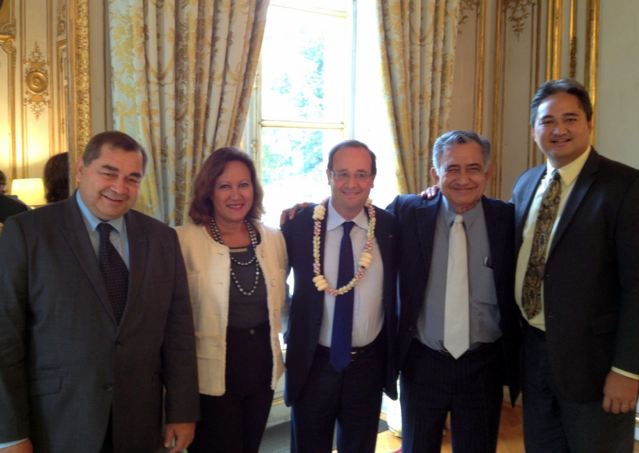
Rencontre au sommet entre le Président de la République et Oscar Manutahi TEMARU


Tahiti Infos


C’est accompagné de Pierre FREBAULT, du Sénateur Richard Ariihau TUHEIAVA et de la 2ème vice-présidente de l’Assemblée de Polynésie que le Président Oscar Manutahi TEMARU a rencontré ce mercredi 27 juin au matin, le Président de la République, François HOLLANDE


En préambule à cette rencontre, une réunion avec Marc Vizy, le conseiller outre-mer du Président de la République a permis de faire le point sur les dossiers abordés avec les trois ministres déjà rencontrés par le Président TEMARU. Le Président de la République a réitéré le message d’un partenariat fort et rénové et s’est enquis des points de blocage subsistant. Il a tenu à confirmer le message porté la veille par Victorin LUREL, pour lequel il est primordial pour l’Etat de rétablir la stabilité financière de la collectivité. 

Avec cette rencontre positive au sommet de l’Etat qui vient clore une série déjà porteuse de résultats, le Président TEMARU démontre bien que c’est le gouvernement qui est en capacité d’interagir avec l’Etat, et qu’avec François HOLLANDE, l’action c’est maintenant. La délégation conduite par le Président TEMARU a ensuite rencontré M. François REBSAMEN, président du groupe socialiste au Sénat, et Catherine Morin-Desailly, Sénatrice de la Seine-maritime.

01 July 2012

U.N. Wraps Up Contentious Study of Native American Communities


By Carey L. Biron
Inter Press Service


WASHINGTON (IPS) - A United Nations special envoy...  called on the U.S. government to step up efforts to address historical injustices that continue to affect the country's indigenous population.


James Anaya, the United Nations Special Rapporteur on the Rights of Indigenous Peoples, warned that historical wrongs, particularly the loss of land, continue to have an overriding impact on the wellbeing of Native American communities. 

Anaya has just finished a 12-day research mission probing the current status and experience of the U.S.'s roughly 5.2 million-strong Native American population. 

The trip marked the first time that the U.N. has waded into the contentious issue of U.S. treatment of its indigenous communities, one of the poorest and most marginalised populations in the United States. 

The unemployment rate for American Indians has typically been double that of the white population. On reservations – self-governed tracts of land given to Native American communities by the U.S. government – Anaya reported a 70 percent unemployment rate.

Native Americans have also long suffered from disproportionately low statistics in health and education, as well. 

But Anaya pointed to an underlying sense of disaffection, as well. 

"The sense of loss, alienation and indignity is pervasive throughout (Native American communities)," Anaya stated at the United Nations headquarters in New York. 

"It is evident that there have still not been adequate measures of reconciliation to overcome the persistent legacies of the history of oppression, and that there is still much healing that needs to be done." 

Previously, the United States has made clear that it sees such issues as constituting internal affairs. Although Anaya was allowed to complete his research mission, he reported a lingering sense of disconnect with parts of the government. 

"I regret that my efforts to meet with members of the U.S. Congress were unsuccessful," he stated, "especially given the prominent role of Congress in defining the status and rights of indigenous peoples within the United States." 

Such engagement was only made possible in the first place due to a sudden U-turn in U.S. policy announced by President Barack Obama in 2010. At that time, the U.S. formally backed the U.N. Declaration on the Rights of Indigenous Peoples (UNDRIP). 

The U.S. was the last country to sign on to the Declaration, which was passed in 2007. The administration of George W. Bush had twice opposed U.S. involvement, including over worries that it would give rise to new legal claims for redress. 

Anaya's trip was aimed at checking into how U.S. commitments towards the UNDRIP have been carried out thus far. He will now be compiling his research into a full report, which is expected to be presented to the U.N. Human Rights Council in September. 

If his initial observations are anything to go by, however, the report's ultimate recommendations to the U.S. government will be based largely on trying to break the negative cycle started by historical wrongs – wrongs that Anaya suggests are directly responsible for the generally dismal condition of Native American communities today. 

"Over the past 12 days, I have heard stories that make evident the profound hurt that indigenous peoples continue to feel because of the history of oppression they have faced," he said in Washington. 

Perhaps most critically, that history – "all grounded in racial discrimination" – includes the significant dispossession of lands, including lands that were officially and legally given over to Native American tribes. 

As such, several of Anaya's most significant recommendations will revolve around self-governance and land issues. This includes "some form of land restoration", the transference of "lost lands" back into Native American hands. 

"Securing the rights of indigenous peoples to their lands is of central importance to indigenous peoples' socio-economic development, self-determination and cultural integrity," Anaya noted. 

"During my visit, I heard almost universal calls from indigenous nations that the government respect tribal sovereignty, that indigenous peoples' ability to control their own affairs be strengthened, and that the many existing barriers to the effective exercise of self-determination be removed." 

That contention is backed up by the National Congress of American Indians (NCAI), a pan-tribal association founded in 1944. In a policy paper released in late April, the NCAI stated that land and sovereignty issues are "underlying the state of Native peoples in America today". 

The paper warned that the U.S. government continues to introduce laws "that prohibit tribal communities and tribal members from free use of their land and natural resources". As recently as Apr. 19, 2012, the paper noted, U.S. officials have cited 1930s legislation "as its authority to regulate Indian land as 'public land' without consideration for the unique status of sovereign land." 

For some observers, such a focus on current events – and their future ramifications – makes more sense than dredging up the distant past. 

Sher Malik, president of the Indigenous Peoples Survival Foundation, spoke with IPS while preparing to leave for the upcoming seventh session of the U.N. Permanent Forum on Indigenous Issues, starting May 7 in New York. 

"We must approach these issues with balance, not focusing on revenge," Malik says. "Unfortunately, we do not seem to learn from our history. So while I'm against what happened 200 years ago, today I'm not going to dig up negativity for a new generation." 

Yet for Anaya, the issue of negativity goes to the heart of the ongoing marginalisation of the U.S.'s indigenous communities today. Native Americans feel "a systemic lack of respect" and discrimination from the U.S. public and media, he said. 

"The broad view in American society seems to be that Native Americans are either gone or, as a group, have become insignificant – and those are simply flat wrong perceptions."

29 June 2012

Communiqué de Victorin Lurel: "rétablir la stabilité financière de la collectivité"


Tahiti Infos


Le Ministre des outre-mer, Victorin Lurel a reçu aujourd’hui Oscar TEMARU, Président de la Polynésie française, en présence des représentants du ministre de l’économie, des finances et du commerce extérieur et du ministre délégué au budget, afin d’aborder la situation financière de la collectivité. 

Cette rencontre s’inscrit dans la volonté du Gouvernement, en cohérence avec les engagements du président de la République, de renouer les relations entre l’Etat et la Polynésie française dans un cadre apaisé et constructif. Les consultations entre le cabinet du ministre et le gouvernement de la Polynésie Française entamées dès le 1er juin dernier, ont permis d’établir un diagnostic partagé et un calendrier de travail destiné à rétablir la stabilité financière de la collectivité. 
 
Plusieurs points ont été abordés lors de cette réunion de travail : 

- Une partie de la dotation exceptionnelle de 50ME prévue par la LFR 2011 sera libérée très rapidement afin de permettre à la Polynésie française de faire face aux difficultés de trésorerie qu’elle connait actuellement. 

- La mise en oeuvre du plan de redressement adopté en 2011 par l’assemblée polynésienne sera poursuivie et accélérée afin d’assurer le rétablissement des comptes publics polynésiens et de mettre en oeuvre les réformes structurelles annoncées, notamment en matière de fiscalité, d’organisation administrative et de stratégie de développement. 

- Le Ministre Lurel a affirmé la disponibilité de l’AFD pour accompagner les projets de développement de la Polynésie Française et les mesures de redressement mises en oeuvre par le gouvernement polynésien. 

Enfin, il a été convenu qu’un comité de suivi associant l’Etat et la Polynésie française serait réuni régulièrement afin de faire les points d’étapes nécessaires sur l’état d’avancement du plan de redressement. Ces mesures permettront à la Polynésie française de renouer avec la confiance, la croissance et le développement économique.

28 June 2012

Marshall Islands Displacement from Nuclear Contamination a concern of United Nations Special Rapporteur


UN expert warns of situation faced by Marshall Islands citizens affected by nuclear tests

Final Report due in September 2012


 Calin Georgescu, UN Special Rapporteur on human rights 
and toxic waste. UN Photo/Jean-Marc Ferre

A “durable solution” has yet to be found to the displacement of communities affected by nuclear testing more than sixty years ago in the Marshall Islands, a United Nations independent expert warned today. 

“I have listened to the concerns and stories of affected communities from Bikini, Enewetak, Rongelap and Utrik. As a result of the nuclear testing, all of these communities have suffered dislocation, in one form or another, from their indigenous way of life,” said the Special Rapporteur on the human rights obligations related to environmentally sound management and disposal of hazardous substances and waste, Calin Georgescu.   

 From 1946 to 158, some 67 nuclear weapons tests were carried out in the Marshall Islands, which were then administered by the United States under trusteeship arrangements with the UN. 

Independent experts, or special rapporteurs, are appointed by the Human Rights Council to examine and report back on a country situation or a specific human rights theme. The positions are honorary and the experts are not United Nations staff, nor are they paid for their work. 

Mr. Georgescu, who just finished the first fact-finding mission to the Marshall Islands by special rapporteur, said many communities “feel like ‘nomads’ in their own country and many have suffered long-term health effects.” 

The expert underlined the need for strategic and long-term measures to tackle the consequences of the nuclear testing programme to ensure sustainable progress and cope with the specific challenges posed by climate change in the country. He urged the Government of the Marshall Islands, the United States and the international community to find effective ways to redress the situation for those affected. 

“The affected communities are searching for solutions, but are yet to feel that they have been restored to a position that is any way equivalent to the life they and their families lived before this dislocation,” Mr. Georgescu said. “Each of the communities from these four affected atolls has a unique history in relation to the nuclear testing and each needs its own solutions.” 

Mr. Georgescu stressed that education will be key for the long-term survival of the country, as there will be an increasing need to sustainably preserve the cultural and environmental heritage of the country, including the Bikini Atoll which has been declared a World Heritage site by the UN Educational, Scientific and Cultural Organization (UNESCO). 

During his four-day mission, Mr. Georgescu met with President Christopher J. Loeak, as well as with government representatives, ministers, senators, high-level officials, experts, academics, civil society, local communities and members of the press.

Mr. Georgescu is due to present his final report to the Human Rights Council in September.

Independence for Scotland discussed at University of Glasgow

The Scottish Government

Scotland’s Constitution – A means to an end

Independence is only the vehicle to a more prosperous Scotland, (said) the Deputy First Minister Nicola Sturgeon.
However, what will determine our success as a nation are our assets, talents, skills and the quality of our leadership.
Giving a lecture at the University of Glasgow School of Law, Nicola Sturgeon focused on the reasons Scotland should become an independent nation and what could be achieved rather than on the mechanics of holding a referendum.
Speaking at the Sir Charles Wilson Lecture Theatre, the Deputy First Minister said:
“I have never believed that independence is an end in itself. I want Scotland to be independent because I believe that it is the best way to further Scottish interests.
“Independence will give Scotland the opportunity to make different decisions and to implement policies designed for its own needs in every area. In welfare as well as health, the economy as well as education.
“In the past the union would have been seen as not just the creator but also the guarantor of the values and vision of the post-war welfare state. Today, many see that it is the union, under the Westminster government, that poses the biggest threat to these values and that vision.
“Only through devolution has the Scottish Government been able to protect the values of our national health service and ensure that it can meet the needs of people in Scotland. Unlike its counterpart in England, the NHS in Scotland will remain a public service, paid for by the public and accountable to the public.  There will be no privatisation of the National Health Service in Scotland.
“Independence would give us the power not only to protect Scotland from policies that offend our sense of decency and social cohesion. It would also allow us to build a fairer Scotland.
“What independence does is put our destiny firmly in our own hands. It gives us the ability to take the decisions that matter, to ensure that our talents and our resources work to the benefit of our people.”

27 June 2012

UN’S CHECKERED RECORD OVER WEST PAPUAN SACRIFICES

                                                         Al Jazeera
                        

  by
Jennifer Robinson 
 London-based human rights lawyer

The views expressed in this article are the author's own and do not necessarily reflect Al Jazeera's editorial policy.

  
 In the 1960s, West Papuans were sacrificed in the name of Cold War politics - and the UN did nothing about it.


Jennifer Robinson
  London, United Kingdom - Thousands have taken part in rallies across West Papua and in Australia to mark the UN Secretary-General's (UNSG) visit to Indonesia, calling on Ban Ki-moon to revisit UN mistakes that lead to the denial of West Papuans' right to self-determination and to assist in resolving ongoing human rights abuses in Papua.
 UN peacekeeping was at the top of the agenda of the UNSG's visit to Indonesia on Tuesday. West Papua was not, but many argue that it should be. After all, West Papuans are asking that the UN revisit its first - and flawed - administration of a post-conflict society. Observers hailed the success of the UN administration of East Timor and its successful transition to independence.

But few are aware of the UN's failure in its first attempt at administration in West Papua more than 40 years earlier. East Timor got a democratic vote. West Papua got a sham vote. East Timor got independence. West Papua became part of Indonesia - against its will and in breach of its right to self-determination under the UN Charter. 


Had the UN properly discharged its mandate back then, West Papuans would have celebrated more than 40 years of independence instead of having endured nearly 50 years of oppression. In that time, it is estimated that as many as 500,000 Papuans have been killed at the hands of Indonesian security forces. Yale and Sydney Universities report that the situation is approaching genocide. Papuan activists campaigning for self-determination are routinely arrested and jailed for peacefully expressing their political opinions.

The recent conviction of the Jayapura Five - including Forkorus Yaboisembut, a Papuan tribal leader - drew international condemnation from lawyers and human rights groups. Speaking from prison, Yaboisembut - a recognised political prisoner - called upon Ban Ki-moon to organise peace talks with Indonesia and to use his visit to Jakarta's new Peacekeeping Centre to negotiate the release of all political prisoners in Indonesia.

 The UNSG made no public supportive comments about West Papua during his visit.
But he may have been dissuaded from doing so given the controversy caused by his comments at the Pacific Islands Forum last September.

Controversy over West Papua

At the Forum, Ban was pressed to support peaceful dialogue between West Papua and Indonesia, to put an end to human rights violations, and "to find a strategy to get Indonesia out of a land that isn't theirs". In response to media questions, Ban said that West Papua should be discussed at the Decolonisation Committee of the UN General Assembly. He emphasised that the UN would "do all to ensure" that human rights will be respected in West Papua and that "whether you are an independent state or a non-self-governing territory or whatever, the human right is inalienable and a fundamental principle of the United Nations".

Ban's comments implicitly recognise that there is a legitimate case for review of West Papua's legal status, as well as an acknowledgment that there is basis for concern regarding the human rights situation. West Papuans welcomed Ban's comments in the belief that, after a long history of UN betrayal, the UN may finally act in their interests and protect their rights under the UN Charter.

The UN act in accordance with the UN Charter? Seems a pretty reasonable expectation. But, sadly, Ban's comments were highly controversial - representing "a remarkable shift" by the UN chief on West Papua since Ban was "the first head of the UN to come out and say that". Fifteen human rights and social justice movements immediately called on Ban to appoint a special UN representative to investigate alleged human rights violations in West Papua and its political status.

But the shift in position was apparently too radical to countenance. Days later, and no doubt in response to Indonesian complaints, an unnamed "Official Spokesperson for the Secretary-General" announced in New York that his "off-the-cuff response may have led to the misunderstanding that he was suggesting the matter of Papua should be placed on the agenda of the Decolonisation Committee. The Secretary-General wishes to clarify that this was not his intention." While the correction let stand the UNSG's apparent endorsement of the need for the UN to "do all to ensure" human rights are protected in West Papua, no action has yet been taken.

It appears the UN has let West Papua down - and this is not the first time.

The UN's history in West Papua

West Papua is the western half of the island of New Guinea, just 300 km north of Australia. The other, better-known half of the island is the independent state of Papua New Guinea (PNG). The Melanesian peoples of West Papua and PNG share similar ethnicities, cultures and religions. It is merely their different colonial past that sets them apart.

West Papua (then West New Guinea) was colonised by the Dutch, but for convenience's sake was loosely administered as part of the Dutch East Indies - modern-day Indonesia. When Indonesia obtained independence after World War II, West New Guinea remained under Dutch control and was prepared for independence, as was PNG by Australia. West Papua was a Dutch colony and Non-Self Governing Territory on the path to independence. More than 50 years ago, on December 1, 1961, West Papuans raised their flag and sang their national anthem as they formally announced their independence from the Dutch.

Soon after, Indonesia invaded with political support and arms from the USSR. The US - concerned about losing Indonesia to the Russians and keen to secure lucrative mining contracts - intervened. Under US pressure, the Dutch agreed to a UN- and US-brokered settlement, the New York Agreement of 1962, providing for a UN-supervised Indonesian administration and vote for self-determination by which Papuans could choose independence or integration with Indonesia.

West Papuans were not consulted.

Under the terms of the agreement, West Papua was transferred by the Netherlands to a United Nations Temporary Executive Authority (UNTEA). Between 1962 and 1963, UNTEA had full authority to administer the territory, to maintain law and order, and to protect the rights of the West Papuans. The territory was then transferred to Indonesian administration in 1963, but on condition that it remained under UN supervision until the vote for self-determination in 1969.

Media reports from around the world at that time highlighted the need for UN vigilance in ensuring a free and fair vote. In 1962, one editorial emphasised, "there is no doubt at all about the United Nations' responsibility under the agreement - quite apart from its moral responsibility - to ensure the Papuans are allowed to exercise a free choice" and that responsibility "should need no stressing".

But the UN turned a blind eye - both to human rights abuse and the fact the voting practices did not meet international standards. The 1969 "Act of 'Free' Choice" is popularly known as the "Act of 'NO' Choice". A handpicked group of 1,022 West Papuans were coerced, under threat of violence, into voting unanimously for integration with Indonesia.

During the period of UN supervision and in the lead-up to the vote, the Indonesian military is estimated to have been responsible for the deaths of 30,000 West Papuans. Frank Galbraith, US Ambassador to Indonesia at the time, warned that Indonesian military operations "had stimulated fears… of intended genocide". Australian journalist and eye-witness Hugh Lunn reported that Papuans carrying signs saying "one man, one vote" in protest against the voting procedures were arrested and jailed. Others were killed.

The UN was aware of the repression - but did nothing about it. And, worse, it collaborated with Indonesia to prevent international criticism.

 Papuans concerned over renewed US-Indonesia military ties

Meantime, the US and Indonesia were busy carving up West Papua's rich natural resources. Having signed concession agreements with US mining company Freeport in 1967, two years before the scheduled vote, Indonesia had no intention of allowing West Papuan independence (Freeport is a major contributor to Indonesia's GDP, and Kissinger was later rewarded with a place on Freeport's board).

The US agreed, but diplomatic cables reveal that it was worried that UN members might "hold out for free and direct elections" (as required by international law), frustrating Indonesia's intentions. The US discussed the need to meet with the UN Representative, Ortiz Sanz, to "make him aware of political realities" but later reported, with relief, that Ortiz conceded "that it would be inconceivable from the point of view of the interest of the UN, as well as the [Indonesian government], that a result other than the continuance of West Irian within [Indonesia]". In July 1969, a US diplomatic cable reported that the "Act of Free Choice... is unfolding like a Greek tragedy, the conclusion preordained".

West Papuans were sacrificed in the name of Cold War politics and natural resources. 

UN officials admitted in private that 95 per cent of Papuans supported independence. But as UN Representative Ortiz Sanz told Australian journalist Hugh Lunn, "West [Papua] is like a cancerous growth on the side of the UN and my job is to surgically remove it". And remove it he did. In 1969, Sanz reported the vote's outcome to the UN General Assembly, noting only that "Indonesian" and not "international" voting practice was adopted. West Papua formally became a province of Indonesia.

Former UN Under-Secretary General Narasimhan has since admitted the process was a "whitewash". British diplomatic correspondence admitted "the process of consultation did not allow a genuinely free choice to be made". Distinguished international jurists dismiss the 1969 vote as a "spurious exercise", amounting to a substantive betrayal of the principle of self-determination.

Yet no action has been taken by the UN - or the international community - to redress this injustice. A growing number of international parliamentarians are calling upon their governments, through the UN, to give effect to West Papua's right to self-determination. As Archbishop Desmond Tutu, a supporter of West Papua's campaign to have the UNSG instigate a review, has asserted, "[a] strong United Nations will be capable of, among other things, acknowledging and correcting its mistakes".

Rights groups have urged the UNSG to appoint a Special Representative to investigate the situation in West Papua, including the outcome of the 1969 "Act of Free Choice" and the contemporary situation, and ask that he use his good offices to negotiate the release of political prisoners and persuade the Indonesian government to lift the ban on access to West Papua for international organisations and journalists.

But will Ban Ki-moon act?

No UN action forthcoming - yet

Since his comments last September, the UNSG has remained silent on West Papua. At his talk in Indonesia on March 20, Ban recalled his own experience as a young boy in South Korea - where he said that UN peacekeepers had been "the beacon of hope" for his people.

Like Ban, the people of West Papua once saw UN peacekeepers as their hope. But as Dr John Saltford, author of The United Nations and the Indonesian Takeover of West Papua, 1962-1969: The Anatomy of Betrayal, has said: "The Papuans had a great deal of trust in the UN, and the UN betrayed them and continues to betray them because, so far, it has refused to review its position on the issue."

As the Human Rights Council is preparing for Indonesia's Universal Periodic Review, submissions have poured in with evidence of widespread human rights abuse in West Papua - evidence that many hope will spur the UN into action. But given its history on West Papua, should Papuans place further hope in the UN?

The UNSG's remarks in Indonesia this week also urged hope in the UN, drawing on his own experience in South Korea: "Please have a bigger sense of hope, don't despair! It may be very difficult for you. But look at me. As a young boy, I was very poor. [South Korea was] almost on the verge of collapse… But because there was the United Nations, because there is still the United Nations, you can have hope... This is my message to you."

Let's hope he is not encouraging more false hope from West Papuans in the UN. Let's hope the UN will act - because if it does not, then it is simply not the organisation that its leader believes in.


Pacific expert discusses the 'new players' in the Pacific Region


Cover Report: The New Players in the Region
Pacific diplomacy boosts links with new friends


Nic Maclellan 

Islands Business


Pacific nations are largely reliant on aid, trade and investment from traditional partners like Australia, New Zealand, United States, France and Japan. But in recent years, there has been increasing interest in finding new sources of development assistance, economic and political support. 


Pacific governments have been diversifying their political and economic links beyond the old regional groupings—led by France, United States and Australia/New Zealand—that dominated islands politics throughout the Cold War years. 
In the mid-1980s, PNG’s then Prime Minister Paias Wingti talked of a ‘Look North’ policy for his country, to extend relations beyond the old colonial ties with Australia. 

Today, Pacific Islands Forum countries are looking north-west, north-east and to other points of the compass. There is a growing interest in South–South cooperation and new countries are seeking the status of Post-Forum dialogue partner with the Pacific Islands Forum.

Read the full article in Islands Business.


26 June 2012

New Political Leader sees independence for Turks & Caicos Islands


     Ewing says TCI ready for independence
by
Vanessa Narine

NEWLY elected leader of the Progressive National Party (PNP), Dr. Rufus Ewing, contends that the Turks and Caicos Islands (TCI) is ready for independence.


Ewing, speaking at a press briefing at the PNP Headquarters..., noted that the party has taken a resolution to support the move towards independence.


He made it clear that the PNP is pro-independence and going forward any moves the party makes will take into consideration an independent TCI.

The PNP Leader acknowledged that there are a few things that can be improved on before the step towards independence is taken.

According to him, the people need to be educated on the pros and cons of independence. 

However, he reiterated that the TCI has long been ready to assert itself independent of the United Kingdom.

Ewing stated that before any decision is taken the views of the people have be taken into consideration, adding that the new PNP will move towards an approach that seeks to increasingly involve the people of the TCI in decision-making.

When asked about a possible timeframe for the attainment of independence, the PNP Leader noted that because this is something that needs to be approached strategically, setting a timeframe would be premature, particularly considering that the return to democratic rule has not been confirmed to happen this year.

Ewing said in going forward, independence has to be planned and strategically implemented in stages to achieve the vision leaders have for the TCI.

He maintains that independence is not to be rushed.

In a prior interview in April, Ewing made it clear that independence is ultimately up to the people, adding that developmental milestones that are advanced by an elected government will indicate the country’s readiness for independence.

“My duty is to prepare the people for that day,” he said then.

10 YEARS AWAY

Former PNP Leader and retired politician Daniel Malcolm addressed the issue of independence in an interview with the Weekly News in the latter part of March.

He contends that the TCI is too young for independence, but noted that achieving a measure of self-determination is a move in the right direction.

“We are at least 10 years away from being ready for Independence…we must develop our country and our people so that when we move to Independence we will do so from a position of strength,” he said.

However, Malcolm, like Ewing, stressed that TCI must prepare for that eventuality down the road.

“Self-determination is where the government and the people of TCI, and other territories like us, make advances toward greater political, social and cultural determination or say within the framework of their own situation,” he posited.

The former PNP Leader was recently been invited to join the Special Committee of experts with regard to the implementation of the Declaration on the Granting of Independence of Colonial Countries and Peoples. 

This endeavour is supported by the Decolonization Unit of the Department of Political Affairs, which is part of the United Nations (UN) Secretariat, via monitoring the implementation of the Declaration, hearing statements from the non-self governing territories, organizing an annual regional seminar and making recommendations regarding the dissemination of information on the decolonization process.

Governor Ric Todd in addressing the issue of independence in the past has said unequivocally that the United Kingdom would grant independence to the TCI, if that were the choice made by the TC people. 


*******


Letter: The changing landscape of TCI government

TCI News Now

by David Forbes


Dear Sir:


Permit me some space on your website to enlighten the people of the TCI to what is taking place under the interim administration. I also want to sensitize members of the Advisory Council and the Consultative Forum. 

When the PDM administration left office in 2003, all key positions in the government were localized, this continued under the PNP. Concerted efforts were made to train local people and build capacity among our people to ensure they are capable of doing their jobs. 

This development has been drastically reversed by the British over the past three years. Frankly speaking the actions of the British Government is tantamount to naked modern day racism.

The above strong statement is supported by the following analysis from TCIG press releases and other well-placed sources.

*****
The results of these decisions are far reaching for any elected government and for the long term sustainable development of the TCI. This trend will also undermine any efforts towards independence. Both PNP and PDM are now talking about nation building. The PNP for certain is pledging to take the TCI independent. None of these proposals are feasible with the brain drain of TCI natives, the removal of local capacity and depriving the islands of an inner ability “to run its own affairs”. 

What will happen to all of these replacements after elections are completed and there is a localized Turks and Caicos government? Can this be considered a long-term trend of replacing career civil servants with these replacements? Mind you some of the persons going home were lazy and dysfunctional and probably should never have held such positions of responsibility in the first place. They in some limited cases almost justify these incorrect steps being taken by the interim government. 

By and large in all cases where bad apples are weeded out and the good ones going home, there are locals, natives, persons with huge experiences in government and education, who can replace the outgoing persons. Mr Governor, CEO, CFO, the Public Service Commission, which is supposedly “local” and has the final say, must know that these decisions cannot be justified on any level. In 60% of the cases here, you are all being totally racist. 

Finally, one must ask the British government a serious question: “Did you come to wipe out corruption of the former government or did you come to install a latter day apartheid system?”